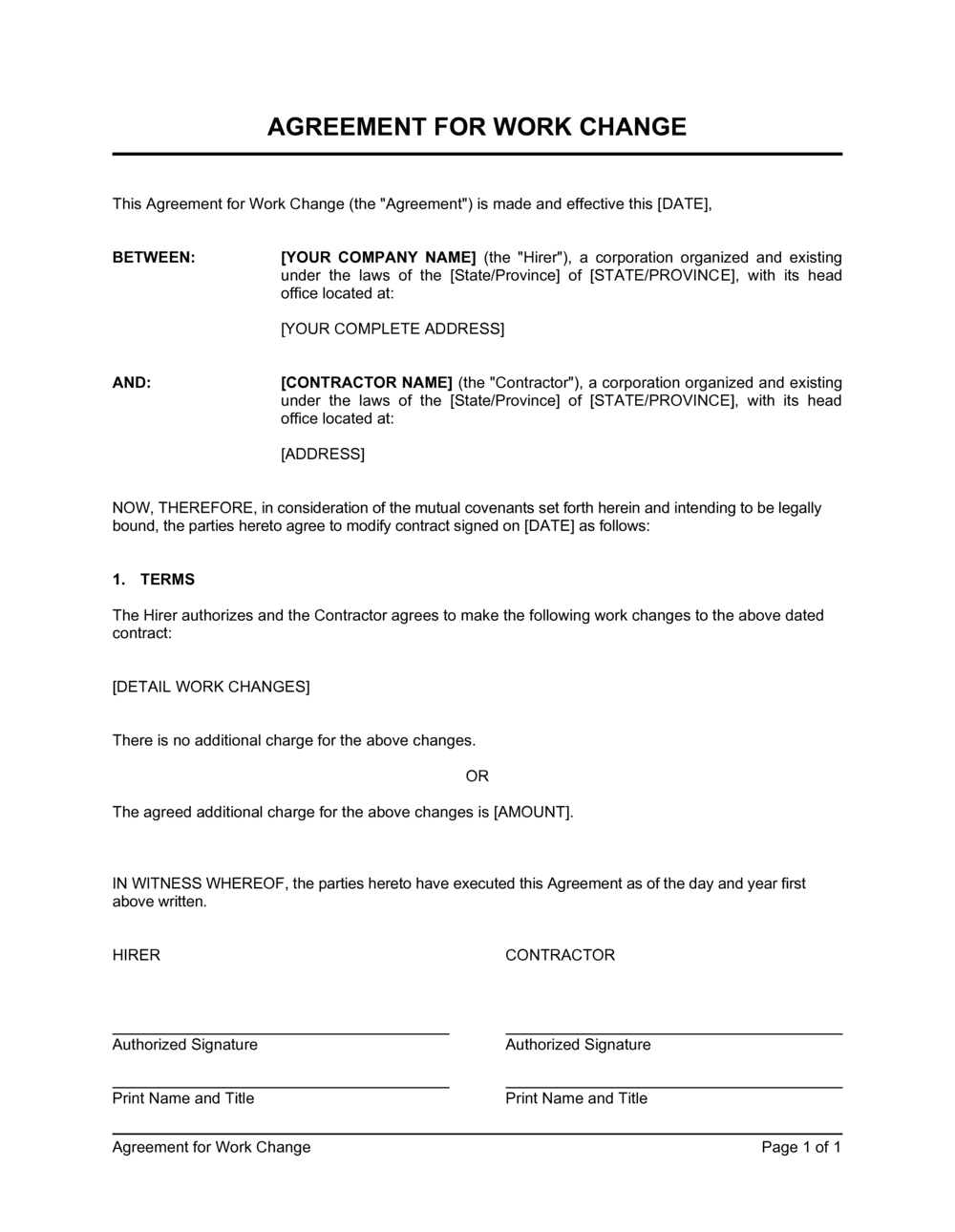
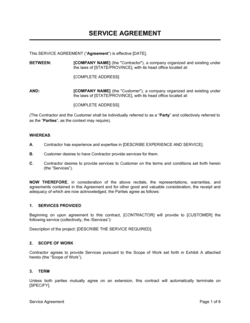
Agreement for Work Change Template

Free Word download β€’ Edit online β€’ Save & share with Drive β€’ Export to PDF

1 pageβ€’20–25 min to fillβ€’Difficulty: Standardβ€’Signature requiredβ€’Legal review recommended
Learn more ↓
FreeAgreement for Work Change Template

At a glance

What it is
An Agreement for Work Change is a legally binding document that formally modifies the scope, cost, timeline, or deliverables of an existing contract between two parties. This free Word download lets you document every change to an ongoing project β€” additional work, reduced scope, revised milestones, or adjusted compensation β€” and have both parties sign off before work proceeds, preventing disputes down the line.
When you need it
Use it whenever a client, contractor, or project owner requests changes to work already under a signed agreement β€” additions to scope, removal of deliverables, schedule shifts, or budget adjustments. It is essential any time a verbal request to "just add that one thing" could create payment or liability ambiguity.
What's inside
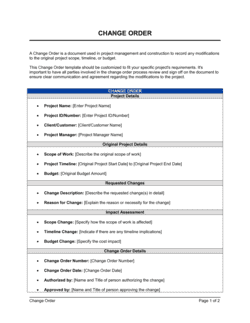
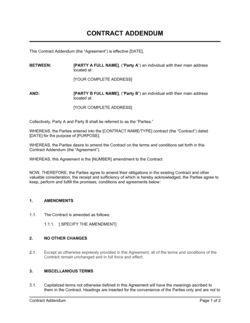
Party identification and original contract reference, description of the change requested, revised pricing and payment terms, updated schedule and milestones, impact on warranties or deliverables, and signatures of all authorizing parties. Together these clauses create a self-contained record that sits alongside β€” and legally modifies β€” the original contract.

What is an Agreement for Work Change?

An Agreement for Work Change is a legally binding document that formally modifies the scope, price, schedule, or deliverables of an existing contract between two parties. Also known as a change order, it records exactly what is being added, removed, or altered β€” along with any adjusted compensation and revised timeline β€” and requires signatures from authorized representatives of both parties before the modified work begins. Without it, changes to active contracts exist only as verbal understandings, which are notoriously difficult to enforce and routinely generate payment disputes.

Why You Need This Document

Every project of any meaningful size encounters change β€” a client adds a room, a development team is asked to build a new feature, a consulting engagement expands beyond the original statement of work. Without a signed agreement for work change, the contractor performing that additional work has no enforceable claim to payment for it, and the client has no documented basis for holding the contractor to the revised deliverables. The cost of proceeding without one is concrete: courts in most jurisdictions treat unauthorized work as a risk taken by the party performing it. A single unresolved change-order dispute can consume the entire profit margin on a project in legal fees alone. This template ensures that every modification to your existing contracts is captured, priced, scheduled, and signed before a single additional hour of work begins β€” creating a clear audit trail that protects both parties if the project relationship sours later.

Which variant fits your situation?

If your situation is…Use this template
Adding work to an existing construction contractConstruction Change Order
Reducing the scope of work already under contractAgreement for Work Change (Scope Reduction)
Revising a professional services engagement timelineContract Amendment
Modifying price only, with no scope changeContract Amendment (Price Adjustment)
Terminating part of the work and settling the remainderTermination Agreement
Replacing an entire contract with a new versionAddendum to Contract
Documenting a verbal change already performedLetter of Confirmation of a Verbal Agreement

Common mistakes to avoid

❌ Proceeding with changed work before signing

Why it matters: Work performed without a signed change order may be treated as a gift or a goodwill gesture rather than a contractual obligation. Recovering payment for unauthorized work is significantly harder and often requires litigation.

Fix: Adopt a firm policy: no work proceeds on any change until both parties have signed the change order. Document verbal approvals in writing immediately and follow up with a formal signature.

❌ Vague scope description

Why it matters: A change order that says 'additional electrical work as discussed' creates a dispute every time β€” the parties remember the discussion differently, and there is no written record to settle it.

Fix: Write scope descriptions specific enough for a third party who was not present at the discussion to understand exactly what was agreed. Attach supporting documents as exhibits.

❌ Omitting the revised contract total

Why it matters: Listing only the change amount requires both parties to manually track a running total across multiple change orders. Arithmetic errors and disagreements about the total contract value are common when this running total is never written down.

Fix: Always restate the cumulative contract total on every change order and maintain a change-order log attached to the original contract file.

❌ No schedule extension for added scope

Why it matters: Approving added work without adjusting the deadline creates an impossible situation: the contractor must deliver more within the original timeframe or face delay penalties for a schedule they cannot control.

Fix: Assess the time impact of every scope addition and adjust the completion date and relevant milestones accordingly, even if the extension is only a few days.

❌ Wrong signatory or missing authority confirmation

Why it matters: A change order signed by an employee without authority to bind the company may be voided. The employer can deny liability, leaving the contractor with no enforceable payment claim for the additional work.

Fix: Verify authority before signing: check the original contract for designated authorized representatives, or request a corporate resolution or authorization letter for high-value changes.

❌ Treating a change order as a standalone contract

Why it matters: A change order that does not reference and integrate with the original agreement may be read as a separate contract with no connection to original terms β€” potentially duplicating or contradicting warranty, indemnity, and dispute resolution clauses.

Fix: Always include an integration clause confirming that the change order amends β€” and is governed by β€” the original contract, and that all other terms remain in effect.

The 8 key clauses, explained

Parties and original contract reference

In plain language: Identifies both parties by legal name and references the original contract β€” title, date, and contract number β€” that this agreement modifies.

Sample language
This Agreement for Work Change ('Change Order') dated [DATE] is entered into by [CONTRACTOR LEGAL NAME] ('Contractor') and [CLIENT LEGAL NAME] ('Client'), and amends the [ORIGINAL CONTRACT TITLE] dated [ORIGINAL CONTRACT DATE] (Contract No. [NUMBER]).

Common mistake: Referencing a contract by project nickname instead of the exact legal title and date. When disputes arise, ambiguity about which underlying contract is being amended can render the change order unenforceable.

Description of the change

In plain language: Specifies precisely what work is being added, removed, or modified β€” including materials, deliverables, labor, and any other affected elements.

Sample language
The scope of work is hereby modified as follows: [DETAILED DESCRIPTION OF ADDED / REMOVED / MODIFIED WORK]. This change [adds / removes / replaces] the following items from the original Scope of Work: [LIST].

Common mistake: Using vague language like 'additional work as discussed.' Without a specific description, the parties will inevitably disagree about exactly what was authorized and what remains outstanding.

Revised contract price and payment terms

In plain language: States the dollar amount added to or deducted from the original contract price, the new total, and when and how the adjustment will be paid.

Sample language
The original contract price of $[ORIGINAL AMOUNT] is [increased / decreased] by $[CHANGE AMOUNT], resulting in a revised total contract price of $[NEW TOTAL]. The additional amount shall be invoiced on [DATE / MILESTONE] and is due Net [30] days from invoice.

Common mistake: Listing only the change amount without restating the new contract total. This forces both parties to manually calculate the running total and creates errors when multiple change orders accumulate.

Revised schedule and milestones

In plain language: Updates the project timeline to reflect the time impact of the change β€” new completion date, adjusted milestones, and any extension to the original deadlines.

Sample language
The [substantial completion / final delivery] date is hereby revised from [ORIGINAL DATE] to [NEW DATE], an extension of [X] calendar days. Milestone [X] is correspondingly revised to [NEW MILESTONE DATE].

Common mistake: Approving scope additions without extending the timeline. When the original deadline remains unchanged despite added work, the contractor faces an impossible schedule and the client expects an on-time delivery β€” guaranteeing a dispute.

Impact on original contract terms

In plain language: Confirms which terms of the original contract remain in force and clarifies any terms this change order supersedes or modifies.

Sample language
Except as expressly modified by this Change Order, all terms and conditions of the original Agreement dated [DATE] remain in full force and effect. In the event of a conflict between this Change Order and the original Agreement, this Change Order shall control.

Common mistake: Failing to include a conflict-of-terms clause. Without it, contradictions between the change order and the original contract are resolved by courts using general principles β€” which may not favor either party's intent.

Reason for the change

In plain language: Documents the cause of the change β€” client request, unforeseen conditions, design error, regulatory requirement β€” to establish context and protect both parties in future disputes.

Sample language
This change is required due to [CLIENT REQUEST / UNFORESEEN SITE CONDITIONS / DESIGN REVISION / REGULATORY REQUIREMENT], as documented in [COMMUNICATION REFERENCE / SITE REPORT / RFI NUMBER].

Common mistake: Omitting the reason for the change entirely. When a change order is disputed months later, a documented cause prevents one party from retroactively recharacterizing who was responsible for the need.

Warranty and defect provisions

In plain language: Addresses how the change interacts with existing warranty obligations β€” whether the original warranty period resets, extends, or remains unaffected for the changed work.

Sample language
The Contractor's warranty obligations under Section [X] of the original Agreement shall apply to all work performed under this Change Order. The warranty period for changed work shall commence on [SUBSTANTIAL COMPLETION DATE OF CHANGED WORK] and run for [X] months.

Common mistake: Assuming the original warranty clause automatically covers change-order work. Courts have found that additions performed under a separate change order fall outside the original warranty scope if not explicitly addressed.

Authorization and signatures

In plain language: Records the names and titles of individuals authorized to approve the change on behalf of each party, and provides signature lines with date fields for execution.

Sample language
By signing below, each party confirms they have read, understood, and agreed to this Agreement for Work Change. [CLIENT REPRESENTATIVE NAME], [TITLE], on behalf of [CLIENT LEGAL NAME]: _______________ Date: [DATE]. [CONTRACTOR REPRESENTATIVE NAME], [TITLE], on behalf of [CONTRACTOR LEGAL NAME]: _______________ Date: [DATE].

Common mistake: Having the wrong person sign on behalf of a company. A signature from an employee without actual or apparent authority to bind the company may not be enforceable, leaving the change order in legal limbo.

How to fill it out

  1. 1

    Reference the original contract precisely

    Enter the full legal names of both parties exactly as they appear in the original contract, then cite the original contract by its official title, execution date, and contract number if one exists.

    πŸ’‘ Pull the signature page of the original contract to confirm legal entity names β€” a mismatch between the change order and the underlying contract is the most common technical defect.

  2. 2

    Describe the change in specific, measurable terms

    Write out exactly what is being added, removed, or modified. For construction, list materials, quantities, and locations. For services, list deliverables, hours, and acceptance criteria.

    πŸ’‘ Attach a sketch, specification sheet, or email thread as Exhibit A β€” any supporting document that eliminates ambiguity about what was agreed.

  3. 3

    Calculate and state the revised contract price

    Enter the change amount β€” positive for additions, negative for deductions β€” and compute the new contract total explicitly. Specify when the change amount is invoiced and the payment due date.

    πŸ’‘ Keep a running log of all change orders on a cover sheet showing the original contract price, each change order amount, and the cumulative revised total. Attach it to every new change order.

  4. 4

    Revise the project schedule

    Assess how the change affects the remaining timeline and update the completion date and any intermediate milestones. State the number of additional calendar days granted explicitly.

    πŸ’‘ If the change is a scope reduction, confirm whether the timeline compresses or stays the same β€” clients often assume a shorter scope means an earlier delivery.

  5. 5

    Document the reason for the change

    Record the cause β€” client-initiated request, unforeseen site condition, regulatory change, or design revision β€” and reference any supporting documentation such as an RFI number, site report, or email.

    πŸ’‘ Neutral, factual language in the reason clause protects both parties. Avoid assigning blame; simply record the documented trigger.

  6. 6

    Address warranty coverage for the changed work

    Confirm that your standard warranty terms apply to the work performed under this change order and state when the warranty period for the changed work begins.

    πŸ’‘ If the change order replaces defective work from the original contract, reset the warranty period for that element specifically β€” and note it explicitly.

  7. 7

    Obtain signatures before work begins

    Both parties must sign before any work under the change order commences. Confirm that each signatory has authority to bind their respective organization.

    πŸ’‘ Use a timestamped electronic signature tool to create an audit trail showing the change was approved before the start date β€” critical if a payment dispute arises later.

Frequently asked questions

What is an agreement for work change?

An agreement for work change is a legally binding document that formally modifies the scope, price, schedule, or deliverables of an existing contract. It is commonly called a change order in construction and project management. Both parties sign it to confirm they agree to the modification before any additional or altered work begins, creating an enforceable record of what changed and what compensation applies.

When do I need a work change agreement?

You need one any time the scope, cost, timeline, or deliverables of an active contract change β€” regardless of how small the change seems. Common triggers include a client requesting additional features or finishes, a contractor encountering unforeseen site conditions, a regulatory change requiring design modifications, or either party agreeing to accelerate or delay the schedule. Verbal agreements to "just handle it" routinely turn into disputes; a signed change order prevents that.

Is a change order legally binding?

Yes, a properly executed change order is generally enforceable as a binding amendment to the original contract, provided it is signed by individuals with authority to bind each party and is supported by consideration β€” typically additional payment for added work or a price reduction for removed scope. Courts in most jurisdictions treat signed change orders as modifications that take precedence over the original contract terms they address.

Can I modify a contract without a written change order?

In most jurisdictions, oral modifications to a written contract are technically possible but extremely difficult to prove and enforce. Many contracts include a 'no oral modification' clause that expressly prohibits unwritten changes β€” meaning a verbal agreement to add work may not be enforceable at all. Even without such a clause, relying on a verbal agreement exposes both parties to disagreements about what was actually agreed.

What happens if work is done without a signed change order?

The contractor risks non-payment for the additional work if the client disputes that it was authorized. Courts may treat the work as a gratuitous service, a goodwill gesture, or work performed at the contractor's own risk. The client, meanwhile, may lose the ability to enforce a fixed price if they instructed changes without a formal record. Both parties are worse off without a signed document.

What is the difference between a change order and a contract amendment?

A change order is a specific type of contract amendment commonly used in construction, engineering, and project-based service contracts to record discrete scope, price, and schedule changes. A contract amendment is the broader term for any formal modification to any contract term β€” pricing, confidentiality, governing law, or party details. Both are legally equivalent modifications; the naming convention depends on the industry and the original contract's terminology.

How should a change order affect the project timeline?

Every scope addition or removal should be assessed for its time impact, and the change order should reflect an adjusted completion date if warranted. Approving additional work without extending the schedule creates a conflict: the contractor faces delay penalties for a timeline they cannot meet, while the client expects on-time delivery. Best practice is to state the number of additional calendar days granted alongside the scope description.

Do both parties need to sign a work change agreement?

Yes. A change order must be signed by authorized representatives of both parties to be enforceable. A document signed only by the contractor represents a unilateral price demand, not a binding modification. Confirm that each signatory has actual authority β€” check the original contract for designated representatives or request written authorization for high-value changes.

How many change orders can be issued on a single contract?

There is no legal limit on the number of change orders a contract can accommodate. However, a large number of change orders on a single project can signal a poorly scoped original contract. Some contracts include a cumulative cap β€” for example, no individual change order may exceed 10% of the original contract value without triggering a formal contract renegotiation. Maintaining a numbered change-order log with a running total is essential when multiple modifications accumulate.

How this compares to alternatives

vs Contract amendment

A contract amendment is a broad instrument that can modify any term of any contract β€” parties, governing law, payment terms, confidentiality provisions. An agreement for work change is a specialized amendment focused specifically on project scope, price, and schedule. Use a work change agreement for active project modifications; use a contract amendment when revising non-scope terms of an ongoing agreement.

vs Addendum to contract

An addendum adds new terms to a contract that were not addressed in the original document β€” typically supplementary provisions, exhibits, or clarifications. An agreement for work change modifies terms that already exist: scope, price, and timeline. If the original contract is silent on a topic, use an addendum; if you are changing an existing obligation, use a work change agreement.

vs Letter of confirmation of a verbal agreement

A letter of confirmation records the terms of a verbal agreement already reached between parties, but is typically a one-sided document and carries less enforceability than a signed bilateral agreement. An agreement for work change is executed by both parties before work proceeds, creating a clear bilateral record. Use the letter of confirmation only as a stopgap when a signed change order cannot be obtained immediately.

vs Service agreement

A service agreement defines the original scope, price, and terms of an engagement from the outset. An agreement for work change modifies a service agreement already in place. These two documents work in tandem: the service agreement governs the baseline engagement, and each work change agreement layers a documented modification on top of it.

Industry-specific considerations

Construction and trades

Change orders are ubiquitous in construction β€” covering unforeseen conditions, owner-directed design changes, and material substitutions, and often tied to lien waiver and retainage provisions.

IT and software development

Feature additions, revised sprint deliverables, and infrastructure changes mid-engagement require documented change orders to prevent scope creep from eroding project profitability.

Professional services and consulting

Engagements frequently expand beyond the original statement of work; a signed work change agreement protects the consultant's right to bill for additional hours or deliverables.

Manufacturing and engineering

Design changes, material substitutions, and production schedule shifts during a manufacturing run require formal change orders to update specifications and pricing before production proceeds.

Jurisdictional notes

United States

Change orders are governed by contract law and, in construction, by state-specific mechanics lien statutes. Many states require written change orders for public construction contracts above a threshold value. At-will oral modification is possible in states without a strict no-oral-modification rule, but most courts give written change orders controlling weight. California, New York, and Texas each have specific construction contract requirements worth reviewing.

Canada

Construction change orders in Canada interact with provincial builders' lien legislation β€” each province has its own lien act with different registration deadlines and holdback requirements. In Ontario, the Construction Act requires a formal process for changes on major projects. Quebec civil law treats contract modifications differently from common-law provinces, requiring mutual consent documented in writing to modify a service or construction contract.

United Kingdom

Change orders in UK construction typically follow the NEC or JCT contract suite procedures, which prescribe specific notice and valuation timelines for compensation events. Failure to give timely notice of a change can bar the right to additional payment under NEC contracts. Outside construction, the UK Contracts (Rights of Third Parties) Act 1999 may affect who can enforce a change order if third-party rights were established in the original contract.

European Union

EU public procurement rules impose strict limits on material modifications to public contracts β€” changes that alter the economic balance significantly in favor of one party may require a fresh procurement process under the EU Public Procurement Directive. For private contracts, member state contract law governs, with France and Germany requiring mutual written consent for enforceable amendments. GDPR considerations arise if the change order involves processing personal data not covered by the original data processing agreement.

Template vs lawyer β€” what fits your deal?

PathBest forCostTime
Use the templateStandard scope or price changes on established contracts between parties with an existing working relationshipFree15–30 minutes per change order
Template + legal reviewHigh-value change orders, government contracts, or changes involving warranty resets, delay claims, or liability exposure$200–$500 for a lawyer review1–3 days
Custom draftedComplex multi-party construction projects, regulated industries, or changes that effectively rewrite the core obligations of the original contract$800–$3,000+1–2 weeks

Glossary

Change Order
A written authorization to modify the scope, price, or schedule of an existing contract β€” used interchangeably with 'agreement for work change' in construction and project management.
Scope of Work
The defined set of deliverables, tasks, and boundaries agreed in the original contract that determine what is and is not covered.
Contract Amendment
A formal modification to an existing contract that changes one or more of its original terms, requiring signatures from all parties to be enforceable.
Consideration
Something of value exchanged by each party β€” typically money, services, or a promise β€” required to make a contract or amendment legally binding.
Force Majeure
A clause that excuses a party from performance obligations when extraordinary events outside their control β€” such as natural disasters or government orders β€” prevent completion.
Milestone
A defined point in a project schedule at which a specific deliverable must be complete, often tied to a payment trigger.
Lien Waiver
A document in which a contractor or subcontractor gives up the right to file a mechanic's lien on a property in exchange for payment β€” sometimes issued alongside a change order in construction.
Retainage
A percentage of payment withheld by the client until the project reaches substantial completion, commonly 5–10% in construction contracts.
Substantial Completion
The point at which work is sufficiently complete that the owner can use the project for its intended purpose, typically triggering final payment and the start of warranty periods.
No-Damage-for-Delay Clause
A contract provision preventing a contractor from claiming additional compensation for delays caused by the owner β€” enforceability varies by jurisdiction.

Part of your Business Operating System

This document is one of 3,000+ business & legal templates included in Business in a Box.

  • Fill-in-the-blanks β€” ready in minutes
  • 100% customizable Word document
  • Compatible with all office suites
  • Export to PDF and share electronically

Create your document in 3 simple steps.

From template to signed document β€” all inside one Business Operating System.
1
Download or open template

Access over 3,000+ business and legal templates for any business task, project or initiative.

2
Edit and fill in the blanks with AI

Customize your ready-made business document template and save it in the cloud.

3
Save, Share, Send, Sign

Share your files and folders with your team. Create a space of seamless collaboration.

Save time, save money, and create top-quality documents.

β˜…β˜…β˜…β˜…β˜…

"Fantastic value! I'm not sure how I'd do without it. It's worth its weight in gold and paid back for itself many times."

Managing Director Β· Mall Farm
Robert Whalley
Managing Director, Mall Farm Proprietary Limited
β˜…β˜…β˜…β˜…β˜…

"I have been using Business in a Box for years. It has been the most useful source of templates I have encountered. I recommend it to anyone."

Business Owner Β· 4+ years
Dr Michael John Freestone
Business Owner
β˜…β˜…β˜…β˜…β˜…

"It has been a life saver so many times I have lost count. Business in a Box has saved me so much time and as you know, time is money."

Owner Β· Upstate Web
David G. Moore Jr.
Owner, Upstate Web

Run your business with a system β€” not scattered tools

Stop downloading documents. Start operating with clarity. Business in a Box gives you the Business Operating System used by over 250,000 companies worldwide to structure, run, and grow their business.

Start freeΒ Β·Β No credit card required