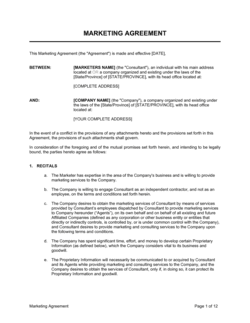
Implementing A Marketing System Template

Free Word download • Edit online • Save & share with Drive • Export to PDF

3 pages25–30 min to fillDifficulty: StandardSignature requiredLegal review recommended
Learn more ↓
FreeImplementing A Marketing System Template

At a glance

What it is
An Implementing A Marketing System agreement is a legally binding contract between a business and a marketing service provider that defines the full scope of building and deploying a structured marketing system — including channels, automation, content workflows, analytics, and reporting. This free Word download covers deliverables, timelines, fees, IP ownership, confidentiality, and termination in a single enforceable document.
When you need it
Use it when engaging an agency, consultant, or in-house team to design and deploy a repeatable marketing system — such as a CRM funnel, email automation suite, or multi-channel lead generation framework — where deliverables, milestones, and ownership need to be formally documented.
What's inside
Scope of work and system specifications, implementation timeline and milestones, fees and payment schedule, intellectual property assignment, confidentiality obligations, performance standards, change-order procedures, and termination and handover terms.

What is an Implementing A Marketing System Agreement?

An Implementing A Marketing System agreement is a legally binding contract that governs the design, construction, and deployment of a structured marketing system by a service provider on behalf of a client business. It defines every material aspect of the engagement: the precise scope of deliverables — including automation workflows, CRM configuration, channel setup, and analytics infrastructure — the phased implementation timeline, the fee and payment schedule, intellectual property ownership, confidentiality obligations, and what happens when the project ends or the relationship breaks down. Unlike a generic services agreement or a simple statement of work, this document addresses the specific complexities of building transferable marketing infrastructure: milestone-linked acceptance, platform credential handover, and the boundary between the provider's pre-existing tools and the custom assets delivered to the client.

Why You Need This Document

Without a written marketing system implementation agreement, both parties are exposed from the moment work begins. The client risks paying in full for a system they do not legally own — because without an explicit IP assignment clause, copyright in creative and technical work product belongs to its creator, not the person who commissioned it. The provider risks completing an entire multi-phase project and receiving only the initial deposit, because without a deemed-acceptance clause, a client can delay final sign-off indefinitely. Platform credentials, ad accounts, and CRM access remain in legal limbo unless a handover clause explicitly mandates their transfer on termination. Scope disputes — the most common source of conflict in marketing engagements — are almost entirely preventable with a clearly written scope and exclusions list tied to a mandatory change order process. This template closes each of those gaps before work starts, giving both parties a clear record of what was agreed, who owns what, and exactly how the engagement ends.

Which variant fits your situation?

If your situation is…Use this template
Ongoing monthly marketing retainer after system is liveMarketing Services Agreement
Engaging a freelancer for a single campaign rather than a full systemIndependent Contractor Agreement
Licensing existing marketing software or platform to a clientSoftware License Agreement
Building a marketing system as part of a broader business partnershipJoint Venture Agreement
Hiring a full-time employee to own the marketing system internallyEmployment Contract
Engaging an agency to run paid advertising only, with no system buildAdvertising Agency Agreement
Defining marketing deliverables as part of a broader consulting engagementConsulting Agreement

Common mistakes to avoid

❌ Starting work before signing

Why it matters: Any work performed before execution is not covered by the contract's IP assignment, confidentiality, or payment clauses — leaving both parties exposed if the relationship breaks down.

Fix: Require a countersigned agreement and receipt of the deposit payment before any implementation activity begins, including discovery calls where proprietary strategy is shared.

❌ No client input deadlines in the timeline

Why it matters: When the client is slow to provide brand assets, copy approvals, or platform access, the provider misses milestone dates through no fault of their own — creating a dispute over the delay.

Fix: Add explicit client delivery deadlines to every milestone and include a clause stating that provider timelines extend day-for-day when the client misses their inputs.

❌ Vague scope without an exclusions list

Why it matters: A scope that says 'marketing system build' without detailing what is excluded invites the client to request adjacent services — social media management, blog writing, paid ads — as included in the original fee.

Fix: Write a dedicated exclusions paragraph listing at least five specific out-of-scope services. Anything not listed as excluded will be assumed included by a reasonable client.

❌ Assigning all IP without carving out pre-existing provider tools

Why it matters: A blanket IP assignment can inadvertently transfer ownership of the provider's proprietary templates, automation playbooks, and methodology documents — assets they need to serve other clients.

Fix: List all pre-existing provider IP in a schedule and confirm it is licensed, not assigned, to the client. Only custom deliverables built specifically for this client should be fully assigned.

❌ No handover obligation on termination

Why it matters: Without a written handover clause, a terminated provider can retain access to the client's ad accounts, CRM, and email platform — effectively locking the client out of their own marketing infrastructure.

Fix: Include a mandatory handover clause listing every platform and asset that must be transferred, with a 15-business-day deadline and a process for credential changes after delivery.

❌ Linking all payment to a single final acceptance

Why it matters: If the client delays final sign-off — whether in good faith or strategically — the provider completes all work but receives only the initial deposit, creating a serious cash flow problem.

Fix: Tie at least three payment instalments to specific, measurable milestones throughout the project, with deemed-acceptance clauses at each stage to prevent indefinite delays.

The 10 key clauses, explained

Parties and recitals

In plain language: Identifies the client and the service provider as legal entities, states the purpose of the agreement, and provides the effective date.

Sample language
This Marketing System Implementation Agreement ('Agreement') is entered into as of [DATE] between [CLIENT LEGAL NAME], a [STATE/PROVINCE] [ENTITY TYPE] ('Client'), and [PROVIDER LEGAL NAME], a [STATE/PROVINCE] [ENTITY TYPE] ('Provider').

Common mistake: Using a trade name instead of the registered legal entity name. If a dispute arises, enforcing the agreement against the wrong entity creates costly procedural delays.

Scope of work and system specifications

In plain language: Defines every deliverable in the marketing system — channels, automations, integrations, content types, and platforms — and explicitly lists what is excluded.

Sample language
Provider shall design and implement a marketing system comprising: (a) [CRM PLATFORM] configuration and automation sequences, (b) [NUMBER] email nurture workflows, (c) [CHANNEL] lead generation setup, and (d) analytics dashboard via [PLATFORM]. The following are expressly excluded: [EXCLUSIONS].

Common mistake: Omitting an exclusions list. Without it, the client assumes every adjacent marketing task is included, and scope creep follows immediately — driving up cost and dispute risk.

Implementation timeline and milestones

In plain language: Sets a phased project schedule with named milestones, target completion dates, and the deliverables that must be accepted before each phase proceeds.

Sample language
Phase 1 — System Architecture: completed by [DATE]. Phase 2 — Build and Integration: completed by [DATE]. Phase 3 — Testing and Launch: completed by [DATE]. Each phase is contingent on Client providing [REQUIRED INPUT] within [X] business days of the phase start.

Common mistake: Setting milestone dates without specifying what the client must provide to enable them. When the client is late supplying access, copy, or approvals, the provider misses dates — creating a liability gap.

Fees, payment schedule, and expenses

In plain language: States the total project fee, the payment instalment structure tied to milestones, acceptable payment methods, late-fee terms, and how pre-approved expenses are reimbursed.

Sample language
Client shall pay Provider a total project fee of $[AMOUNT]. Payment schedule: [X]% upon execution ($[AMOUNT]), [X]% upon Phase 2 completion ($[AMOUNT]), [X]% upon final acceptance ($[AMOUNT]). Late payments accrue interest at [X]% per month. Pre-approved expenses reimbursed within [30] days of receipt of itemized invoice.

Common mistake: Tying all payment to final acceptance. If the client delays sign-off indefinitely, the provider can complete all work and still face cash flow problems. Stage payments to milestone completions instead.

Acceptance procedures

In plain language: Describes how the client reviews and formally approves each deliverable, how long they have to review, what constitutes deemed acceptance, and how revision requests are handled.

Sample language
Client shall review each deliverable within [10] business days of delivery. Client may request up to [2] rounds of revisions within the original scope. If Client fails to provide written feedback within [10] business days, the deliverable is deemed accepted. Additional revisions beyond [2] rounds constitute a change order.

Common mistake: No deemed-acceptance clause. Without it, a silent client can indefinitely withhold acceptance, blocking payment to the provider and stalling the next phase.

Intellectual property ownership and licensing

In plain language: Assigns all created work product to the client upon full payment, specifies any pre-existing provider IP retained by the provider and licensed to the client, and addresses third-party platform terms.

Sample language
Upon receipt of full payment, Provider assigns to Client all right, title, and interest in all work product created under this Agreement. Provider retains ownership of its pre-existing methodologies, templates, and tools ('Provider IP'), and grants Client a non-exclusive, perpetual, royalty-free license to use Provider IP solely as embedded in the delivered system.

Common mistake: Assigning IP without distinguishing pre-existing tools from custom-built deliverables. The provider may unintentionally assign frameworks they need to reuse with other clients, creating downstream legal exposure.

Confidentiality

In plain language: Prohibits both parties from disclosing the other's proprietary information — customer data, pricing, platform credentials, and strategic plans — during and after the engagement.

Sample language
Each party agrees to hold the other's Confidential Information in strict confidence and not to disclose it to any third party without prior written consent. This obligation survives termination for a period of [3] years. 'Confidential Information' excludes information that is publicly available through no fault of the receiving party.

Common mistake: A one-sided confidentiality clause protecting only the client. Providers share proprietary methodologies and pricing with clients — mutual confidentiality is appropriate and expected.

Change order procedure

In plain language: Establishes a written process for requesting, pricing, and approving any work outside the original scope, preventing unauthorized scope expansion and protecting both parties.

Sample language
Any modification to the scope of work requires a written Change Order signed by both parties. Provider shall submit a Change Order within [5] business days of identifying a scope change, stating the additional fee and timeline impact. Work on the change shall not commence until the Change Order is signed.

Common mistake: Allowing verbal change approvals. Unwritten scope expansions lead to fee disputes and uncompensated work. All changes must be in writing with a signature from both parties.

Termination and handover

In plain language: States the notice period required to terminate for convenience, grounds for immediate termination for cause, and the structured handover process — including asset delivery, credential transfer, and final payment obligations.

Sample language
Either party may terminate this Agreement for convenience with [30] days' written notice. Client may terminate for cause immediately upon written notice if Provider materially breaches and fails to cure within [10] business days. Upon termination, Provider shall deliver all completed work product, credentials, and documentation to Client within [15] business days of the termination date.

Common mistake: No handover obligation on termination. A provider who retains platform credentials, ad accounts, or CRM access after termination can effectively hold the client's marketing infrastructure hostage.

Governing law and dispute resolution

In plain language: Specifies which jurisdiction's law governs the agreement and the mechanism for resolving disputes — typically arbitration, mediation, or litigation — along with the venue.

Sample language
This Agreement shall be governed by the laws of [STATE/PROVINCE/COUNTRY]. Any dispute shall first be submitted to non-binding mediation administered by [ORGANIZATION]. If unresolved within [30] days, disputes shall be resolved by binding arbitration in [CITY] under the rules of [AAA/JAMS/OTHER].

Common mistake: Choosing a governing law that has no connection to where either party operates. Courts in the actual operating jurisdiction may apply local law regardless, creating a conflict between the contract and the enforced outcome.

How to fill it out

  1. 1

    Identify both parties with their registered legal names

    Enter the full registered legal name, entity type, and state or province of incorporation for both the client and the provider. Do not use trade names or 'doing business as' names as the primary identifier.

    💡 Verify the provider's legal entity name against their state or provincial corporate registry before signing — this prevents enforcement issues if the relationship goes wrong.

  2. 2

    Define the scope of work with explicit exclusions

    List every deliverable by name, platform, and specification. Then add a separate exclusions paragraph identifying adjacent services that are not included — such as paid media spend, graphic design, or ongoing content creation after launch.

    💡 Attach a detailed Schedule A for the full scope specification rather than embedding it in the body — this lets you update the scope via an addendum without amending the main contract.

  3. 3

    Set phased milestones with client input deadlines

    Break the implementation into named phases, assign a target completion date to each, and specify what the client must provide — logins, brand assets, approved copy — and the deadline for providing it. Make provider milestone dates contingent on timely client delivery.

    💡 Build in a 5–7 business day client-delay buffer per phase. Most implementation delays originate on the client side, not the provider side.

  4. 4

    Complete the fee and payment schedule

    Enter the total project fee and break it into milestone-linked instalments — typically 30% at signing, 40% at mid-project milestone, and 30% at final acceptance. Specify the currency, accepted payment methods, and the late-fee rate.

    💡 Avoid a final instalment larger than 30% of the total fee. Large back-end payments incentivize the client to delay acceptance indefinitely.

  5. 5

    Set the acceptance window and deemed-acceptance clause

    Specify how many business days the client has to review each deliverable, how many revision rounds are included, and that silence after the review window constitutes acceptance. This protects the provider from indefinite approval delays.

    💡 Ten business days is the accepted standard review window for marketing deliverables. Shorter windows are reasonable for simple assets; longer windows increase project risk.

  6. 6

    Clarify IP ownership and pre-existing tools

    Confirm that all custom-built work product is assigned to the client upon full payment. List any provider templates, methodologies, or software components that remain the provider's property and are licensed — not assigned — to the client.

    💡 If the provider uses a proprietary playbook or template system, carve it out explicitly as licensed Provider IP. Failing to do so can deprive the provider of tools they depend on for other clients.

  7. 7

    Define the termination and handover process

    State the notice period for termination for convenience, list specific grounds for immediate termination for cause, and include a mandatory handover clause requiring the provider to deliver all assets, credentials, and documentation within 15 business days of termination.

    💡 Name the specific platforms and accounts covered by the handover obligation — CRM, ad manager, email platform, analytics — so there is no ambiguity about what must be transferred.

  8. 8

    Sign before implementation begins

    Both parties must execute the agreement before any work commences. Work performed before signing may not be covered by the contract's IP, confidentiality, or payment protections.

    💡 Use a timestamped eSignature tool and store the fully executed agreement with both parties' copies linked to the project folder for easy reference during the engagement.

Frequently asked questions

What is a marketing system implementation agreement?

A marketing system implementation agreement is a legally binding contract between a business and a marketing service provider that governs the design, build, and deployment of a structured marketing system. It defines the full scope of deliverables — channels, automations, integrations, and analytics — along with the timeline, fees, IP ownership, confidentiality obligations, and termination process. It replaces informal emails and statements of work with a single enforceable document.

When do I need a marketing system implementation agreement?

Use one any time you engage an agency, freelance consultant, or in-house team to build a repeatable marketing infrastructure — such as a CRM funnel, email automation suite, or multi-channel lead generation system. If the engagement involves significant fees, proprietary data, platform credentials, or custom-built assets that will remain with your business after the project, a written agreement is essential to protect both parties.

Who owns the marketing assets built under this agreement?

Ownership depends on the IP clause negotiated between the parties. In a typical arrangement, the client owns all custom-built deliverables upon full payment, while the provider retains a license to any pre-existing proprietary tools, templates, or methodologies embedded in the system. Without a written IP assignment clause, the provider may retain copyright in creative and technical work product they created, even if the client paid for it.

What should a marketing system implementation agreement include?

At minimum: party identification, a detailed scope of work with exclusions, a phased milestone schedule with client input deadlines, a milestone-linked payment schedule, acceptance procedures with a deemed-acceptance clause, IP ownership and licensing terms, mutual confidentiality obligations, a change order process, a termination clause with handover obligations, and governing law. Missing the acceptance procedure and handover clause are the two most common and costly omissions.

Can a marketing system implementation agreement protect against scope creep?

Yes — a well-drafted scope of work with an explicit exclusions list and a mandatory change order process is the primary mechanism for preventing scope creep. Every request for work outside the original scope must be documented in a signed change order before the work begins, with an agreed additional fee and timeline impact. Verbal approvals for additional work are not enforceable and routinely lead to disputes.

Is this agreement different from a standard marketing services retainer?

Yes. A marketing system implementation agreement covers a finite project with a defined scope, milestones, and end state — the delivery of a working marketing system. A retainer agreement governs ongoing, recurring marketing services after the system is live, typically billed monthly with no fixed end date. Most engagements use an implementation agreement for the build phase, then transition to a retainer for ongoing management.

Do I need a lawyer to review this agreement?

For straightforward domestic engagements under $25,000 with a single provider, a well-drafted template typically provides adequate protection. Engage a lawyer when the project fee exceeds $50,000, when the system will process regulated data (health or financial), when the provider is in a different country, or when the IP being built is central to the client's competitive advantage. A 1–2 hour review typically costs $300–$600 and is worthwhile for material engagements.

What happens if the provider misses a milestone deadline?

The contract should specify consequences for missed milestones, which typically include a cure period — such as 10 business days — before the client can terminate for cause. Some agreements include liquidated damages for specific critical deadlines, such as a launch date tied to a product release or marketing campaign. However, milestone dates must account for client input deadlines: if the client was late providing required assets, the provider's date obligation shifts accordingly.

What should the handover clause cover?

The handover clause should list every platform, account, and asset that must be transferred — including CRM access, email service provider accounts, ad manager credentials, analytics properties, social media accounts, and all created content files. It should set a deadline of no more than 15 business days after termination and require the provider to document the system with written instructions or a training session. Providers should retain no ongoing access to client platforms after handover is complete.

How this compares to alternatives

vs Independent Contractor Agreement

An independent contractor agreement defines a general service relationship — who the provider is, what they will do, how they will be paid, and that they are not an employee. A marketing system implementation agreement goes significantly further: it specifies milestone deliverables, acceptance criteria, IP assignment, change order procedures, and a structured handover process. Use the contractor agreement for simple, ongoing service relationships; use the implementation agreement for a defined, multi-phase build project.

vs Consulting Agreement

A consulting agreement governs advisory services — research, recommendations, and strategy — where the consultant provides expertise but does not necessarily build or deliver tangible assets. A marketing system implementation agreement governs the active construction and deployment of a system with defined specifications and acceptance criteria. If the engagement produces a working, transferable marketing infrastructure, the implementation agreement is the more appropriate document.

vs Marketing Services Retainer Agreement

A retainer agreement covers recurring, ongoing marketing services billed monthly with no fixed end date or system deliverable. A marketing system implementation agreement covers a finite project with a defined scope, milestones, and endpoint — the delivery of a working system. The two documents are complementary: the implementation agreement governs the build phase, and a retainer governs ongoing management once the system is live.

vs Joint Venture Agreement

A joint venture agreement structures a collaborative business relationship where two parties share investment, risk, and profit in a shared enterprise. A marketing system implementation agreement is a vendor-client transaction: one party pays for a defined deliverable, and the other builds and transfers it. Use a joint venture agreement only when both parties co-own the marketing system or share its commercial outcomes long term.

Industry-specific considerations

SaaS / Technology

Implementation covers CRM setup, trial-to-paid email sequences, in-app messaging workflows, and product analytics integration — with IP clauses covering proprietary onboarding automation.

Professional Services

Marketing systems typically include thought-leadership content pipelines, LinkedIn outreach sequences, and webinar funnels — requiring confidentiality clauses to protect client-targeting strategy.

Retail / E-commerce

Scope covers email abandon-cart flows, SMS marketing automation, loyalty program integration, and paid retargeting setup — with platform credential handover critical on termination.

Healthcare

Patient acquisition funnels must comply with HIPAA in the US and equivalent privacy regulations elsewhere — requiring enhanced confidentiality clauses and explicit data handling obligations.

Financial Services

Marketing systems must comply with FCA, SEC, or FINRA advertising rules — requiring compliance review checkpoints built into the milestone schedule and approval obligations on the client side.

Professional Education / Coaching

Implementation typically covers webinar funnels, lead magnet sequences, and course launch campaigns — with IP ownership of content templates being a frequent negotiation point.

Jurisdictional notes

United States

IP ownership defaults to the creator under US copyright law unless a written assignment clause is included. Work-for-hire doctrine applies narrowly to employees and certain commissioned works — a marketing system built by an independent contractor does not automatically belong to the client without a signed assignment. State law governs enforceability of non-solicitation and confidentiality clauses, which vary significantly between California, New York, and Texas.

Canada

PIPEDA and provincial privacy statutes (including Quebec's Law 25) impose strict obligations on how customer data collected through a marketing system is stored, processed, and transferred. Quebec-based providers or clients may require French-language contract versions for provincially regulated entities. IP assignment must be explicit in writing; moral rights in creative works persist separately under the Copyright Act and should be waived by the provider in the agreement.

United Kingdom

Marketing systems that collect, process, or store personal data must comply with UK GDPR and the Data Protection Act 2018 — the agreement should include a data processing addendum if the provider handles personal data on behalf of the client. The Unfair Contract Terms Act 1977 limits exclusion-of-liability clauses; overly broad limitations may not be enforceable. UK courts generally enforce liquidated damages clauses provided the amount is a genuine pre-estimate of loss.

European Union

Any marketing system that processes EU residents' personal data is subject to GDPR — requiring a Data Processing Agreement (DPA) as a mandatory addendum if the provider acts as a data processor. Marketing automation tools involving email or SMS must comply with the ePrivacy Directive, including consent requirements that vary by member state. Cross-border data transfers to US-based platforms require appropriate safeguards such as Standard Contractual Clauses.

Template vs lawyer — what fits your deal?

PathBest forCostTime
Use the templateDomestic engagements under $25,000 with a single provider, straightforward scope, and no regulated dataFree30–60 minutes
Template + legal reviewEngagements between $25,000 and $100,000, cross-state providers, or systems handling customer PII$300–$7002–4 days
Custom draftedEnterprise-scale implementations, cross-border engagements, regulated industries, or systems central to competitive IP$1,500–$5,000+1–3 weeks

Glossary

Marketing System
A documented, repeatable set of processes, tools, and channels designed to attract, convert, and retain customers at a predictable cost.
Scope of Work
A detailed written description of every deliverable, task, and exclusion that defines exactly what the service provider will and will not do.
Milestone
A defined checkpoint in the project timeline tied to a specific deliverable or phase completion, often linked to a payment trigger.
Acceptance Criteria
The measurable standards a deliverable must meet before the client is obligated to approve it and trigger the associated payment.
Intellectual Property Assignment
A clause transferring ownership of all created work — copy, designs, automations, and code — from the service provider to the client upon full payment.
Change Order
A written amendment to the original scope of work that documents new or modified deliverables, adjusts the fee, and requires both parties' signatures.
Confidential Information
Non-public data either party shares during the engagement — including customer lists, pricing, strategy documents, and technology credentials.
Handover
The structured process by which the service provider transfers all system assets, credentials, documentation, and training to the client at project completion or termination.
Performance Standard
Minimum service quality benchmarks — such as uptime, delivery timelines, or open rates — against which the provider's work is measured.
Force Majeure
A contract clause that excuses a party from performance obligations when an extraordinary event outside their control — such as a natural disaster or platform outage — prevents delivery.
Liquidated Damages
A pre-agreed sum the breaching party must pay for a specific failure — such as missing a launch milestone — calculated in advance rather than proven after the fact.


Part of your Business Operating System

This document is one of 3,000+ business & legal templates included in Business in a Box.

  • Fill-in-the-blanks — ready in minutes
  • 100% customizable Word document
  • Compatible with all office suites
  • Export to PDF and share electronically

Create your document in 3 simple steps.

From template to signed document — all inside one Business Operating System.
1
Download or open template

Access over 3,000+ business and legal templates for any business task, project or initiative.

2
Edit and fill in the blanks with AI

Customize your ready-made business document template and save it in the cloud.

3
Save, Share, Send, Sign

Share your files and folders with your team. Create a space of seamless collaboration.

Save time, save money, and create top-quality documents.

★★★★★

"Fantastic value! I'm not sure how I'd do without it. It's worth its weight in gold and paid back for itself many times."

Managing Director · Mall Farm
Robert Whalley
Managing Director, Mall Farm Proprietary Limited
★★★★★

"I have been using Business in a Box for years. It has been the most useful source of templates I have encountered. I recommend it to anyone."

Business Owner · 4+ years
Dr Michael John Freestone
Business Owner
★★★★★

"It has been a life saver so many times I have lost count. Business in a Box has saved me so much time and as you know, time is money."

Owner · Upstate Web
David G. Moore Jr.
Owner, Upstate Web

Run your business with a system — not scattered tools

Stop downloading documents. Start operating with clarity. Business in a Box gives you the Business Operating System used by over 250,000 companies worldwide to structure, run, and grow their business.

Free Forever Plan · No credit card required