30-Day Return Policy Template

Free Word download β€’ Edit online β€’ Save & share with Drive β€’ Export to PDF

2 pagesβ€’20–25 min to fillβ€’Difficulty: Standard
Learn more ↓
Free30-Day Return Policy Template

At a glance

What it is
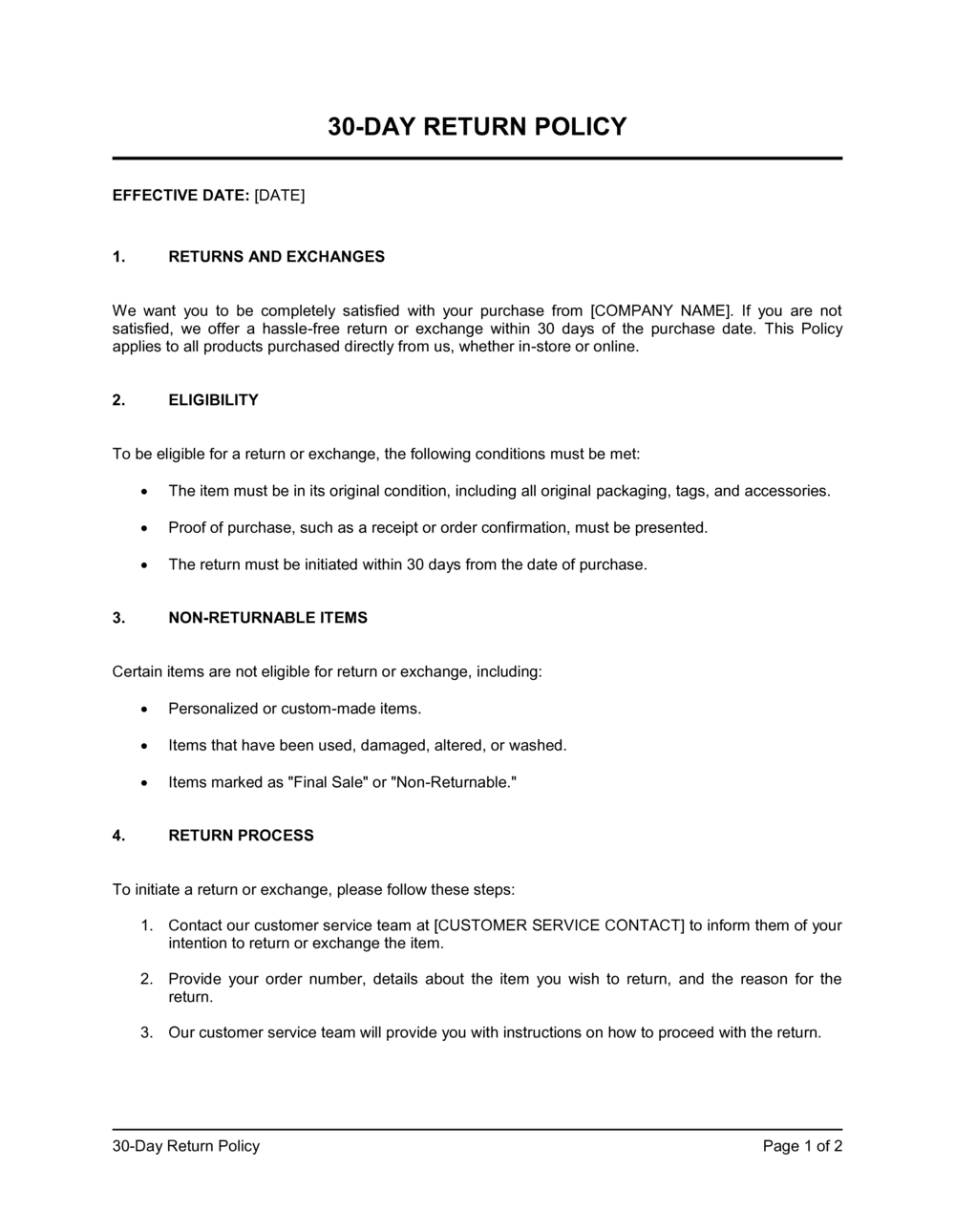
A 30 Day Return Policy is a written operational document that defines the conditions under which customers may return products or cancel services within 30 days of purchase and receive a refund, exchange, or store credit. This free Word download gives you a structured, customer-ready policy you can edit online and publish to your website, include in your order confirmation emails, or post at your point of sale.
When you need it
Use it when launching a new retail or e-commerce store, updating outdated return procedures, or responding to a pattern of disputed returns that an informal policy cannot resolve. Any business selling physical goods or subscription services to consumers benefits from having this document in place before the first sale.
What's inside
Eligibility criteria and the 30-day window definition, acceptable product condition requirements, step-by-step return instructions, refund methods and timelines, exchange and store-credit options, non-returnable item categories, defective and damaged goods handling, and contact information for return requests.

What is a 30 Day Return Policy?

A 30 Day Return Policy is a written operational document that specifies the conditions under which customers may return products within 30 days of purchase or delivery and receive a refund, exchange, or store credit. It defines the return window, eligibility criteria, non-returnable item categories, step-by-step return instructions, refund methods and timelines, and the process for defective or damaged goods. Rather than leaving return decisions to individual staff judgment, the policy creates a consistent, documented standard that applies to every transaction across every sales channel.

Why You Need This Document

Selling without a written return policy exposes your business on three fronts simultaneously. First, customers who cannot find clear return terms are more likely to file a chargeback with their bank rather than contacting you β€” and without a documented, acknowledged policy, card networks almost always rule in the customer's favor. Second, inconsistent ad-hoc return decisions create staff friction, inventory tracking errors, and liability when one customer receives a refund another was denied. Third, several jurisdictions β€” including California, New York, the EU, and major platforms like Amazon β€” require a publicly posted return policy, and operating without one risks fines or seller account suspension. A clearly written 30-day return policy, linked from your checkout page and acknowledged at purchase, is your most cost-effective protection against disputes, chargebacks, and the operational chaos of undocumented returns.

Which variant fits your situation?

If your situation is…Use this template
Selling exclusively physical goods with no digital component30 Day Return Policy (Physical Goods)
Selling software, downloads, or digital productsNo-Refund Policy (Digital Products)
Offering a longer satisfaction guarantee to compete on trust60 Day Return Policy
Running a subscription or SaaS business with recurring billingCancellation and Refund Policy
Operating a fashion or apparel brand with high return volumesApparel Return and Exchange Policy
Selling through a third-party marketplace with platform-specific rulesMarketplace Seller Return Policy
Managing warranty claims alongside standard returnsProduct Warranty and Return Policy

Common mistakes to avoid

❌ Starting the 30-day window at purchase rather than delivery

Why it matters: Customers who order online and wait two weeks for delivery have effectively only 16 days to evaluate the product. This creates disputes, negative reviews, and chargeback claims that a simple wording change eliminates.

Fix: Define the window as 30 days from the confirmed delivery date, and use shipping carrier tracking confirmation as the clock-start event.

❌ No list of non-returnable items

Why it matters: Without explicit exclusions, staff must make ad-hoc decisions on opened products, final-sale items, and hygiene goods β€” leading to inconsistent outcomes, staff friction, and customers gaming the policy.

Fix: Add a named exclusion list before publishing. Review it quarterly as your product catalog changes and add new categories before they generate disputes.

❌ Vague refund timeline with no bank processing disclosure

Why it matters: Publishing '5 business days' without noting the additional 3–10 days for the bank to post the credit causes a flood of 'where is my refund?' contacts and triggers premature chargebacks.

Fix: State the internal processing time and the bank posting window separately: 'We process refunds within 5 business days of receiving your return. Allow 3–10 additional business days for the credit to appear on your statement.'

❌ Routing defective items through the standard return process

Why it matters: Asking a customer to pay return shipping and wait for an RMA when the product arrived broken is a seller-fault scenario β€” doing so reliably produces chargebacks and public negative reviews.

Fix: Create a distinct, expedited defective-item path: free return label, no RMA wait, and a 1-business-day response commitment. This resolves the issue before the customer escalates to their bank.

The 9 key sections, explained

Policy overview and scope

Eligibility criteria

Non-returnable items

How to initiate a return

Return shipping instructions

Refund processing and timeline

Exchanges and store credit

Defective, damaged, and incorrect items

Contact information and escalation

How to fill it out

  1. 1

    Define your return window start date

    Choose whether the 30-day window runs from the purchase date, the ship date, or the delivery date. For e-commerce, delivery date is strongly recommended since customers cannot evaluate what they have not received.

    πŸ’‘ For items with long delivery windows (international shipping or custom orders), consider a 30-day window from delivery confirmation rather than the order date.

  2. 2

    List your non-returnable item categories

    Identify every product category your business sells that cannot be resold once opened or returned β€” perishables, hygiene items, digital content, customized products, and final-sale clearance. List them explicitly in the non-returnable section.

    πŸ’‘ If you sell across multiple categories, group non-returnable items by reason (health and safety, digital delivery, final sale) to help customers understand the logic rather than feeling it is arbitrary.

  3. 3

    Set your return shipping responsibility rule

    Decide whether customers pay return shipping on all returns, only on non-defective returns, or never. Document this rule clearly in the return shipping section and apply it consistently.

    πŸ’‘ Offering free return labels for defective items but not for change-of-mind returns is a widely accepted standard that balances cost control with customer goodwill.

  4. 4

    Specify the refund method and processing timeline

    State whether refunds go back to the original payment method, store credit, or check. Enter your actual internal processing time (e.g., 3–5 business days after receipt) and add the bank processing window (3–10 additional days) so customers have accurate expectations.

    πŸ’‘ Do not quote the best-case timeline as your standard β€” if your warehouse processes returns in 1–2 days on a good week but 5 days when volume spikes, quote 5 days.

  5. 5

    Add your RMA and return address details

    Fill in the specific return mailing address (which may differ from your business address), the process for requesting an RMA number, and whether a packing slip or form must be included in the return package.

    πŸ’‘ If you use a third-party fulfillment center, confirm the return address with your 3PL before publishing β€” sending customers to the wrong address is a costly operational error.

  6. 6

    Customize the defective-item handling section

    Enter the email address, response time commitment, and photo documentation requirements for defective or damaged item claims. Make clear that this is a separate, expedited process from standard returns.

    πŸ’‘ A dedicated defective-item email address (e.g., defects@yourbrand.com) routes these higher-urgency cases away from general support queues and cuts resolution time.

  7. 7

    Publish the policy and link it from key touchpoints

    Once finalized, publish the policy on a dedicated page on your website and link to it from your homepage footer, product pages, cart page, and order confirmation email. For physical retail, post it at the register.

    πŸ’‘ Your checkout flow should require customers to acknowledge the return policy before completing a purchase β€” this acknowledgment is your strongest defense against unjustified chargebacks.

Frequently asked questions

What should a 30-day return policy include?

A complete 30-day return policy covers: the return window definition (when the 30 days starts), item eligibility requirements, a list of non-returnable categories, step-by-step return initiation instructions, return shipping responsibility, refund methods and processing timelines, exchange and store-credit options, and a separate process for defective or damaged items. Policies that omit any of these sections routinely generate disputes that the document was supposed to prevent.

Is a 30-day return policy required by law?

In the US, federal law does not mandate a specific return period, but the FTC's Mail, Internet, or Telephone Order Merchandise Rule requires sellers to fulfill orders within stated timeframes or offer cancellation. Several US states (including California, New York, and Florida) require posted return policies in retail settings. The EU's Consumer Rights Directive mandates a minimum 14-day return window for online purchases. A 30-day policy meets or exceeds most statutory minimums and should be reviewed for the specific jurisdictions where you sell.

Should the 30-day window start at purchase or delivery?

For e-commerce, the window should start at confirmed delivery, not purchase date. A customer who orders on day one and receives the product on day 16 would have only 14 days to evaluate and return β€” functionally half the window you advertised. Using delivery confirmation as the start date is both fairer to customers and defensible in chargeback disputes. For in-store retail, the purchase date is an acceptable starting point since the customer takes possession immediately.

Who pays for return shipping?

The standard practice for non-defective, change-of-mind returns is for the customer to cover return shipping. For defective, damaged, or incorrect items, the seller should cover return shipping since the error is on the seller's side. Some businesses offer free returns as a competitive differentiator β€” this increases return rates but can boost conversion rates enough to offset the cost. Whichever rule you choose, state it explicitly in the policy.

Can I charge a restocking fee?

Yes, restocking fees are generally permissible in most jurisdictions provided they are disclosed to the customer before purchase. Common restocking fees range from 10–25% of the item price and are typically applied to large or heavy items, electronics, or opened goods. Fees should not apply to defective or incorrect items. Some states and platforms (notably Amazon) restrict or prohibit restocking fees for certain categories, so check applicable rules before adding one.

What items should be excluded from a 30-day return policy?

Common non-returnable categories include perishable goods, opened personal care and hygiene products, digital downloads and software licenses once activated, customized or personalized items, gift cards, and items explicitly marked as final sale at checkout. Hazardous materials, intimate apparel, and swimwear are also frequently excluded for health and safety reasons. List your exclusions explicitly β€” a vague "some items may not be eligible" clause provides no real protection.

How is a return policy different from a refund policy?

A return policy governs the physical process of sending a product back β€” eligibility, condition requirements, RMA procedures, and shipping instructions. A refund policy governs what the customer receives after the return is processed β€” the refund method, amount, and timeline. In practice, most businesses combine both into a single document. Keeping them clearly organized within that document β€” with a dedicated section for each β€” prevents customer confusion about whether a return automatically results in a full monetary refund.

Do I need a different return policy for digital products?

Yes. Digital products β€” downloads, software licenses, online courses, and SaaS subscriptions β€” cannot be physically returned and cannot be re-sold once accessed. Most businesses either exclude digital products from their standard return policy entirely or offer a limited satisfaction guarantee (e.g., 7-day no-questions-asked refund before the course is more than 20% complete). Clearly marking digital purchases as non-refundable at checkout, and obtaining customer acknowledgment, is the most defensible approach.

How does a return policy reduce chargebacks?

A clearly written and prominently displayed return policy is your primary defense against chargebacks. When a customer files a dispute with their bank rather than contacting you first, card networks review whether the merchant had a disclosed policy and whether the customer acknowledged it. A policy linked from your checkout page with a mandatory acknowledgment checkbox gives you documented evidence to contest the chargeback. Without a written policy, the bank almost always sides with the customer.

How this compares to alternatives

vs Refund Policy

A refund policy specifies what compensation a customer receives after a return is approved β€” method, amount, and timeline. A return policy governs the eligibility and logistics of physically sending the product back. Most businesses combine both in one document, but the return section and refund section should be organized separately to avoid customer confusion about whether initiating a return guarantees a full monetary refund.

vs Terms and Conditions

Terms and conditions is a comprehensive legal document governing all aspects of the customer relationship β€” intellectual property, liability limits, dispute resolution, and acceptable use. A return policy is a focused operational document on one specific post-purchase process. The return policy is typically referenced within the terms and conditions but functions as a standalone customer-facing document.

vs Warranty Policy

A warranty policy covers manufacturer or seller obligations for product defects over a defined period β€” often 90 days to one year β€” and may require repair or replacement rather than a refund. A return policy covers change-of-mind returns and short-window dissatisfaction within 30 days. Both may apply to a defective item; the return policy provides the faster resolution path while the warranty policy governs longer-term claims.

vs Exchange Policy

An exchange policy is a subset of a return policy focused specifically on replacing one item with another rather than issuing a refund. A full 30-day return policy typically incorporates exchange procedures as one section rather than treating them as a separate document. A standalone exchange policy makes sense for businesses that offer exchanges but not monetary refunds β€” such as final-sale apparel retailers.

Industry-specific considerations

Retail and e-commerce

High SKU volumes across multiple categories require explicit non-returnable lists and RMA workflows that scale without manual intervention for every return.

Consumer electronics

Opened-box and serial-number tracking requirements mean return policies must address software activation, accessories completeness, and restocking fee disclosures for opened units.

Apparel and fashion

High return rates (often 20–40%) make return shipping cost allocation and exchange-for-size procedures the central operational concern, with hygiene exclusions for swimwear and undergarments.

Food and beverage

Perishable goods are generally non-returnable, so the policy focuses on damaged-in-transit and incorrect-order resolutions rather than standard customer-initiated returns.

Template vs pro β€” what fits your needs?

PathBest forCostTime
Use the templateSmall to mid-size retailers, e-commerce stores, and marketplace sellers needing a professional policy without legal overheadFree30–60 minutes to customize and publish
Template + professional reviewBusinesses selling in multiple countries, high-ticket items, or categories with regulatory return requirements$150–$400 for a one-hour attorney or compliance consultant review1–3 days
Custom draftedEnterprise retailers, businesses with complex supply chains, or sellers subject to FTC, EU Consumer Rights Directive, or platform-specific compliance audits$500–$2,000+1–2 weeks

Glossary

Return Window
The number of days after purchase during which a customer is eligible to initiate a return β€” in this policy, 30 calendar days.
Restocking Fee
A percentage of the purchase price deducted from the refund to cover the cost of inspecting, repackaging, and re-shelving a returned item.
RMA (Return Merchandise Authorization)
A reference number issued by the seller that authorizes and tracks a specific return shipment before the item is sent back.
Original Condition
The requirement that returned items be unused, unaltered, and in the same state as when sold β€” typically with original tags, packaging, and accessories.
Store Credit
A non-cash refund issued as credit toward future purchases, often used as an alternative to a monetary refund.
Defective Item
A product that arrives broken, malfunctions on first use, or does not match its description β€” typically eligible for a full refund or replacement regardless of standard return conditions.
Final Sale
A purchase explicitly designated as non-returnable and non-refundable at the time of sale, often applied to clearance, perishable, or hygiene items.
Refund Method
The form in which a refund is issued β€” original payment method, store credit, check, or exchange β€” and the timeframe for the credit to appear.
Return Shipping Responsibility
The policy rule that determines whether the customer or the seller pays for shipping costs associated with returning an item.
Proof of Purchase
Documentation β€” receipt, order confirmation, or packing slip β€” required to verify the transaction date and eligibility for a return.

Part of your Business Operating System

This document is one of 3,000+ business & legal templates included in Business in a Box.

  • Fill-in-the-blanks β€” ready in minutes
  • 100% customizable Word document
  • Compatible with all office suites
  • Export to PDF and share electronically

Create your document in 3 simple steps.

From template to signed document β€” all inside one Business Operating System.
1
Download or open template

Access over 3,000+ business and legal templates for any business task, project or initiative.

2
Edit and fill in the blanks with AI

Customize your ready-made business document template and save it in the cloud.

3
Save, Share, Send, Sign

Share your files and folders with your team. Create a space of seamless collaboration.

Save time, save money, and create top-quality documents.

β˜…β˜…β˜…β˜…β˜…

"Fantastic value! I'm not sure how I'd do without it. It's worth its weight in gold and paid back for itself many times."

Managing Director Β· Mall Farm
Robert Whalley
Managing Director, Mall Farm Proprietary Limited
β˜…β˜…β˜…β˜…β˜…

"I have been using Business in a Box for years. It has been the most useful source of templates I have encountered. I recommend it to anyone."

Business Owner Β· 4+ years
Dr Michael John Freestone
Business Owner
β˜…β˜…β˜…β˜…β˜…

"It has been a life saver so many times I have lost count. Business in a Box has saved me so much time and as you know, time is money."

Owner Β· Upstate Web
David G. Moore Jr.
Owner, Upstate Web

Run your business with a system β€” not scattered tools

Stop downloading documents. Start operating with clarity. Business in a Box gives you the Business Operating System used by over 250,000 companies worldwide to structure, run, and grow their business.

Start freeΒ Β·Β No credit card required