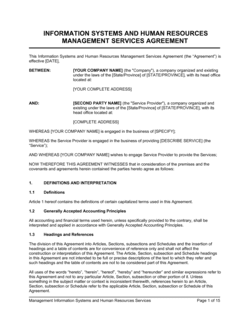
Implementing Business Systems Template

Free Word download • Edit online • Save & share with Drive • Export to PDF

3 pages25–30 min to fillDifficulty: StandardSignature requiredLegal review recommended
Learn more ↓
FreeImplementing Business Systems Template

At a glance

What it is
An Implementing Business Systems agreement is a legally binding contract between a client organization and a systems integrator or technology vendor that governs the planning, configuration, deployment, and handover of a business software or operational system. This free Word download gives you a structured, professionally drafted starting point you can edit online and export as PDF to share with counterparties, legal counsel, or procurement teams.
When you need it
Use it any time a vendor or consultant will design, install, configure, or deploy a business system — such as an ERP, CRM, HRIS, or custom software platform — within your organization. It is especially critical when the engagement spans multiple phases, involves data migration, or requires ongoing post-launch support.
What's inside
Scope of work and project milestones, acceptance testing criteria, IP ownership and licensing, data migration responsibilities, confidentiality obligations, limitation of liability, change-order procedures, and post-implementation support and maintenance terms.

What is an Implementing Business Systems Agreement?

An Implementing Business Systems Agreement is a legally binding contract between a client organization and a technology vendor or systems integrator that governs every phase of a system deployment engagement — from initial discovery and configuration through data migration, acceptance testing, go-live, and post-launch support. Unlike a simple statement of work or a project proposal, it creates enforceable obligations on both sides: the vendor to deliver defined outputs by specific milestones, and the client to provide access, data, and timely approvals that enable the project to proceed. The agreement typically covers scope of work, IP ownership, milestone payment conditions, acceptance testing criteria, data security, limitation of liability, change-order procedures, and post-implementation SLA terms — all in a single governing document.

Why You Need This Document

Without a written implementation agreement, three categories of dispute are nearly guaranteed on any significant system deployment. First, scope creep goes undocumented — vendors perform work they cannot invoice, or clients receive surprise charges for tasks they assumed were included, with no written record to resolve the disagreement. Second, IP ownership defaults to the vendor in most common-law jurisdictions, meaning a client who paid six figures to build a custom integration may have no right to modify it without the vendor's permission. Third, post-go-live support falls back to goodwill rather than obligation — exactly when the client's dependency on the system is highest and their bargaining power is lowest. A properly executed implementation agreement closes all three gaps before the project starts, when both parties have maximum flexibility to negotiate. This template gives you a structured, professionally drafted starting point that addresses every critical term — so you can protect your investment, manage your data responsibly, and hold all parties accountable to a clear and measurable definition of success.

Which variant fits your situation?

If your situation is…Use this template
Deploying a large-scale ERP across multiple business unitsImplementing Business Systems (Enterprise ERP)
Engaging a consultant for CRM configuration onlyIT Consulting Agreement
Commissioning fully custom software development alongside implementationSoftware Development Agreement
Ongoing managed IT services after go-liveIT Services Agreement
Engaging an independent contractor for system configuration tasksIndependent Contractor Agreement
Licensing third-party software as part of the implementationSoftware License Agreement
Migrating data from a legacy system to a new platformData Migration Services Agreement

Common mistakes to avoid

❌ No written change-order process

Why it matters: Implementation projects routinely expand in scope. Without a written change-order requirement, vendors perform undocumented work and clients receive surprise invoices — or vendors refuse to complete work because they were never formally authorized.

Fix: Include an explicit clause stating that no out-of-scope work may be performed or billed without a signed Change Order, and define a maximum turnaround time for change-order approvals.

❌ Payment tied to delivery rather than acceptance

Why it matters: Releasing milestone payments on delivery rather than successful acceptance testing leaves the client with no financial leverage to compel remediation of non-conforming deliverables.

Fix: Structure every milestone payment to be conditional on a signed acceptance certificate, and give the client a defined cure period — typically 15 business days — to identify defects before payment is due.

❌ No IP assignment clause for custom developments

Why it matters: In most common-law jurisdictions, IP created by an independent vendor remains with the vendor unless explicitly assigned. A client who paid $500,000 to build a custom integration may have no right to modify or transfer it without the vendor's permission.

Fix: Include an explicit IP assignment for all custom work product developed exclusively for the client, with a carve-out licensing the vendor's pre-existing tools on a perpetual basis.

❌ Omitting post-go-live support and SLA terms

Why it matters: Without contracted support terms, clients are at the mercy of the vendor's goodwill after go-live — when the client's bargaining power is at its lowest and the cost of system downtime is at its highest.

Fix: Negotiate and attach a post-implementation SLA before the contract is signed. Minimum acceptable terms: 4-hour response for P1 issues, 99.5% uptime, and 12 months of hypercare support.

❌ Single go-live deadline with no intermediate milestones

Why it matters: A single deadline gives the client no early warning mechanism and no contractual leverage until the entire project has collapsed. Delays that surface at month eleven of a twelve-month project are nearly impossible to recover from.

Fix: Break the project into at least four milestone phases, each with a target date, acceptance criteria, and a linked milestone payment. Include a delay-credit mechanism for missed milestones beyond a defined grace period.

❌ Unlimited or uncapped liability

Why it matters: An implementation agreement without a liability cap exposes the vendor to potentially ruinous claims — and many competent vendors will refuse to sign. Conversely, a cap set at one month's fees on a $2M project leaves the client with no meaningful remedy for a failed deployment.

Fix: Set a liability cap proportionate to the total contract value — typically 100% of total fees paid in the preceding 12 months — and carve out specific exclusions such as IP infringement, gross negligence, and data breaches.

The 10 key clauses, explained

Parties, recitals, and definitions

In plain language: Identifies the client and the implementing vendor or integrator as legal entities, states the commercial context, and defines key terms used throughout the agreement.

Sample language
This Implementing Business Systems Agreement ('Agreement') is entered into on [DATE] between [CLIENT LEGAL NAME], a [STATE/PROVINCE] [ENTITY TYPE] ('Client'), and [VENDOR LEGAL NAME], a [STATE/PROVINCE] [ENTITY TYPE] ('Vendor'). Capitalized terms have the meanings set out in Schedule A.

Common mistake: Using trade names instead of registered legal entity names. If the contracting entity differs from the operating brand, enforcing payment or IP clauses against the correct party becomes legally complicated.

Scope of work and statement of work

In plain language: Defines precisely what the vendor will deliver — phases, system components, configurations, integrations, and exclusions — by reference to a detailed Statement of Work schedule.

Sample language
Vendor shall perform the implementation services described in Schedule B (Statement of Work), including [PHASE 1: DISCOVERY], [PHASE 2: CONFIGURATION], [PHASE 3: TESTING], and [PHASE 4: GO-LIVE], subject to the timelines set out therein. Services not listed in Schedule B are excluded unless added by a signed Change Order.

Common mistake: Describing scope in the contract body rather than a separate schedule. Embedding scope in the contract makes updates require a full contract amendment rather than a simple schedule revision.

Project milestones and timeline

In plain language: Sets the key dates by which each project phase must be completed, the dependencies between phases, and the consequences — delay credits or termination rights — for material missed deadlines.

Sample language
Vendor shall complete each milestone by the dates in Schedule C. If Vendor misses a milestone by more than [10] business days without a mutually agreed extension, Client may elect a daily delay credit of [X]% of the applicable milestone fee, up to [X]% of the total contract value.

Common mistake: Setting a single go-live date with no intermediate milestones. A single-date structure gives the client no early warning of a slipping project and no contractual leverage until the entire engagement has failed.

Acceptance testing and sign-off

In plain language: Defines the criteria, process, and timeline for the client to formally test and accept each deliverable, and establishes what happens if a deliverable fails testing.

Sample language
Within [10] business days of Vendor's notice of completion, Client shall perform acceptance testing against the criteria in Schedule D. Client shall either issue a written acceptance certificate or deliver a defect notice itemizing non-conformances. Vendor shall remedy material defects within [15] business days.

Common mistake: No written acceptance process at all — payment is released on delivery rather than acceptance. Vendors bill for work the client later disputes as non-conforming, leading to withheld payments and disputes with no contractual resolution path.

Fees, payment schedule, and change orders

In plain language: States the total contract price, the milestone-based payment schedule, invoicing process, and the procedure for pricing and approving changes to scope.

Sample language
Client shall pay the fees in Schedule E, totaling $[AMOUNT], on the milestone schedule therein. All invoices are due within [30] days of receipt. Any change to scope must be documented in a Change Order signed by both parties before Vendor commences additional work. Vendor is not obligated to perform, and Client is not obligated to pay for, out-of-scope work absent a signed Change Order.

Common mistake: No change-order clause, or a clause that allows verbal change approvals. Scope creep on implementation projects is almost universal — without a written change-order requirement, vendors perform additional work they cannot bill and clients receive surprises on invoices.

Intellectual property ownership and licensing

In plain language: Determines who owns custom code, configurations, integrations, and documentation produced during the engagement, and what rights each party has to use or sublicense them.

Sample language
All custom developments created exclusively for Client under this Agreement ('Custom IP') are hereby assigned to Client upon full payment. Vendor retains ownership of its pre-existing tools, frameworks, and methodologies ('Vendor IP') and grants Client a perpetual, non-exclusive license to use Vendor IP solely as embedded in the deliverables.

Common mistake: No IP clause at all, leaving ownership governed by jurisdiction-specific defaults. In most common-law jurisdictions, IP created by an independent contractor remains with the contractor unless explicitly assigned — meaning the client may not own the system it just paid to build.

Data migration, security, and confidentiality

In plain language: Governs the vendor's obligations when handling the client's existing data — accuracy, security controls, breach notification, and restrictions on use of client data outside the project.

Sample language
Vendor shall implement and maintain commercially reasonable security measures for all Client Data accessed during migration. Vendor shall notify Client within [48] hours of discovering any unauthorized access to Client Data. Client Data shall not be used by Vendor for any purpose other than performing the services under this Agreement.

Common mistake: A generic confidentiality clause that does not specifically address data migration. Without explicit data-handling obligations, the vendor's security standards, breach notification timeline, and data-deletion obligations after go-live are all undefined.

Limitation of liability and indemnification

In plain language: Caps each party's maximum financial exposure to the other, excludes consequential and indirect damages, and sets out indemnification obligations for third-party IP claims.

Sample language
Each party's total aggregate liability to the other under this Agreement shall not exceed the total fees paid or payable in the [12] months preceding the claim. Neither party is liable for indirect, consequential, or incidental damages. Vendor shall indemnify Client against third-party claims that the deliverables infringe any intellectual property right.

Common mistake: An unlimited liability clause — or a clause with a cap so low (e.g., one month's fees) that it provides no meaningful protection on a multi-year ERP project. Caps should be proportionate to the contract value and the realistic downside of a failed implementation.

Termination, suspension, and transition assistance

In plain language: States the grounds and notice requirements for terminating the agreement early, the consequences of termination (fees, deliverable ownership), and the vendor's obligation to assist with transition to a successor.

Sample language
Either party may terminate this Agreement on [30] days' written notice for material breach if the breach remains uncured after [15] days' notice. Upon termination, Vendor shall deliver all completed work product and Client Data within [10] business days and provide up to [60] days of transition assistance at Vendor's standard hourly rates.

Common mistake: No transition-assistance clause. If a client terminates a vendor mid-project, the client is left holding an incomplete system with no contractual right to assistance handing it off to a new implementer.

Post-implementation support and SLA

In plain language: Defines the support tier, response times, uptime commitments, and maintenance scope the vendor provides after go-live, typically in an attached SLA schedule.

Sample language
For [12] months following the Go-Live Date, Vendor shall provide Level [2] support as described in Schedule F, including a [4]-hour response time for Priority 1 issues and [99.5]% uptime for Vendor-hosted components. Failure to meet SLA targets entitles Client to service credits as specified in Schedule F.

Common mistake: Omitting post-go-live support terms from the implementation contract and treating them as a separate future negotiation. Vendors have maximum leverage at project kickoff — securing support terms then produces better outcomes than negotiating after the system is live and the client is dependent.

How to fill it out

  1. 1

    Identify both parties with their full legal entity names

    Enter the registered corporate names — not trade names or DBAs — of both the client organization and the implementing vendor. Include entity type (LLC, Inc., Ltd.) and jurisdiction of incorporation.

    💡 Verify the vendor's registered name against their state or Companies House filing before signing — mismatched names create enforcement complications.

  2. 2

    Attach a detailed statement of work as Schedule B

    Draft or import a scope document that lists every project phase, deliverable, system component, and explicit exclusion. Reference it in the contract body rather than embedding scope in the main text.

    💡 Include a one-line exclusion list — 'the following are out of scope' — to prevent future scope disputes over items neither party consciously considered.

  3. 3

    Define project milestones and go-live date in Schedule C

    List each phase with a target completion date, the dependencies that gate it, and the acceptance criteria that mark it complete. Tie each milestone to a payment in Schedule E.

    💡 Build at least two weeks of buffer before the contractual go-live date. Client-side delays — data cleanup, stakeholder training, procurement approvals — are the most common cause of missed go-live dates.

  4. 4

    Set acceptance testing criteria in Schedule D

    Define objective, measurable pass/fail criteria for each deliverable — response time thresholds, error rates, feature checklists — not subjective satisfaction standards.

    💡 Agree on testing criteria before the project starts, not after delivery. Vendors who define acceptance criteria at delivery tend to write them to match what they built.

  5. 5

    Complete the fee schedule and payment milestones

    Enter the total contract value, allocate fees across milestones (typically 10–20% on signature, 60–70% across phases, 10–20% on final acceptance), and state invoice-due dates.

    💡 Never front-load more than 30% of the total fee before any deliverable is accepted. Milestone-gated payments are the client's primary contractual leverage throughout the project.

  6. 6

    Specify IP ownership and licensing terms

    Decide whether custom developments are assigned to the client, licensed back to the vendor, or jointly owned. Document vendor pre-existing IP that will be embedded in deliverables and the license scope for each.

    💡 If the vendor's proprietary framework is core to the system, negotiate a source-code escrow at signing — not after go-live, when the vendor has no incentive to agree.

  7. 7

    Fill in data migration and security obligations

    Specify which data sets will be migrated, who is responsible for data cleansing, acceptable error tolerances, and the timeline for legacy data deletion after go-live.

    💡 Require the vendor to provide a written data migration test report before go-live, not just a verbal confirmation that migration was successful.

  8. 8

    Attach the post-implementation SLA as Schedule F

    Define support tiers, response-time targets by priority level, uptime commitments for hosted components, and the service-credit formula for SLA breaches.

    💡 Negotiate at least 12 months of hypercare support at the same SLA level as the implementation phase — the most critical issues surface in the first 90 days post-go-live.

Frequently asked questions

What is an implementing business systems agreement?

An implementing business systems agreement is a legally binding contract between a client organization and a technology vendor or systems integrator that governs the planning, configuration, deployment, and handover of a business software or operational system. It defines the scope of work, project milestones, acceptance testing criteria, IP ownership, data migration responsibilities, payment terms, and post-implementation support. It replaces informal project proposals or statements of work as the authoritative governing document for the engagement.

When do I need an implementing business systems agreement?

You need one any time a third party will deploy, configure, or integrate a business system on your behalf — including ERP, CRM, HRIS, payroll, e-commerce, or custom software implementations. The agreement is especially critical when the engagement spans multiple phases, involves migrating sensitive data from a legacy system, or includes ongoing post-launch support. Without it, scope, IP ownership, and payment obligations are governed only by informal emails and proposals.

Who owns the custom code and configurations built during the implementation?

Ownership depends entirely on what the contract says. In most common-law jurisdictions, IP created by an independent vendor remains with the vendor unless the contract includes an explicit assignment clause. Clients who do not address IP ownership in the agreement may find they have no right to modify, transfer, or sublicense the system they paid to build. Always include an IP assignment for custom work product and a clear license for any vendor pre-existing tools embedded in the deliverables.

What is acceptance testing and why does it matter?

Acceptance testing is the formal process by which the client verifies that each delivered system component meets the agreed functional and performance criteria before approving it — and, critically, before releasing milestone payments. Without a defined acceptance process, clients lose their primary contractual leverage to require remediation of defective deliverables. Acceptance criteria should be objective and measurable — response times, error rates, feature checklists — not subjective satisfaction standards.

How should fees and payments be structured in this type of agreement?

Milestone-based payment is the standard structure for implementation agreements. A typical allocation is 10–20% on contract signature, 60–70% spread across project phase milestones tied to accepted deliverables, and 10–20% on final go-live acceptance. Front-loading more than 30% of the total fee before any deliverable is accepted significantly reduces the client's leverage. Each payment should be conditional on a signed acceptance certificate, not merely on delivery.

What happens if the vendor misses the go-live deadline?

The contract should specify the consequences explicitly. Common remedies include daily or weekly delay credits — typically a percentage of the applicable milestone fee — credited against future invoices, escalating to a right to terminate for cause if the delay exceeds a defined threshold. Without a written delay remedy, the client's only recourse is a general breach claim, which requires proving actual damages — difficult and expensive in practice.

Does this agreement need to be reviewed by a lawyer?

For straightforward small-scale implementations, a well-drafted template is a sound starting point. Legal review is strongly recommended when the total contract value exceeds $100,000, the implementation involves sensitive personal or financial data subject to GDPR, HIPAA, or PCI-DSS, the vendor is in a different jurisdiction, or the agreement includes significant IP development. A 2–4 hour attorney review typically costs $600–$1,200 and is proportionate on any mid-to-large implementation project.

What is a change order and why is it important?

A change order is a written, signed amendment to the original scope of work that documents any additions, removals, or modifications to deliverables and their impact on cost and timeline. Implementation scope creep is nearly universal — client requirements evolve, data is messier than expected, and integrations are more complex than scoped. A change-order clause ensures every deviation from the original SOW is formally documented and priced before work begins, preventing invoice disputes and uncompensated overruns on both sides.

What post-implementation support terms should I include?

At minimum, define the support tier (Level 1–3), response times by priority level (e.g., 4-hour response for P1 production outages), uptime targets for any vendor-hosted components (typically 99.5% or higher), the duration of post-go-live hypercare (at least 90 days), and the service-credit formula for SLA breaches. Negotiate these terms before signing the implementation contract — vendors have maximum flexibility at the outset of the engagement and far less incentive to agree once the system is live and the client is dependent on it.

How does this agreement differ from a software license agreement?

A software license agreement grants the client the right to use an existing software product under defined terms — it does not cover the work of configuring, integrating, or deploying it. An implementing business systems agreement covers the professional services engagement to stand the system up, including scope, milestones, data migration, and acceptance testing. Complex technology projects typically require both: a license agreement for the underlying platform and an implementation agreement for the deployment services.

How this compares to alternatives

vs IT Services Agreement

An IT services agreement covers ongoing managed services — help desk, maintenance, monitoring — for systems already in production. An implementing business systems agreement is project-specific, governing a defined deployment from kickoff to go-live. Use an implementation agreement for the deployment phase and an IT services agreement for the support arrangement that follows.

vs Software Development Agreement

A software development agreement governs the creation of custom software from scratch, with a focus on code ownership, development methodology, and version control. An implementing business systems agreement covers the configuration and deployment of existing or partially existing platforms. When an engagement involves both custom development and deployment, both agreements may be needed — or a single agreement with combined provisions.

vs Consulting Agreement

A consulting agreement governs advisory services — strategy, recommendations, analysis — without binding deliverable acceptance or go-live obligations. An implementing business systems agreement is deliverable-driven, with defined milestones, acceptance testing, and technical hand-off obligations. Use a consulting agreement for advisory-only engagements and an implementation agreement when a vendor is actually building and deploying the system.

vs Software License Agreement

A software license agreement grants the right to use an existing software product and governs usage restrictions, fees, and renewal terms. It does not cover the professional services needed to configure and deploy that product. Most enterprise technology projects require both: a license agreement for the platform and an implementation agreement for the deployment engagement.

Industry-specific considerations

Manufacturing and distribution

ERP implementations covering inventory, production scheduling, and supply chain integration require detailed data-migration obligations and multi-site go-live sequencing built into the agreement.

Financial services and fintech

Regulatory data-handling obligations under SOX, PCI-DSS, and applicable banking laws must be explicitly incorporated by reference, with enhanced breach-notification timelines and audit-access rights for the client.

Healthcare and life sciences

HIPAA Business Associate Agreement requirements must be addressed alongside the implementation terms, with strict data-encryption standards, access controls, and patient-data deletion obligations after go-live.

Retail and e-commerce

Seasonal go-live timing is critical — implementation agreements for retail clients should include a blackout period preventing go-live during peak trading windows and enhanced SLA terms during high-traffic periods.

Jurisdictional notes

United States

Contract law governing technology implementation agreements is primarily state-based; most parties select Delaware, New York, or California as governing law. Data migration clauses must account for applicable state privacy laws — California (CCPA), Virginia (CDPA), and others impose breach notification timelines as short as 72 hours. Limitation-of-liability clauses are generally enforceable but courts in some states scrutinize caps that are disproportionately low relative to foreseeable harm.

Canada

PIPEDA (federal) and provincial privacy laws — including Quebec Law 25, which is among the strictest in North America — impose specific data-handling, breach notification, and consent obligations that must be reflected in data migration clauses. Quebec-regulated entities require contracts in French. Common law governs in all provinces except Quebec, where civil law applies and contract interpretation can differ materially from other provinces.

United Kingdom

UK GDPR and the Data Protection Act 2018 require data processing agreements (DPAs) to be in place before any personal data is migrated or processed — these are typically appended to or incorporated by reference into the implementation agreement. The Unfair Contract Terms Act 1977 and Consumer Rights Act 2015 may limit the enforceability of broadly drafted limitation-of-liability and indemnification clauses depending on the parties' relative bargaining power.

European Union

GDPR Article 28 requires a written data processing agreement with mandatory clauses before any personal data is processed by the vendor — non-compliance can result in fines up to 4% of global annual turnover. Implementation agreements must also address cross-border data transfer mechanisms if the vendor is based outside the EU (Standard Contractual Clauses are the most common mechanism). Member-state contract law varies; Germany, France, and the Netherlands each have jurisdiction-specific considerations for IT services contracts.

Template vs lawyer — what fits your deal?

PathBest forCostTime
Use the templateSmall-to-mid-size implementations under $100,000 with domestic vendors and standard system configurationsFree1–3 hours to complete
Template + legal reviewImplementations involving sensitive data, cross-border vendors, significant custom development, or total fees of $100,000–$500,000$600–$1,500 for a 2–4 hour attorney review3–7 days
Custom draftedEnterprise ERP or core-system deployments over $500,000, regulated industries (healthcare, financial services), or multi-jurisdiction engagements with complex IP structures$3,000–$10,000+2–4 weeks

Glossary

Statement of Work (SOW)
A detailed exhibit attached to the contract that defines the specific tasks, deliverables, timelines, and resources for the implementation project.
Acceptance Testing
A formal process in which the client verifies that each delivered system component meets the agreed functional and performance criteria before approving it.
Change Order
A written amendment to the original scope of work that documents any additions, removals, or modifications to deliverables and their impact on cost and timeline.
Go-Live Date
The contractually agreed date on which the implemented system is activated for live production use by the client organization.
Data Migration
The process of transferring existing records, files, or structured data from a legacy system into the newly implemented platform, as defined in the contract.
Escrow (Source Code)
An arrangement in which a neutral third party holds the vendor's source code, releasing it to the client if the vendor ceases operations or materially breaches the agreement.
Limitation of Liability
A clause capping the maximum financial exposure of either party — typically expressed as the total fees paid in the preceding 12 months — for losses arising from the contract.
Service Level Agreement (SLA)
A schedule defining the minimum performance standards for post-implementation support, including response times, uptime targets, and remedies for breach.
Intellectual Property (IP) Assignment
A clause determining whether custom configurations, integrations, or code developed during the project are owned by the client, the vendor, or jointly licensed.
Force Majeure
A clause excusing a party from performance obligations when a delay or failure is caused by events outside its reasonable control, such as natural disasters or government actions.
Milestone Payment
A payment structure in which fees are released upon verified completion of defined project phases rather than on a fixed calendar schedule.

Part of your Business Operating System

This document is one of 3,000+ business & legal templates included in Business in a Box.

  • Fill-in-the-blanks — ready in minutes
  • 100% customizable Word document
  • Compatible with all office suites
  • Export to PDF and share electronically

Create your document in 3 simple steps.

From template to signed document — all inside one Business Operating System.
1
Download or open template

Access over 3,000+ business and legal templates for any business task, project or initiative.

2
Edit and fill in the blanks with AI

Customize your ready-made business document template and save it in the cloud.

3
Save, Share, Send, Sign

Share your files and folders with your team. Create a space of seamless collaboration.

Save time, save money, and create top-quality documents.

★★★★★

"Fantastic value! I'm not sure how I'd do without it. It's worth its weight in gold and paid back for itself many times."

Managing Director · Mall Farm
Robert Whalley
Managing Director, Mall Farm Proprietary Limited
★★★★★

"I have been using Business in a Box for years. It has been the most useful source of templates I have encountered. I recommend it to anyone."

Business Owner · 4+ years
Dr Michael John Freestone
Business Owner
★★★★★

"It has been a life saver so many times I have lost count. Business in a Box has saved me so much time and as you know, time is money."

Owner · Upstate Web
David G. Moore Jr.
Owner, Upstate Web

Run your business with a system — not scattered tools

Stop downloading documents. Start operating with clarity. Business in a Box gives you the Business Operating System used by over 250,000 companies worldwide to structure, run, and grow their business.

Free Forever Plan · No credit card required