Cession of Priority of Rank Agreement Template

Free Word download • Edit online • Save & share with Drive • Export to PDF

3 pages25–30 min to fillDifficulty: ComplexSignature requiredLegal review recommended
Learn more ↓
FreeCession of Priority of Rank Agreement Template

At a glance

What it is
A Cession of Priority of Rank Agreement is a legally binding contract in which one secured creditor (the ceding party) voluntarily relinquishes its priority position over a specific asset or collateral in favour of another creditor (the beneficiary). This free Word download gives you a structured, professionally drafted starting point you can edit online and export as PDF for execution by all parties.
When you need it
Use it when a senior lender agrees to allow a new or existing lender to take a higher-priority security position over shared collateral — for example, when refinancing real property, restructuring business debt, or bringing in a new secured lender whose funding is conditional on holding first-ranking security.
What's inside
Identification of all creditor parties and the debtor, a precise description of the collateral and the registered security interests affected, the cession and priority-ranking terms, conditions precedent, representations and warranties, governing law, and execution blocks for all parties.

What is a Cession of Priority of Rank Agreement?

A Cession of Priority of Rank Agreement is a legally binding contract in which one secured creditor — the ceding party — voluntarily agrees that another creditor's security interest will take precedence over its own with respect to identified collateral. The ceding creditor does not surrender its security interest; it relinquishes its place in the payment queue, agreeing to be paid from enforcement proceeds only after the beneficiary creditor has been satisfied up to the agreed priority amount. This instrument is the civil-law equivalent of a subordination agreement and is widely used in Quebec, South Africa, and a number of European jurisdictions, as well as in cross-border transactions where parties operating under different legal traditions need a single authoritative document to govern creditor ranking.

Why You Need This Document

Without a properly executed cession of priority of rank agreement, a new or incoming lender has no legally enforceable basis for the first-ranking security position it bargained for — leaving both the transaction at risk of collapse and the beneficiary exposed to the full uncertainty of statutory priority rules if the debtor defaults. For the ceding creditor, an undocumented priority arrangement is equally dangerous: in insolvency proceedings, a trustee or liquidator will apply registered priority order unless a signed, binding agreement to the contrary can be produced. Enforcement disputes between creditors without written priority arrangements are among the most protracted and expensive forms of commercial litigation. This template gives all parties — ceding creditor, beneficiary, and debtor — a complete, executed record of the agreed priority structure, a capped exposure amount, a defined enforcement waterfall, and an automatic restoration mechanism when the arrangement ends, replacing informal side-agreements with a document that will withstand scrutiny in court or in a registry proceeding.

Which variant fits your situation?

If your situation is…Use this template
Full subordination of all rights of one lender to anotherSubordination Agreement
Multiple lenders agreeing on payment waterfall and enforcement rightsIntercreditor Agreement
Landlord agreeing to subordinate lease rights to a mortgage lenderSubordination, Non-Disturbance and Attornment Agreement (SNDA)
Priority shift limited to a specific tranche of real property debtMortgage Postponement Agreement
Creditor agreeing to defer enforcement during a standstill periodStandstill Agreement
Borrower granting a new first-ranking fixed and floating chargeGeneral Security Agreement

Common mistakes to avoid

❌ No cap on the priority amount

Why it matters: An uncapped cession means the ceding creditor subordinates itself to any amount the beneficiary chooses to advance — including future increases the ceding creditor never agreed to. In a worst-case default, the ceding creditor may recover nothing.

Fix: Always specify a maximum priority amount equal to the beneficiary's committed facility limit, and require the ceding creditor's written consent before any increase above that cap.

❌ Omitting the debtor as a party

Why it matters: A cession agreed only between two creditors, without the debtor's acknowledgment, may not bind the debtor's estate in insolvency. A trustee in bankruptcy or liquidator may challenge the arrangement as ineffective against the debtor.

Fix: Always include the debtor as a named party with a signature block, and have the debtor acknowledge the priority arrangement and confirm the status of each security interest.

❌ Choosing governing law inconsistent with collateral location

Why it matters: Security interest priority is generally determined by the lex situs — the law where the collateral is situated. A contract governed by a different jurisdiction's law may be overridden at the point of enforcement, making the priority arrangement unenforceable.

Fix: Confirm the location or registration jurisdiction of all collateral before selecting governing law. If collateral is in multiple jurisdictions, consider separate agreements or a multi-jurisdiction legal opinion.

❌ No notice obligation before enforcement

Why it matters: If the ceding creditor can enforce without notice, the beneficiary may have no opportunity to step in, cure the default, or protect its security position before the collateral is seized or sold.

Fix: Include an express obligation for the ceding creditor to provide written notice — at least 10 business days — before commencing any enforcement action against the collateral covered by this agreement.

❌ No termination and priority-restoration mechanism

Why it matters: Without automatic restoration of the original ranking on repayment of the beneficiary's facility, the ceding creditor may remain technically subordinated even after the deal it agreed to subordinate for has closed out.

Fix: Draft a specific termination clause providing that, upon written confirmation of full repayment and discharge of the beneficiary's security, the ceding creditor's priority is automatically restored to its original registered ranking.

❌ Execution by an unauthorized signatory

Why it matters: A cession signed by a person without board authority or a valid power of attorney can be declared void by a court, leaving both the beneficiary's priority and the ceding creditor's original position in dispute at exactly the moment enforcement is needed.

Fix: Obtain and retain a certified board resolution or current power of attorney for each corporate signatory before execution, and attach certified copies to the original agreement.

The 10 key clauses, explained

Parties and recitals

In plain language: Identifies all parties — the ceding creditor, the beneficiary creditor, and the debtor — and sets out the background facts explaining why the priority shift is being agreed.

Sample language
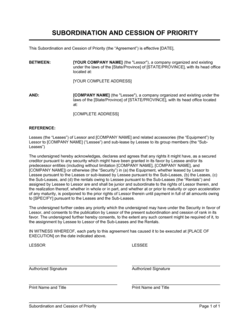
THIS AGREEMENT is made between [CEDING CREDITOR LEGAL NAME] ('Ceding Creditor'), [BENEFICIARY CREDITOR LEGAL NAME] ('Beneficiary'), and [DEBTOR LEGAL NAME] ('Debtor'). WHEREAS, the Ceding Creditor holds a [DESCRIBE SECURITY INTEREST] registered on [DATE] over [COLLATERAL DESCRIPTION]; and the Beneficiary requires first-ranking security over the same collateral as a condition of advancing [FACILITY DESCRIPTION].

Common mistake: Omitting the debtor as a named party. Without the debtor's acknowledgment and consent, the agreement may not bind the debtor's estate in insolvency proceedings, and the debtor may later dispute the priority arrangement.

Description of security interests

In plain language: Precisely identifies each security instrument affected — by registration number, date, amount secured, and the specific collateral — so there is no ambiguity about which interests are being reordered.

Sample language
The Ceding Creditor's Security Interest means the [MORTGAGE / CHARGE / DEBENTURE] registered on [DATE] under registration number [NUMBER] at [LAND REGISTRY / PPSA REGISTRY] securing all amounts owing under the [LOAN AGREEMENT] dated [DATE], up to a maximum of $[AMOUNT]. The Beneficiary's Security Interest means the [MORTGAGE / CHARGE] registered on [DATE] under registration number [NUMBER] securing the [NEW FACILITY AGREEMENT] dated [DATE].

Common mistake: Using general descriptions like 'the first mortgage' without citing registration numbers. Ambiguous collateral descriptions can be challenged during enforcement, delaying recovery and generating costly litigation.

Cession of priority

In plain language: The operative clause in which the ceding creditor formally agrees that the beneficiary's security interest shall rank ahead of its own with respect to the specified collateral, to the extent and amount stated.

Sample language
The Ceding Creditor hereby irrevocably cedes and transfers to the Beneficiary priority of rank over the Collateral, such that the Beneficiary's Security Interest shall rank ahead of the Ceding Creditor's Security Interest to the extent of $[AMOUNT] (the 'Priority Amount'). The Ceding Creditor retains its security interest in the Collateral but agrees that its right to enforcement proceeds shall be subordinate to the Beneficiary's claim up to the Priority Amount.

Common mistake: Failing to specify a maximum priority amount. An uncapped cession can expose the ceding creditor to losses far exceeding the original commercial deal — for example, if the beneficiary's facility is later increased without the ceding creditor's consent.

Conditions precedent

In plain language: Lists the deliverables and events that must occur before the cession takes effect — such as registration of the beneficiary's security interest, delivery of facility documents, and payment of fees.

Sample language
This Agreement shall become effective only upon satisfaction of all of the following conditions: (a) registration of the Beneficiary's Security Interest in the [APPLICABLE REGISTRY] in a form acceptable to the Beneficiary; (b) delivery of a certified copy of the [FACILITY AGREEMENT] to the Ceding Creditor; and (c) payment by the Debtor of all outstanding amounts owing to the Ceding Creditor as at [DATE].

Common mistake: Including no conditions precedent at all. Without them, the cession may take effect before the beneficiary has actually advanced funds or registered its security — giving away priority for nothing.

Representations and warranties

In plain language: Each party confirms the accuracy of their stated security interest, their authority to enter the agreement, and the absence of other undisclosed competing claims over the collateral.

Sample language
Each party represents and warrants that: (a) it has full power and authority to enter into this Agreement; (b) this Agreement constitutes a valid and binding obligation enforceable in accordance with its terms; and (c) there are no undisclosed encumbrances, liens, or competing claims over the Collateral that would affect the priority arrangements set out herein.

Common mistake: Omitting a warranty that no other undisclosed security interests exist. If a third creditor holds a hidden claim that the ceding creditor knew about, the beneficiary may find its supposedly first-ranking security is actually second or third.

Obligations of the ceding creditor

In plain language: Sets out what the ceding creditor must do — and refrain from doing — to preserve the beneficiary's priority position, such as not amending its own security without consent and providing notice of any enforcement action.

Sample language
The Ceding Creditor shall: (a) not amend, extend, or increase the amount secured by the Ceding Creditor's Security Interest without the prior written consent of the Beneficiary; (b) provide the Beneficiary with not less than [X] days' prior written notice before commencing any enforcement action against the Collateral; and (c) promptly notify the Beneficiary of any default by the Debtor under the Ceding Creditor's facility.

Common mistake: No restriction on the ceding creditor increasing its own facility. If the ceding creditor grows the secured amount, it effectively erodes the value of the collateral available to the beneficiary — undermining the entire purpose of the cession.

Proceeds distribution on enforcement

In plain language: Establishes the waterfall for distributing enforcement proceeds — the beneficiary receives its secured amount first, up to the priority amount, and the ceding creditor receives what remains.

Sample language
Upon any enforcement of security over the Collateral, the net proceeds shall be applied in the following order: first, to the Beneficiary in satisfaction of all amounts owing under the Beneficiary's facility up to the Priority Amount; second, to the Ceding Creditor in satisfaction of all amounts owing under the Ceding Creditor's facility; and third, any surplus to the Debtor.

Common mistake: Not addressing costs and expenses of enforcement before the distribution waterfall. Enforcement costs can be material, and if not allocated first, a dispute over who bears them can paralyze the entire recovery process.

Term and termination

In plain language: States when the cession expires — typically when the beneficiary's facility is fully repaid — and the mechanics for restoring the original priority ranking upon termination.

Sample language
This Agreement shall remain in effect until the Beneficiary has confirmed in writing that all amounts owing under the Beneficiary's facility have been repaid in full and the Beneficiary's Security Interest has been discharged. Upon termination, the priority ranking of the Ceding Creditor's Security Interest shall be automatically restored as if this Agreement had never been entered into.

Common mistake: No automatic restoration of priority upon repayment of the beneficiary's facility. Without it, the ceding creditor may need to register a new document or take further steps to recover its original ranking — adding cost and delay.

Governing law and jurisdiction

In plain language: Specifies which jurisdiction's laws govern the agreement and which courts have authority to resolve disputes, which is critical given that security interest priority is largely determined by the lex situs (law of the place where the collateral is located).

Sample language
This Agreement is governed by and shall be construed in accordance with the laws of [JURISDICTION]. Each party irrevocably submits to the exclusive jurisdiction of the courts of [JURISDICTION] in respect of any dispute arising out of or in connection with this Agreement.

Common mistake: Choosing a governing law that differs from the jurisdiction where the collateral is registered. Conflicting governing law and registration jurisdiction creates uncertainty about which priority rules apply — courts may apply the lex situs regardless of what the contract says.

Notice and execution

In plain language: Provides contact details and delivery methods for formal notices between parties, and includes signature blocks for all parties with authority confirmations.

Sample language
Any notice under this Agreement shall be in writing and delivered to: Ceding Creditor: [NAME, ADDRESS, EMAIL]; Beneficiary: [NAME, ADDRESS, EMAIL]; Debtor: [NAME, ADDRESS, EMAIL]. This Agreement may be executed in counterparts, each of which shall constitute an original, and all of which together shall constitute one agreement.

Common mistake: Execution by a signatory without documented authority. If the person who signs does not have board authority or a valid power of attorney, the agreement may be challenged as unauthorized — voiding the priority arrangement at the worst possible moment.

How to fill it out

  1. 1

    Identify and name all parties correctly

    Enter the full registered legal name of the ceding creditor, the beneficiary creditor, and the debtor. For corporate entities, use the exact name as it appears on the certificate of incorporation or registration.

    💡 Cross-reference each party's name against the security registrations — a mismatch between the agreement and the registry entry can create enforceability gaps.

  2. 2

    Describe each security interest precisely

    For every security instrument being reordered, enter the registration number, registration date, the registry where it is filed, the maximum amount secured, and a description of the collateral. Do this for both the ceding creditor's and beneficiary's interests.

    💡 Obtain a current registry search certificate immediately before execution to confirm registrations are exactly as described and no new interests have been registered since the deal was agreed.

  3. 3

    State the priority amount clearly

    Specify the exact dollar amount up to which the beneficiary's claim will rank ahead of the ceding creditor's. This should match the commitment amount in the beneficiary's facility agreement, not an open-ended cap.

    💡 Negotiate a 10–15% buffer above the facility principal to cover accrued interest and enforcement costs — but confirm this is acceptable to the ceding creditor before drafting.

  4. 4

    List all conditions precedent

    Draft a complete checklist of deliverables that must be satisfied before the cession takes effect — registration confirmation, facility agreement delivery, legal opinions if required, and any outstanding debt clearance.

    💡 Assign responsibility and a target date to each condition. An unresolved condition precedent is the most common reason a cession fails to become effective on closing day.

  5. 5

    Define the ceding creditor's ongoing obligations

    Specify exactly what the ceding creditor cannot do without the beneficiary's consent — increasing its facility, amending collateral descriptions, or commencing enforcement — and set the required notice period before any enforcement action.

    💡 Set the enforcement notice period at a minimum of 10 business days to give the beneficiary time to step in and protect its position before the ceding creditor acts.

  6. 6

    Draft the enforcement waterfall

    Write out the exact sequence in which enforcement proceeds will be applied — costs first, then the beneficiary up to the priority amount, then the ceding creditor, then any surplus to the debtor.

    💡 Express each tier in dollar-amount terms alongside percentage-of-proceeds language to eliminate ambiguity when actual enforcement numbers are known.

  7. 7

    Confirm governing law matches collateral location

    Select the governing law of the jurisdiction where the collateral is physically located or registered. For real property, this is the province, state, or country of the land registry. For personal property, apply the jurisdiction of the relevant PPSA or UCC registry.

    💡 If collateral spans multiple jurisdictions, seek legal advice on whether separate cession agreements are needed in each registry jurisdiction.

  8. 8

    Execute with proper authority and retain all counterparts

    Confirm that each signatory has board authorization or a current power of attorney before execution. Use wet-ink or qualified electronic signatures as required by the applicable registry. Retain a fully executed copy and a certified copy of all conditions precedent deliverables.

    💡 Register a notice or notation of the cession agreement against the relevant security registrations immediately after execution where the applicable registry permits it.

Frequently asked questions

What is a cession of priority of rank agreement?

A cession of priority of rank agreement is a legally binding contract in which one secured creditor voluntarily agrees that another creditor's security interest will rank ahead of its own over specified collateral. It does not cancel the ceding creditor's security interest — it simply changes the order in which each creditor will be paid from enforcement proceeds. The arrangement is commonly used in real estate financing and corporate debt restructuring when a new lender requires first-ranking security as a condition of advancing funds.

What is the difference between a cession of priority and a subordination agreement?

The two documents achieve the same commercial outcome — reordering creditor priority — but are used in different legal traditions. Cession of priority of rank is the terminology predominantly used in civil-law jurisdictions such as Quebec, South Africa, and many European countries. Subordination agreement is the term used in common-law jurisdictions such as the United States, English Canada, the United Kingdom, and Australia. The legal mechanics differ slightly, but the practical effect is the same: one creditor agrees to step back in the payment queue in favour of another.

Does the debtor need to sign a cession of priority agreement?

Yes, in virtually all cases the debtor should be a party to the agreement and sign it. While the priority arrangement is technically between the two creditors, the debtor's acknowledgment is needed to bind the debtor's estate in insolvency proceedings and to confirm the status of each security interest. Without the debtor's signature, a bankruptcy trustee or liquidator may challenge the arrangement as ineffective against the general body of creditors.

When is a cession of priority of rank agreement typically used?

The most common situations are: a property owner refinancing an existing mortgage where the new lender requires first-ranking security; a business bringing in a new secured lender whose facility is conditional on holding first-priority position; a corporate debt restructuring where senior and junior creditors agree to formalize their relative ranking; and private equity transactions where mezzanine, senior, and revolving credit facilities must be properly subordinated to each other.

Does a cession of priority need to be registered?

Registration requirements depend on the jurisdiction and the type of collateral. For real property, many land registries permit or require notation of a priority agreement against the relevant title. For personal property security, the PPSA registries in Canadian provinces and the UCC registries in US states do not typically have a mechanism to register subordination agreements directly, but the priority arrangement is contractually binding between the parties. Legal advice on the specific registry jurisdiction is recommended before execution.

Can the priority amount be changed after the agreement is signed?

Yes, but only with the written consent of all parties, including the ceding creditor. A well-drafted agreement will require the ceding creditor's prior written consent before the beneficiary's facility is increased above the agreed priority cap. Any amendment increasing the priority amount should be documented by a formal amendment agreement signed by all parties and, where applicable, noted against the relevant security registrations.

What happens to the cession if the beneficiary's loan is repaid?

A properly drafted cession of priority agreement includes a termination clause providing that the priority arrangement automatically ends when the beneficiary's facility is fully repaid and its security interest is discharged. Upon termination, the ceding creditor's security interest reverts to its original registered ranking. If the agreement lacks an automatic restoration mechanism, the ceding creditor should request a written discharge of the cession from the beneficiary upon repayment.

Can a cession of priority be partial — limited to a specific amount?

Yes, and this is in fact best practice. A partial or capped cession limits the priority granted to the beneficiary to a specified maximum dollar amount — for example, $500,000. Above that cap, the ceding creditor retains its original priority ranking. This protects the ceding creditor from being subordinated to facility increases it never agreed to and is strongly preferred over an open-ended cession.

How this compares to alternatives

vs Subordination Agreement

A subordination agreement and a cession of priority of rank agreement achieve the same result — one creditor steps behind another — but subordination is the common-law term used in the US, English Canada, and the UK, while cession of priority is used in civil-law and mixed jurisdictions such as Quebec, South Africa, and parts of Europe. The operative mechanics differ slightly under each legal tradition, but both documents must identify all parties, describe the affected security interests, cap the priority amount, and set out enforcement waterfall terms.

vs Intercreditor Agreement

An intercreditor agreement is a broader document governing the full range of rights and obligations among multiple creditors — including payment waterfalls, voting rights, enforcement coordination, and standstill periods. A cession of priority addresses only the ranking of security interests over specific collateral. Use a cession when the sole issue is priority; use a full intercreditor agreement when creditors also need to coordinate enforcement, cure rights, and cross-default triggers.

vs Postponement Agreement

A postponement agreement typically defers a creditor's right to enforce or be repaid until a specified event or condition — it is time-based or conditional rather than permanently reordering priority. A cession of priority of rank permanently (or for the life of the beneficiary's facility) changes the ranking of security interests. Use a postponement for temporary deferral; use a cession when a permanent ranking change is needed for the duration of the beneficiary's credit facility.

vs General Security Agreement

A general security agreement creates a new security interest over a debtor's assets in favour of a creditor. A cession of priority of rank does not create new security — it reorders the ranking of security interests that already exist. Both documents are often executed together when a new lender takes a general security agreement and simultaneously requires an existing creditor to cede priority, but they serve distinct legal functions.

Industry-specific considerations

Real estate and property finance

Construction and development lenders routinely require a cession of priority from an existing mortgagee to secure first-ranking position over the land before advancing funds for a build.

Corporate and commercial banking

Banks restructuring multi-tranche facilities use cession agreements to formalize the ranking of senior, mezzanine, and revolving credit lines over shared corporate collateral.

Private equity and alternative lending

PE-backed leveraged buyouts require precise intercreditor and priority arrangements across acquisition debt tranches, with cession agreements documenting each creditor's agreed ranking.

Small and medium enterprise (SME) lending

SMEs refinancing equipment loans or commercial property mortgages often need the outgoing lender to cede priority to the new lender as a condition of obtaining better financing terms.

Jurisdictional notes

United States

In the US, priority among creditors for personal property is primarily governed by Article 9 of the Uniform Commercial Code (UCC), under which first-to-file generally wins. Parties may contractually alter priority by subordination agreement. For real property, recording acts in each state govern mortgage priority. California, New York, and Texas each have distinct recording and priority rules, and legal counsel in the relevant state is advisable for any material transaction.

Canada

Canadian personal property security is governed by provincial PPSA legislation, with priority generally determined by registration order. In common-law provinces (Ontario, BC, Alberta), the document is typically called a subordination or postponement agreement. In Quebec, civil-law rules under the Civil Code govern hypothecs and priority cession, and French-language documentation may be required for provincially regulated transactions. Legal advice is recommended for cross-provincial collateral.

United Kingdom

In England and Wales, priority among registered charges over land is governed by the Land Registration Act 2002, and priority among company charges is governed by the Companies Act 2006. Deed of priority (the UK equivalent) is the standard instrument used to reorder security ranking and should be executed as a deed, not merely a simple contract. Scottish law applies different property and security rules, and separate legal advice is needed for Scottish collateral.

European Union

There is no unified EU framework for security interest priority — rules vary significantly by member state. France and Belgium use civil-law mortgage and pledge priority rules; Germany applies the Bürgerliches Gesetzbuch (BGB) framework. Cross-border collateral within the EU may trigger conflict-of-laws analysis under Rome I and the lex situs principle. GDPR is unlikely to affect the document directly, but data shared between creditors during the transaction should be handled under applicable data-processing agreements.

Template vs lawyer — what fits your deal?

PathBest forCostTime
Use the templateStraightforward priority shifts between two creditors over clearly identified domestic collateral in a single jurisdictionFree30–60 minutes
Template + legal reviewMulti-party priority arrangements, real property collateral, or any transaction where enforcement risk is material$500–$1,5002–5 business days
Custom draftedComplex multi-tranche financings, cross-border collateral, insolvency or restructuring contexts, or transactions exceeding $1M in secured value$2,000–$8,000+1–3 weeks

Glossary

Priority of Rank
The order in which creditors have the right to be paid from the proceeds of a debtor's collateral upon default or insolvency.
Cession
A voluntary transfer or relinquishment of a right — here, the right to priority — from one party to another.
Senior Creditor
The creditor who holds the highest-ranking security interest over a given asset and is paid first in the event of enforcement.
Junior Creditor
A creditor whose security interest ranks below that of the senior creditor and who is paid only after the senior creditor's claim is satisfied.
Collateral
The specific asset or pool of assets over which a security interest is registered and against which a creditor may enforce upon default.
Subordination
The act of agreeing that one debt or security interest ranks below another, altering the default statutory or contractual priority order.
Intercreditor Agreement
A broader agreement among two or more creditors governing their respective rights, priorities, and enforcement powers with respect to shared collateral and a common debtor.
Postponement
An arrangement in which a creditor agrees to defer the exercise of its rights or priority position for a defined period or until a condition is met.
First Ranking Security
A security interest that takes precedence over all other registered or known interests in the same collateral.
Conditions Precedent
Specific events or deliverables that must occur or be provided before the cession of priority becomes effective and binding.
Enforcement
The legal process by which a creditor exercises its rights under a security instrument to recover amounts owed, typically by seizing or selling the collateral.

Part of your Business Operating System

This document is one of 3,000+ business & legal templates included in Business in a Box.

  • Fill-in-the-blanks — ready in minutes
  • 100% customizable Word document
  • Compatible with all office suites
  • Export to PDF and share electronically

Create your document in 3 simple steps.

From template to signed document — all inside one Business Operating System.
1
Download or open template

Access over 3,000+ business and legal templates for any business task, project or initiative.

2
Edit and fill in the blanks with AI

Customize your ready-made business document template and save it in the cloud.

3
Save, Share, Send, Sign

Share your files and folders with your team. Create a space of seamless collaboration.

Save time, save money, and create top-quality documents.

★★★★★

"Fantastic value! I'm not sure how I'd do without it. It's worth its weight in gold and paid back for itself many times."

Managing Director · Mall Farm
Robert Whalley
Managing Director, Mall Farm Proprietary Limited
★★★★★

"I have been using Business in a Box for years. It has been the most useful source of templates I have encountered. I recommend it to anyone."

Business Owner · 4+ years
Dr Michael John Freestone
Business Owner
★★★★★

"It has been a life saver so many times I have lost count. Business in a Box has saved me so much time and as you know, time is money."

Owner · Upstate Web
David G. Moore Jr.
Owner, Upstate Web

Run your business with a system — not scattered tools

Stop downloading documents. Start operating with clarity. Business in a Box gives you the Business Operating System used by over 250,000 companies worldwide to structure, run, and grow their business.

Free Forever Plan · No credit card required