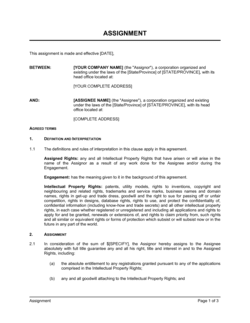
Industrial Design Assignment Agreement Template

Free Word download • Edit online • Save & share with Drive • Export to PDF

2 pages20–30 min to fillDifficulty: StandardSignature requiredLegal review recommended
Learn more ↓
FreeIndustrial Design Assignment Agreement Template

At a glance

What it is
An Industrial Design Assignment Agreement is a legally binding contract that transfers full ownership of one or more registered or unregistered industrial designs — including the visual, ornamental, and aesthetic features of a product — from an assignor to an assignee. This free Word download gives you a structured, editable template covering all material transfer terms, which you can export as PDF and execute with wet or electronic signatures.
When you need it
Use it whenever a designer, contractor, or company transfers design rights to another party — including employer-to-company transfers at onboarding, contractor handoffs at project completion, or sale of a design portfolio as part of a business acquisition. It is also required when recording the assignment with a national industrial design registry such as the USPTO, CIPO, or EUIPO.
What's inside
Identification of the assigned designs with registration numbers, scope of rights transferred, consideration and payment terms, warranties of clear title and non-infringement, moral rights waiver, recordal obligations, governing law, and representations by both parties. A schedule of assigned designs is included as an appendix for precise identification.

What is an Industrial Design Assignment Agreement?

An Industrial Design Assignment Agreement is a legally binding contract that permanently transfers ownership of one or more industrial design rights — covering the ornamental, visual, and aesthetic features of a product — from the original owner (the assignor) to a new owner (the assignee). Unlike a licence, which grants permission to use a design while the creator retains title, an assignment is a full, irrevocable transfer of all rights in the design, including the right to register, enforce, sub-licence, and modify it going forward. The agreement identifies each design precisely by registration or application number, states the consideration exchanged, sets out the assignor's warranties of clear title, and obliges both parties to cooperate with the formal recordal filings that update the public IP register.

Industrial designs are a distinct category of intellectual property separate from patents, trademarks, and copyright — protecting the way a product looks rather than how it works or what it is called. They are registered through national and regional IP offices such as the USPTO (as design patents), the EUIPO (as Community designs), and the CIPO in Canada, each with its own assignment recordal process and requirements.

Why You Need This Document

Without a signed industrial design assignment agreement, ownership of a design remains legally ambiguous — even when a company has paid a freelancer or contractor to create it. Verbal agreements and invoice receipts do not transfer IP rights in any jurisdiction. An unresolved chain of title can block product launches, prevent registration in new markets, expose the business to infringement claims from a prior owner, and create material liabilities in due diligence during financing rounds or acquisitions. Startup founders who neglect to assign designs created by co-founders or early contractors into the company entity frequently encounter this problem precisely when the business is most valuable.

A properly executed and recorded assignment resolves all of these risks: it creates an unambiguous public record of ownership, closes off the assignor's ability to assert competing claims, and satisfies the recordal requirements of every major IP registry. This template gives you a structured, enforceable starting point that covers the full scope of rights, moral rights waiver, and further-assurances obligations — the provisions most commonly omitted in handwritten or informal transfers.

Which variant fits your situation?

If your situation is…Use this template
Transferring design rights created by a freelance contractorIndependent Contractor IP Assignment Agreement
Assigning design rights as part of an employee onboardingEmployment IP Assignment Agreement
Licensing design rights without transferring ownershipIndustrial Design License Agreement
Transferring design and other IP assets in a business saleIP Assignment Agreement (General)
Protecting design confidentiality before assignment negotiationsNon-Disclosure Agreement
Assigning a trademark alongside the industrial designTrademark Assignment Agreement
Commissioning a new design with automatic ownership at deliveryDesign Services Agreement

Common mistakes to avoid

❌ Describing designs by product name without registration numbers

Why it matters: A vague description creates genuine ambiguity about what was assigned and can prevent the assignee from recording the transfer with an IP registry, leaving their ownership unprotected on the public record.

Fix: Always populate Schedule A with exact registration or application numbers, filing jurisdictions, and filing dates for every design covered by the agreement.

❌ Failing to include a moral rights waiver

Why it matters: In Canada, the UK, and the EU, moral rights remain with the original creator even after ownership is assigned. Without an express waiver, the assignor could object to modifications or claim attribution on the assignee's products.

Fix: Add a moral rights waiver clause that covers all applicable jurisdictions and expressly includes the rights of attribution and integrity, to the fullest extent permitted by local law.

❌ Omitting pending and unregistered design rights from the scope

Why it matters: An assignment limited to 'registered designs' leaves pending applications and valuable unregistered design rights — which carry independent protection in the UK and EU — still owned by the assignor.

Fix: Draft the scope clause to explicitly cover registered rights, unregistered rights, pending applications, priority rights, and all worldwide equivalents of the listed designs.

❌ No further-assurances or recordal obligation clause

Why it matters: If the assignor becomes unavailable, uncooperative, or insolvent after execution, the assignee may have no contractual basis to compel the signing of recordal documents in secondary jurisdictions.

Fix: Include a further-assurances clause requiring the assignor to execute any documents and take any steps reasonably necessary to complete the transfer, at the assignee's expense.

❌ Paying the full consideration before recordal is complete

Why it matters: If a pre-existing encumbrance or co-ownership claim surfaces after payment, the assignee has limited leverage to recover funds or compel the assignor to resolve the issue.

Fix: Structure payment to retain a portion — 10–20% — in escrow until recordal with the primary registry is confirmed, or obtain a title warranty with indemnification backed by adequate consideration.

❌ Using a single agreement for designs registered across multiple IP systems

Why it matters: The USPTO, EUIPO, CIPO, and national registries each have distinct recordal requirements for assignment documents. A format accepted by one registry may not satisfy another, delaying or blocking recordal.

Fix: Check the specific recordal requirements of each relevant registry before execution and prepare jurisdiction-specific cover sheets or notarized copies where required.

The 10 key clauses, explained

Parties and recitals

In plain language: Identifies the assignor and assignee by full legal name and entity type, and states the commercial context that prompted the assignment.

Sample language
This Industrial Design Assignment Agreement is entered into on [DATE] between [ASSIGNOR LEGAL NAME], a [ENTITY TYPE] incorporated in [JURISDICTION] ('Assignor'), and [ASSIGNEE LEGAL NAME], a [ENTITY TYPE] ('Assignee').

Common mistake: Using a trading name instead of the registered legal entity for either party. A mismatch between the contract name and the name on the design registry record can invalidate recordal filings.

Schedule of assigned designs

In plain language: Lists every design being transferred by registration number, application number, title, filing date, and jurisdiction — leaving no ambiguity about what has been assigned.

Sample language
The Assignor hereby assigns to the Assignee all right, title, and interest in the designs set out in Schedule A, including Design Registration No. [NUMBER] in [JURISDICTION], filed [DATE], for the design of [PRODUCT DESCRIPTION].

Common mistake: Describing designs by product name only, without registration numbers. If a design has multiple national registrations, each must be listed individually or the assignment may not cover every jurisdiction.

Scope of rights transferred

In plain language: Defines exactly what is being assigned — registered rights, unregistered rights, pending applications, and the right to sue for past infringement.

Sample language
The assignment includes all registered and unregistered industrial design rights, all pending applications, all rights to claim priority, and all causes of action for past infringement of the Assigned Designs, throughout the world.

Common mistake: Limiting the assignment to 'registered designs' and inadvertently excluding pending applications or unregistered design rights that carry independent value in the UK and EU.

Consideration and payment terms

In plain language: States the purchase price, how and when it is paid, and whether any portion is contingent on successful registration or recordal.

Sample language
In consideration for the assignment, Assignee shall pay Assignor the sum of [AMOUNT] ([CURRENCY]) on or before [DATE], by [PAYMENT METHOD]. No further royalties, fees, or compensation shall be owed to Assignor in respect of the Assigned Designs.

Common mistake: Stating a nominal consideration of $1 without confirming this satisfies local enforceability requirements. Some jurisdictions scrutinize whether nominal consideration is adequate for registering the assignment.

Warranties and representations

In plain language: The assignor confirms they own the designs outright, the designs do not infringe third-party rights, no undisclosed encumbrances exist, and the assignor has the authority to execute the agreement.

Sample language
Assignor represents and warrants that: (a) Assignor is the sole and unencumbered owner of the Assigned Designs; (b) the Assigned Designs do not infringe any third-party intellectual property rights; (c) no licence, pledge, or encumbrance over the Assigned Designs has been granted to any third party.

Common mistake: Omitting a warranty that no prior licences have been granted. An assignee who later discovers a pre-existing exclusive licence may have paid for rights they cannot fully exercise.

Moral rights waiver

In plain language: The assignor, to the extent permitted by law, waives any moral rights — including the right of attribution and the right to object to modification — in relation to the assigned designs.

Sample language
To the fullest extent permitted by applicable law, Assignor irrevocably waives all moral rights in and to the Assigned Designs in favour of Assignee and its successors, assigns, and licensees.

Common mistake: Treating moral rights as automatically transferred with the assignment. In Canada, the UK, and the EU, moral rights cannot be assigned — they can only be waived, and must be waived expressly in writing.

Recordal and further assurances

In plain language: Obliges the assignor to sign any additional documents, cooperate with registry filings, and execute any instrument reasonably required to complete the transfer in every relevant jurisdiction.

Sample language
Assignor shall, at Assignee's reasonable request and expense, execute all documents and take all steps necessary to record this assignment with any relevant intellectual property registry, including the USPTO, EUIPO, CIPO, or any national registry in Schedule A.

Common mistake: No further-assurances clause. If the assignor later becomes unavailable or uncooperative, the assignee may be unable to record the assignment in a secondary jurisdiction without a contractual obligation to compel cooperation.

Indemnification

In plain language: The assignor agrees to compensate the assignee for any losses arising from a breach of the assignor's warranties — for example, a third-party infringement claim that predates the assignment.

Sample language
Assignor shall indemnify, defend, and hold harmless Assignee from and against any claims, damages, costs, and expenses (including reasonable legal fees) arising from any breach of Assignor's representations and warranties in this Agreement.

Common mistake: No cap on indemnification liability. Assignors — especially individual designers — should negotiate a liability cap tied to the consideration received, or the indemnity exposure can exceed the deal value.

Confidentiality

In plain language: Restricts both parties from disclosing the financial terms of the assignment and any proprietary design information shared during the transaction.

Sample language
Each party shall keep confidential the terms of this Agreement and all Confidential Information disclosed by the other party in connection with this transaction, and shall not disclose such information to any third party without prior written consent.

Common mistake: Omitting a confidentiality clause entirely. The assignment price and the existence of unregistered designs disclosed during due diligence are both commercially sensitive and require explicit protection.

Governing law and dispute resolution

In plain language: Specifies which jurisdiction's law governs the agreement and how disputes are resolved — court litigation, arbitration, or mediation.

Sample language
This Agreement is governed by the laws of [STATE/PROVINCE/COUNTRY] without regard to its conflict-of-law provisions. Any dispute arising hereunder shall be resolved by binding arbitration under the rules of [AAA / ICDR / LCIA] in [CITY], except claims for interim injunctive relief.

Common mistake: Choosing a governing law that has no connection to where the designs are registered or where either party operates. Courts in several jurisdictions will apply local design law regardless of the chosen governing law.

How to fill it out

  1. 1

    Identify both parties with their full legal entity names

    Enter the registered legal name — not a trade name — of both the assignor and assignee, along with entity type, jurisdiction of incorporation, and principal address.

    💡 Cross-check the assignor's name against the name on each design registration record before drafting. A mismatch creates a recordal problem that can take months to resolve.

  2. 2

    Complete Schedule A with every design being transferred

    List every design by registration number, application number, title, product description, filing jurisdiction, and filing date. Include pending applications as well as granted registrations.

    💡 If the assignor holds corresponding registrations in multiple countries for the same design, list each national or regional registration as a separate line item.

  3. 3

    Define the scope of rights transferred

    Specify whether the assignment covers registered rights only, unregistered rights, pending applications, rights of priority, and the right to sue for past infringement. An assignment that is silent on scope will be interpreted narrowly.

    💡 Include 'throughout the world' in the territorial scope if the assignee plans to use the designs globally — a territorial limit can create gaps in protection.

  4. 4

    State the consideration clearly

    Enter the purchase price, currency, payment method, and deadline. If payment is in installments or contingent on a milestone (such as successful recordal), set out the schedule precisely.

    💡 Avoid lump-sum payments tied to completion of recordal filings — registry timelines vary by country from weeks to over a year. Decouple payment from recordal timing.

  5. 5

    Review and tailor the warranties

    Confirm the assignor can truthfully make each warranty: sole ownership, no encumbrances, no undisclosed licences, and no known infringement of third-party rights. Remove or qualify any warranty the assignor cannot honestly give.

    💡 If the design was co-created with a third party, all co-owners must sign the assignment — a single co-owner cannot transfer full title alone.

  6. 6

    Include an express moral rights waiver

    Add a moral rights waiver clause covering all jurisdictions in which the designs are protected. In Canada, the UK, and the EU, moral rights survive independently of ownership transfer and must be waived in writing.

    💡 Check whether the applicable jurisdiction permits waiver at all — France, for example, restricts the scope of moral rights waiver under its droit moral doctrine.

  7. 7

    Specify recordal responsibilities

    Decide which party is responsible for filing the assignment with each relevant IP registry and who bears the associated costs. Include a further-assurances clause obliging the assignor to cooperate with any filing.

    💡 File with all relevant registries promptly after execution — recordal deadlines exist in some jurisdictions, and unrecorded assignments can be void against bona fide third-party purchasers.

  8. 8

    Execute before transferring access or payment

    Both parties must sign the agreement — ideally with witnessed signatures — before any design files are delivered and before the purchase price is paid. Retain executed originals and submit copies to registries.

    💡 Use dated signatures and store execution copies securely. Registry recordal applications require a legible copy of the signed agreement.

Frequently asked questions

What is an industrial design assignment agreement?

An industrial design assignment agreement is a legally binding contract that transfers full ownership of one or more industrial design rights — registered or unregistered — from the current owner (assignor) to a new owner (assignee). It identifies the specific designs being transferred, sets the purchase price and payment terms, provides warranties of clear title, and obliges the assignor to cooperate with registry recordal filings. Once executed and recorded, the assignee becomes the legal owner on the public IP register.

What is the difference between assigning and licensing an industrial design?

An assignment transfers permanent, full ownership of the design rights to the assignee — the assignor retains nothing. A licence grants the licensee permission to use the design for a defined scope, territory, or term while the assignor remains the owner. Use an assignment when the goal is a clean, permanent transfer of IP — for example, when a startup transfers designs into the company entity, or when a design is sold as part of a business acquisition. Use a licence when the designer wants to retain ownership while generating revenue from the rights.

Does an industrial design assignment need to be recorded with an IP registry?

Recording is not always legally required for the assignment to be valid between the parties, but it is strongly advisable. In most jurisdictions, an unrecorded assignment is void against a bona fide third party who later acquires the same design rights without notice. The USPTO, EUIPO, CIPO, and most national registries allow — and in some cases require — assignments to be recorded to reflect the correct owner on the public register. Recording protects the assignee's title against subsequent claims and is essential if the assignee plans to enforce, licence, or sell the design.

Can an industrial design assignment cover multiple countries?

Yes — a single agreement can cover design rights in any number of jurisdictions, provided each registration or application is listed individually in the schedule of assigned designs. However, each national or regional IP registry has its own recordal requirements, which may include local-language translations, notarization, or jurisdiction-specific forms. Assignees acquiring designs across multiple IP systems should budget for registry-specific filings and confirm requirements with local IP agents.

What are moral rights and do they transfer with the design?

Moral rights are the creator's non-economic rights to claim authorship and to object to derogatory treatment of their work. In most jurisdictions, moral rights cannot be transferred — they can only be waived by the original creator. An industrial design assignment must include an express moral rights waiver to prevent the assignor from later objecting to modifications or asserting attribution rights on the assignee's products. The scope of permissible waiver varies by country — France, for example, imposes stricter limits than common-law jurisdictions.

What warranties should the assignor give in an industrial design assignment?

At minimum, the assignor should warrant that they are the sole owner of the design rights with full authority to assign, that no undisclosed licences or encumbrances exist, that the designs do not infringe any third-party intellectual property, and that no litigation or challenge to the designs is pending or threatened. If the design was co-created with a third party, all co-owners must join the assignment — a single co-owner cannot assign full title. Breach of any warranty typically triggers the assignor's indemnification obligation.

Do I need a lawyer to draft an industrial design assignment agreement?

For straightforward domestic assignments between two commercial parties with no cross-border registrations or complex consideration structures, a high-quality template is often sufficient. Engage a lawyer when the assignment covers multiple IP registries in different countries, when the designs are a core business asset with significant value, when the transaction is part of a larger M&A deal, or when there are questions about co-ownership, existing licences, or the chain of title. Legal review for a straightforward assignment typically costs $500–$1,500.

What happens if the assignor no longer owns the design at the time of assignment?

If the assignor does not hold clear title at the time of signing, the assignment cannot convey valid rights to the assignee — the principle of nemo dat quod non habet (no one gives what they do not have) applies in most jurisdictions. This situation commonly arises when a prior employment agreement or contractor agreement already assigned the design to a third party. The assignee's primary protection is the assignor's warranty of title backed by an indemnification clause. A thorough title search before signing reduces this risk significantly.

Is a nominal consideration of $1 sufficient for an industrial design assignment?

In many common-law jurisdictions, nominal consideration is technically sufficient to create a binding contract, provided the agreement is signed as a deed or the parties confirm it is intended to be binding. In practice, however, nominal consideration can invite scrutiny — tax authorities may assess the transaction at fair market value regardless of the stated price, and some IP registries require evidence that bona fide consideration was exchanged. Stating a realistic market-rate price is generally preferable and avoids subsequent valuation disputes.

How this compares to alternatives

vs Industrial Design License Agreement

A licence grants permission to use a design for a defined scope, territory, or term while the licensor retains ownership. An assignment permanently transfers full ownership to the assignee, who then holds all rights going forward. Use a licence when the designer wants ongoing royalties and retained ownership; use an assignment when the goal is a clean, one-time transfer — such as when a startup vests designs into the company or a business is sold.

vs IP Assignment Agreement (General)

A general IP assignment covers the transfer of multiple IP asset classes — patents, trademarks, copyrights, and trade secrets — in a single document. An industrial design assignment is specific to ornamental design rights and uses the terminology, registry recordal steps, and warranty language tailored to that IP type. Where only design rights are being transferred, the design-specific agreement is cleaner and more registry-compatible.

vs Non-Disclosure Agreement

An NDA protects confidential design information shared during negotiations or design reviews without transferring any rights. An assignment transfers ownership permanently. Use an NDA first when sharing design details before a deal is agreed; execute the assignment once the transfer terms are confirmed and consideration is ready to be paid.

vs Copyright Assignment Agreement

Copyright covers the expressive and artistic dimensions of a design and may subsist alongside industrial design protection, particularly for surface ornamentation and two-dimensional patterns. A copyright assignment transfers those rights separately. Where a design enjoys both industrial design and copyright protection — common for textile and surface designs — both agreements may be required, or a single agreement should expressly cover both IP layers.

Industry-specific considerations

Consumer Electronics and Hardware

Product enclosures, display bezels, and UI physical forms are routinely assigned from external design agencies to hardware manufacturers before launch, with assignments covering both registered designs and pending international applications.

Fashion and Apparel

Surface patterns, garment silhouettes, and accessories are protected as registered or unregistered designs; assignments frequently accompany licensing deals or brand acquisitions and must address moral rights waivers explicitly under French and Italian law.

Automotive and Transportation

Vehicle body styling, wheel designs, and interior trim elements are protected as registered designs across multiple jurisdictions; assignments between design studios and OEMs require multi-registry recordal programs managed by regional IP agents.

Medical Devices and Healthcare

Device enclosures and ergonomic form factors are protectable as industrial designs separate from patent protection; clean IP assignment is a regulatory due-diligence requirement in FDA 510(k) and CE-mark submissions involving product ownership changes.

Furniture and Interior Products

Furniture form and surface ornamentation receive strong protection as registered and unregistered designs in the EU; assignments must address whether unregistered Community design rights are included alongside registered EUIPO filings.

Toy and Consumer Goods Manufacturing

Toy figure appearances, packaging shapes, and product form are routinely registered as industrial designs; assignments during licensing negotiations or brand acquisitions must cover both visual and three-dimensional design elements across key market jurisdictions.

Jurisdictional notes

United States

Industrial designs are protected as design patents in the US (not as 'industrial designs' per se), with a term of 15 years from grant. Assignments of design patents are recorded with the USPTO Assignment Division. The US does not recognize unregistered design rights. Work-made-for-hire doctrine under copyright law does not automatically vest design patent ownership in an employer — an explicit written assignment is required for contractor-created designs.

Canada

Canada protects industrial designs under the Industrial Design Act, with a term of 10 years from registration. Assignments must be recorded with the Canadian Intellectual Property Office (CIPO) to be valid against subsequent bona fide purchasers. Moral rights under the Copyright Act apply to original artistic works and must be waived separately — they cannot be assigned. Quebec's civil law framework may affect interpretation of assignment terms for parties operating in that province.

United Kingdom

The UK protects both registered designs (10 years, renewable to 25 years) and unregistered design rights that arise automatically for up to 15 years. Post-Brexit, UK and EU design rights are now independent systems requiring separate recordal. Assignments of registered designs must be recorded with the UK Intellectual Property Office (IPO). Moral rights under the Copyright, Designs and Patents Act 1988 must be waived expressly in writing and cannot be assigned.

European Union

The EU offers registered Community designs (EUIPO, up to 25 years) and unregistered Community designs (3 years from first disclosure, no registration required). Assignments of registered Community designs are recorded with the EUIPO. The unregistered Community design right is a distinct asset that should be expressly covered in the assignment scope. Many EU member states — particularly France and Italy — have strong moral rights traditions that limit the scope of permissible waiver in domestic courts, even when an express waiver is included.

Template vs lawyer — what fits your deal?

PathBest forCostTime
Use the templateDomestic assignments between two commercial parties covering a small number of designs in a single jurisdictionFree30–60 minutes
Template + legal reviewAssignments covering designs registered in two or more countries, high-value designs, or transactions involving a startup IP vest-in$500–$1,500 for an IP lawyer review2–5 days
Custom draftedM&A transactions, large design portfolios, multi-registry recordal programs, or assignments where co-ownership or title chain issues exist$2,000–$8,000+1–4 weeks

Glossary

Industrial Design
The ornamental or aesthetic features of a product — such as shape, configuration, pattern, or color — that are protectable as intellectual property distinct from functional features.
Assignor
The party who currently owns the industrial design rights and is transferring ownership to the other party.
Assignee
The party receiving full ownership of the industrial design rights under the assignment agreement.
Registered Design
An industrial design that has been formally recorded with a national or regional IP registry, providing exclusive rights against unauthorized copying for a defined term.
Unregistered Design Right
Protection that arises automatically in some jurisdictions — notably the UK and EU — for original designs without requiring formal registration, typically for a shorter term.
Moral Rights
Non-economic rights that allow a creator to claim authorship and object to derogatory treatment of their work; in many jurisdictions these must be expressly waived in a commercial assignment.
Recordal
The formal filing of an assignment with a national IP registry — such as the USPTO, CIPO, or EUIPO — so that the change of ownership is reflected in the public record.
Consideration
The payment or other benefit exchanged for the transfer of design rights; without valid consideration, an assignment may be unenforceable in common-law jurisdictions.
Warranty of Title
A guarantee by the assignor that they have full, clear ownership of the design rights being transferred, free from undisclosed encumbrances or third-party claims.
Work Made for Hire
A US copyright doctrine under which designs created by employees within their employment scope are owned by the employer by default; industrial design law has separate rules that may require an explicit assignment regardless.
Encumbrance
Any existing lien, licence, pledge, or third-party claim on the design rights that could limit or challenge the assignee's enjoyment of full ownership.
Right of Priority
Under the Paris Convention, the right to file for design protection in member countries within six months of an initial filing, claiming the original filing date — relevant when assignee plans cross-border registration.

Part of your Business Operating System

This document is one of 3,000+ business & legal templates included in Business in a Box.

  • Fill-in-the-blanks — ready in minutes
  • 100% customizable Word document
  • Compatible with all office suites
  • Export to PDF and share electronically

Create your document in 3 simple steps.

From template to signed document — all inside one Business Operating System.
1
Download or open template

Access over 3,000+ business and legal templates for any business task, project or initiative.

2
Edit and fill in the blanks with AI

Customize your ready-made business document template and save it in the cloud.

3
Save, Share, Send, Sign

Share your files and folders with your team. Create a space of seamless collaboration.

Save time, save money, and create top-quality documents.

★★★★★

"Fantastic value! I'm not sure how I'd do without it. It's worth its weight in gold and paid back for itself many times."

Managing Director · Mall Farm
Robert Whalley
Managing Director, Mall Farm Proprietary Limited
★★★★★

"I have been using Business in a Box for years. It has been the most useful source of templates I have encountered. I recommend it to anyone."

Business Owner · 4+ years
Dr Michael John Freestone
Business Owner
★★★★★

"It has been a life saver so many times I have lost count. Business in a Box has saved me so much time and as you know, time is money."

Owner · Upstate Web
David G. Moore Jr.
Owner, Upstate Web

Run your business with a system — not scattered tools

Stop downloading documents. Start operating with clarity. Business in a Box gives you the Business Operating System used by over 250,000 companies worldwide to structure, run, and grow their business.

Free Forever Plan · No credit card required