- Certificate of Incorporation
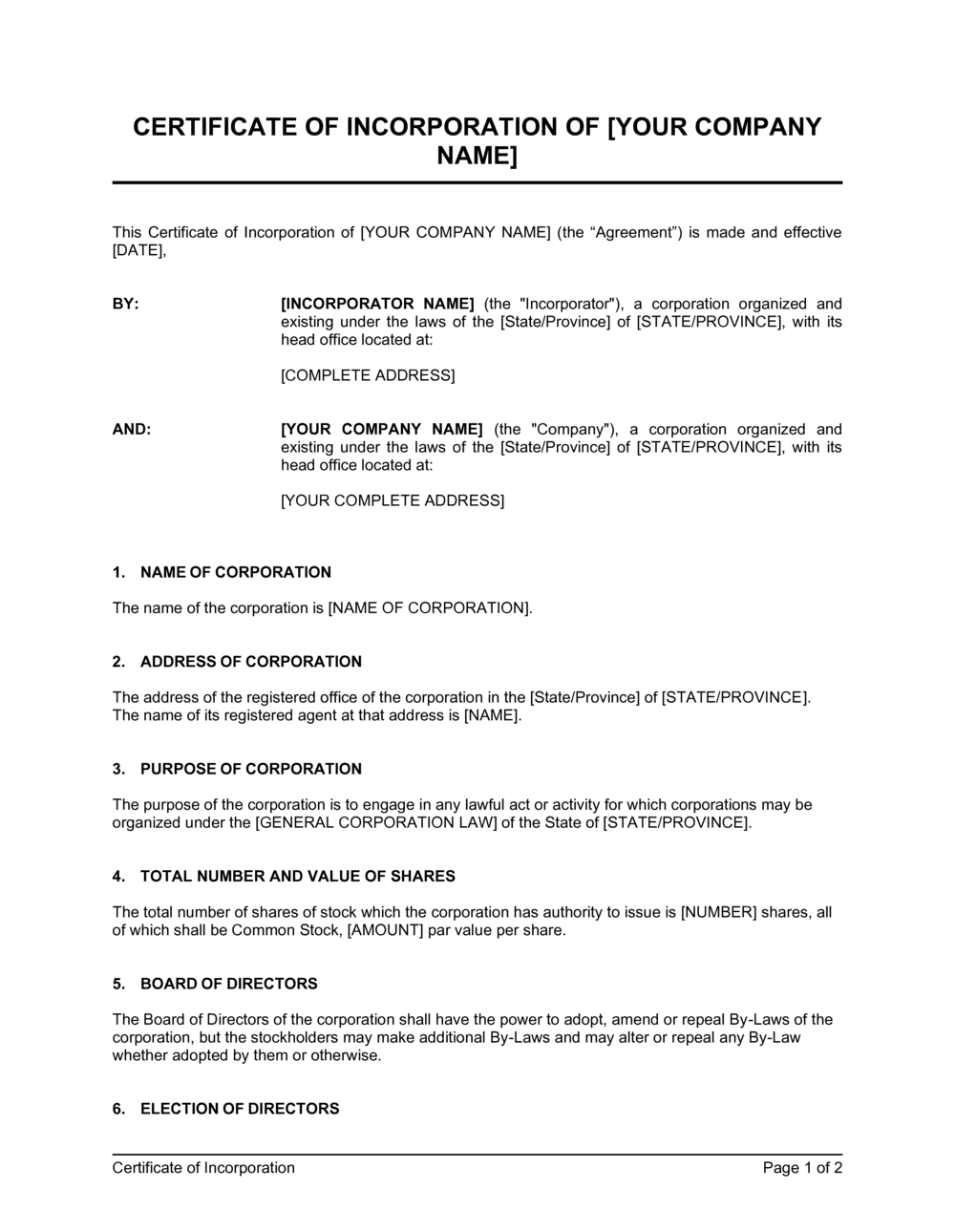
- The official document issued by a government registry confirming that a corporation has been legally formed and exists as a separate legal entity.
- Articles of Incorporation
- The founding charter filed with a state or national registry that establishes a corporation's name, purpose, share structure, and registered agent — the filing that produces the Certificate of Incorporation.
- Registered Agent
- A person or company designated to receive legal documents, tax notices, and regulatory correspondence on behalf of the corporation in its state of incorporation.
- Registered Office
- The official address of a company as recorded with the registry — not necessarily where operations occur, but where official legal notices may be served.
- Authorized Share Capital
- The maximum number and classes of shares a corporation is permitted to issue under its certificate of incorporation, before any are actually distributed to shareholders.
- Incorporator
- The individual or entity that signs and files the articles of incorporation with the registry to legally create the corporation.
- Entity Type
- The legal classification of a business — such as C-Corporation, S-Corporation, or Private Limited Company — that determines tax treatment, governance rules, and liability protections.
- Certificate of Good Standing
- A separate document issued by a registry confirming that an already-incorporated company is current on all filings and fees — often confused with, but distinct from, the Certificate of Incorporation.
- Par Value
- A nominal minimum price assigned to each share in the articles of incorporation; many modern corporations use a very low par value (e.g., $0.0001 per share) or no par value at all.
- Corporate Veil
- The legal separation between a corporation and its shareholders that limits personal liability — established at incorporation and maintained through proper governance.
- S-Corporation Election
- A tax election filed with the IRS after incorporation allowing a qualifying C-Corporation to be taxed as a pass-through entity, avoiding double taxation at the corporate level.