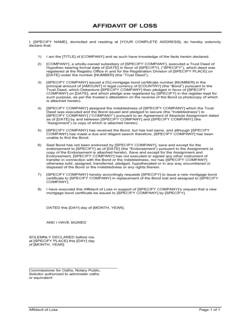
Affidavit of Lost, Stolen or Destroyed Stock Certificate Template

Free Word download • Edit online • Save & share with Drive • Export to PDF

1 page20–30 min to fillDifficulty: StandardSignature requiredLegal review recommended
Learn more ↓
FreeAffidavit of Lost, Stolen or Destroyed  Stock Certificate Template

At a glance

What it is
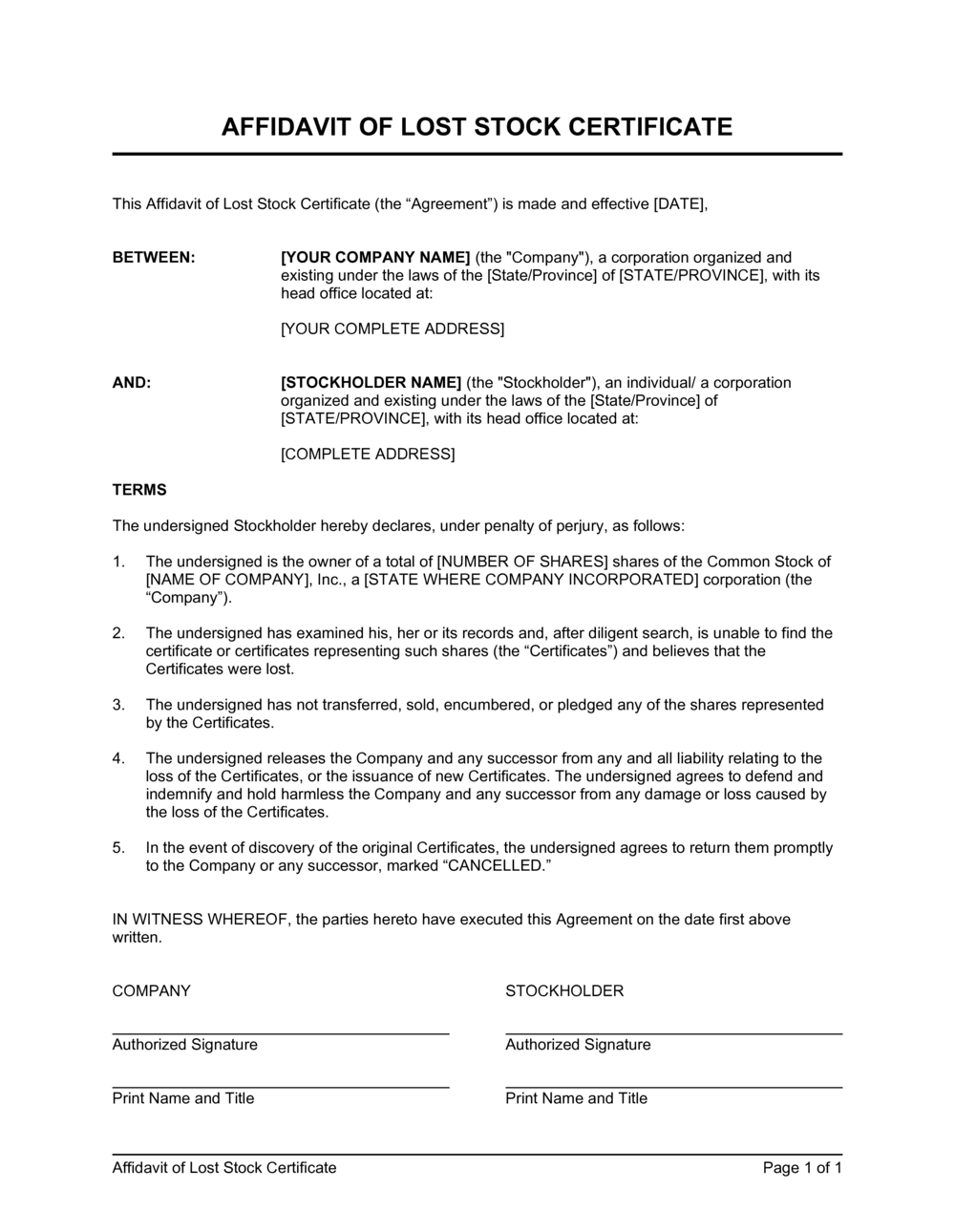
An Affidavit of Lost, Stolen, or Destroyed Stock Certificate is a sworn legal document in which a shareholder declares under oath that their original share certificate has been lost, stolen, or destroyed and requests that the issuing corporation issue a replacement. This free Word download provides a professionally formatted template you can edit online, sign before a notary, and submit to the corporation's transfer agent or corporate secretary to initiate the reissuance process.
When you need it
Use it when a shareholder cannot produce their original stock certificate — whether due to loss, theft, fire, flood, or any other destruction — and needs the corporation to issue a replacement certificate representing the same shares. It is also required by transfer agents and brokers when a certificated shareholder attempts to sell, transfer, or pledge shares without presenting the original certificate.
What's inside
The affidavit contains a sworn declaration of the circumstances of loss or destruction, full identification of the certificate including share class and certificate number, an indemnification agreement protecting the corporation against any future claim on the lost certificate, and signature and notarization blocks. Some versions also include a bond or surety provision when the value of the shares exceeds a threshold set by the corporation's bylaws.

What is an Affidavit of Lost, Stolen, or Destroyed Stock Certificate?

An Affidavit of Lost, Stolen, or Destroyed Stock Certificate is a sworn legal document in which a shareholder formally declares under oath that their original share certificate has been lost, stolen, or destroyed and requests that the issuing corporation cancel the missing certificate on its share register and issue a replacement. It identifies the missing certificate by number, class, and share count; recounts the circumstances of loss; confirms that no third party has any claim on the shares; and commits the affiant to indemnify the corporation against any future claim arising from the reissuance. Because it is an affidavit, it must be executed before a notary public or equivalent authorized officer to carry legal force. For corporations and transfer agents, this document is the authoritative evidentiary basis for treating the original certificate as void and issuing a new one in its place.

Why You Need This Document

Without a properly executed affidavit, a corporation has no legal basis to issue a replacement certificate — and doing so without one exposes the corporation to double-ownership claims if the original certificate later surfaces. For shareholders, the absence of a valid certificate blocks share transfers, sale transactions, and pledging of shares as collateral. In mergers and acquisitions, a single missing certificate that lacks a corresponding affidavit can stall or kill a closing, as buyers routinely require clean title to every issued share as a condition precedent. Estate administrators who discover missing certificates without this document face probate delays and potential personal liability. This template provides the complete, notarization-ready structure — indemnification, cancellation request, and governing law — that corporations, transfer agents, and acquirers accept, so you can resolve the missing certificate issue cleanly and move forward without rebuilding the document from scratch.

Which variant fits your situation?

If your situation is…Use this template
Individual shareholder replacing a certificate for a private corporationAffidavit of Lost, Stolen, or Destroyed Stock Certificate
Shares held in a trust or estate where the original holder is deceasedAffidavit of Lost Stock Certificate (Estate / Trust)
Corporate entity (not an individual) is the shareholderCorporate Resolution for Replacement Stock Certificate
Corporation needs to formally record the cancellation of the lost certificateStock Certificate Cancellation Resolution
Transfer agent requires a bond in addition to the affidavitLost Securities Bond / Surety Agreement
Shareholder is transferring shares to a new owner at the same time as replacementStock Transfer Agreement

Common mistakes to avoid

❌ Signing before a notary without the correct legal name

Why it matters: If the name on the affidavit doesn't match the share register exactly, the transfer agent will reject the document and require a corrected, re-notarized version — delaying the replacement by weeks.

Fix: Confirm the registered name on the share register with the corporate secretary before filling out the affidavit, and use that exact name in the affiant identification clause.

❌ Omitting or vaguely describing the circumstances of loss

Why it matters: A vague affidavit raises suspicion of fraud and gives the corporation grounds to refuse reissuance. If the original certificate later surfaces and is presented by a third party, a vague sworn account is harder to defend.

Fix: Write a specific, dated factual account — including the last known location of the certificate and the steps taken to find it — even if those details seem insignificant.

❌ Failing to check whether a lost-securities bond is required

Why it matters: Corporations and transfer agents that require a bond can and will withhold the replacement certificate until one is provided, regardless of how complete the affidavit is otherwise.

Fix: Contact the corporate secretary or transfer agent before executing the affidavit to confirm bond requirements and the acceptable bond amount and insurer.

❌ Submitting a photocopy instead of the notarized original

Why it matters: An affidavit derives its legal force from the notary's original ink signature and seal. Photocopies are routinely rejected by transfer agents and corporate secretaries.

Fix: Always submit the notarized original. Request a certified copy from the notary for your own records before submitting the original to the corporation.

❌ Not requesting formal cancellation of the original certificate

Why it matters: If the corporation issues a replacement without formally cancelling the original on its share register, both certificates represent valid ownership claims — creating a title dispute if the original resurfaces.

Fix: Include an explicit clause requesting cancellation of the original certificate number on the share register and ask the corporate secretary to confirm cancellation in writing after the replacement is issued.

❌ Using a template governed by the wrong jurisdiction

Why it matters: Affidavit requirements — notarization, jurat language, and bond thresholds — vary by state and country. An affidavit that complies with New York law may be deficient under Delaware corporate law or Ontario's Business Corporations Act.

Fix: Confirm the governing law for the affidavit is the state or province of the corporation's incorporation, and verify that the notarization block uses the correct jurat language for that jurisdiction.

The 9 key clauses, explained

Affiant Identification

In plain language: Identifies the person making the sworn statement — their full legal name, address, and relationship to the shares (registered holder, executor, trustee, etc.).

Sample language
I, [FULL LEGAL NAME], residing at [ADDRESS], being duly sworn, depose and say that I am the registered holder of the shares described herein and that the following statements are true to the best of my knowledge and belief.

Common mistake: Using a nickname or trade name instead of the affiant's exact legal name as it appears on the original share register. A name mismatch causes the transfer agent to reject the affidavit and restart the process.

Certificate Identification

In plain language: Describes the lost certificate precisely — certificate number, share class, number of shares, and the name in which it was registered — so the corporation can locate and cancel the record.

Sample language
Certificate No. [CERTIFICATE NUMBER], representing [NUMBER] shares of [CLASS] common stock of [CORPORATION NAME], registered in the name of [REGISTERED HOLDER NAME], originally issued on [DATE OF ISSUANCE].

Common mistake: Omitting the certificate number or share class because the affiant doesn't have the original. Contact the corporate secretary or transfer agent to retrieve this information from the share register before completing the affidavit.

Circumstances of Loss, Theft, or Destruction

In plain language: A sworn factual account of how and when the certificate was lost, stolen, or destroyed, including the last known location and any steps taken to recover it.

Sample language
The said certificate was [lost / stolen / destroyed] on or about [DATE] under the following circumstances: [DESCRIPTION OF CIRCUMSTANCES]. Affiant has made diligent search and inquiry for the said certificate and has been unable to locate or recover it.

Common mistake: Writing vague boilerplate like 'it was lost at some point' without a specific date or circumstance. Transfer agents and corporations are entitled to a reasonably specific account; vagueness invites rejection or legal exposure.

Declaration of Non-Transfer

In plain language: A sworn statement that the affiant has not sold, pledged, assigned, or otherwise transferred the certificate to any third party, and that no lien or encumbrance exists on the shares.

Sample language
Affiant has not sold, transferred, assigned, pledged, hypothecated, or otherwise disposed of the said certificate or the shares represented thereby, and no other person has any claim, lien, or encumbrance on said shares to the best of Affiant's knowledge.

Common mistake: Skipping this clause when the shares were previously used as collateral. A pledge creates a third-party interest; omitting this disclosure can constitute fraud.

Request for Replacement Certificate

In plain language: A formal request that the corporation cancel the original certificate on its share register and issue a new certificate representing the same shares to the same registered holder.

Sample language
Affiant respectfully requests that [CORPORATION NAME] cancel Certificate No. [CERTIFICATE NUMBER] on its share register and issue a new stock certificate representing [NUMBER] shares of [CLASS] stock in the name of [REGISTERED HOLDER NAME].

Common mistake: Failing to specify that the original certificate should be formally cancelled, not merely replaced. Without an explicit cancellation request, the corporation may issue a duplicate without invalidating the original, creating two certificates for the same shares.

Indemnification of the Corporation

In plain language: The affiant agrees to indemnify and hold harmless the corporation, its transfer agent, and their agents from any losses, damages, costs, or claims arising from the reissuance — including any claim by a third party who later presents the original certificate.

Sample language
Affiant agrees to indemnify, defend, and hold harmless [CORPORATION NAME], its officers, directors, transfer agents, and assigns from and against any and all claims, damages, losses, and expenses, including reasonable attorneys' fees, arising from the issuance of a replacement certificate, including any claim based on or arising out of the original Certificate No. [CERTIFICATE NUMBER].

Common mistake: Using a one-sentence indemnity that doesn't cover attorneys' fees or third-party claims. Courts have found narrow indemnity clauses unenforceable when they fail to cover the full range of foreseeable losses.

Surety Bond or Waiver Provision

In plain language: States whether a lost-securities bond is required by the corporation's bylaws or the transfer agent — including the bond amount and the insurer — or documents the corporation's formal waiver of the bond requirement.

Sample language
In connection with the issuance of the replacement certificate, Affiant [has provided / agrees to provide] a surety bond in the amount of [X]% of the current market value of the shares, issued by [SURETY COMPANY], Bond No. [BOND NUMBER]. [Alternatively: Corporation hereby waives the bond requirement pursuant to [BYLAW PROVISION / BOARD RESOLUTION dated DATE].]

Common mistake: Omitting this clause entirely when the corporation's bylaws require a bond. If the bylaw provision exists and no bond is obtained or waiver documented, the replacement certificate may be challenged as improperly issued.

Governing Law

In plain language: Specifies the state, province, or country whose laws govern the affidavit and any disputes arising from the replacement process.

Sample language
This Affidavit shall be governed by and construed in accordance with the laws of the State of [STATE] / Province of [PROVINCE], without regard to its conflict-of-law principles.

Common mistake: Omitting the governing law clause entirely and relying on implication. The state of incorporation and the state where the affiant resides may differ, creating ambiguity about which jurisdiction's affidavit and notarization requirements apply.

Signature, Jurat, and Notarization Block

In plain language: The affiant's original signature, the date of signing, and the notary's certification — including the notary's commission expiration date and official seal — confirming the affidavit was sworn before a duly authorized officer.

Sample language
Signed and sworn to before me this [DAY] day of [MONTH], [YEAR]. _________________________________ Notary Public, State of [STATE]. My commission expires: [DATE]. [NOTARY SEAL]

Common mistake: Having the affidavit notarized in a different state than the governing law clause specifies, without confirming the notarization is recognized across jurisdictions. Multi-state notarization issues are a common reason transfer agents reject affidavits.

How to fill it out

  1. 1

    Retrieve the share register details from the corporation

    Contact the corporate secretary or transfer agent to obtain the original certificate number, share class, number of shares, and the exact registered name. You need these details to complete the certificate identification clause accurately.

    💡 Request a certified copy of the share register entry in writing. This creates a paper trail showing you made diligent inquiry before executing the affidavit.

  2. 2

    Enter the affiant's full legal name and address

    Use the exact legal name as it appears on the share register and a current residential or business address. For estates or trusts, enter the executor's or trustee's name followed by their capacity.

    💡 If the registered name on the certificate differs from the affiant's current legal name (due to marriage or legal name change), attach a copy of the supporting legal document and note the discrepancy in the circumstances clause.

  3. 3

    Describe the circumstances of loss, theft, or destruction

    Write a factual, specific account of when and how the certificate was lost, stolen, or destroyed. Include the date, location, and any recovery efforts made. For destruction, describe the event (fire, flood, shredding) and confirm no recoverable remnant exists.

    💡 Specificity protects you. A vague account invites scrutiny; a precise, dated account is harder to challenge and signals good faith.

  4. 4

    Complete the non-transfer declaration

    Confirm that the certificate has not been sold, pledged, or assigned to any third party. If shares were previously used as collateral and the lien has since been released, attach a copy of the lien release before executing the affidavit.

    💡 If any uncertainty exists about prior encumbrances, consult the corporation's capitalization table and your own financing records before signing — this is a sworn statement.

  5. 5

    Draft the indemnification clause to cover the full loss exposure

    Ensure the indemnification covers not just the corporation but also its transfer agent and their respective agents, and that it includes attorneys' fees and third-party claims arising from the original certificate.

    💡 Some corporations require the indemnity to run for a specific period — typically 10 years or until the statute of limitations expires for securities fraud in the governing jurisdiction.

  6. 6

    Confirm bond requirements with the corporation or transfer agent

    Check the corporation's bylaws and the transfer agent's requirements to determine whether a lost-securities bond is required. Bond amounts typically range from 100% to 150% of the current fair market value of the shares.

    💡 For closely held private companies, the board often waives the bond requirement by resolution. Ask for a copy of that resolution to attach to the affidavit.

  7. 7

    Sign the affidavit before a notary public

    Do not sign the affidavit before appearing before the notary. Bring government-issued photo ID matching the legal name in the document. The notary will witness your signature and apply their seal and commission expiration date.

    💡 Confirm the notary is commissioned in the state or province specified in the governing law clause, or confirm that the corporation and transfer agent accept out-of-state notarizations.

  8. 8

    Submit to the corporate secretary or transfer agent with all attachments

    Deliver the notarized original (not a copy) along with any required bond, lien release, or supporting corporate resolution. Keep a certified copy for your own records and request written confirmation of the replacement certificate's issuance.

    💡 Send by certified mail or trackable courier and request a delivery receipt. The notarized original has legal significance; you need proof of submission and receipt.

Frequently asked questions

What is an affidavit of lost, stolen, or destroyed stock certificate?

An affidavit of lost, stolen, or destroyed stock certificate is a sworn legal document in which a shareholder declares under oath that their original share certificate has been lost, stolen, or destroyed and requests that the corporation issue a replacement. It identifies the specific certificate, explains the circumstances of loss, and includes an indemnification promise that protects the corporation if the original certificate later surfaces. Most corporations and transfer agents require this document before they will reissue a certificate.

Does a lost stock certificate affidavit need to be notarized?

Yes. Because an affidavit is a sworn statement, it must be signed in the presence of a notary public or other officer authorized to administer oaths in the jurisdiction where it is executed. The notary verifies the affiant's identity, witnesses the signature, and applies their official seal and commission expiration date. A document labeled as an affidavit that lacks notarization is not a valid affidavit and will typically be rejected by the transfer agent or corporate secretary.

Do I need a surety bond to replace a lost stock certificate?

It depends on the corporation's bylaws and the transfer agent's requirements. Many private corporations waive the bond requirement for closely held shareholders upon a board resolution. Transfer agents handling publicly traded or high-value shares more commonly require a lost-securities bond, typically at 100–150% of the shares' current market value. Check with the corporate secretary or transfer agent before executing the affidavit to confirm whether a bond is required and which insurers are acceptable.

What happens if the original certificate is found after a replacement has been issued?

If the original certificate is found after a replacement has been issued, the original is legally void — the corporation's share register will show it as cancelled. The shareholder is obligated to return or destroy the original and, in most cases, to notify the corporation in writing. The indemnification clause in the affidavit protects the corporation from any costs if a third party attempts to present the original; the surety bond, if obtained, covers any resulting financial loss.

Can I use this affidavit for shares held in a brokerage account?

Most shares held in street name through a brokerage account are book-entry shares — there is no physical certificate to lose. If you hold certificated shares in a brokerage account and the certificate is lost, start with your broker; they typically have a proprietary replacement process. For directly registered certificated shares, the affidavit is the correct starting point and should be submitted to the corporation's transfer agent.

What information do I need to complete the affidavit?

You need the original certificate number, share class (e.g., Class A common stock), number of shares represented, the name in which the certificate was registered, the date of original issuance, and the name of the issuing corporation. If you do not have this information, contact the corporate secretary or transfer agent — they are required to maintain a share register and can provide the details needed to complete the affidavit accurately.

How long does it take to get a replacement stock certificate?

Processing time varies by corporation and transfer agent. For private companies with an in-house corporate secretary, replacement can take 1–2 weeks once the notarized affidavit and any required bond are submitted. For publicly traded companies using a third-party transfer agent, the process typically takes 2–4 weeks. Complex situations — estate-related replacements, missing certificate numbers, or high-value shares requiring a bond — can take 4–8 weeks or longer.

Is this affidavit different for private versus public companies?

The core document is the same, but the practical requirements differ. Public companies always route replacement requests through a registered transfer agent, which has standardized procedures and may require a lost-securities bond regardless of share value. Private companies often handle replacements through their corporate secretary, have more flexibility on bond requirements, and may process replacements by board resolution alone. In both cases, the notarized affidavit with indemnification is the essential starting document.

Does this affidavit transfer ownership of the shares to someone else?

No. This affidavit is solely a replacement document — it requests reissuance of the same shares to the same registered holder. If you also want to transfer the shares to a new owner, you need a separate stock transfer agreement or stock power, and the replacement and transfer are typically processed simultaneously by the transfer agent. Using this affidavit to replace a certificate and then immediately transferring the shares is common in M&A due diligence cleanup.

Can a corporation refuse to issue a replacement stock certificate?

Generally, a corporation is obligated to replace a lost certificate upon receipt of proper documentation — including a sworn affidavit and any required bond — under the Uniform Commercial Code Article 8 (in most US states) and equivalent provincial statutes in Canada. A corporation that unreasonably refuses replacement may be liable to the shareholder. However, the corporation may condition replacement on satisfaction of its bylaw requirements, including the bond, and may investigate the circumstances of loss before proceeding.

How this compares to alternatives

vs Stock Transfer Agreement

A stock transfer agreement conveys ownership of shares from a seller to a buyer and requires production of the original certificate. An affidavit of lost stock certificate is the prerequisite document used when the original certificate cannot be produced — it replaces the physical certificate so the transfer can then proceed. The two documents are often executed simultaneously in M&A transactions.

vs Corporate Resolution for Stock Issuance

A corporate resolution for stock issuance is a board-level document authorizing the initial issuance of new shares. An affidavit of lost stock certificate deals with replacing an already-issued certificate, not authorizing new equity. Both documents interact with the share register, but they serve entirely different functions in the corporate lifecycle.

vs Shareholders Agreement

A shareholders agreement governs the ongoing rights and obligations of all shareholders — transfer restrictions, voting, and drag-along rights. An affidavit of lost stock certificate is a narrow, transactional document addressing a single administrative event. The shareholders agreement may, however, specify the procedure and bond requirements that apply when a certificate is lost.

vs Bill of Sale for Business Assets

A bill of sale documents the transfer of tangible or intangible assets between parties in exchange for consideration. An affidavit of lost stock certificate makes no transfer — it is a sworn declaration that restores documentary evidence of existing ownership. Confusing the two risks attempting to replace a certificate with a document that has no legal effect on the share register.

Industry-specific considerations

Startups and Venture-Backed Companies

Founders frequently lose early share certificates before a Series A; missing certificates must be resolved through a notarized affidavit before investors will close, as clean cap table documentation is a standard closing condition.

Estate and Trust Administration

Executors and trustees regularly encounter missing share certificates for deceased shareholders; affidavits in this context require additional documentation of the affiant's authority, such as letters testamentary or a trust certification.

Financial Services and Brokerage

Transfer agents and broker-dealers require notarized affidavits before processing any transfer or sale involving a certificated security where the original cannot be produced, often combined with a mandatory surety bond requirement.

Mergers and Acquisitions

Acquisition due diligence routinely uncovers missing share certificates; the acquiring company's counsel typically requires all certificates to be replaced or properly documented before closing, making this affidavit a standard pre-closing deliverable.

Jurisdictional notes

United States

In the US, replacement of lost stock certificates is governed by Uniform Commercial Code Article 8, which has been adopted in all 50 states. UCC §8-405 obligates the issuer to replace a lost certificate upon receipt of a sworn affidavit and an indemnity bond if required by the issuer. Delaware — the state of incorporation for the majority of US corporations — follows UCC Article 8 and permits the corporation to require a bond of up to twice the market value of the shares. California and New York have similar provisions but may impose additional notarization or transfer agent requirements.

Canada

In Canada, the replacement of lost share certificates is governed by the Canada Business Corporations Act (CBCA) for federal corporations and by provincial statutes such as the Ontario Business Corporations Act (OBCA) for provincially incorporated entities. Section 70 of the CBCA requires the corporation to issue a replacement on receipt of a sworn declaration and adequate indemnity. Quebec-incorporated corporations must comply with the Business Corporations Act (Quebec), and affidavits executed in Quebec for Quebec corporations must be sworn before a commissioner for oaths or notary under Quebec civil law rules.

United Kingdom

In the UK, share certificates are governed by the Companies Act 2006 and the company's articles of association. A shareholder who loses a certificate must apply to the company for a replacement under the procedure set out in the articles — typically submitting a statutory declaration (equivalent to a sworn affidavit) under the Statutory Declarations Act 1835, often alongside an indemnity. The declaration must be sworn before a solicitor, commissioner for oaths, or notary public. UK companies are not required to accept US-notarized affidavits; a separate UK statutory declaration is typically required.

European Union

Within the EU, requirements for replacing lost share certificates vary significantly by member state, as company law is not fully harmonized. Many EU jurisdictions — including Germany (GmbH shares) and France (SAS/SA shares) — now use book-entry or dematerialized share records, meaning no physical certificate exists to lose. Where certificated shares do exist, the replacement procedure is typically governed by the company's articles of incorporation and national civil procedure rules on sworn declarations. GDPR considerations apply to the personal data included in the affidavit; the corporation should handle and store submitted affidavits in compliance with applicable data protection law.

Template vs lawyer — what fits your deal?

PathBest forCostTime
Use the templateShareholders replacing certificates for closely held private companies with straightforward loss circumstances and no bond requirementFree (plus notary fee of $5–$25)1–3 hours to complete; 1–2 weeks for the corporation to process
Template + legal reviewShares with significant value, situations involving prior encumbrances or lien releases, or estate-related replacements requiring proof of authority$300–$800 for a 1–2 hour attorney review2–5 business days for review; 2–4 weeks total processing
Custom draftedHigh-value shares in publicly traded companies, M&A closing deliverables, cross-border shareholders, or situations with contested ownership history$1,000–$3,500+ depending on complexity1–2 weeks drafting; 3–8 weeks total resolution

Glossary

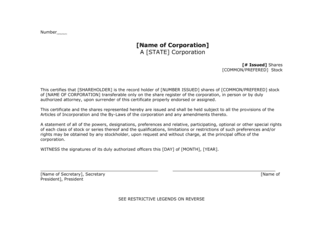
Stock Certificate
A physical document issued by a corporation that evidences a shareholder's ownership of a specified number of shares of a particular class.
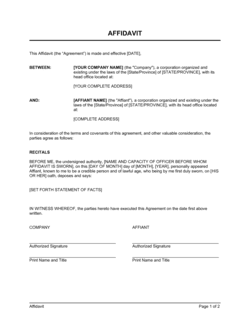
Affidavit
A written statement of fact made voluntarily and confirmed by oath or affirmation before a notary public or other authorized officer.
Notarization
The process by which a notary public verifies the identity of a signer, witnesses the signing, and applies an official seal — converting a document into a sworn statement.
Indemnification Clause
A contractual promise by the shareholder to compensate the corporation for any losses, costs, or claims it incurs if the original certificate later surfaces and is presented by a third party.
Transfer Agent
A bank, trust company, or corporation appointed by an issuer to maintain shareholder records, process share transfers, and issue or cancel stock certificates.
Surety Bond / Lost Securities Bond
An insurance instrument purchased by the shareholder that guarantees compensation to the corporation if the original certificate is found and presented after a replacement has been issued.
CUSIP Number
A nine-character alphanumeric identifier assigned to each class of securities issued in North America, used by transfer agents to identify the specific security on the certificate.
Bearer Certificate
A rare form of stock certificate in which ownership is presumed to belong to whoever physically holds the certificate — these carry the highest replacement risk and are now banned in most jurisdictions.
Book-Entry Shares
Shares recorded electronically in a shareholder's name by the transfer agent or issuer, with no physical certificate issued — eliminating the possibility of a lost certificate claim.
Corporate Secretary
The officer responsible for maintaining corporate records, managing share registers, and overseeing the issuance and cancellation of stock certificates.
Share Register
The official ledger maintained by the corporation or transfer agent listing all shareholders, their share classes, certificate numbers, and ownership history.

Part of your Business Operating System

This document is one of 3,000+ business & legal templates included in Business in a Box.

  • Fill-in-the-blanks — ready in minutes
  • 100% customizable Word document
  • Compatible with all office suites
  • Export to PDF and share electronically

Create your document in 3 simple steps.

From template to signed document — all inside one Business Operating System.
1
Download or open template

Access over 3,000+ business and legal templates for any business task, project or initiative.

2
Edit and fill in the blanks with AI

Customize your ready-made business document template and save it in the cloud.

3
Save, Share, Send, Sign

Share your files and folders with your team. Create a space of seamless collaboration.

Save time, save money, and create top-quality documents.

★★★★★

"Fantastic value! I'm not sure how I'd do without it. It's worth its weight in gold and paid back for itself many times."

Managing Director · Mall Farm
Robert Whalley
Managing Director, Mall Farm Proprietary Limited
★★★★★

"I have been using Business in a Box for years. It has been the most useful source of templates I have encountered. I recommend it to anyone."

Business Owner · 4+ years
Dr Michael John Freestone
Business Owner
★★★★★

"It has been a life saver so many times I have lost count. Business in a Box has saved me so much time and as you know, time is money."

Owner · Upstate Web
David G. Moore Jr.
Owner, Upstate Web

Run your business with a system — not scattered tools

Stop downloading documents. Start operating with clarity. Business in a Box gives you the Business Operating System used by over 250,000 companies worldwide to structure, run, and grow their business.

Start free · No credit card required