1
Define the scope and assemble a working group
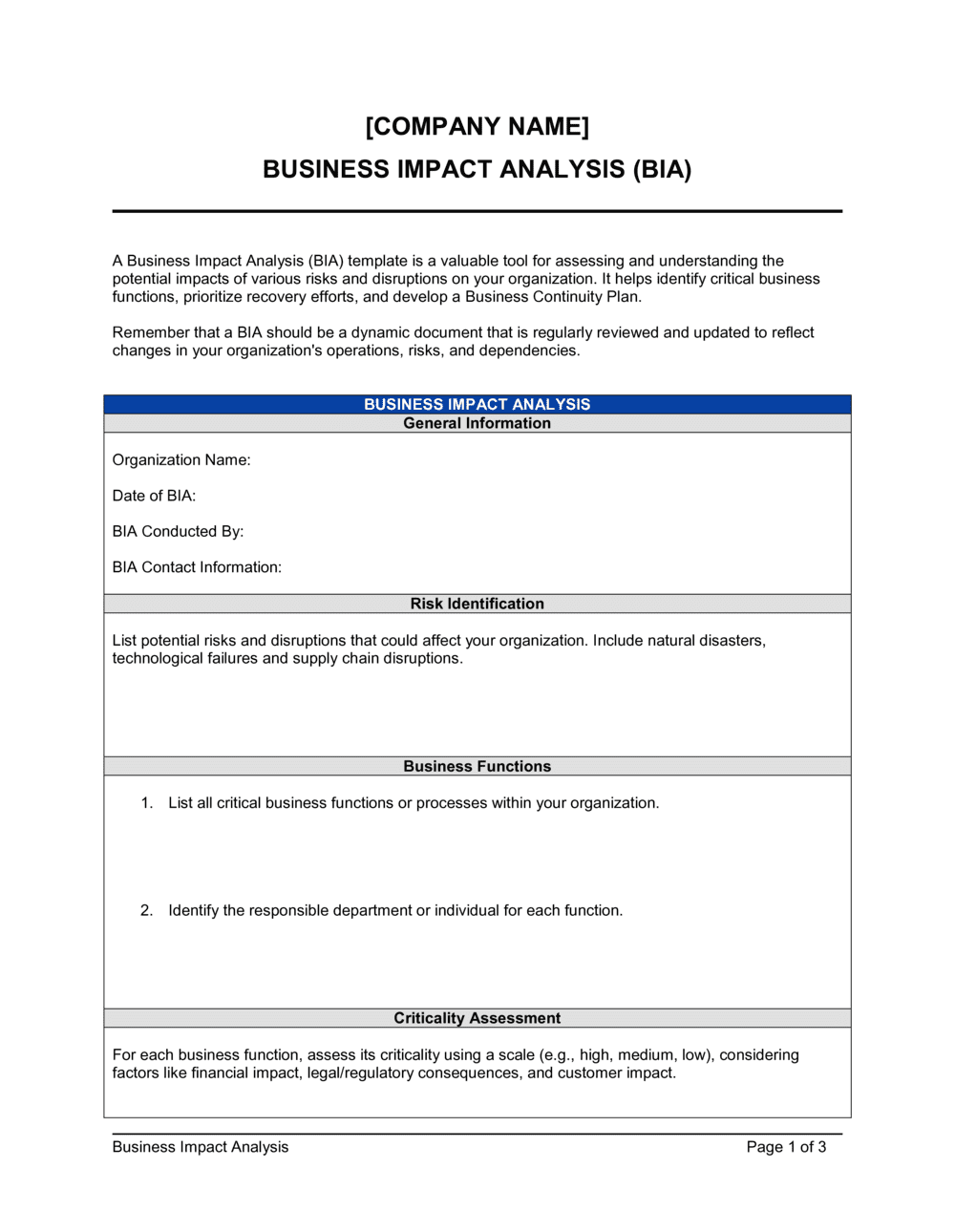
Identify which business units, locations, and processes the BIA will cover. Assemble a working group with one owner per business unit who can speak to their function's dependencies and criticality.
💡 Document the scope boundary in writing before any interviews begin — scope creep is the most common reason BIAs stall midway through.
2
Inventory all business functions within scope
List every function performed by each unit in scope. Classify each as High, Medium, or Low criticality based on revenue contribution, regulatory obligation, or customer commitment.
💡 Use a structured interview or survey for each business unit owner rather than relying on organizational charts — actual critical functions rarely align with org-chart hierarchy.
3
Map dependencies for each critical function
For each High and Medium criticality function, document the IT systems, key personnel, external suppliers, data sets, and facilities it depends on. Flag any dependency that has no backup or alternative.
💡 Ask the function owner: 'If this one thing were unavailable tomorrow morning, what would stop first?' — this surfaces SPOFs faster than structured checklists alone.
4
Quantify financial impact over time
For each critical function, estimate the direct cost of disruption at 1 hour, 4 hours, 1 day, and 1 week. Include lost revenue, idle labor cost, contractual penalties, and estimated recovery expenses.
💡 Pull actuals from your last incident or system outage as a baseline — estimated costs are always more credible when anchored to a real historical event.
5
Assess non-financial impacts
For each critical function, document regulatory risk, reputational exposure, customer SLA breach timing, and any staff safety implications. Rate each impact category as Low, Medium, or High.
💡 Cross-reference your regulatory obligations against each function — a compliance breach triggered at Hour 4 may be more consequential than a financial loss that accumulates over a week.
6
Set RTO, RPO, and MTD targets
Using the financial and non-financial impact data, set a Recovery Time Objective, Recovery Point Objective, and Maximum Tolerable Downtime for each critical function. Document the data supporting each target.
💡 Validate targets against your current IT recovery capabilities before finalizing — an RTO of 2 hours is meaningless if your backup restore process takes 6 hours.
7
Identify SPOFs and compile the risk summary
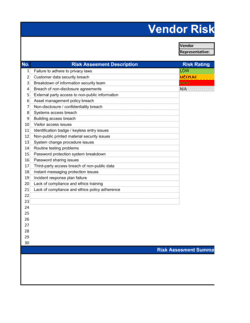
Review the dependency maps for every critical function and flag any resource — person, system, or supplier — with no documented backup. Assign a recommended action and a named owner to each SPOF.
💡 Limit the risk summary to the top 10 findings ranked by impact — a 40-item list with no prioritization will not drive action.
8
Build the recovery priority roadmap and present findings
Rank all critical functions by the order they must be restored, using MTD as the primary sort and financial impact as the tiebreaker. Present findings to leadership with specific investment or process recommendations.
💡 Express recovery priorities in clock-time milestones — 'restore within 4 hours of incident declaration' — not vague tiers, so the BCP team can write actionable procedures directly from this document.