Checklist Pre-Layoff

Free download β€’ Use as a template β€’ Print or share

2 pagesβ€’20–25 min to useβ€’Difficulty: Standard
Learn more ↓
FreeChecklist Pre-Layoff Template

At a glance

What it is
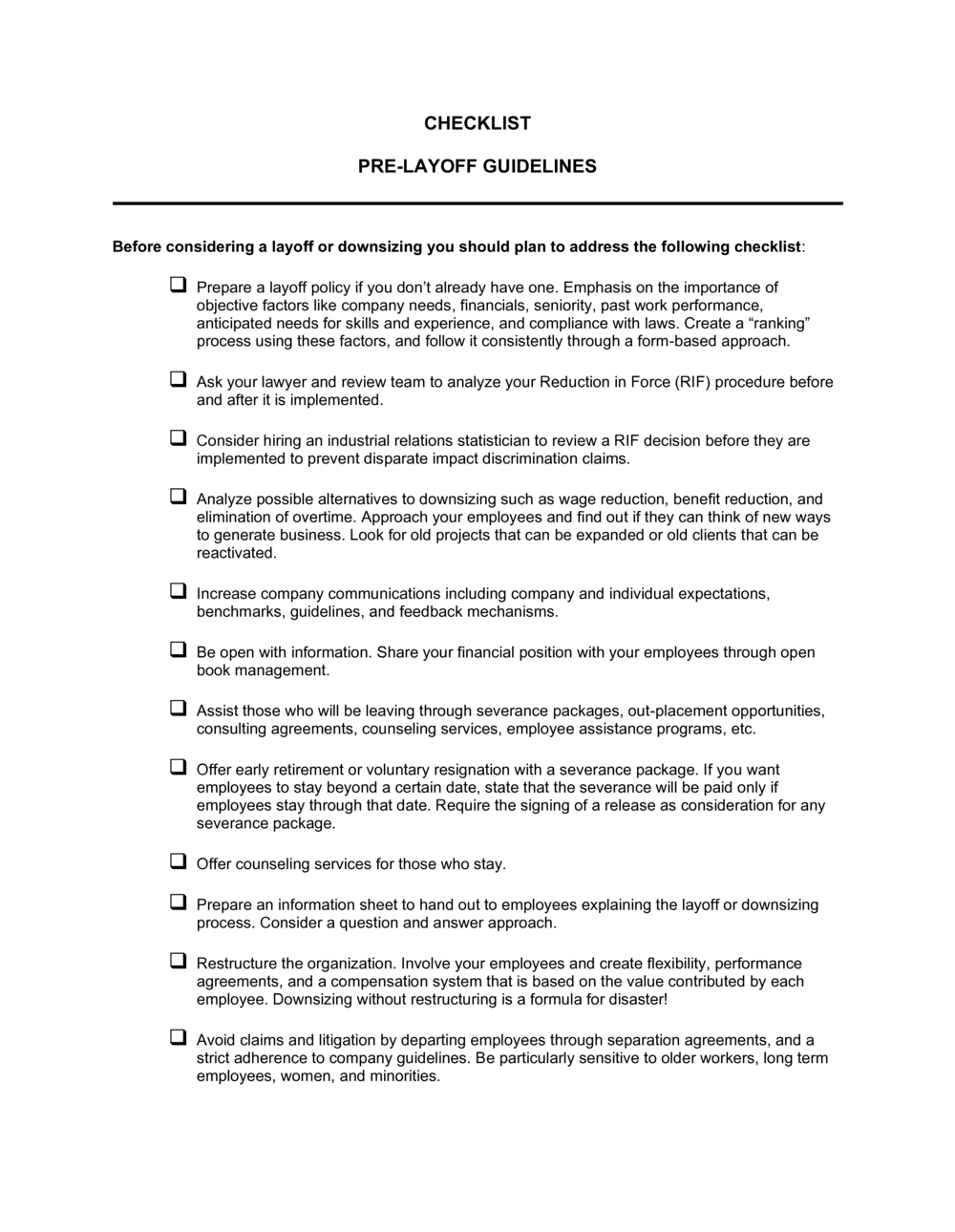
A Checklist Pre Layoff is a structured form HR teams and managers use to track every required action before notifying an employee of a layoff or reduction in force. This free Word download is fully editable β€” customize it for your organization's policies and export as PDF for use during the process.
When you need it
Use it when planning a single termination for economic reasons or a broader workforce reduction. It ensures nothing is missed between the decision to eliminate a role and the employee's last day.
What's inside
Legal and compliance verification steps, documentation and severance preparation tasks, IT and systems access items, manager communication guidance, and final offboarding confirmation checkboxes β€” all organized in a single printable form.

What is a Checklist Pre Layoff?

A Checklist Pre Layoff is a structured form that HR professionals and managers use to track every required action before notifying an employee of a layoff or reduction in force. It organizes compliance verification, documentation preparation, severance package review, IT access revocation, and communication sequencing into a single printable checklist β€” so nothing is missed between the internal decision to eliminate a role and the moment the employee is informed. Unlike a termination-for-cause process, a layoff requires additional steps specific to economic separations: adverse impact analysis, WARN Act assessment, and OWBPA waiting periods for employees aged 40 or older.

Why You Need This Document

A layoff handled without a written pre-layoff checklist is one of the most common sources of employment litigation, wage claims, and regulatory complaints. Skipping the adverse impact analysis exposes the company to EEOC charges even when the business reason is entirely legitimate. Presenting a severance agreement to an employee over 40 without the required consideration period voids the release of age discrimination claims β€” defeating the entire purpose of offering severance. Failing to issue the final paycheck on the state-mandated timeline turns a compliant reduction in force into a wage violation. This template gives HR teams and business owners a step-by-step process control tool that documents every action taken, creates a defensible paper trail, and ensures each affected employee is treated consistently β€” reducing legal exposure and protecting the organization before, during, and after the notification meeting.

Which variant fits your situation?

If your situation is…Use this template
Laying off a single employee for economic reasonsChecklist Pre Layoff
Conducting a formal written notification to the affected employeeLayoff Notice Letter
Documenting the terms of severance pay and conditionsSeverance Agreement
Conducting a structured offboarding after the layoff noticeEmployee Offboarding Checklist
Eliminating 50 or more employees at a single site requiring WARN Act noticeWARN Act Notice Template
Terminating an employee for cause rather than economic reasonsEmployee Termination Checklist

Common mistakes to avoid

❌ Skipping the adverse impact analysis

Why it matters: A layoff that disproportionately affects a protected class β€” even unintentionally β€” can trigger an EEOC charge or class-action lawsuit regardless of the business reason.

Fix: Run a statistical comparison of the protected-class composition of those selected against the eligible pool before any notifications go out.

❌ Revoking IT access before the notification meeting

Why it matters: An employee who loses system access before being told why immediately suspects what is coming β€” and may react by downloading files, contacting clients, or consulting an attorney before you have completed the process.

Fix: Schedule IT revocation to occur within minutes of the notification meeting ending, not before. Coordinate the timing explicitly with your IT team.

❌ Presenting the severance agreement without the required OWBPA waiting period

Why it matters: Employees age 40 and older must have 21 days to consider a severance agreement under OWBPA. Skipping this voids the release of age discrimination claims, negating the legal protection the agreement was designed to provide.

Fix: Flag every employee aged 40 or older on the checklist and build the 21-day consideration period into the severance timeline before scheduling notification.

❌ Not documenting the business reason for the layoff in writing

Why it matters: Without a written rationale on file, a terminated employee who sues for wrongful dismissal can claim the stated reason was pretextual, and you have no contemporaneous record to contradict that claim.

Fix: Complete the rationale field on the checklist at the time of the decision β€” before the notification meeting β€” and retain it in the employee's HR file.

The 10 key fields, explained

Employee and position information

Layoff rationale and classification

Legal and compliance review

Severance package details

Documentation preparation

IT and systems access revocation

Manager and stakeholder communication plan

Final pay and benefits reconciliation

Return of company property

Post-separation obligations reminder

How to fill it out

  1. 1

    Record the employee and position details

    Enter the employee's legal name, job title, department, and employee ID at the top of the checklist. Confirm the separation type is layoff (position elimination or reduction in force), not performance-based termination.

    πŸ’‘ Cross-check the name and ID against the payroll system before the checklist is used β€” a mismatch creates administrative errors in the severance paperwork.

  2. 2

    Complete the legal and compliance review

    Assess whether the WARN Act applies based on headcount and number of employees being separated. Run an adverse impact analysis comparing the protected-class composition of those selected against the broader workforce pool.

    πŸ’‘ Even if the WARN Act threshold is not met, document that you assessed it β€” this creates a clear compliance record if the layoff is later challenged.

  3. 3

    Prepare the severance package and documentation

    Calculate severance pay, confirm COBRA eligibility, and draft the severance agreement. Flag whether OWBPA applies (employee is 40 or older) and build the required consideration period into your timeline.

    πŸ’‘ Prepare the final paycheck calculation at the same time so it is ready to issue on the employee's last day without a separate rush request to payroll.

  4. 4

    Coordinate IT access revocation timing

    Work with IT to schedule system and physical access revocation for immediately after the notification meeting ends β€” not before, and not days later. List every system the employee accesses by name.

    πŸ’‘ For remote employees, confirm with IT that VPN and cloud application access is revoked within 15 minutes of the notification call ending.

  5. 5

    Plan the notification meeting sequence

    Set the date, time, location, and attendees for the notification meeting. Confirm the internal announcement to remaining staff is scheduled for after the affected employee has been notified.

    πŸ’‘ Hold the notification meeting on a Tuesday, Wednesday, or Thursday β€” Monday notifications leave the employee with a full week of uncertainty, and Friday meetings prevent access to support resources over the weekend.

  6. 6

    Conduct the property return and benefits wrap-up

    Use the property return section of the checklist during or immediately after the notification meeting. Provide written reminders of post-separation obligations β€” NDA, non-solicitation β€” at the same time.

    πŸ’‘ Issue a receipt for any company property returned on the spot. A signed acknowledgment eliminates disputes about what was and was not returned.

  7. 7

    File the completed checklist in the employee's HR record

    Once all boxes are checked and dates are recorded, file the completed checklist alongside the severance agreement and layoff letter in the employee's confidential HR file.

    πŸ’‘ Retain layoff documentation for at least four years β€” the statute of limitations for ADEA claims is three years, and employment records are frequently requested in class-action discovery.

Frequently asked questions

What is a pre-layoff checklist?

A pre-layoff checklist is a structured form that guides HR professionals and managers through every required action before notifying an employee of a layoff. It covers legal compliance steps, documentation preparation, IT access revocation, severance package details, and communication planning β€” ensuring nothing is missed between the decision to eliminate a role and the employee's final day.

What is the difference between a layoff and a termination for cause?

A layoff eliminates a position for business reasons β€” budget cuts, restructuring, or a reduction in force β€” and is not based on the employee's performance or conduct. Termination for cause removes an individual employee due to misconduct, policy violations, or performance failure. The two require different documentation, different notice obligations, and different severance considerations.

When does the WARN Act apply to a layoff?

The federal WARN Act applies to employers with 100 or more employees when a layoff affects 50 or more workers at a single site within a 30-day period. It requires 60 days' advance written notice to affected employees, state agencies, and local government. Many states have mini-WARN laws with lower thresholds β€” some apply to employers with as few as 50 total employees. Always assess both federal and state requirements before proceeding.

Is severance pay legally required during a layoff?

In the United States, severance pay is not federally mandated. However, if an employer has a written severance policy or the employment contract specifies severance terms, those obligations are enforceable. Most employers offer severance in exchange for a release of claims. In Canada and the UK, statutory notice or pay in lieu is required by law, with amounts based on length of service.

What is an adverse impact analysis and why does it matter?

An adverse impact analysis is a statistical review that compares the protected-class composition of employees selected for layoff against the pool from which selections were made. It identifies whether the reduction disproportionately affects employees by age, race, gender, or another protected characteristic. Running this analysis before notifications go out allows you to adjust selections or document a business justification β€” reducing exposure to discrimination claims.

How soon must a final paycheck be issued after a layoff?

Final paycheck timing is set by state law in the US and varies significantly β€” California requires payment on the last day of employment, while other states allow up to 72 hours or the next regular payday. Most states also require payout of accrued and unused PTO if company policy or state law mandates it. Confirm the specific deadline for your state before scheduling the notification meeting.

Should a pre-layoff checklist be kept confidential?

Yes. The completed checklist contains sensitive personal and legal information β€” severance amounts, OWBPA flags, and compliance notes β€” and should be treated as a confidential HR document. Store it in the employee's restricted personnel file, limit access to HR and legal personnel, and retain it for at least four years to cover potential discrimination claim statutes of limitations.

Can this checklist be used for a group layoff affecting multiple employees?

Complete one checklist per affected employee so each individual's severance terms, IT access items, and property return are tracked separately. For a group reduction in force, maintain a master tracking log that lists all affected employees alongside their notification dates, severance amounts, and completion status β€” but do not consolidate individual checklists, as each person's legal and documentation requirements may differ.

How this compares to alternatives

vs Employee Termination Checklist

An employee termination checklist covers separations for cause β€” misconduct, policy violations, or performance failure. A pre-layoff checklist addresses economic separations where the role is eliminated, not the individual. Layoffs require adverse impact analysis, WARN Act assessment, and OWBPA compliance steps that termination-for-cause checklists do not include.

vs Severance Agreement

A severance agreement is the binding contract that exchanges severance pay for a release of claims. The pre-layoff checklist is the process control tool used to prepare and present that agreement correctly. The checklist ensures the agreement is ready, the OWBPA waiting period is observed, and all supporting documentation is in place before the employee signs.

vs Employee Offboarding Checklist

An employee offboarding checklist covers the post-notification steps β€” equipment return, final paycheck, benefits wrap-up, and knowledge transfer β€” after the layoff has been announced. The pre-layoff checklist covers everything that must happen before the employee is notified. Both are needed for a complete, compliant process.

vs Layoff Notice Letter

A layoff notice letter is the written communication delivered to the employee confirming the separation, effective date, and severance terms. The pre-layoff checklist is the preparation tool that ensures the letter is ready, legally reviewed, and delivered at the right moment in the right sequence.

Industry-specific considerations

Technology / SaaS

Emphasis on immediate revocation of code repository, cloud infrastructure, and SaaS tool access to protect proprietary systems and customer data.

Financial Services

Regulatory licensing notifications, CRD record updates, and enhanced confidentiality reminders covering client account and trading data.

Manufacturing

Physical facility access deactivation, equipment and safety gear return, and union agreement interaction where collective bargaining agreements govern layoff procedures.

Professional Services

Client non-solicitation reminders are critical given direct client relationships, along with handoff of active files and billable matter documentation before departure.

Template vs pro β€” what fits your needs?

PathBest forCostTime
Use the templateHR managers and small business owners managing individual or small-group layoffs with standard severanceFree30–60 minutes per employee
Template + professional reviewLayoffs involving employees aged 40 or older, multi-state separations, or any reduction affecting 10 or more employees$300–$800 for an employment attorney review1–3 days
Custom draftedMass layoffs triggering WARN Act obligations, unionized workforces, or companies in heavily regulated industries$1,500–$5,000+ for employment counsel1–3 weeks

Glossary

Reduction in Force (RIF)
A planned elimination of positions β€” typically for economic, structural, or strategic reasons β€” rather than for individual performance.
WARN Act
The US Worker Adjustment and Retraining Notification Act, which requires employers with 100 or more employees to provide 60 days' advance notice before mass layoffs affecting 50 or more workers at a single site.
Severance Agreement
A contract between an employer and a departing employee that provides severance pay in exchange for a release of legal claims.
COBRA
A US federal law that allows terminated employees to continue their employer-sponsored health insurance coverage for up to 18 months at their own cost.
Adverse Impact Analysis
A statistical review of which employees are selected for layoff to identify unintentional discrimination based on protected characteristics such as age, race, or gender.
OWBPA
The Older Workers Benefit Protection Act, which requires employees 40 and older to receive 21 days to consider a severance agreement and 7 days to revoke it after signing.
Final Paycheck
The last wage payment owed to a departing employee, including any accrued and unused paid time off, due on a timeline set by state or provincial law.
Exit Interview
A structured conversation or written survey conducted with a departing employee to gather feedback on their experience and the reasons for their departure.
Position Elimination
A layoff scenario in which the employee's role is removed entirely from the organizational structure rather than replaced by another hire.

Part of your Business Operating System

This document is one of 3,000+ business & legal templates included in Business in a Box.

  • Fill-in-the-blanks β€” ready in minutes
  • 100% customizable Word document
  • Compatible with all office suites
  • Export to PDF and share electronically

Create your document in 3 simple steps.

From template to signed document β€” all inside one Business Operating System.
1
Download or open template

Access over 3,000+ business and legal templates for any business task, project or initiative.

2
Edit and fill in the blanks with AI

Customize your ready-made business document template and save it in the cloud.

3
Save, Share, Send, Sign

Share your files and folders with your team. Create a space of seamless collaboration.

Save time, save money, and create top-quality documents.

β˜…β˜…β˜…β˜…β˜…

"Fantastic value! I'm not sure how I'd do without it. It's worth its weight in gold and paid back for itself many times."

Managing Director Β· Mall Farm
Robert Whalley
Managing Director, Mall Farm Proprietary Limited
β˜…β˜…β˜…β˜…β˜…

"I have been using Business in a Box for years. It has been the most useful source of templates I have encountered. I recommend it to anyone."

Business Owner Β· 4+ years
Dr Michael John Freestone
Business Owner
β˜…β˜…β˜…β˜…β˜…

"It has been a life saver so many times I have lost count. Business in a Box has saved me so much time and as you know, time is money."

Owner Β· Upstate Web
David G. Moore Jr.
Owner, Upstate Web

Run your business with a system β€” not scattered tools

Stop downloading documents. Start operating with clarity. Business in a Box gives you the Business Operating System used by over 250,000 companies worldwide to structure, run, and grow their business.

Free Forever PlanΒ Β·Β No credit card required