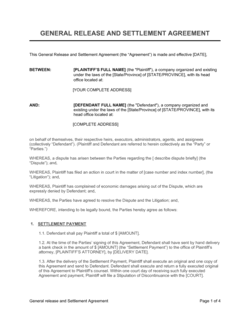
Board Resolution to Settle Litigation Template

Free Word download • Edit online • Save & share with Drive • Export to PDF

1 page20–30 min to fillDifficulty: StandardSignature requiredLegal review recommended
Learn more ↓
FreeBoard Resolution to Settle Litigation Template

At a glance

What it is
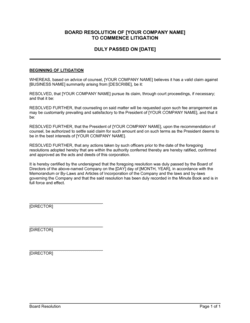
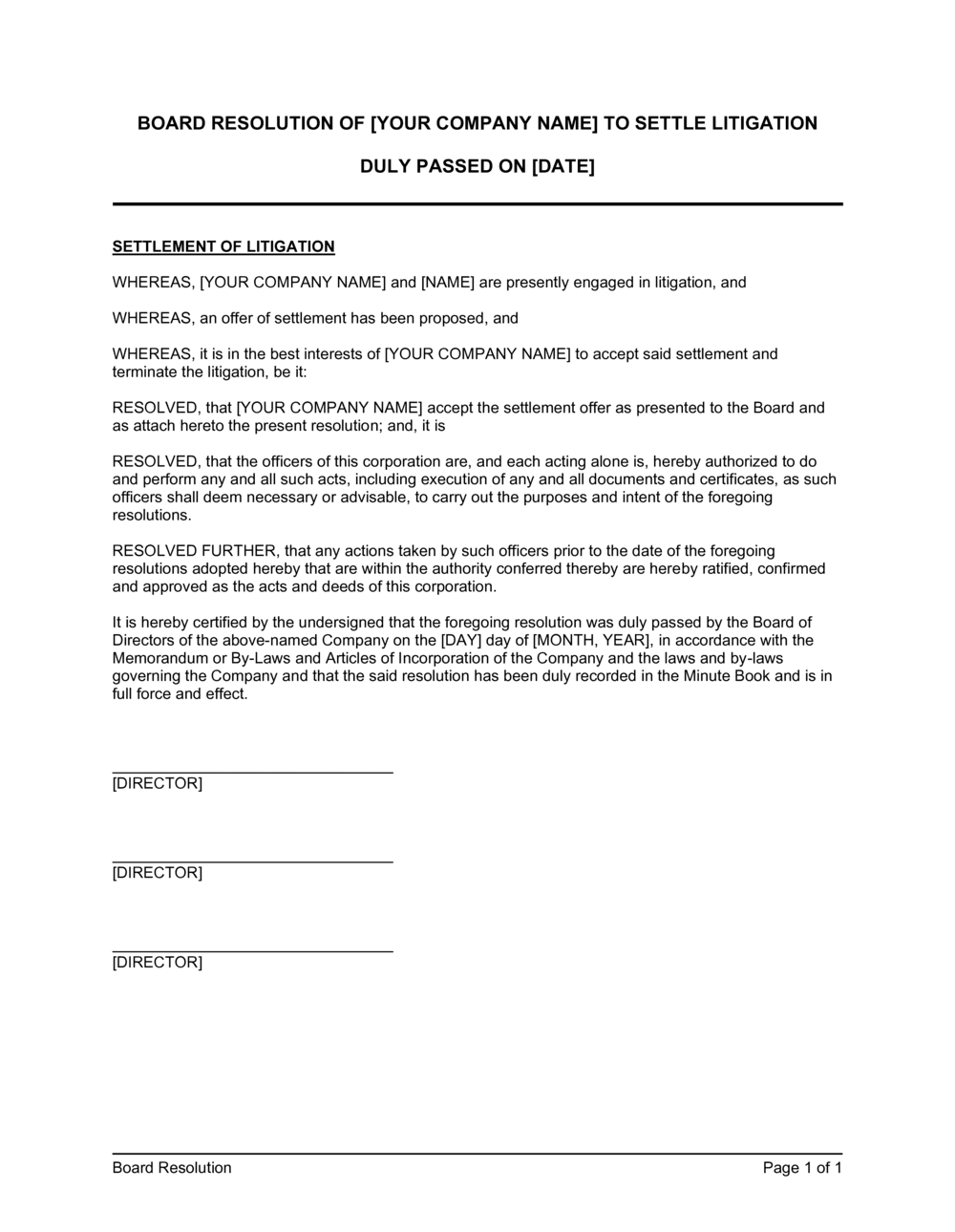
A Board Resolution To Settle Litigation is a formal corporate document in which a company's board of directors votes to authorize and approve the settlement of a pending or threatened legal dispute. This free Word download gives you a structured, attorney-ready starting point you can edit online and export as PDF — capturing the vote record, settlement terms, and the delegation of signing authority in a single enforceable resolution.
When you need it
Use it whenever a corporation needs to document board approval before executing a settlement agreement, satisfying the counterparty's counsel, a court, or an insurer that the company's signatory has proper corporate authority. It is typically required before any settlement exceeding a threshold set in the corporate bylaws or shareholders' agreement.
What's inside
Recitals identifying the litigation, a resolution clause granting settlement authority, delegation of signing power to named officers, the authorized settlement terms and payment amounts, a ratification clause for prior actions, and officer certification with signature blocks.

What is a Board Resolution To Settle Litigation?

A Board Resolution To Settle Litigation is a formal corporate governance document in which a company's board of directors votes to authorize the settlement of a pending or threatened legal dispute and delegates to named officers the power to execute the settlement agreement on the corporation's behalf. The resolution records the vote tally, confirms a quorum was present, documents the business judgment basis for the decision, and is certified by the corporate secretary as a true extract of the corporate minute book. Courts, counterparty counsel, and insurers routinely require a certified copy before a settlement can be finalized, making this document the essential link between a board's decision to end litigation and the officers' legal authority to sign on the company's behalf.

Why You Need This Document

Without a valid board resolution, an officer who signs a settlement agreement may be acting without corporate authority — exposing the company to an ultra vires challenge that could unwind the settlement entirely and leave both the litigation and any payments made in legal limbo. Counterparty counsel will typically refuse to file a stipulation of dismissal until they hold a certified resolution confirming the signatory was duly authorized. Litigation insurers condition payment on documented board approval. And in any future M&A transaction or financing round, buyers and lenders will review the corporate minute book — an undocumented settlement is a red flag that delays or reprices the deal. This template gives you a properly structured resolution that satisfies courts, opposing counsel, insurers, and auditors, capturing every required element — quorum, vote record, authorized terms, delegation, ratification, and certification — in a single document you can execute in under an hour.

Which variant fits your situation?

If your situation is…Use this template
Settling a lawsuit where the board meets in person or by teleconferenceBoard Resolution To Settle Litigation (Meeting Format)
Board cannot convene — needing unanimous written consent insteadWritten Consent of Directors in Lieu of Meeting
Settlement involves paying or receiving amounts above a material thresholdBoard Resolution To Settle Litigation (with CFO Certification)
Settling a dispute involving a related party or director personallyConflict-of-Interest Board Resolution
Authorizing outside counsel to enter into arbitration settlementBoard Resolution Authorizing Legal Representation
Recording settlement approval for a nonprofit or charitable entityNonprofit Board Resolution
LLC member vote needed to authorize settlement instead of a boardLLC Member Resolution To Settle Litigation

Common mistakes to avoid

❌ Using a trade name instead of the registered legal entity

Why it matters: A resolution signed by 'ABC Widgets' instead of 'ABC Widgets, Inc.' will be rejected by counterparty counsel and may not satisfy a court requiring proof of corporate authority. The mismatch can delay or derail settlement execution.

Fix: Pull the exact entity name from the state or provincial incorporation registry before drafting and use it verbatim in every field of the resolution.

❌ Omitting the vote tally and quorum confirmation

Why it matters: A resolution that says only 'duly adopted' without a recorded quorum and vote count cannot be verified by a court, a lender, or an insurer. It may be treated as an unsigned internal memo rather than a binding corporate act.

Fix: Record the total board size, number present, quorum threshold from the bylaws, and the exact for/against/abstain count every time — make it a standard template field you cannot overlook.

❌ Approving 'the settlement' without stating the authorized terms

Why it matters: A term-free resolution provides no internal check on what officers actually sign. If the settlement agreement is later disputed or amended, the corporation has no documentary evidence of what the board approved.

Fix: Insert the settlement amount, release scope, payment deadline, and any key non-monetary conditions directly into the operative resolution clause, even if they mirror the attached exhibit.

❌ Signing after the settlement agreement is already executed

Why it matters: A board resolution signed after the settlement agreement creates an ultra vires risk — the signatory lacked authority at the time of execution. Counterparties and courts can challenge the agreement's enforceability on this basis.

Fix: Adopt and certify the resolution before any officer executes the settlement agreement. If timing is unavoidable, include a strong retroactive ratification clause and consult counsel about whether additional steps are needed.

❌ Having the settlement signatory also certify the resolution

Why it matters: The corporate secretary's certification is meant to be an independent confirmation that the board properly authorized the signatory's acts. Self-certification undermines that independence and is a red flag during legal due diligence.

Fix: Designate a different officer — the corporate secretary, assistant secretary, or a non-signing director — to execute the certification block.

❌ Failing to address a conflicted director's recusal

Why it matters: A director with a personal financial interest in the settlement outcome who votes without recusing creates a duty-of-loyalty problem. The resolution — and the settlement — can be challenged by shareholders or a trustee in bankruptcy on interested-director grounds.

Fix: Identify any director with a personal stake in the litigation outcome before the meeting, have them recuse and leave the room, and record the recusal by name and stated reason in the vote record clause.

The 10 key clauses, explained

Caption and identification of the corporation

In plain language: Opens the resolution by naming the exact legal entity — full registered corporate name, state or province of incorporation, and date of the resolution.

Sample language
BOARD RESOLUTION OF [FULL LEGAL CORPORATE NAME], a [STATE/PROVINCE] [ENTITY TYPE] ('Corporation'), adopted on [DATE].

Common mistake: Using a trade name or DBA instead of the registered legal entity name. Counterparty counsel and courts will reject a resolution that does not match the entity named in the litigation caption.

Recitals — description of the litigation

In plain language: Sets out the background: the name of the case, the parties, the court or arbitral forum, the nature of the claims, and the stage of the proceedings.

Sample language
WHEREAS, the Corporation is a [plaintiff/defendant] in the matter of [CASE NAME], Case No. [CASE NUMBER], pending in the [COURT NAME], involving claims related to [BRIEF DESCRIPTION OF DISPUTE];

Common mistake: Describing the claims so vaguely that the resolution cannot be matched to the specific litigation. If the company has multiple active disputes, a vague recital creates ambiguity about which case is being settled.

Recitals — basis for settlement

In plain language: States the board's business judgment reasons for settling — typically cost, risk, management distraction, and the recommendation of litigation counsel.

Sample language
WHEREAS, the Board has reviewed and considered the recommendation of [OUTSIDE COUNSEL NAME] and has determined that settlement of the Litigation on the terms described herein is in the best interests of the Corporation;

Common mistake: Omitting any reference to counsel's recommendation. Courts and insurers scrutinize settlement approvals — documenting that the board received legal advice supports the business judgment rule defense if the decision is later challenged.

Resolution to approve settlement

In plain language: The operative clause formally resolving that the settlement is approved on specific terms, including the settlement amount, release scope, and any non-monetary conditions.

Sample language
RESOLVED, that the settlement of the Litigation on terms including payment of $[AMOUNT] by [PAYING PARTY] to [RECEIVING PARTY], mutual releases of all claims through [DATE], and [ANY NON-MONETARY TERMS], is hereby approved.

Common mistake: Approving 'the settlement' without specifying the key financial and release terms in the resolution itself. If the settlement agreement is later amended, a term-free resolution provides no check on what was actually authorized.

Delegation of signing authority

In plain language: Names the specific officer or officers authorized to sign the settlement agreement and any related documents — releases, stipulations, court filings, and payment instructions.

Sample language
RESOLVED FURTHER, that [CEO / PRESIDENT / NAMED OFFICER TITLE], and each of them acting individually, is hereby authorized and directed to execute and deliver the Settlement Agreement and all related documents on behalf of the Corporation.

Common mistake: Delegating authority generically to 'any officer' without naming titles. Counterparty counsel may demand a resolution that names the exact signatory to confirm the person who signed the agreement had authority.

Authorization for related acts

In plain language: Grants the authorized officer broad authority to take all further actions necessary to carry out the settlement — making payments, dismissing claims, and executing ancillary documents.

Sample language
RESOLVED FURTHER, that the authorized officers are hereby authorized to take any and all additional actions, execute any and all additional documents, and make any payments necessary or advisable to carry out and consummate the settlement.

Common mistake: Limiting the clause to signing only the settlement agreement. Payment instructions, court dismissals, tax forms, and releases often require separate signatures — an overly narrow delegation creates gaps.

Ratification of prior acts

In plain language: Confirms that actions already taken by officers or counsel in connection with negotiating or partially performing the settlement are ratified and approved by the board retroactively.

Sample language
RESOLVED FURTHER, that all actions taken prior to the date of this Resolution by the officers and agents of the Corporation in connection with the negotiation, documentation, and performance of the settlement are hereby ratified, confirmed, and approved.

Common mistake: Omitting the ratification clause when officers have already signed term sheets or exchanged binding emails. Without ratification, those prior acts remain potentially unauthorized and could be challenged.

Vote record

In plain language: Records the number of directors present, the quorum confirmation, and the vote tally — for, against, and abstaining — along with any director recusals for conflict of interest.

Sample language
The foregoing Resolution was adopted by a vote of [X] directors in favor, [X] opposed, and [X] abstaining, constituting a quorum of the Board of Directors of the Corporation. [DIRECTOR NAME] recused [himself/herself] due to [CONFLICT].

Common mistake: Omitting the vote tally entirely and recording only that the resolution was 'duly adopted.' A bare adoption statement without a quorum and vote count is insufficient for courts and lenders requiring proof of proper corporate action.

Corporate secretary certification

In plain language: A signed certification by the corporate secretary confirming the resolution is a true and accurate record, was duly adopted in accordance with the bylaws, and remains in full force.

Sample language
I, [NAME], Corporate Secretary of [CORPORATION NAME], hereby certify that the foregoing is a true and correct copy of a resolution duly adopted by the Board of Directors at a [meeting/written consent] on [DATE], and that this Resolution is in full force and effect.

Common mistake: Having the same person who signed the settlement agreement certify the resolution. The corporate secretary should be a different individual to maintain the separation between authorization and execution.

Governing law reference

In plain language: States the jurisdiction whose corporate law governs the validity and interpretation of the resolution — typically the state or province of incorporation.

Sample language
This Resolution shall be governed by and construed in accordance with the laws of the State/Province of [JURISDICTION], without regard to conflict-of-law principles.

Common mistake: Omitting governing law entirely. If the corporation is incorporated in one state and the litigation is in another, the absence of a governing law clause creates ambiguity about which corporate statute controls the resolution's validity.

How to fill it out

  1. 1

    Enter the corporation's full legal name and incorporation details

    Use the exact registered entity name as it appears in the incorporation documents — not a trade name or abbreviation. Include the state or province of incorporation and the date the resolution is adopted.

    💡 Cross-reference the litigation caption to ensure the entity name in the resolution matches exactly — any discrepancy will require a corrective certificate.

  2. 2

    Complete the litigation recitals with case-specific detail

    Enter the case name, docket number, court or arbitral forum, a brief description of the claims, and whether the corporation is plaintiff or defendant. If multiple claims are at issue, list each one.

    💡 Pull the case caption directly from the most recent court filing to ensure the format and spelling are identical.

  3. 3

    Document the basis for the board's settlement decision

    In the second recital, summarize the board's business judgment reasoning — litigation risk, estimated defense cost, counsel's recommendation, and management distraction. This supports the business judgment rule if the decision is later challenged.

    💡 Reference outside counsel by firm name and the date their written recommendation was received, even if it was delivered verbally — ask counsel to confirm in a brief email you can cite.

  4. 4

    State the approved settlement terms precisely

    Enter the settlement amount, which party pays, the payment deadline, the scope of the mutual releases (claims through what date), and any non-monetary conditions such as confidentiality, non-disparagement, or injunctive relief.

    💡 If the settlement agreement has not been fully negotiated, use bracketed placeholders and pass a second resolution once terms are final — do not leave key financial terms blank in the operative clause.

  5. 5

    Name the authorized signatories by title and name

    List the specific officers authorized to sign the settlement agreement, with both their title and full legal name. If more than one officer may sign, state whether they may act individually or must act jointly.

    💡 Confirm each named signatory's title matches their current officer designation in the corporate minute book — outdated titles create enforceability questions.

  6. 6

    Record the quorum and vote tally

    Confirm the total number of directors on the board, how many were present or participating, the quorum threshold under the bylaws, and the exact vote count for, against, and abstaining. Note any recusals by name and stated reason.

    💡 If any director participated by telephone or video, note the technology used — most modern corporation statutes permit remote participation but require it to be recorded.

  7. 7

    Have the corporate secretary certify and sign

    The corporate secretary should sign the certification block with their full name, title, and the certification date. The signature confirms the resolution is a true extract of the corporate records and was duly adopted.

    💡 Keep the original signed resolution in the corporate minute book and provide certified copies to outside counsel, the counterparty's counsel, and the insurer if litigation defense costs are covered by a policy.

  8. 8

    Attach or reference the settlement agreement as an exhibit

    Attach the final executed settlement agreement — or the most current draft — as Exhibit A to the resolution so the authorized terms are part of the corporate record.

    💡 If the agreement is finalized after the resolution is passed, pass a brief confirming resolution or have the corporate secretary note the final agreement date in the minute book alongside the original resolution.

Frequently asked questions

What is a board resolution to settle litigation?

A board resolution to settle litigation is a formal corporate document recording the board of directors' vote to authorize a settlement of a pending or threatened legal dispute. It establishes that the corporation's signatory has proper authority to execute the settlement agreement, satisfies courts and counterparty counsel who require proof of corporate authorization, and creates a permanent record in the corporate minute book.

When does a corporation need a board resolution to settle litigation?

A corporation typically needs this resolution any time a settlement amount exceeds the threshold set in its bylaws or shareholders' agreement for officer authority to act alone — commonly $10,000 to $100,000 depending on company size. Courts and opposing counsel routinely require it before filing stipulations of dismissal. Insurers covering litigation costs also generally require documented board authorization before issuing settlement payments.

Can an officer settle litigation without a board resolution?

In some cases yes — if the corporate bylaws or a prior blanket resolution grant officers authority to settle disputes up to a specified dollar amount. However, for settlements above that threshold, execution without a resolution creates an ultra vires risk: the settlement can be challenged as unauthorized. In practice, most counterparties and their counsel request a certified resolution regardless of amount to eliminate any authority questions before closing the deal.

What is the difference between a board resolution and minutes?

Minutes are the full written record of a board meeting's proceedings — they document everything discussed, all resolutions passed, and the attendance record. A board resolution is a specific decision extracted from or adopted at a meeting, focused on one or more discrete corporate actions. A certified copy of a resolution is typically what courts, lenders, and counterparties request because it is concise and directly confirms the action taken, without the context of broader meeting discussions.

Does the resolution need to be notarized?

Notarization is not generally required for a board resolution to be valid and enforceable under US, Canadian, UK, or EU corporate law. The corporate secretary's certification and the directors' signatures are sufficient in most jurisdictions. However, if the settlement involves real property, foreign enforcement, or court filing requirements in certain jurisdictions, notarization or apostille may be required — confirm with litigation counsel before execution.

What happens if a director has a conflict of interest in the settlement?

A director with a personal financial interest in the outcome of the litigation — for example, as an individual defendant in the same case — must recuse from the vote to avoid breaching their duty of loyalty to the corporation. The recusal should be recorded by name and stated reason in the resolution's vote record. Remaining non-conflicted directors should constitute a quorum. Failing to recuse a conflicted director exposes the resolution and the settlement to challenge by shareholders or a bankruptcy trustee.

How long should the corporation keep this resolution?

The resolution should be kept permanently in the corporate minute book alongside the executed settlement agreement. Most corporate governance guidelines and US state corporation statutes require permanent retention of board resolutions. Even after the litigation is fully resolved, the resolution may be needed for future due diligence — such as an M&A transaction — where a buyer's counsel reviews the corporation's litigation history and settlement authority.

Do I need a lawyer to prepare a board resolution to settle litigation?

For straightforward commercial settlements with clear terms and no conflicted directors, a well-structured template is often sufficient for the resolution itself. However, litigation counsel should always review the settlement agreement the resolution authorizes. Engage a corporate lawyer to review or draft the resolution when the settlement is material in size, involves a related-party conflict, requires court approval, or will be scrutinized in an M&A due diligence process.

How this compares to alternatives

vs Written Consent of Directors in Lieu of Meeting

A written consent achieves the same authorization outcome as a board resolution but without convening a formal meeting — directors sign individually and the consent must typically be unanimous. A board resolution adopted at a meeting is appropriate when directors need to deliberate, a quorum is readily available, or the bylaws require a meeting for material actions. Use written consent when speed is critical and all directors are aligned.

vs Settlement Agreement

The settlement agreement is the binding contract between the disputing parties that resolves the litigation. The board resolution is the internal corporate authorization that gives an officer the power to sign that agreement on the corporation's behalf. Both documents are needed: the resolution without the settlement agreement settles nothing; the settlement agreement without the resolution may be unenforceable as unauthorized.

vs Corporate Authorization Letter

A corporate authorization letter is a simpler document signed by an officer confirming that another individual has authority to act on behalf of the company. It does not record a board vote and carries no quorum or vote record. A board resolution is the authoritative governance document required by courts and counterparty counsel; an authorization letter may be a useful supplement but is not a substitute.

vs Power of Attorney

A power of attorney grants a named agent broad or specific legal authority to act on a principal's behalf — it is an external-facing instrument. A board resolution is an internal corporate governance document recording the directors' authorization decision. Some settlements require both: the resolution documents the board's approval, and a limited power of attorney formally empowers outside counsel to sign ancillary documents on closing day.

Industry-specific considerations

Technology / SaaS

Frequently used to authorize settlement of IP infringement claims, software licensing disputes, and data breach litigation where board-level authorization thresholds are typically lower to satisfy investor governance requirements.

Construction and Real Estate

Required for settling contractor disputes, mechanics' lien claims, and construction defect litigation, where settlement payments often involve multiple related entities and require clear delegation to a project officer.

Financial Services

Regulatory and compliance requirements in banking, securities, and insurance sectors mean board-level settlement authorization is frequently mandatory and scrutinized by regulators during examinations.

Healthcare

Malpractice, billing dispute, and HIPAA-related settlements require documented board authorization for insurance coverage purposes, and resolutions must align with medical staff bylaw requirements at hospital entities.

Manufacturing

Product liability, supply chain contract disputes, and workplace injury settlements require board authorization when amounts exceed typical officer authority levels, with the resolution often attached to insurance claim files.

Professional Services

Law firms, accounting firms, and consulting companies use board resolutions to authorize settlement of professional liability claims, with the resolution serving as evidence of proper governance to the professional liability insurer.

Jurisdictional notes

United States

Corporate authority to settle litigation is governed by state corporation statutes — Delaware, Nevada, and California each have distinct rules on board delegation and officer authority. Most bylaws set a dollar threshold above which board approval is required. Some states require a majority of disinterested directors to approve settlements involving a conflicted director under duty-of-loyalty safe-harbor provisions such as DGCL §144.

Canada

Under the Canada Business Corporations Act and provincial equivalents, directors may delegate settlement authority to officers within limits set by the articles or bylaws. Quebec civil law requires particular attention to the resolution's language to ensure it meets Code civil requirements for mandate and representation. Written resolutions in lieu of meetings are permitted under the CBCA when signed by all directors entitled to vote.

United Kingdom

UK company law under the Companies Act 2006 allows boards to pass resolutions at meetings or by written resolution under the articles of association. For settlements involving amounts that could constitute a substantial property transaction or a payment to a director, shareholder approval under sections 190 or 197 may be required in addition to a board resolution. The resolution should reference the specific article granting delegation authority.

European Union

EU member states vary significantly in board authority requirements for settlement. German GmbH and AG law requires specific Geschäftsführer authorization tracked in board minutes; French SAS and SA structures may require supervisory board approval for significant settlements. In many EU jurisdictions, notarization of the resolution or an apostille is required before the document is recognized in cross-border enforcement proceedings.

Template vs lawyer — what fits your deal?

PathBest forCostTime
Use the templateStraightforward commercial settlements with clear terms, no conflicted directors, and amounts within routine officer authority thresholdsFree30–60 minutes
Template + legal reviewSettlements above $50,000, those involving related-party conflicts, or matters where an insurer requires documented board authorization$300–$800 (1–2 hours of corporate counsel review)1–3 days
Custom draftedMaterial litigation settlements, court-supervised settlements, publicly traded companies, or M&A transactions where settlement history is subject to buyer due diligence$1,000–$3,500+3–7 days

Glossary

Board Resolution
A formal written record of a decision made by a company's board of directors, binding on the corporation once duly adopted.
Quorum
The minimum number of directors who must be present or participating for a board vote to be legally valid under the corporate bylaws.
Recitals
The introductory clauses of a resolution (often beginning with 'WHEREAS') that set out the background facts and reasons for the board's decision.
Delegation of Authority
A provision in the resolution naming one or more officers who are authorized to sign the settlement agreement and take related actions on behalf of the corporation.
Ratification
A clause confirming that actions already taken by officers or counsel in connection with the settlement are approved and adopted retroactively by the board.
Ultra Vires
An act taken beyond a corporation's legal powers or without proper authority — a settlement executed without a valid board resolution can be challenged on this basis.
Settlement Agreement
The binding contract between the disputing parties that resolves the litigation, the execution of which the board resolution authorizes.
Corporate Secretary Certification
A signed statement by the corporate secretary certifying that the resolution was duly adopted, a quorum was present, and the vote count is accurately recorded.
Minutes
The written record of a board meeting's proceedings, including resolutions passed — the board resolution is often extracted from or appended to the minutes.
Signatory Authority
The legal power of a named individual to bind a corporation by signing contracts and legal documents on its behalf.
Written Consent in Lieu of Meeting
A procedure allowing directors to adopt a resolution by signing a written consent form instead of holding a formal meeting, permitted in most jurisdictions when unanimous.

Part of your Business Operating System

This document is one of 3,000+ business & legal templates included in Business in a Box.

  • Fill-in-the-blanks — ready in minutes
  • 100% customizable Word document
  • Compatible with all office suites
  • Export to PDF and share electronically

Create your document in 3 simple steps.

From template to signed document — all inside one Business Operating System.
1
Download or open template

Access over 3,000+ business and legal templates for any business task, project or initiative.

2
Edit and fill in the blanks with AI

Customize your ready-made business document template and save it in the cloud.

3
Save, Share, Send, Sign

Share your files and folders with your team. Create a space of seamless collaboration.

Save time, save money, and create top-quality documents.

★★★★★

"Fantastic value! I'm not sure how I'd do without it. It's worth its weight in gold and paid back for itself many times."

Managing Director · Mall Farm
Robert Whalley
Managing Director, Mall Farm Proprietary Limited
★★★★★

"I have been using Business in a Box for years. It has been the most useful source of templates I have encountered. I recommend it to anyone."

Business Owner · 4+ years
Dr Michael John Freestone
Business Owner
★★★★★

"It has been a life saver so many times I have lost count. Business in a Box has saved me so much time and as you know, time is money."

Owner · Upstate Web
David G. Moore Jr.
Owner, Upstate Web

Run your business with a system — not scattered tools

Stop downloading documents. Start operating with clarity. Business in a Box gives you the Business Operating System used by over 250,000 companies worldwide to structure, run, and grow their business.

Start free · No credit card required