Board Resolution Amending the Signing of Checks Template

Free Word download • Edit online • Save & share with Drive • Export to PDF

2 pages20–30 min to fillDifficulty: StandardSignature requiredLegal review recommended
Learn more ↓
FreeBoard Resolution Amending the Signing of Checks Template

At a glance

What it is
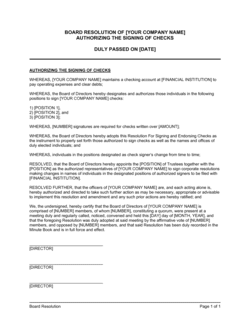
A Board Resolution Amending the Signing of Checks is a formal corporate document in which a company's board of directors officially changes who is authorized to sign checks and other financial instruments on behalf of the organization. This free Word download gives you a ready-to-edit template that can be executed, certified, and submitted to your bank to update your account records in a single sitting.
When you need it
Use it whenever an authorized signatory leaves the company, a new officer or director assumes financial responsibility, the board changes its signing threshold policy (for example, requiring two signatures above $10,000), or the organization opens or consolidates bank accounts.
What's inside
Meeting or consent details, recitals revoking prior authority, a clear designation of new authorized signatories with their titles, applicable signing thresholds or dual-signature requirements, bank account identification, certification language, and officer signatures — everything a financial institution needs to update its records immediately.

What is a Board Resolution Amending the Signing of Checks?

A Board Resolution Amending the Signing of Checks is a formal corporate document adopted by a company's board of directors to officially change who is authorized to sign checks, drafts, and other financial instruments drawn on the company's bank accounts. It revokes any prior check-signing authority, designates newly authorized signatories by full legal name and corporate title, establishes applicable signing thresholds or dual-signature requirements, and identifies the specific accounts covered. Once certified by the corporate secretary, it is delivered to the company's financial institution as the binding instruction to update account-level signing authority.

Why You Need This Document

Operating without a current, formally adopted check-signing resolution exposes your organization to two distinct risks simultaneously. First, a departed officer whose authority was never formally revoked may still be able to sign checks — and your bank may be legally obligated to honor those instruments if an outdated resolution remains on file. Second, an incoming officer who begins signing checks without board authorization may expose the company to internal control findings, audit exceptions, or — in the case of nonprofits and regulated entities — regulatory violations. Banks will not accept verbal instructions or informal emails to change signatory authority; they require a certified board resolution every time. This template gives you a properly structured, bank-ready document that closes both gaps in under 30 minutes, with clear revocation language, explicit signatory designations, and a certification block that meets the evidentiary standards of financial institutions across North America and the UK.

Which variant fits your situation?

If your situation is…Use this template
Appointing the first authorized signatories at company formationBoard Resolution Authorizing Check Signing
Removing a signatory without appointing a replacementBoard Resolution Revoking Check Signing Authority
Amending signing authority across all corporate bank accountsBoard Resolution Amending the Signing of Checks
Authorizing a specific officer to open or close a bank accountBoard Resolution to Open a Bank Account
Delegating check signing to a non-officer employee for operationsBoard Resolution Delegating Financial Authority
Updating electronic payment and wire transfer authorizationBoard Resolution Authorizing Electronic Funds Transfers
Establishing a dollar threshold requiring dual signaturesBoard Resolution Setting Dual-Signature Policy

Common mistakes to avoid

❌ Failing to revoke prior signatory authority explicitly

Why it matters: A departing officer whose authority was not formally revoked may still be able to sign checks, and the bank may be legally obligated to honor those instruments if the prior resolution is still on file.

Fix: Include a specific revocation clause naming or referencing all prior resolutions granting check-signing authority, effective upon delivery of the new resolution to the bank.

❌ Using only job titles instead of full legal names for signatories

Why it matters: Banks verify signatories against government-issued ID. A resolution listing 'the CFO' without a name creates ambiguity every time the officer in that role changes.

Fix: List each signatory's full legal name and corporate title. When an officer changes, adopt a new amending resolution rather than relying on the title to carry forward.

❌ Adopting the resolution without confirming quorum

Why it matters: A resolution passed without a quorum of directors is procedurally defective and may be challenged by auditors, lenders, or the bank's compliance team — voiding the authority it purports to grant.

Fix: Confirm the required quorum under your bylaws before the meeting, record attendance in the minutes, and state in the resolution that quorum was present and acting.

❌ Delivering the resolution to the bank without a certified copy for the minute book

Why it matters: The minute book is the definitive record of corporate action. A resolution that exists only at the bank and not in your corporate records creates a gap that surfaces in due diligence, audits, and legal disputes.

Fix: Retain at least one certified copy of every adopted resolution in the corporate minute book and a digital backup. Deliver a separate certified copy to each affected financial institution.

❌ Setting a dual-signature threshold in the resolution but not on the bank account

Why it matters: Banks enforce signing controls at the account level, not purely based on a resolution on file. A threshold stated only in the resolution may not be enforced by the bank's systems.

Fix: Contact your bank's corporate banking officer when delivering the resolution and confirm whether the threshold must also be configured in the account profile — obtain written confirmation that it has been.

❌ Dating the resolution after delivering it to the bank

Why it matters: A resolution dated after delivery creates a timeline inconsistency that can expose the company to claims of unauthorized transactions during the gap period.

Fix: Always execute and date the resolution before or on the date it is delivered to the bank. Use the date of the last required signature as the execution date.

The 9 key clauses, explained

Recitals and authority basis

In plain language: States that the board is empowered to act, identifies the company's legal name and jurisdiction of incorporation, and references any prior resolutions being superseded.

Sample language
WHEREAS, [COMPANY LEGAL NAME], a [STATE/PROVINCE] [ENTITY TYPE] (the 'Corporation'), is duly organized and existing; and WHEREAS, the Board of Directors previously authorized certain individuals to sign checks as set forth in resolutions dated [PRIOR DATE], which the Board now wishes to amend;

Common mistake: Omitting the reference to prior resolutions. Without it, the bank may find two conflicting resolutions on file and require legal clarification before honoring either one.

Meeting or written consent recitation

In plain language: Records how the resolution was adopted — either at a duly noticed meeting with a quorum present and voting, or by unanimous written consent of all directors.

Sample language
BE IT RESOLVED, that at a [special / regular] meeting of the Board of Directors of the Corporation held on [DATE] at [TIME], at which a quorum was present and acting throughout, the following resolutions were duly adopted:

Common mistake: Failing to confirm quorum. A resolution adopted without quorum is procedurally defective and can be challenged by a bank, auditor, or counterparty.

Revocation of prior signatory authority

In plain language: Expressly cancels any previously granted check-signing authority so that former signatories have no continuing power to bind the company's accounts.

Sample language
RESOLVED, that any and all prior authorizations granted to individuals to sign checks or other financial instruments on behalf of the Corporation are hereby revoked in their entirety, effective immediately upon certification of this resolution to the Corporation's financial institutions.

Common mistake: Using soft language like 'superseded' without explicitly revoking. Banks have honored checks from removed signatories because the revocation wording was ambiguous.

Designation of new authorized signatories

In plain language: Names each newly authorized individual by full legal name and corporate title, and states the scope of their authority — which accounts, which instrument types, and any dollar limits.

Sample language
RESOLVED, that the following individuals are hereby authorized to sign checks, drafts, and other orders for the payment of money drawn on any account of the Corporation: [FULL NAME], [TITLE]; [FULL NAME], [TITLE]; each acting individually up to $[THRESHOLD AMOUNT].

Common mistake: Listing individuals by title only, without their legal names. If an officer changes, the bank cannot confirm identity without a name match.

Dual-signature threshold

In plain language: Specifies the dollar amount above which two authorized signatures are required on a single instrument, establishing an internal financial control.

Sample language
RESOLVED FURTHER, that any check, draft, or payment order in an amount exceeding $[DUAL-SIGNATURE THRESHOLD] shall require the signatures of any two of the above-authorized individuals before the Corporation's financial institution shall honor such instrument.

Common mistake: Setting the dual-signature threshold in the resolution but failing to communicate it to the bank. The bank is only bound if the threshold is formally registered on the account.

Account identification

In plain language: Identifies the specific bank accounts covered by this resolution, either by account number, account name, or by reference to all accounts held at the named institution.

Sample language
RESOLVED FURTHER, that this resolution applies to all accounts maintained by the Corporation at [BANK NAME], including without limitation account number(s) [ACCOUNT NUMBER(S)], and any accounts subsequently opened at the same institution.

Common mistake: Omitting account numbers and relying solely on the bank's name. If the company holds multiple accounts, the bank may apply the resolution inconsistently across accounts.

Bank reliance and indemnification

In plain language: Authorizes the financial institution to rely on this resolution and the signatures of designated individuals without further inquiry, and holds the bank harmless for doing so.

Sample language
RESOLVED FURTHER, that the Corporation's financial institutions are hereby authorized and directed to honor any check, draft, or order signed in accordance with this resolution, and the Corporation shall indemnify and hold harmless each such institution for relying upon this resolution.

Common mistake: Omitting the reliance clause entirely. Without it, some banks will not update their records and may require a separate bank-form resolution to be completed.

Certification by corporate secretary

In plain language: A statement signed by the corporate secretary (or another officer) confirming that the resolution was duly adopted, remains in full force, and that the attached document is a true copy.

Sample language
I, [SECRETARY NAME], Secretary of [COMPANY LEGAL NAME], hereby certify that the foregoing is a true and correct copy of resolutions duly adopted by the Board of Directors on [DATE], that such resolutions are in full force and effect and have not been rescinded or amended, and that the [ENTITY TYPE] is duly organized and in good standing.

Common mistake: Having the same person who benefits from the signatory change also certify the resolution. Most banks and auditors require certification by a disinterested officer.

Officer signatures and date

In plain language: Signature lines for the required number of directors or officers, the date of execution, and — where applicable — the corporate seal.

Sample language
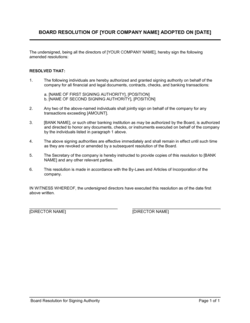
IN WITNESS WHEREOF, the undersigned, being all [or a majority] of the directors of [COMPANY LEGAL NAME], have executed this resolution as of [DATE]. _____________________ [DIRECTOR NAME], Director _____________________ [DIRECTOR NAME], Director

Common mistake: Dating the resolution after it is delivered to the bank. The execution date must precede or match the delivery date or the bank may question whether the resolution was in effect when the change was requested.

How to fill it out

  1. 1

    Enter the corporation's full legal details

    Insert the company's registered legal name (not a trade name), state or province of incorporation, and entity type (e.g., corporation, LLC). Confirm these match your corporate registry filing.

    💡 Cross-reference the entity name on file with your bank — even a minor spelling difference can cause the bank to reject the resolution.

  2. 2

    Record the meeting or written consent details

    State whether the resolution was adopted at a board meeting (include date, time, and location) or by unanimous written consent (include the date all directors signed). Confirm quorum was met.

    💡 For small companies with two or three directors, unanimous written consent is faster and eliminates scheduling risk — all directors sign the same document.

  3. 3

    Reference and revoke all prior signatory resolutions

    Identify any previous resolutions that granted check-signing authority by date and, if possible, resolution number. Explicitly state that all prior authorizations are revoked effective upon bank notification.

    💡 Pull your corporate minute book before drafting — it is common to discover an older resolution that was never formally revoked.

  4. 4

    Name each new authorized signatory by full legal name and title

    List every individual being granted authority with their exact legal name as it appears on government-issued ID and their current corporate title. Include each person's signing scope — all accounts or specific account numbers.

    💡 Ask each new signatory to verify the spelling of their name against their ID before the resolution is finalized — banks match signatures against ID, not just the resolution.

  5. 5

    Set signing thresholds and dual-signature requirements

    Enter the individual signing limit in dollars and the dual-signature threshold if one applies. Confirm these amounts align with your internal financial controls policy and your bank's account setup.

    💡 Coordinate with your bank before finalizing thresholds — some banks cannot enforce per-check dollar limits without a separate account-level configuration.

  6. 6

    Identify the covered bank accounts

    List each financial institution and account number covered by the resolution. If the resolution is intended to cover all current and future accounts at a given bank, say so explicitly.

    💡 Obtain a current account list from your bank before drafting to ensure no accounts are accidentally omitted.

  7. 7

    Have the corporate secretary certify the resolution

    The corporate secretary (or another disinterested officer) signs the certification block confirming the resolution is a true copy, duly adopted, and in full force. Include the certification date.

    💡 Most banks require the certifying officer to be different from any individual being named as a signatory in the same resolution.

  8. 8

    Execute, file, and deliver to the bank

    Collect all required director signatures, date the document on the date of last signature, retain a certified copy in the corporate minute book, and deliver a certified copy to the bank's branch manager or corporate banking officer.

    💡 Request written confirmation from the bank that the new signatory authority has been activated on the account — verbal confirmation is insufficient for your records.

Frequently asked questions

What is a board resolution amending the signing of checks?

A board resolution amending the signing of checks is a formal corporate document in which the board of directors officially changes who is authorized to sign checks and other financial instruments on behalf of the company. It typically revokes any prior check-signing authority, designates new authorized signatories by name and title, sets any applicable dollar thresholds or dual-signature requirements, and identifies the bank accounts it covers. The resolution is then certified and delivered to the company's financial institution to update account records.

When does a company need to amend check-signing authority?

Common triggers include an officer or director resignation, termination, or promotion; a change in the company's treasury or finance team structure; the adoption of a new dual-signature internal control policy; a banking relationship change; or a routine governance review. Any time the individuals listed on a prior check-signing resolution no longer reflect who should have that authority, a new amending resolution is required.

Does a board resolution need to be notarized to be valid at a bank?

In most jurisdictions, notarization is not legally required for a board resolution to be valid. Banks typically require a certified copy of the resolution — meaning a copy accompanied by a certification statement from the corporate secretary confirming it is a true and accurate extract of the minute book. Some banks have their own resolution forms they prefer alongside or instead of the corporate document; confirm your bank's requirements before finalizing the resolution.

Can a single director adopt a board resolution for check-signing authority?

A single director can adopt a resolution only if the company has a one-director board and that director constitutes quorum under the bylaws. In a multi-director board, quorum — typically a majority of directors — must be present and voting. If all directors sign a unanimous written consent, a formal meeting is not required in most jurisdictions. Adopting a resolution without proper quorum renders it procedurally defective.

What is the difference between a check-signing resolution and a banking resolution?

A banking resolution is a broader document that covers all account-level authorities at a financial institution — including opening and closing accounts, wire transfers, credit facilities, and check signing. A check-signing resolution is narrower, addressing only who may sign checks and under what conditions. Some banks accept a standalone check-signing resolution; others require a full banking resolution. Use the check-signing resolution when that is the only authority being changed.

How do dual-signature requirements work in practice?

A dual-signature requirement specifies a dollar threshold above which any single check must bear the signatures of two separately authorized individuals before the bank will honor it. For example, a resolution may allow any one signatory to sign checks up to $5,000, but require two signatures for amounts exceeding that threshold. The requirement must be stated in the board resolution and also configured at the account level with the bank — the resolution alone does not automatically trigger the bank's controls.

What happens if a check is signed by someone whose authority was not formally revoked?

If a prior resolution naming that individual is still on file with the bank and was never formally revoked, the bank may be legally entitled to honor the check — even if the company internally no longer considers that person authorized. This is why explicit revocation language in the amending resolution is essential, and why the revocation must be promptly delivered to and acknowledged by the bank.

Can an LLC use this type of resolution to amend check-signing authority?

Yes, though the terminology differs. LLCs managed by a board of managers adopt resolutions in the same way as corporations. Member-managed LLCs may use a member resolution or consent instead. The underlying purpose and content are identical — formally designating who may sign financial instruments and on what terms. Confirm your operating agreement's requirements for authorizing financial decisions before adopting the resolution.

How often should check-signing authority be reviewed?

Best practice is to review authorized signatories at least annually as part of the governance calendar, and immediately whenever a signatory leaves the organization or changes roles. Many auditors and lenders will flag stale signatory resolutions — particularly those naming individuals who have not been with the company for years — as an internal controls weakness.

How this compares to alternatives

vs Board Resolution to Open a Bank Account

A resolution to open a bank account establishes the account relationship and designates initial signatories for a new account. A check-signing amendment resolution is used after the account already exists, specifically to update who may sign on existing accounts. Use the opening resolution for new accounts and the amending resolution for all subsequent signatory changes on existing accounts.

vs Corporate Banking Resolution (Bank Form)

Many banks provide their own proprietary banking resolution forms that cover all account authorities — signing, wire transfers, and credit access — on a single document. A corporate check-signing resolution drafted by the company is more flexible and comprehensive in its recitals, but some banks require their own form alongside it. Check your bank's requirements and use both where necessary.

vs Board Resolution Authorizing Electronic Funds Transfers

An EFT authorization resolution governs wire transfers, ACH payments, and other electronic disbursements — a distinct authority from physical check signing. Companies should maintain separate resolutions for check signing and electronic transfers, as the risk profiles, approval thresholds, and bank account configurations for each are typically different.

vs Unanimous Written Consent of Directors

A unanimous written consent is the procedural mechanism by which directors adopt resolutions without a formal meeting — every director signs a single document. A check-signing amendment resolution is the substantive content of what is being decided. The two are complementary: the check-signing resolution can be adopted by written consent rather than at a meeting, combining both into one executed document.

Industry-specific considerations

Financial Services

Regulatory requirements often mandate board-level documentation of all financial controls, making a current check-signing resolution essential for compliance audits and examiner reviews.

Nonprofit Organizations

Nonprofit boards are responsible for financial oversight; grant-makers and auditors routinely request current signatory resolutions to confirm compliance with dual-signature and internal control requirements.

Healthcare

Healthcare organizations subject to CMS, Joint Commission, or state health department oversight must maintain current financial control documentation as part of corporate compliance programs.

Professional Services

Law firms, accounting practices, and consultancies with multiple partners or principals frequently amend check-signing authority as equity structures and partner rosters change.

Jurisdictional notes

United States

Corporate check-signing authority is governed by the corporation's state of incorporation, its bylaws, and the Uniform Commercial Code (UCC) Article 3 (negotiable instruments). Most states do not require notarization of board resolutions, but banks may require a certified copy from the corporate secretary. Some states — including Delaware and California — have specific statutory requirements for the form of board action by written consent. Dual-signature thresholds are enforceable contractually with the bank but must be configured at the account level to have operational effect.

Canada

Under federal and provincial corporate statutes (Canada Business Corporations Act, Ontario Business Corporations Act, and equivalents), boards act by resolution at a duly called meeting or by written resolution signed by all directors. Banks in Canada routinely require a certified resolution on the company's letterhead alongside the bank's own banking resolution form. Quebec-incorporated companies should ensure the resolution is available in French if submitted to a Quebec financial institution. Dual-signature requirements are common and are recognized as an internal control best practice by CPA Canada.

United Kingdom

Under the Companies Act 2006, board resolutions may be passed at a meeting of directors or, if the company's articles permit, by written resolution signed by all directors. UK banks typically require a certified extract of the board minutes or resolution, along with a mandate form from the bank. The resolution should reference the company's registered number and Companies House details. Financial Conduct Authority-regulated firms must maintain records of all authorized signatories as part of their governance and compliance obligations.

European Union

Requirements vary significantly by member state. In Germany, France, Spain, and the Netherlands, resolutions must comply with national company law on board decision-making — quorum, notice, and form requirements differ by jurisdiction and entity type. GDPR considerations apply when the resolution names individuals in a document that may be shared with third parties such as banks. Many EU jurisdictions require notarization or apostille for corporate documents submitted to financial institutions, particularly when the company and bank are in different member states.

Template vs lawyer — what fits your deal?

PathBest forCostTime
Use the templateSmall to mid-size companies making routine signatory changes with standard bank accounts in a single jurisdictionFree15–30 minutes
Template + legal reviewCompanies with complex account structures, multiple financial institutions, high-value thresholds, or board governance concerns$150–$400 for a corporate counsel review1–2 business days
Custom draftedRegulated financial institutions, publicly traded companies, or organizations undergoing M&A where signatory authority is subject to regulatory or lender scrutiny$500–$2,000+3–7 business days

Glossary

Board Resolution
A formal written decision adopted by a company's board of directors, either at a duly convened meeting or by unanimous written consent, that binds the corporation.
Authorized Signatory
An individual designated by the board to sign checks, contracts, or other financial instruments on behalf of the corporation.
Unanimous Written Consent
A mechanism allowing directors to adopt a resolution without a physical meeting, provided every director signs the written consent document.
Dual-Signature Requirement
A control policy requiring two authorized signatories to sign any check above a defined dollar threshold, reducing the risk of unauthorized disbursements.
Revocation of Authority
The formal board act that cancels a previously granted signatory right, effective upon notice to the financial institution.
Corporate Seal
An embossed or stamped emblem used by some jurisdictions and financial institutions to authenticate corporate documents, though its use is increasingly optional.
Certified Resolution
A copy of a board resolution accompanied by a certification statement from the corporate secretary or another officer confirming it is a true and accurate extract of the minute book.
Signing Threshold
The maximum dollar amount a single authorized signatory may approve independently; amounts above this limit trigger dual-signature or board approval requirements.
Minutes
The official written record of proceedings at a board or shareholder meeting, including resolutions adopted, votes cast, and attendees present.
Banking Resolution
A board resolution submitted to a financial institution to establish, change, or revoke account-level authorities such as check signing, wire transfers, or account access.

Part of your Business Operating System

This document is one of 3,000+ business & legal templates included in Business in a Box.

  • Fill-in-the-blanks — ready in minutes
  • 100% customizable Word document
  • Compatible with all office suites
  • Export to PDF and share electronically

Create your document in 3 simple steps.

From template to signed document — all inside one Business Operating System.
1
Download or open template

Access over 3,000+ business and legal templates for any business task, project or initiative.

2
Edit and fill in the blanks with AI

Customize your ready-made business document template and save it in the cloud.

3
Save, Share, Send, Sign

Share your files and folders with your team. Create a space of seamless collaboration.

Save time, save money, and create top-quality documents.

★★★★★

"Fantastic value! I'm not sure how I'd do without it. It's worth its weight in gold and paid back for itself many times."

Managing Director · Mall Farm
Robert Whalley
Managing Director, Mall Farm Proprietary Limited
★★★★★

"I have been using Business in a Box for years. It has been the most useful source of templates I have encountered. I recommend it to anyone."

Business Owner · 4+ years
Dr Michael John Freestone
Business Owner
★★★★★

"It has been a life saver so many times I have lost count. Business in a Box has saved me so much time and as you know, time is money."

Owner · Upstate Web
David G. Moore Jr.
Owner, Upstate Web

Run your business with a system — not scattered tools

Stop downloading documents. Start operating with clarity. Business in a Box gives you the Business Operating System used by over 250,000 companies worldwide to structure, run, and grow their business.

Start free · No credit card required