Board Resolution to Adopt a Fiscal Year Template

Free Word download • Edit online • Save & share with Drive • Export to PDF

1 page20–30 min to fillDifficulty: StandardSignature requiredLegal review recommended
Learn more ↓
FreeBoard Resolution to Adopt a Fiscal Year Template

At a glance

What it is
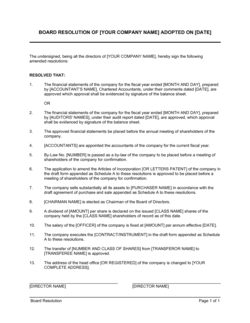
A Board Resolution To Adopt A Fiscal Year is a formal corporate governance document in which a company's board of directors officially votes to establish the twelve-month accounting period the organization will use for financial reporting, tax filings, and budgeting. This free Word download provides a structured, professionally formatted resolution you can edit online, execute at a board meeting or by written consent, and file with your accountant, state agency, or taxing authority as needed.
When you need it
Use it when a newly formed corporation, LLC, or nonprofit needs to establish its first fiscal year, when the entity is changing from a calendar year to a non-calendar fiscal year, or when a state registration or bank account opening requires documented proof of the board's fiscal year decision.
What's inside
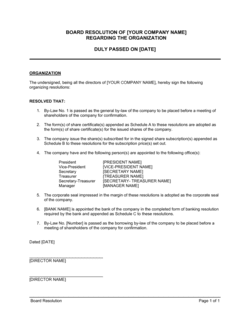
The resolution identifies the entity and its governing board, states the adopted fiscal year start and end dates, authorizes designated officers to notify tax authorities and update corporate records, and includes signature blocks for board members or the secretary certifying the resolution's adoption.

What is a Board Resolution To Adopt A Fiscal Year?

A Board Resolution To Adopt A Fiscal Year is a formal corporate governance document in which a company's board of directors officially votes to establish the twelve-month accounting period the organization will use for financial reporting, tax filings, and budgeting. It records the board's decision in writing, identifies the fiscal year start and end dates, authorizes officers to notify tax authorities and update corporate records, and is certified by the corporate secretary as a true and binding action of the board. Like all board resolutions, it becomes a permanent part of the corporate minute book and serves as the authoritative internal and external evidence that the fiscal year was properly established.

Why You Need This Document

Without a formal board resolution, a company's fiscal year adoption exists informally at best — and tax authorities, banks, and auditors routinely require documented proof of the board's decision before processing filings, opening accounts, or completing diligence. In the US, the IRS may default an entity to a calendar year if no election is properly documented; in Canada, the CRA expects the fiscal year to be established with the first T2 filing. A missing or defective resolution can delay bank account openings, stall loan closings, create short-period tax return obligations, and introduce inconsistencies between corporate records and public filings that require costly retroactive corrections. This template gives newly formed entities and existing businesses changing their fiscal year a complete, certifiable resolution — drafted to the standard that accountants, attorneys, and financial institutions actually rely on.

Which variant fits your situation?

If your situation is…Use this template
Newly incorporated entity establishing its first fiscal yearBoard Resolution To Adopt A Fiscal Year
Existing corporation changing from calendar year to a non-calendar fiscal yearBoard Resolution To Change Fiscal Year
LLC managed by members adopting a fiscal year without a formal boardLLC Member Resolution To Adopt A Fiscal Year
Nonprofit organization adopting a fiscal year for grant complianceNonprofit Board Resolution (Fiscal Year)
S-Corporation electing a fiscal year with IRS approvalBoard Resolution Authorizing IRS Form 1128 Filing
Board acting by written consent rather than at a formal meetingWritten Consent of the Board of Directors
Board adopting multiple organizational policies at formationOrganizational Meeting Minutes

Common mistakes to avoid

❌ Using a trade name instead of the registered legal entity name

Why it matters: Tax authorities and state agencies match filings to registered entity names. A mismatch between the resolution and the articles of incorporation can cause the filing to be rejected or the fiscal year election to be disregarded.

Fix: Confirm the exact legal name from the articles of incorporation or certificate of formation and use it verbatim in the resolution, including punctuation and designators like 'Inc.' or 'LLC.'

❌ Omitting the effective date or setting it mid-period without planning for a short tax year

Why it matters: A missing or ambiguous effective date leaves the fiscal year adoption open to interpretation, and an unplanned short period triggers a prorated tax return filing with its own deadlines and minimum taxes.

Fix: Always state a specific effective date. If a short period is unavoidable, coordinate with your accountant before execution to prepare the additional filing and calculate any prorated obligations.

❌ Collecting only one director's signature on a written consent resolution

Why it matters: Most jurisdictions and corporate bylaws require unanimous written consent for a resolution adopted outside a meeting. A single signature makes the resolution voidable and may not satisfy a bank's or auditor's reliance standard.

Fix: Collect signatures from every director entitled to vote, or confirm the minimum threshold in your bylaws and governing statute before circulating the consent for execution.

❌ Failing to file IRS Form 1128 or the equivalent after adoption

Why it matters: Adopting the fiscal year internally without notifying the tax authority means the IRS or CRA may default the entity to a calendar year, creating a discrepancy between corporate records and tax filings that requires a formal correction.

Fix: Assign responsibility for the tax authority filing to a named officer in the resolution itself, and confirm the filing deadline with your accountant — in the US, Form 1128 is due by the due date of the first return for the new tax year.

❌ Skipping the corporate secretary certification

Why it matters: Banks, lenders, and government agencies routinely require a certified copy of the resolution before acting on it. An uncertified copy may be rejected, delaying account openings, loan closings, or registrations.

Fix: Always complete the certification block after all directors have signed. Store the certified original in the corporate minute book and provide certified copies wherever the resolution is submitted.

❌ Adopting a non-calendar fiscal year for an entity type that requires IRS approval

Why it matters: S-corporations, personal service corporations, and partnerships generally must use a calendar year unless they obtain IRS approval for a different period. Adopting an unapproved fiscal year exposes the entity to penalties and forced re-filing.

Fix: Before completing the resolution, confirm with your accountant whether the entity type requires IRS consent via Form 1128 or Form 2553, and obtain that approval before or concurrently with the board adoption.

The 9 key clauses, explained

Entity identification and recitals

In plain language: States the full legal name of the corporation or organization, its state or province of incorporation, and the background context explaining why the resolution is being adopted.

Sample language
WHEREAS, [COMPANY LEGAL NAME], a [STATE] [ENTITY TYPE] (the 'Company'), was incorporated on [DATE] and requires the establishment of a fiscal year for accounting, tax, and financial reporting purposes;

Common mistake: Using a trade name or DBA instead of the registered legal entity name. The resolution must match the exact name on the articles of incorporation or certificate of formation, or it may be rejected by tax authorities.

Board authorization and quorum recital

In plain language: Confirms that the board meeting was duly called and held with the required quorum present, or that all directors have signed a written consent, making the resolution valid and binding.

Sample language
The undersigned, constituting all of the members of the Board of Directors of the Company, hereby waive notice of a meeting and adopt the following resolutions by written consent in lieu of a meeting, pursuant to [STATE] [STATUTE CITATION].

Common mistake: Omitting the quorum or consent confirmation entirely. Without this recital, a third party — such as a bank or auditor — has no assurance the resolution was validly adopted and may refuse to rely on it.

Adoption of fiscal year

In plain language: The operative clause that formally names the start and end dates of the fiscal year the board is adopting, stated as a calendar date range.

Sample language
RESOLVED, that the fiscal year of the Company shall commence on [START DATE, e.g., January 1] and end on [END DATE, e.g., December 31] of each calendar year, effective [EFFECTIVE DATE].

Common mistake: Stating only the end month without specifying the start date. Tax authorities and banks require both the start and end dates to be explicitly stated; an incomplete date range creates filing ambiguity.

Effective date

In plain language: Specifies the date on which the adopted fiscal year takes effect, which is typically the date of the resolution or the first day of the new fiscal period.

Sample language
RESOLVED FURTHER, that the fiscal year adopted herein shall be effective as of [EFFECTIVE DATE], and shall apply to all financial reporting and tax filings of the Company from that date forward.

Common mistake: Setting an effective date that falls mid-fiscal-year without accounting for the resulting short period. A short tax year may require a separate, prorated tax return filing.

Authorization to notify tax authorities

In plain language: Delegates authority to named officers to file any required forms with the IRS, CRA, HMRC, or other tax authority to formally elect or confirm the fiscal year.

Sample language
RESOLVED FURTHER, that the [TITLE, e.g., President] and [TITLE, e.g., Chief Financial Officer] of the Company are each authorized and directed to file IRS Form 1128 or any other required governmental form to elect and confirm the fiscal year adopted herein.

Common mistake: Authorizing only one officer by name rather than by title. If that individual leaves the company before the filing is made, no one else has documented authority to sign the form.

Authorization to update corporate records

In plain language: Directs the corporate secretary or a named officer to record the adopted fiscal year in the corporate minute book and notify the company's accountants, auditors, and financial institutions.

Sample language
RESOLVED FURTHER, that the Secretary of the Company is authorized and directed to record this resolution in the corporate minute book and to notify the Company's accountants, auditors, and banking institutions of the adopted fiscal year.

Common mistake: Skipping the records update authorization. Without it, the fiscal year may appear in the resolution but never be reflected in the company's bank account setup, payroll system, or audit engagement letter.

Ratification of prior acts

In plain language: Confirms and ratifies any actions already taken by officers or agents in connection with the fiscal year adoption, covering steps taken before the resolution was formally passed.

Sample language
RESOLVED FURTHER, that all acts and proceedings taken by the officers, employees, or agents of the Company prior to the date hereof in connection with the adoption of the fiscal year described herein are hereby ratified, confirmed, and approved.

Common mistake: Including a broad ratification clause that covers unrelated prior acts. Ratification clauses should be scoped specifically to the fiscal year adoption; an overly broad clause can inadvertently legitimize unauthorized actions.

Certification by corporate secretary

In plain language: A separate certification block in which the corporate secretary attests that the resolution was duly adopted, is a true and correct copy, and remains in full force and effect.

Sample language
I, [SECRETARY NAME], Secretary of [COMPANY LEGAL NAME], hereby certify that the foregoing is a true and correct copy of a resolution duly adopted by the Board of Directors of the Company and that such resolution has not been amended or rescinded and remains in full force and effect.

Common mistake: Treating the certification as optional. Banks, state agencies, and counterparties routinely require a certified copy of the resolution — an uncertified document may not be accepted.

Signature blocks

In plain language: Provides signature lines for all board members (if acting by written consent) or for the chairperson and secretary (if adopted at a meeting), with printed names, titles, and dates.

Sample language
IN WITNESS WHEREOF, the undersigned, being all of the directors of [COMPANY LEGAL NAME], have executed this Written Consent as of [DATE]. [DIRECTOR NAME] _______________________ Director | [DIRECTOR NAME] _______________________ Director

Common mistake: Collecting only the chairperson's signature when the resolution is adopted by written consent. Written consent typically requires the signatures of all directors or the threshold specified in the bylaws — a single signature is insufficient.

How to fill it out

  1. 1

    Enter the entity's full legal name and incorporation details

    Replace all placeholders with the company's exact registered legal name, state or province of incorporation, and entity type (corporation, LLC, nonprofit). Cross-reference the articles of incorporation or certificate of formation to confirm the exact name.

    💡 Even minor discrepancies — 'Inc.' vs. 'Incorporated' — can cause a tax authority or bank to reject the document.

  2. 2

    Choose and state the fiscal year start and end dates

    Determine whether the entity will use a calendar year (January 1 – December 31) or a non-calendar fiscal year (e.g., July 1 – June 30). Insert both the start and end dates explicitly in the adoption clause.

    💡 For S-corporations and personal service corporations in the US, non-calendar fiscal years require IRS approval via Form 1128 or Form 2553 — confirm eligibility with your accountant before choosing dates.

  3. 3

    Set the effective date

    Enter the date on which the fiscal year takes effect. For new entities, this is typically the date of incorporation or the first day of the desired fiscal period. For existing entities changing their year, coordinate with your accountant to avoid a short-period tax year unless intended.

    💡 If the effective date creates a short fiscal period (fewer than 12 months), budget for an additional tax return filing and any prorated minimum franchise taxes.

  4. 4

    Identify the authorized officers by title

    In the tax-authority notification clause, fill in the titles of the officers authorized to file Form 1128 or equivalent. Use titles rather than names where possible so the authorization survives a personnel change.

    💡 Authorize at least two officers — President and CFO, or President and Secretary — so one can act if the other is unavailable at filing time.

  5. 5

    Confirm the adoption method — meeting or written consent

    Decide whether the resolution will be adopted at a formal board meeting (in which case, meeting minutes should accompany it) or by written consent of all directors. Update the recital language accordingly, citing the applicable state or provincial statute.

    💡 Written consent is faster for small boards, but some jurisdictions require unanimous consent for written resolutions — verify your bylaws and governing statute before using this method.

  6. 6

    Complete the certification block

    Have the corporate secretary fill in their name, sign the certification, and date it. The certification should be completed after all directors have signed, not before.

    💡 Keep the signed original in the corporate minute book and provide certified copies to your accountant, bank, and registered agent as needed.

  7. 7

    Collect director signatures

    If adopting by written consent, obtain signatures from all directors (or the number required by your bylaws). If adopting at a meeting, the chairperson and secretary sign and the resolution is attached to the meeting minutes.

    💡 Date each signature line individually — a resolution where all directors appear to have signed on the same day as a meeting held two months earlier raises credibility issues in an audit.

  8. 8

    File or distribute certified copies as required

    Provide a certified copy to your accountant for tax filing purposes, to your bank if required for account setup or loan documentation, and to any state agency requesting proof of fiscal year adoption.

    💡 File IRS Form 1128 (or CRA, HMRC, or equivalent equivalent form) promptly after resolution adoption — most jurisdictions impose a deadline tied to the first tax year under the new period.

Frequently asked questions

What is a board resolution to adopt a fiscal year?

A board resolution to adopt a fiscal year is a formal corporate governance document in which a company's board of directors votes to establish the twelve-month accounting period the organization will use for financial reporting and tax purposes. It becomes part of the official corporate record once signed and is typically required by tax authorities, banks, and state agencies as evidence of the board's formal decision. Without it, the entity's fiscal year election lacks documented board authorization.

When does a company need to adopt a fiscal year?

A company needs to adopt a fiscal year at or shortly after formation, before its first tax return is due. In the US, the IRS requires entities to establish a tax year with their first filing; in Canada, the CRA expects the fiscal year to be set when the corporation files its first T2 return. Entities changing from a calendar year to a non-calendar fiscal year also need a new resolution and, in most jurisdictions, a formal election filed with the tax authority.

Does every company have to use a calendar year?

No. C-corporations can generally choose any twelve-month fiscal year. S-corporations, partnerships, and personal service corporations are generally required to use a calendar year unless they obtain IRS approval for a different period via Form 1128 or demonstrate a business purpose. Nonprofits often choose a July–June fiscal year to align with grant cycles. The right fiscal year depends on the entity type, tax elections, and the natural operating cycle of the business.

What is IRS Form 1128 and when is it needed?

IRS Form 1128 is the Application To Adopt, Change, or Retain a Tax Year. It is required when an entity adopts a non-calendar fiscal year that is not automatically permitted for its entity type, or when an existing entity changes its tax year. For C-corporations adopting a fiscal year at formation, the form is typically filed with the first income tax return. Partnerships and S-corporations generally need advance IRS approval before changing their tax year. Failure to file can result in the IRS reverting the entity to a calendar year.

Can an LLC adopt a fiscal year by board resolution?

Manager-managed LLCs can adopt a fiscal year by manager resolution using substantially the same format as a board resolution. Member-managed LLCs typically require a member consent or member resolution. The key difference is the governing authority — members in a member-managed LLC, managers in a manager-managed LLC. The resolution should reference the applicable provisions of the LLC operating agreement and the governing state statute.

What happens if a company never formally adopts a fiscal year?

If no formal election is made, most tax authorities default the entity to a calendar year. This may not match the company's intended operating cycle, creating misalignment between internal reporting and tax filings. More practically, banks and lenders often require documented board authorization of the fiscal year as part of account-opening or loan-documentation packages. The absence of a resolution can delay closings and require retroactive correction filings.

Does a board resolution to adopt a fiscal year need to be notarized?

Notarization is generally not required for a board resolution to adopt a fiscal year in the US, Canada, the UK, or the EU. The document is typically self-authenticated by the corporate secretary's certification and the directors' signatures. Some foreign jurisdictions and certain international filings may require notarization or apostille; confirm local requirements if the resolution will be used outside the entity's home jurisdiction.

How often can a company change its fiscal year?

In the US, C-corporations can change their tax year, but doing so more than once in a ten-year period typically requires IRS approval and a demonstrated business purpose. S-corporations and partnerships face more restrictive rules. In Canada, a corporation can change its fiscal year end by notifying the CRA, but changes may trigger short-period return requirements. Frequent changes draw scrutiny from tax authorities and auditors, so most businesses establish a fiscal year at formation and maintain it consistently.

What documents should be filed alongside the resolution?

Depending on the entity type and jurisdiction, the resolution may need to be accompanied by IRS Form 1128 (US tax year adoption or change), Canada Revenue Agency notification, or an amended annual return. Banks typically require only a certified copy of the resolution itself. Nonprofit entities registering with state charity bureaus may need to include the resolution as part of their initial registration package. Your accountant or corporate attorney can confirm the complete filing checklist for your jurisdiction.

How this compares to alternatives

vs Board Resolution To Change Fiscal Year

A resolution to adopt a fiscal year is used at entity formation to establish the accounting period for the first time. A resolution to change a fiscal year is used by an existing entity that is moving from one fiscal period to another — a process that typically requires tax authority approval and creates a short-period return obligation. Use the adoption resolution at incorporation; use the change resolution only after the entity has already been operating under an established fiscal year.

vs Minutes of the First Meeting of the Board of Directors

First-meeting minutes record all actions taken at the organizational board meeting, which often includes adopting the fiscal year among many other decisions. A standalone fiscal year resolution is the appropriate document when the fiscal year decision needs to be separately certified or submitted to a bank or tax authority. Both documents may exist for the same entity — the minutes record the meeting, and the standalone resolution provides the self-contained, certifiable instrument a third party can rely on.

vs Written Consent of the Board of Directors

A written consent is a general-purpose instrument for any board action taken outside a formal meeting. A board resolution to adopt a fiscal year is a specific, purpose-built document with the exact clauses, operative language, and certification block that tax authorities and banks expect. The written consent format is appropriate when multiple actions are being authorized simultaneously; the standalone resolution is preferred when the fiscal year adoption is the sole matter requiring documentation and third-party submission.

vs Corporate Bylaws

Corporate bylaws may authorize the board to set the fiscal year but rarely specify the dates themselves, leaving that decision to a board resolution. The bylaws are the governing document that grants the authority; the resolution is the exercise of that authority. Both documents should be consistent — if the bylaws reference a specific fiscal year, the resolution should match.

Industry-specific considerations

Technology / SaaS

SaaS companies commonly adopt a January 31 or March 31 fiscal year to align with enterprise sales cycles and subscription renewal periods, requiring a board resolution at or shortly after incorporation.

Retail / E-commerce

Retailers frequently adopt a fiscal year ending January 31 so the holiday season falls within a single reporting period, making the board resolution a standard post-formation formality.

Nonprofit Organizations

Nonprofits often adopt a July 1 – June 30 fiscal year to align with government grant cycles and foundation funding rounds, and state charity registration typically requires a board resolution as supporting documentation.

Professional Services

Law firms, accounting practices, and consulting firms typically adopt calendar-year fiscal years to match client billing cycles, and the resolution is a required element of the post-incorporation formalities checklist.

Jurisdictional notes

United States

C-corporations may generally adopt any fiscal year by filing with their first tax return. S-corporations, personal service corporations, and partnerships are generally required to use a calendar year unless they obtain IRS approval via Form 1128 or Form 2553. Most states do not require a separate state-level fiscal year election, but the adopted year should be reflected consistently in state income tax and franchise tax filings. Delaware, the most common state of incorporation, imposes no restriction on fiscal year selection for C-corporations.

Canada

Canadian corporations under the Canada Business Corporations Act and provincial equivalents may set any fiscal year not exceeding 53 weeks. The fiscal year end is established with the first T2 corporate income tax return. Changing a fiscal year requires CRA notification and may result in a short fiscal year with a prorated return obligation. Quebec corporations must also comply with the Act respecting the legal publicity of enterprises, which requires consistent fiscal year reporting in annual declarations.

United Kingdom

UK companies incorporated under the Companies Act 2006 have an accounting reference date — the last day of the month in which the anniversary of incorporation falls — automatically assigned by Companies House. Directors may change this date by filing Form AA01 with Companies House, but changes are limited in frequency and require a board resolution as the governing internal authority. The accounting reference date determines the corporation tax accounting period reported to HMRC, though the two periods may differ in certain circumstances.

European Union

EU member states each have their own rules on fiscal year adoption, but most permit corporations to adopt any twelve-month period by board decision, with the selected year disclosed in the entity's first annual accounts filed with the national company registry. Germany (Handelsgesetzbuch), France (Code de commerce), and the Netherlands (Burgerlijk Wetboek) all permit non-calendar fiscal years for corporations. Entities operating across multiple member states should ensure their fiscal year elections are consistent across all national registrations to avoid conflicting reporting obligations.

Template vs lawyer — what fits your deal?

PathBest forCostTime
Use the templateNewly incorporated C-corporations or LLCs adopting a standard calendar year with no special tax electionsFree15–20 minutes
Template + legal reviewEntities adopting a non-calendar fiscal year, S-corporations, or nonprofits with grant-cycle requirements$150–$400 for a one-hour accountant or attorney review1–2 business days
Custom draftedComplex multi-entity structures, regulated industries, or entities with cross-border tax obligations requiring coordinated fiscal year elections$500–$2,000+3–7 business days

Glossary

Fiscal Year
A twelve-month accounting period a business or organization uses for financial reporting and tax purposes, which may or may not coincide with the calendar year.
Calendar Year
A fiscal year that runs from January 1 through December 31 — the default accounting period for most individual taxpayers and many corporations.
Board Resolution
A formal written record of a decision made by a company's board of directors, which becomes part of the official corporate record once adopted.
Written Consent
A method of adopting a board resolution without holding a meeting, by obtaining the signatures of all required directors on a written document.
Corporate Minute Book
The official binder or file maintained by a corporation that holds its formation documents, bylaws, share registers, and all board and shareholder resolutions.
IRS Form 1128
The US federal form filed with the Internal Revenue Service to adopt, change, or retain a tax year, required for certain entities changing from the calendar year default.
Natural Business Year
A fiscal year that ends at or near the low point of a business's annual operating cycle — for example, a retailer whose fiscal year ends January 31, after the holiday season.
52/53-Week Fiscal Year
A fiscal year that always ends on the same day of the week nearest the end of a calendar month, resulting in a year that is either 52 or 53 weeks long.
Quorum
The minimum number of board members who must be present or participating for a board vote to be legally valid under the entity's bylaws or governing statutes.
Corporate Secretary
The officer responsible for maintaining corporate records, certifying resolutions, and ensuring the company meets its governance and filing obligations.
Tax Year
The annual period used for calculating and reporting taxable income to a government authority — usually the same as the entity's fiscal year once formally elected.

Part of your Business Operating System

This document is one of 3,000+ business & legal templates included in Business in a Box.

  • Fill-in-the-blanks — ready in minutes
  • 100% customizable Word document
  • Compatible with all office suites
  • Export to PDF and share electronically

Create your document in 3 simple steps.

From template to signed document — all inside one Business Operating System.
1
Download or open template

Access over 3,000+ business and legal templates for any business task, project or initiative.

2
Edit and fill in the blanks with AI

Customize your ready-made business document template and save it in the cloud.

3
Save, Share, Send, Sign

Share your files and folders with your team. Create a space of seamless collaboration.

Save time, save money, and create top-quality documents.

★★★★★

"Fantastic value! I'm not sure how I'd do without it. It's worth its weight in gold and paid back for itself many times."

Managing Director · Mall Farm
Robert Whalley
Managing Director, Mall Farm Proprietary Limited
★★★★★

"I have been using Business in a Box for years. It has been the most useful source of templates I have encountered. I recommend it to anyone."

Business Owner · 4+ years
Dr Michael John Freestone
Business Owner
★★★★★

"It has been a life saver so many times I have lost count. Business in a Box has saved me so much time and as you know, time is money."

Owner · Upstate Web
David G. Moore Jr.
Owner, Upstate Web

Run your business with a system — not scattered tools

Stop downloading documents. Start operating with clarity. Business in a Box gives you the Business Operating System used by over 250,000 companies worldwide to structure, run, and grow their business.

Free Forever Plan · No credit card required