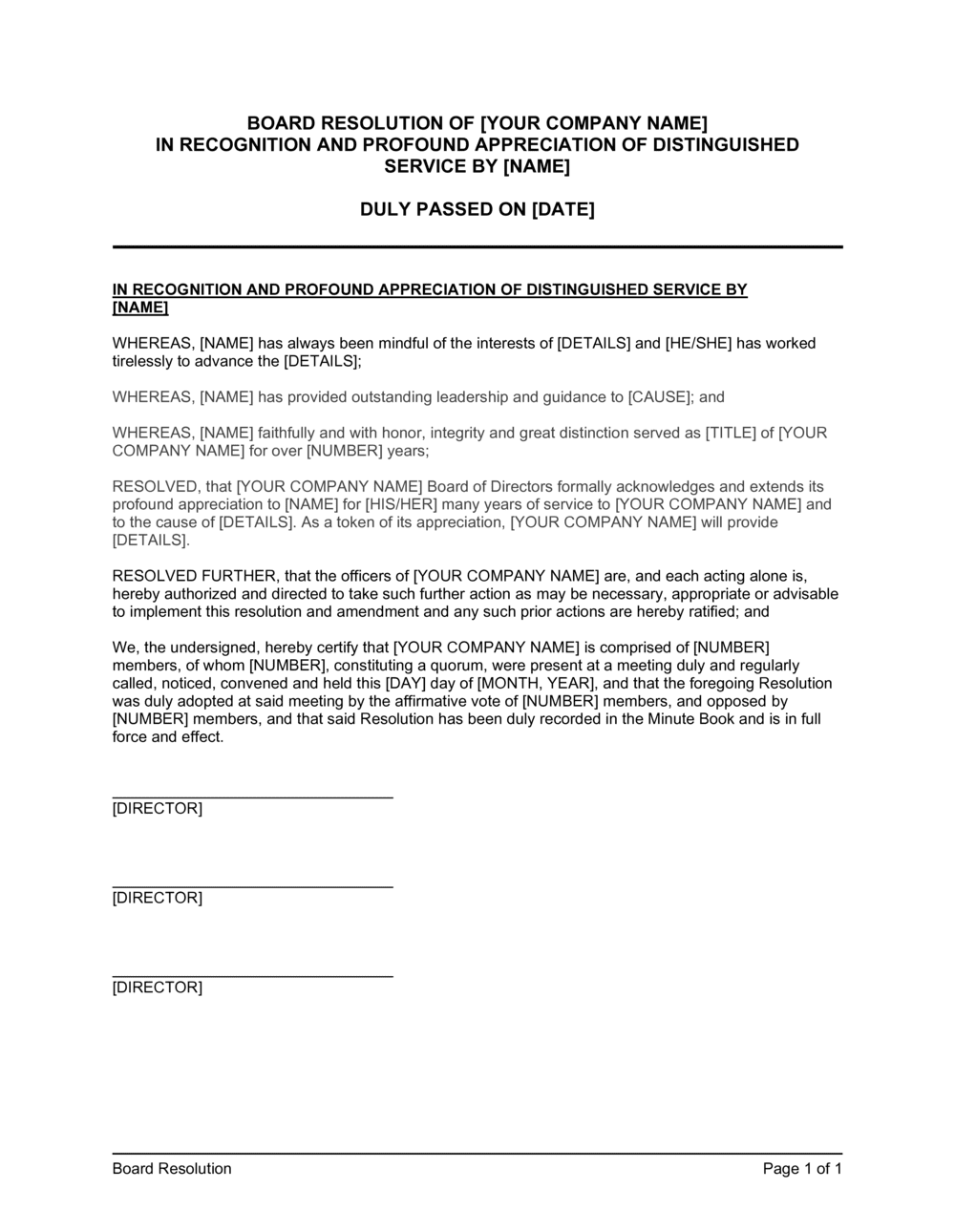
Board Resolution in Recognition of Distinguished Service Template

Free Word download • Edit online • Save & share with Drive • Export to PDF

1 page20–30 min to fillDifficulty: StandardSignature requiredLegal review recommended
Learn more ↓
FreeBoard Resolution in Recognition of Distinguished Service Template

At a glance

What it is
A Board Resolution in Recognition of Distinguished Service is a formal corporate document through which a board of directors officially acknowledges and records an individual's exceptional contributions to the organization. This free Word download provides a structured, board-ready template you can edit online and export as PDF, capturing the vote, the honoree's service record, and the board's formal declaration in a single legally recorded document.
When you need it
Use it when a board wishes to formally recognize a departing executive, long-tenured employee, board member, or volunteer whose contributions warrant an official corporate record — particularly at retirement, resignation, term completion, or a significant anniversary milestone.
What's inside
Identifies the corporation and the honoree, recites the specific contributions and duration of service, records the board's unanimous or majority vote to adopt the resolution, states the formal declaration of recognition, and is attested by the board chair and corporate secretary to create a permanent minute-book record.

What is a Board Resolution in Recognition of Distinguished Service?

A Board Resolution in Recognition of Distinguished Service is a formal corporate document through which a company's board of directors officially acknowledges, on the record, an individual's exceptional and sustained contributions to the organization. Structured around the standard resolution format — factual "WHEREAS" recitals followed by operative "BE IT RESOLVED" declarations — it transforms a moment of personal appreciation into a permanent entry in the corporation's minute book. Unlike an informal letter of thanks, this document carries the collective legal authority of the full board and can be certified, extracted, and presented as official evidence of the corporation's recognition in governance reviews, regulatory examinations, or historical records.

Why You Need This Document

Without a formal resolution, recognition for a departing executive or long-serving director exists only as a verbal acknowledgment or a personal letter — neither of which constitutes a corporate act or survives a leadership transition intact. Organizations that fail to formalize recognition lose the institutional record of the honoree's specific contributions, creating gaps in minute-book continuity that auditors, successor boards, and accreditation reviewers may question. For nonprofits, the absence of formal recognition documentation can complicate grant reporting and governance attestations. Where the resolution also authorizes a financial gift or honorary title, adopting it as a proper board resolution establishes the authorization trail required for clean accounting treatment. This template gives your board a complete, professionally structured resolution ready to adopt in under 30 minutes, ensuring the recognition is both meaningful and correctly recorded.

Which variant fits your situation?

If your situation is…Use this template
Recognizing a retiring CEO or C-suite executiveBoard Resolution in Recognition of Distinguished Service (Executive)
Honoring an outgoing board member at term completionBoard Resolution Accepting Resignation of Director
Formally accepting an executive's resignation with acknowledgmentBoard Resolution Accepting Resignation of Officer
Granting a departing executive a formal title or emeritus statusBoard Resolution Appointing an Honorary Officer
Recording recognition alongside a severance or retirement package approvalBoard Resolution Approving Executive Compensation
Documenting recognition for a volunteer or community contributorBoard Resolution Commending Community Service
Recognizing a long-tenured employee below board level through HR processEmployee Recognition Letter

Common mistakes to avoid

❌ Generic, non-specific recitals

Why it matters: A resolution that says only 'provided valuable service' carries no evidentiary weight and fails to create a meaningful organizational record. It also diminishes the recognition itself.

Fix: Document at least three specific, verifiable contributions with measurable context — tenure in years, programs initiated, financial impact, or awards received — in separate whereas clauses.

❌ Authorizing a financial gift without a dollar cap

Why it matters: An uncapped gift authorization creates accounting ambiguity and potential tax exposure for both the organization and the honoree, and may exceed the board's delegated spending authority.

Fix: Add an explicit dollar ceiling in the resolved clause (e.g., 'a gift not to exceed $[AMOUNT]') and reference the approved budget line or authorize a specific disbursement.

❌ Omitting the quorum confirmation

Why it matters: A resolution adopted without confirming quorum can be voided by a dissenting director or challenged during a governance review, auditor examination, or regulatory inquiry.

Fix: State explicitly in the opening paragraph that a quorum was present throughout the meeting, and cross-check the bylaws for your organization's specific threshold.

❌ Using aspirational rather than declaratory language in the resolved clause

Why it matters: Phrases like 'the board intends to recognize' or 'wishes to honor' do not constitute a formal board action. The resolution must state a completed, present-tense act.

Fix: Use the standard formula: 'BE IT RESOLVED, that the Board of Directors of [CORPORATION NAME] hereby [action].' The word 'hereby' signals a present act, not a future intention.

❌ Single signature when bylaws require both chair and secretary

Why it matters: Many corporate bylaws require dual attestation for resolutions to be valid. A resolution signed only by the chair or only by the secretary may fail to meet the corporation's own governance standards.

Fix: Review your bylaws' attestation requirements before execution and collect all required signatures before filing the document in the minute book.

❌ Failing to file the resolution in the minute book promptly

Why it matters: A signed resolution that never reaches the minute book has no official status. Auditors, successor boards, and legal counsel rely on the minute book as the authoritative record.

Fix: Direct the corporate secretary in a 'FURTHER RESOLVED' clause to file the resolution and distribute certified copies within a defined timeframe — five business days is a workable standard.

The 9 key clauses, explained

Corporate identification and meeting recital

In plain language: Names the corporation, confirms the date and type of meeting (regular, special, or written consent), and establishes that a quorum was present and the meeting was duly called.

Sample language
The undersigned, being all the directors of [CORPORATION NAME], a [STATE/PROVINCE] [ENTITY TYPE], hereby adopt the following resolution at a [regular / special] meeting of the Board of Directors held on [DATE] at [LOCATION / via [PLATFORM]], at which a quorum was present throughout.

Common mistake: Omitting confirmation that a quorum was present. Without it, the resolution's validity can be challenged if a governance dispute arises later.

Honoree identification

In plain language: States the full name, title, and role of the individual being recognized so the record is unambiguous.

Sample language
WHEREAS, [HONOREE FULL NAME] has served as [TITLE / ROLE] of [CORPORATION NAME] from [START DATE] to [END DATE / present];

Common mistake: Using a nickname or shortened title instead of the honoree's full legal name and official corporate title, creating an ambiguous record.

Recital of service and contributions (Whereas clauses)

In plain language: Sets out the specific contributions, achievements, and tenure of the honoree in a series of factual recital paragraphs that form the basis for the board's recognition.

Sample language
WHEREAS, during [his/her/their] tenure, [HONOREE NAME] [SPECIFIC ACHIEVEMENT 1], [SPECIFIC ACHIEVEMENT 2], and [SPECIFIC ACHIEVEMENT 3], each of which materially advanced the mission and interests of [CORPORATION NAME];

Common mistake: Writing generic recitals like 'provided valuable service' without specifics. Vague language undermines the document's credibility and reduces its value as a meaningful organizational record.

Board's expression of gratitude

In plain language: A formal whereas clause expressing the board's collective appreciation for the honoree's dedication, character, and impact.

Sample language
WHEREAS, the Board of Directors wishes to formally express its deep appreciation for [HONOREE NAME]'s dedication, integrity, and distinguished contributions to [CORPORATION NAME] and those it serves;

Common mistake: Conflating gratitude language with legal indemnification or release language. The recognition clause should be celebratory, not a liability instrument.

Resolved: formal declaration of recognition

In plain language: The operative clause through which the board formally and officially recognizes the honoree's distinguished service on behalf of the corporation.

Sample language
NOW, THEREFORE, BE IT RESOLVED, that the Board of Directors of [CORPORATION NAME] hereby formally recognizes and honors [HONOREE NAME] for [his/her/their] distinguished service and outstanding contributions to the organization.

Common mistake: Using aspirational language ('the board hopes to recognize') instead of declaratory language ('the board hereby recognizes'). The resolution must state a completed act, not an intention.

Resolved: direction to record and communicate

In plain language: Authorizes the corporate secretary to enter the resolution in the minute book and, optionally, to communicate the recognition to relevant stakeholders.

Sample language
FURTHER RESOLVED, that the Secretary of [CORPORATION NAME] is directed to record this resolution in the minute book and to transmit a certified copy to [HONOREE NAME] as a lasting record of the Board's recognition.

Common mistake: Failing to direct the secretary to record the resolution. Without this clause, the document may not be systematically filed, leaving it out of the official corporate record.

Resolved: any accompanying honors or designations

In plain language: If the board is conferring an honorary title, naming a program, or authorizing a gift or award, this clause states those specifics with authorized amounts or descriptions.

Sample language
FURTHER RESOLVED, that [CORPORATION NAME] is hereby authorized to present [HONOREE NAME] with [DESCRIPTION OF HONOR — e.g., a commemorative plaque / a gift not to exceed $[AMOUNT] / the title of Director Emeritus], as an expression of the Board's appreciation.

Common mistake: Authorizing a financial gift without specifying a dollar cap or referencing board-approved budget authority. An uncapped authorization creates accounting and tax exposure.

Vote record

In plain language: Records the outcome of the vote — unanimous or by specific count — and confirms no directors dissented or abstained, or notes any exceptions.

Sample language
The foregoing resolution was duly adopted by [unanimous vote / a vote of [X] in favor, [Y] opposed, and [Z] abstaining] of the directors present and voting at the meeting.

Common mistake: Omitting the vote count entirely and stating only 'duly adopted.' In the event of a governance challenge, the specific vote record is the evidentiary foundation.

Attestation and certification block

In plain language: The corporate secretary certifies that the resolution is a true and correct record of board action, and the chair and secretary sign to authenticate the document.

Sample language
I, [SECRETARY NAME], Secretary of [CORPORATION NAME], hereby certify that the foregoing is a true and correct copy of a resolution duly adopted by the Board of Directors on [DATE]. _________________________ [CHAIR NAME], Board Chair | _________________________ [SECRETARY NAME], Corporate Secretary

Common mistake: Having only one signature when corporate bylaws require both the chair and secretary to attest. A single-signature resolution may not satisfy the corporation's own governance documents.

How to fill it out

  1. 1

    Confirm the meeting date, type, and quorum

    Enter the corporation's full legal name, the date, and the type of board meeting (regular, special, or written consent). Verify that the required quorum of directors was present before the vote was taken.

    💡 Check your bylaws for the quorum threshold — it is typically a majority of seated directors, but some organizations require a supermajority for resolutions with financial components.

  2. 2

    Identify the honoree with their full legal name and title

    Enter the honoree's full legal name — exactly as it appears on corporate records — along with their official title and the precise dates of their service tenure.

    💡 Cross-reference the honoree's name against payroll or HR records and prior board minutes to ensure consistency across all corporate documents.

  3. 3

    Draft specific whereas recitals for each major contribution

    Write one whereas clause for each distinct achievement or contribution you want the record to reflect. Include measurable outcomes wherever possible — revenue impact, years of tenure, programs launched, or awards received.

    💡 Aim for three to five whereas clauses. Fewer than three feels perfunctory; more than seven makes the document unwieldy for a minute-book record.

  4. 4

    Write the formal declaration in the resolved clause

    Complete the operative 'NOW, THEREFORE, BE IT RESOLVED' paragraph using declaratory present-tense language. The board is making an official statement of record, not a promise.

    💡 Avoid subjective qualifiers like 'deeply' or 'most sincerely' in the resolved clause — reserve expressive language for the whereas recitals and keep the resolved clause formal and direct.

  5. 5

    Add any accompanying honors or authorized gifts

    If the board is approving a commemorative item, honorary title, or financial gift, add a 'FURTHER RESOLVED' clause specifying the exact item and, for any financial component, a dollar cap and the budget line it draws from.

    💡 Gifts to individuals may be taxable income to the recipient. Consult with your accountant before authorizing amounts above a nominal threshold — in the US, this is generally $25 for business gifts.

  6. 6

    Record the vote outcome

    State the vote count: number in favor, opposed, and abstaining. If the resolution was adopted by written consent in lieu of a meeting, note that all directors signed in lieu.

    💡 If any director recused themselves due to a personal relationship with the honoree, note the recusal in the vote record to document procedural fairness.

  7. 7

    Complete the attestation block and collect signatures

    Have the board chair and corporate secretary sign the attestation block. Enter the date of signing, which should match the meeting date or the date of the last director's signature for written consent.

    💡 File the signed original in the minute book and provide a certified copy — stamped or signed by the secretary — to the honoree as a keepsake.

  8. 8

    File in the minute book and distribute certified copies

    Direct the corporate secretary to file the resolution immediately following the corresponding meeting minutes in the minute book and to distribute certified copies as directed by the resolution.

    💡 For nonprofit organizations, retain a copy in the honoree's personnel or volunteer file as well as the minute book — grant auditors and accreditation reviewers may request evidence of formal governance practices.

Frequently asked questions

What is a board resolution in recognition of distinguished service?

A board resolution in recognition of distinguished service is a formal corporate document through which a board of directors officially records its acknowledgment of an individual's exceptional contributions to the organization. It follows the standard resolution format — whereas recitals followed by resolved clauses — and becomes part of the corporation's permanent minute-book record once adopted by vote and attested by the corporate secretary.

When should a board adopt a recognition resolution?

Boards typically adopt a recognition resolution at a departing executive's final board meeting, at a retirement ceremony, upon completion of a multi-year term by a board member, or at a significant service anniversary milestone such as 10, 20, or 25 years. The resolution should be adopted while the honoree is still formally associated with the organization so the vote date aligns with the period of service.

Is a board resolution in recognition of distinguished service legally binding?

A recognition resolution is a formal corporate act and is binding in the sense that it becomes an official part of the corporation's records. However, it is primarily a declaratory instrument rather than a contractual one — it does not create new financial obligations unless a specific 'FURTHER RESOLVED' clause authorizes a gift, award, or honorarium. Any financial component authorized in the resolution is binding on the organization to the extent of the board's spending authority.

Does a recognition resolution need to be voted on at a board meeting?

Typically, yes. Most corporate bylaws require a quorum of directors to be present for a vote. However, many jurisdictions and bylaws also permit unanimous written consent — where all directors sign the resolution in lieu of a meeting — as an equivalent mechanism. Check your organization's bylaws for the specific requirements governing how resolutions may be adopted.

Who signs a board resolution in recognition of distinguished service?

At minimum, the corporate secretary signs the attestation block, certifying the resolution as a true record of board action. Most organizations also require the board chair's signature. Some bylaws require all attending directors to sign. Review your bylaws and the specific resolution's requirements before circulating for signatures.

Can a recognition resolution authorize a gift or award?

Yes. A 'FURTHER RESOLVED' clause can authorize a commemorative item, monetary gift, honorary title, or other tangible recognition. Any financial component should specify a dollar cap and reference the applicable budget authority. Note that gifts to individuals may constitute taxable income to the recipient — in the US, the IRS generally treats employer gifts above de minimis amounts as compensation, so consult your accountant before authorizing amounts above a nominal threshold.

What is the difference between a recognition resolution and a commendation letter?

A recognition resolution is a formal corporate act adopted by the board and recorded in the minute book — it carries the authority of the entire board and becomes part of the official corporate record. A commendation letter is an informal written acknowledgment, typically from an individual executive or manager, that does not constitute a corporate action. Resolutions are appropriate for senior leaders, directors, and individuals whose service warrants a permanent institutional record.

Does a recognition resolution need to be notarized?

Notarization is generally not required for a standard board resolution in most jurisdictions. The corporate secretary's attestation and signatures of the required officers are typically sufficient for the document to be valid and admissible as a corporate record. However, if the resolution is being used as supporting evidence in a legal proceeding or regulatory filing, consider having it notarized for added evidentiary weight.

Can a nonprofit board adopt a recognition resolution?

Yes. Nonprofits frequently use recognition resolutions to honor departing executive directors, founding board members, major donors, and long-serving volunteers. The same format applies — whereas recitals followed by resolved clauses — but the language should reference the organization's mission and the honoree's contribution to it. Nonprofit boards should ensure the recognition does not inadvertently create private benefit in a way that could jeopardize tax-exempt status, particularly for large financial gifts.

How this compares to alternatives

vs Board Resolution Accepting Resignation of Director

A resignation acceptance resolution is a procedural document that formally records the board's acceptance of a director's departure and closes the corporate record on their tenure. A recognition resolution is a separate, celebratory instrument that documents the board's appreciation for the individual's contributions. Both are often adopted at the same meeting, but they serve distinct purposes and should be recorded as separate resolutions in the minute book.

vs Board Resolution Accepting Resignation of Officer

An officer resignation acceptance resolution handles the administrative and legal mechanics of the departure — effective date, transition of duties, and authorization for the successor. A recognition resolution is the honorific counterpart, expressing the board's formal appreciation. The two documents complement each other for a complete and respectful transition record.

vs Employee Recognition Letter

An employee recognition letter is an informal written acknowledgment from a manager or executive to an individual employee. It carries no corporate authority and is not recorded in the minute book. A board resolution is a formal corporate act carrying the collective authority of the board, appropriate for senior leaders, officers, and directors whose recognition warrants a permanent institutional record.

vs Board Meeting Minutes

Board meeting minutes are a comprehensive record of all proceedings at a board meeting — attendance, agenda items, discussions, and all votes taken. A recognition resolution is a standalone document that details one specific board action and is designed to be extractable from the minute book as a certified copy. The resolution is adopted during the meeting and recorded in the minutes, but the resolution itself is the primary legal instrument.

Industry-specific considerations

Nonprofit Organizations

Recognizing founding executives, major donors, or long-serving board members whose departure warrants a permanent mission-level record alongside grant and accreditation documentation.

Financial Services

Formally documenting recognition for retiring officers to satisfy regulatory governance requirements and demonstrate board oversight practices to examiners.

Healthcare

Honoring medical directors, chief nursing officers, or board-level clinical advisors whose service spans regulatory transitions or accreditation cycles.

Professional Services

Recording partner or principal recognition through the governance structure of a professional corporation, partnership, or LLP where board-level formality is expected by clients and regulators.

Jurisdictional notes

United States

Corporate resolutions are governed by state corporation law and the organization's own bylaws. Most state statutes permit unanimous written consent as an alternative to a meeting vote. Any financial gift authorized in the resolution may constitute taxable compensation to the recipient under IRS rules — amounts above de minimis thresholds should be reported on Form W-2 or 1099. Nonprofit organizations should ensure recognition gifts do not create prohibited private benefit under IRC §501(c)(3).

Canada

Under the Canada Business Corporations Act and provincial equivalents, directors may pass resolutions by written consent signed by all directors in lieu of a meeting. Resolutions must be filed in the corporate minute book. Financial gifts or honoraria may be subject to income tax withholding obligations under the Income Tax Act. Quebec corporations operating under the Business Corporations Act (Quebec) should ensure the resolution is available in French upon request.

United Kingdom

Under the Companies Act 2006, board resolutions may be passed at a quorate board meeting or, for private companies, by written resolution signed by all eligible directors. The resolution should be retained as part of the company's statutory books. Any payment or gift authorized by the resolution may be subject to PAYE and National Insurance contributions if the honoree is an employee, and must be disclosed in the directors' remuneration report for listed companies.

European Union

Corporate governance requirements for board resolutions vary by member state — German GmbH, French SAS, and Dutch BV structures each have distinct rules on quorum, voting, and minute-book obligations. Financial recognition payments may trigger personal income tax obligations for the recipient under national tax law. Where the honoree's personal data appears in the resolution, GDPR data minimization principles apply to how the document is stored, shared, and retained.

Template vs lawyer — what fits your deal?

PathBest forCostTime
Use the templateStandard recognition for a retiring staff member, outgoing board member, or long-tenured volunteer at an established organization with straightforward bylawsFree20–30 minutes
Template + legal reviewRecognition resolutions that include a financial gift, honorary title, or emeritus designation, or organizations in regulated industries with formal governance requirements$150–$400 (corporate attorney or governance consultant review)1–3 days
Custom draftedExecutive-level recognition tied to complex departure arrangements, deferred compensation, equity vesting, or where the resolution may be referenced in regulatory filings$500–$1,500+3–7 days

Glossary

Board Resolution
A formal written decision made by a company's board of directors, recorded in the minute book as an official act of the corporation.
Whereas Clause
A recital paragraph beginning with 'WHEREAS' that sets out the factual background and reasons supporting the board's action.
Resolved Clause
The operative paragraph beginning with 'NOW, THEREFORE, BE IT RESOLVED' that states the board's formal decision or declaration.
Quorum
The minimum number of board members required to be present for a meeting's votes and resolutions to be legally valid.
Unanimous Written Consent
A mechanism allowing all directors to sign a resolution in lieu of a formal meeting, treated as equivalent to a duly convened board vote.
Corporate Secretary
The officer responsible for maintaining the corporation's official records, including minutes, resolutions, and the minute book.
Minute Book
The official bound or electronic record of a corporation's board meetings, resolutions, and significant corporate actions.
Attestation
The act of an authorized officer — typically the corporate secretary — certifying that a document is a true and accurate record of a board action.
Emeritus
An honorary title granted to a retiring officer or director, acknowledging past service without conferring active authority or fiduciary duties.
Fiduciary Duty
The legal obligation of a board member to act in the best interests of the corporation and its stakeholders, including duties of care and loyalty.

Part of your Business Operating System

This document is one of 3,000+ business & legal templates included in Business in a Box.

  • Fill-in-the-blanks — ready in minutes
  • 100% customizable Word document
  • Compatible with all office suites
  • Export to PDF and share electronically

Create your document in 3 simple steps.

From template to signed document — all inside one Business Operating System.
1
Download or open template

Access over 3,000+ business and legal templates for any business task, project or initiative.

2
Edit and fill in the blanks with AI

Customize your ready-made business document template and save it in the cloud.

3
Save, Share, Send, Sign

Share your files and folders with your team. Create a space of seamless collaboration.

Save time, save money, and create top-quality documents.

★★★★★

"Fantastic value! I'm not sure how I'd do without it. It's worth its weight in gold and paid back for itself many times."

Managing Director · Mall Farm
Robert Whalley
Managing Director, Mall Farm Proprietary Limited
★★★★★

"I have been using Business in a Box for years. It has been the most useful source of templates I have encountered. I recommend it to anyone."

Business Owner · 4+ years
Dr Michael John Freestone
Business Owner
★★★★★

"It has been a life saver so many times I have lost count. Business in a Box has saved me so much time and as you know, time is money."

Owner · Upstate Web
David G. Moore Jr.
Owner, Upstate Web

Run your business with a system — not scattered tools

Stop downloading documents. Start operating with clarity. Business in a Box gives you the Business Operating System used by over 250,000 companies worldwide to structure, run, and grow their business.

Start free · No credit card required