Board Resolution For Share Issuance Template

Free Word download • Edit online • Save & share with Drive • Export to PDF

2 pages20–30 min to fillDifficulty: StandardSignature requiredLegal review recommended
Learn more ↓
FreeBoard Resolution For Share Issuance Template

At a glance

What it is
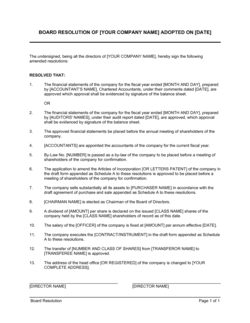
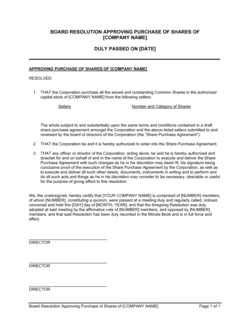
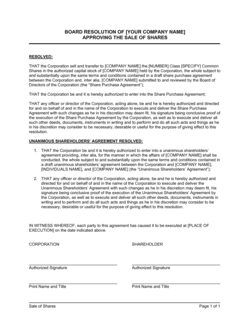
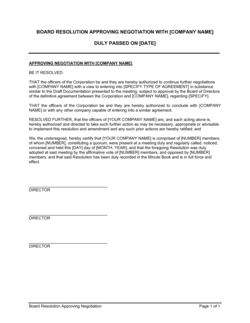
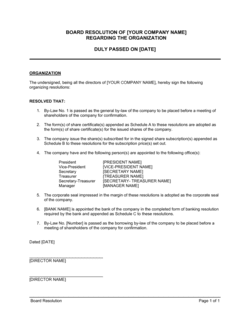
A Board Resolution for Share Issuance is a formal corporate document in which a company's board of directors votes to authorize the creation and allotment of new shares. This template is a free Word download you can edit online and export as PDF — specifying the share class, number of shares, issuance price, subscriber details, and any attached conditions in a single authoritative record.
When you need it
Use it any time the board authorizes new equity: a funding round, an employee stock option exercise, a share-based acquisition payment, or a dividend reinvestment that requires new share creation. Most corporate registries, cap-table administrators, and securities counsel require a signed board resolution before recording or transferring the shares.
What's inside
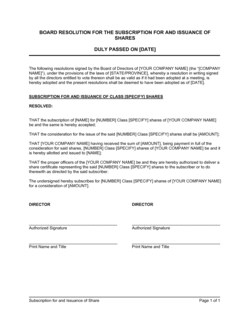
Meeting or written-consent recitals, authority confirmation against the articles and authorized share capital, share class and number, issuance price and consideration, subscriber identification, conditions precedent, filing and notice instructions, and director signature blocks.

What is a Board Resolution for Share Issuance?

A Board Resolution for Share Issuance is a formal corporate document in which a company's board of directors votes to authorize the creation and allotment of new shares to a named subscriber. It records the share class, number of shares, price per share, form of consideration, and any conditions that must be satisfied before the shares are formally issued. The resolution functions as the internal corporate act that empowers the company to perform its obligations under any accompanying subscription agreement, and it provides the authoritative record that share registrars, cap-table administrators, securities counsel, and regulatory bodies require before recording a new equity position.

Why You Need This Document

Without a signed board resolution, a share issuance has no formal corporate authorization — making the allotment potentially voidable and creating a title defect on the shares that will surface in every subsequent due diligence exercise. Investors closing a funding round, acquirers reviewing a target, and auditors confirming equity balances all ask for the underlying board resolution as the first document in their diligence request list. Absent that document, correcting the defect requires a retroactive ratification resolution, legal opinions, and in some cases re-execution of the subscription agreement — an expensive and avoidable problem. This template gives you a jurisdictionally aware, immediately usable starting point that covers authorization, subscriber identification, pre-emption handling, conditions precedent, and regulatory filing obligations in a single document you can execute in under 30 minutes for a standard share issuance.

Which variant fits your situation?

If your situation is…Use this template
Issuing common shares to a new investor in a priced funding roundBoard Resolution for Share Issuance
Granting stock options to employees under an equity incentive planStock Option Grant Agreement
Authorizing a share repurchase or buyback from an existing holderBoard Resolution for Share Repurchase
Converting convertible notes to equity at a priced roundConvertible Note Agreement
Issuing preferred shares with specific liquidation or anti-dilution rightsPreferred Share Terms Resolution
Recording shareholder approval alongside board approval for a new share classShareholder Resolution
Admitting a new partner or member in an LLC or partnership structureAmendment to Operating Agreement

Common mistakes to avoid

❌ Issuing shares without confirming remaining authorized capital

Why it matters: Allotting more shares than authorized is void in most jurisdictions and must be unwound — potentially after funds have already changed hands, creating legal and financial chaos at a sensitive moment in a capital raise.

Fix: Before drafting the resolution, reconcile the authorized share capital in the articles against all issued shares, reserved option pools, and any prior outstanding resolutions authorizing but unissued shares.

❌ Skipping pre-emption right waivers

Why it matters: Existing shareholders with pre-emption rights can challenge the allotment as invalid, require the company to offer them shares on the same terms, or seek an injunction — all of which can unwind a closed funding round.

Fix: Identify all holders of pre-emption rights before the resolution date, circulate written waiver requests, and attach executed waivers as a schedule to the resolution before it is signed.

❌ Using a trade name or abbreviated name for the subscriber

Why it matters: A mismatch between the subscriber name in the resolution and the share register creates a title defect that surfaces during due diligence for subsequent rounds or an acquisition, requiring costly legal corrections.

Fix: Require the subscriber to provide their exact registered legal name and jurisdiction in writing before drafting the resolution, and cross-check it against their formation documents.

❌ Omitting regulatory filing obligations from the resolution

Why it matters: Share issuances in most jurisdictions trigger time-sensitive filings — 15 days for SEC Form D, 1 month for UK Companies House SH01 — and missing these deadlines results in fines, loss of exemption, and investor-facing penalties.

Fix: Include a specific clause naming the applicable filings, their deadlines, and the officer responsible for each, so the obligation is documented and delegated on the face of the resolution.

The 10 key clauses, explained

Authority and recitals

In plain language: Confirms the board is acting within its authority by referencing the applicable articles, bylaws, and authorized share capital, and states the purpose of the resolution.

Sample language
WHEREAS, the Articles of Incorporation of [COMPANY NAME] (the 'Company') authorize the issuance of up to [NUMBER] shares of [SHARE CLASS], and the Board of Directors (the 'Board') is authorized to allot shares up to that limit without further shareholder approval;

Common mistake: Failing to confirm that the proposed allotment does not exceed the remaining authorized but unissued share pool — if it does, a shareholder resolution to increase authorized capital must be passed first.

Meeting or written consent recitals

In plain language: States whether the resolution was passed at a duly noticed board meeting with quorum, or by unanimous written consent, and records the date.

Sample language
BE IT RESOLVED that the undersigned, constituting all of the directors of [COMPANY NAME], hereby adopt the following resolution by unanimous written consent in lieu of a meeting, effective [DATE];

Common mistake: Using a written consent resolution when the company's articles or applicable law require a formal meeting for equity issuances above a threshold — check the governing documents before defaulting to consent.

Share class, number, and description

In plain language: Identifies precisely which class of shares is being issued, how many, and any special rights or restrictions that attach to those shares.

Sample language
RESOLVED, that the Company is hereby authorized to allot and issue [NUMBER] shares of [SHARE CLASS] (the 'New Shares'), carrying the rights and restrictions set out in Schedule A attached hereto;

Common mistake: Describing shares generically as 'common shares' without specifying whether they are voting or non-voting, and whether they carry the same dividend and liquidation rights as existing shares of the same class.

Issuance price and consideration

In plain language: States the price per share, the total consideration, and the form of payment — cash, property, services, or debt conversion — ensuring it meets any par value or fair-market-value requirements.

Sample language
RESOLVED, that the New Shares shall be issued at a price of $[PRICE PER SHARE] per share, for aggregate consideration of $[TOTAL AMOUNT], payable in [cash / conversion of the convertible note dated [DATE] / other consideration] on or before [CLOSING DATE];

Common mistake: Setting an issuance price below par value in a jurisdiction that prohibits it, or failing to document non-cash consideration with an independent valuation — both can render the allotment voidable.

Subscriber identification

In plain language: Names the individual or entity receiving the shares with enough specificity — full legal name, jurisdiction, and address — to allow share register and cap-table entries.

Sample language
RESOLVED, that the New Shares shall be issued to [SUBSCRIBER FULL LEGAL NAME], a [INDIVIDUAL / ENTITY TYPE] organized under the laws of [JURISDICTION], with its principal address at [ADDRESS] ('Subscriber');

Common mistake: Using a trade name or abbreviated entity name instead of the subscriber's full registered legal name — mismatches between the resolution and the share register create disputes during audits, transfers, and exits.

Pre-emption rights waiver or confirmation

In plain language: Records either that existing shareholders have waived pre-emption rights for this allotment, or that the issuance is exempt from pre-emption under the articles or applicable law.

Sample language
RESOLVED, that the Board confirms that the pre-emption rights of existing shareholders with respect to the New Shares have been validly waived in writing by all holders of pre-emptive rights, copies of which waivers are attached hereto as Schedule B;

Common mistake: Issuing shares without addressing pre-emption rights at all — even if the articles appear to give the board discretion, existing shareholders can challenge the allotment as invalid if statutory or contractual pre-emption was not properly waived.

Conditions precedent and closing mechanics

In plain language: Lists any conditions that must be satisfied before shares are formally allotted — receipt of payment, regulatory approval, or execution of a subscription agreement — and designates who is responsible for confirming satisfaction.

Sample language
RESOLVED, that the issuance of the New Shares is conditioned upon: (a) receipt of the full consideration by the Company on or before [DATE]; (b) execution of the Subscription Agreement by Subscriber; and (c) [ANY REGULATORY APPROVAL], and that the [CEO / CFO / Corporate Secretary] is authorized to confirm satisfaction of each condition;

Common mistake: Omitting conditions precedent entirely, which can leave the company unable to rescind an improperly funded allotment or expose it to liability if a regulatory approval was required but not obtained.

Share register update and share certificate instructions

In plain language: Directs the corporate secretary or registrar to record the allotment in the share register and, where applicable, to issue a share certificate to the subscriber.

Sample language
RESOLVED, that the Corporate Secretary is hereby directed to enter the New Shares in the Company's share register in the name of Subscriber, and to issue [a share certificate / a DRS statement] evidencing ownership of the New Shares promptly following closing;

Common mistake: Failing to instruct the share register update in the resolution — delays in recording the allotment can create priority disputes and complicate subsequent funding rounds or due diligence.

Filing and regulatory notice obligations

In plain language: Identifies any required government filings or notices triggered by the issuance — SEC Form D, Companies House return, SEDAR filing, or similar — and delegates responsibility for filing.

Sample language
RESOLVED, that the [CEO / CFO / General Counsel] is authorized and directed to file all required notices and returns with applicable regulatory authorities, including [Form D with the SEC / SH01 with Companies House / the applicable provincial securities regulator], within the required timeframes following closing;

Common mistake: Treating the regulatory filing as an afterthought not addressed in the resolution — the officer tasked with filing may be unaware of the obligation, resulting in late filings and associated fines.

General authorization clause

In plain language: Grants one or more named officers the authority to execute all ancillary documents, take all further actions, and spend reasonable funds to carry the resolution into effect.

Sample language
RESOLVED, that each of the [CEO] and [CFO] is individually authorized to execute and deliver any and all agreements, instruments, and documents, and to take any and all further actions, as they deem necessary or advisable to carry out the intent and purpose of the foregoing resolutions;

Common mistake: Limiting authorization to a single officer by name without an alternate — if that officer is unavailable at closing, the transaction can stall while the board convenes again to grant authority to someone else.

How to fill it out

  1. 1

    Confirm available authorized share capital

    Review the company's articles of incorporation and current cap table to verify that the number of shares you intend to issue does not exceed the authorized but unissued pool. If the pool is insufficient, a shareholder resolution to increase authorized capital must be passed before the board resolution.

    💡 Pull the most recent cap table and cross-reference it with the authorized capital in your articles — not the cap table alone — because phantom shares or options may have reduced the available pool without updating the articles.

  2. 2

    Choose meeting or written consent format

    Determine whether applicable law and your corporate governing documents permit a unanimous written consent in lieu of a meeting for share issuances. If a formal meeting is required, complete the meeting recitals with the date, location, quorum confirmation, and vote tally.

    💡 Delaware and most Canadian provinces permit written consent for board actions; the UK requires board approval but not necessarily a physical meeting — check your specific jurisdiction and articles.

  3. 3

    Specify share class, number, and attached rights

    Enter the exact share class name as it appears in your articles, the precise number of shares, and any special rights — voting ratios, dividend preferences, or conversion features — that attach. Attach a schedule if the rights are complex.

    💡 Use the exact class designation from your articles (e.g., 'Series A Preferred Stock' not 'preferred shares') to avoid any ambiguity in the share register or future investor documents.

  4. 4

    Set the issuance price and document consideration

    Enter the price per share and total consideration. If payment is non-cash — a debt conversion, property transfer, or services — describe the consideration specifically and attach any valuation supporting fair market value.

    💡 For equity rounds, the price per share in the resolution must match the price in the subscription agreement and the term sheet exactly — discrepancies trigger investor queries during closing.

  5. 5

    Identify the subscriber with full legal details

    Enter the subscriber's full registered legal name, entity type, jurisdiction of formation, and address. For individuals, include their full legal name as it appears on government-issued ID.

    💡 If the subscriber is a fund or investment vehicle, use the specific fund entity name — not the general partner or manager name — to ensure the share register matches the entity that holds the shares.

  6. 6

    Address pre-emption rights

    Confirm whether existing shareholders have waived pre-emption rights in writing or whether the issuance is exempt under the articles or applicable statute. Attach signed waiver letters as a schedule if waivers were obtained.

    💡 Collect pre-emption waivers before the board resolution is signed, not after — reversing an allotment made without proper waivers is expensive and may require a shareholder meeting.

  7. 7

    List conditions precedent and closing steps

    Add any conditions that must be met before the shares are formally issued — receipt of funds, execution of subscription documents, or regulatory clearance — and identify the officer responsible for confirming each condition is satisfied.

    💡 Set a specific long-stop date (e.g., 30 days from the resolution date) after which the authorization lapses if conditions are not met, to avoid open-ended authority to issue shares.

  8. 8

    Obtain director signatures and file the resolution

    Have all required directors sign the resolution (or the written consent) before closing. File any required regulatory notices — Form D, SH01, or provincial securities filings — within the prescribed period. Store the executed resolution in the corporate minute book.

    💡 Scan and store the executed resolution in your cap-table management platform immediately after signing so it is attached to the share issuance record and retrievable in future due diligence.

Frequently asked questions

What is a board resolution for share issuance?

A board resolution for share issuance is a formal corporate document in which the board of directors votes to authorize the allotment of new shares to a specific subscriber at a stated price. It records the decision as a binding corporate act, confirms the board's authority under the company's articles and applicable law, and provides the documentary foundation for updating the share register, cap table, and any required regulatory filings.

When is a board resolution required to issue shares?

In most jurisdictions a board resolution — or equivalent written consent — is required any time new shares are created and allotted: a priced funding round, an employee option exercise, a share-based acquisition payment, or a debt-to-equity conversion. Securities counsel, cap-table administrators, transfer agents, and corporate registries will not record a new share issuance without a signed authorizing resolution on file.

Do shareholders need to approve a share issuance?

It depends on the jurisdiction and the company's governing documents. In many cases, the board has authority to allot shares up to the authorized capital limit without shareholder approval. Shareholder approval is typically required when: authorized capital must be increased to accommodate the issuance, pre-emption rights have not been validly waived, or the company's articles require shareholder consent above a certain threshold. UK public companies require standing shareholder authority to allot shares under the Companies Act 2006.

What is the difference between authorized and issued share capital?

Authorized share capital is the maximum number of shares the company is permitted to create under its articles — a ceiling set at incorporation and changeable only by shareholder vote. Issued share capital is the number of shares actually allotted and outstanding. A board resolution to issue shares must confirm that the proposed allotment fits within the unissued portion of the authorized capital; if it does not, the articles must be amended first.

What regulatory filings are required after issuing shares?

In the US, a private placement of securities typically requires filing an SEC Form D within 15 days of the first sale, plus any applicable state blue-sky notice filings. In Canada, similar provincial securities reports are due within 10 days. In the UK, a Companies House SH01 return must be filed within one month of allotment. EU member states have varying national filing requirements. Missing these deadlines can trigger fines and, in some cases, loss of the applicable securities law exemption.

What happens if shares are issued without a board resolution?

An allotment made without proper board authorization may be voidable — meaning it can be challenged and unwound by the company or affected shareholders. In practice, undocumented issuances surface during due diligence for a subsequent round or acquisition, creating a title defect on the shares. Correcting the defect typically requires a ratification resolution and, depending on how much time has passed, legal opinions confirming the shares are validly issued.

Are pre-emption rights always required to be waived?

Not always — some issuances are exempt from pre-emption by statute or under the company's articles. Common exemptions include issuances for non-cash consideration, allotments under an employee equity plan, and issuances where the articles expressly exclude pre-emption. Outside those exemptions, existing shareholders with pre-emption rights must be given the opportunity to subscribe pro-rata, or must provide written waivers, before shares can be allotted to a new subscriber.

Do I need a lawyer to prepare a board resolution for share issuance?

For a straightforward cash-consideration issuance to a single subscriber in a jurisdiction you know well, a high-quality template is typically sufficient for early-stage companies. Engage a lawyer when the issuance involves complex preferred share terms, a convertible instrument, a cross-border subscriber, pre-emption complications, or is part of a material funding round where securities law compliance is critical. A one-hour legal review typically costs $300–$600 and is worthwhile for any issuance above $100,000.

How this compares to alternatives

vs Shareholder Resolution

A shareholder resolution records a decision made by the shareholders rather than the directors — required when authorized capital must be increased, a new share class created, or pre-emption rights disapplied beyond what the board can authorize alone. A board resolution for share issuance operates within already-authorized limits; a shareholder resolution changes those limits. Both documents are often needed together for a new share class or a capital increase.

vs Stock Option Grant Agreement

A stock option grant agreement gives an employee or advisor the right to purchase shares at a fixed price in the future — no shares are issued at grant. A board resolution for share issuance is needed later, when the option is exercised and actual shares must be allotted. The grant agreement establishes the right; the resolution executes it.

vs Subscription Agreement

A subscription agreement is a bilateral contract between the company and an investor setting out the commercial terms of a share purchase — representations, warranties, and conditions. A board resolution is the internal corporate authorization that empowers the company to perform its obligations under the subscription agreement. Both documents are required to close a share issuance; one without the other leaves the transaction incomplete.

vs Minutes of Board Meeting

Board meeting minutes record everything that occurred at a formal meeting — attendance, discussion, and all resolutions passed. A standalone board resolution (or written consent) is a single-purpose document containing only the share issuance authorization, used when the board acts between meetings or when a clean standalone record is needed for filing. Minutes are the comprehensive record; a resolution is the targeted authorization document.

Industry-specific considerations

Technology / SaaS

Seed and Series A priced rounds, employee option exercises under a stock incentive plan, and SAFEs converting to equity all require a board resolution to formally record each allotment.

Financial Services

Regulated entities may require regulator notification or approval before issuing shares above certain ownership thresholds, making the resolution a prerequisite for filing the change-of-control notice.

Professional Services

Law firms, accounting practices, and consultancies admitting new equity partners typically use a board or shareholder resolution to document the share allotment alongside the partnership or shareholder agreement amendment.

Healthcare / Life Sciences

FDA-regulated companies raising capital from strategic investors must confirm that share issuances do not inadvertently trigger ownership thresholds requiring pre-market notification or foreign investment review under CFIUS.

Manufacturing

Share-for-assets acquisitions — issuing shares to a supplier or joint-venture partner in exchange for equipment or IP — require a resolution that documents both the non-cash consideration and any independent valuation obtained.

Real Estate

Special-purpose vehicles issuing shares to multiple co-investors at close need a resolution for each subscriber, often executed simultaneously under a single omnibus resolution covering all investors in the same round.

Jurisdictional notes

United States

Delaware and most states permit board approval of share issuances by unanimous written consent without a meeting. The allotment must not exceed authorized capital under the certificate of incorporation. Private placements typically require an SEC Form D exemption filing within 15 days of first sale, plus state blue-sky notices. Some states impose a minimum par value; issuances below par are prohibited.

Canada

Under the CBCA and provincial business corporations acts, the board may issue shares up to the authorized limit without shareholder approval unless the articles restrict this. Written consent resolutions are permitted for private companies. Provincial securities regulators require a Report of Exempt Distribution within 10 days of closing. Quebec-incorporated companies must comply with the Business Corporations Act (Quebec) and maintain French-language corporate records.

United Kingdom

Under the Companies Act 2006, directors of a public company require standing shareholder authority (s.551) to allot shares; private companies with a single share class may allot freely. Pre-emption rights under s.561 apply unless disapplied by a special resolution or specific articles provision. A Companies House SH01 return must be filed within one month of allotment. Board approval may be by written resolution for private companies.

European Union

EU member states implement share issuance rules differently under national company law. Germany requires notarial involvement for GmbH capital increases; France requires a shareholders' extraordinary general meeting to authorize new share issuances beyond the board's standing authority. Most EU jurisdictions require a filing with the national commercial register within 30 days of allotment. GDPR considerations apply when subscriber personal data is processed as part of the share register.

Template vs lawyer — what fits your deal?

PathBest forCostTime
Use the templateEarly-stage companies issuing common shares for cash consideration to a known subscriber in a single domestic jurisdictionFree15–30 minutes
Template + legal reviewIssuances involving preferred shares, non-cash consideration, pre-emption complications, or a cross-border subscriber$300–$6001–2 days
Custom draftedMaterial funding rounds above $500K, complex preferred share terms, regulated industries, or multi-subscriber closings with concurrent securities filings$1,500–$5,000+1–2 weeks

Glossary

Board Resolution
A formal written record of a decision made by a company's board of directors, either at a duly convened meeting or by unanimous written consent.
Allotment
The formal act of creating and assigning new shares to a subscriber, distinct from the subsequent transfer of already-issued shares.
Authorized Share Capital
The maximum number and class of shares a company is permitted to issue under its articles of incorporation or memorandum, before any amendment.
Issued Share Capital
The portion of authorized shares that have actually been allotted and are outstanding in the hands of shareholders.
Share Class
A category of shares carrying a defined bundle of rights — voting, dividend, and liquidation preferences — such as Class A Common, Series A Preferred, or ordinary shares.
Consideration
The value given in exchange for shares — cash, property, services, or a debt conversion — which must meet minimum statutory requirements to make the allotment valid.
Pre-emption Rights
Existing shareholders' contractual or statutory right to purchase new shares pro-rata before they are offered to outside subscribers, preserving their ownership percentage.
Subscriber
The individual or entity receiving the newly issued shares, identified by full legal name, address, and, where required, tax identification number.
Par Value
A nominal minimum price per share stated in the articles — common in US and some international structures — below which shares generally cannot be legally issued.
Written Consent in Lieu of Meeting
A procedure allowing directors to approve a resolution by signing a written document rather than holding a physical or virtual meeting, permitted in most jurisdictions.
Dilution
The reduction in each existing shareholder's ownership percentage that occurs when new shares are issued, increasing the total number of shares outstanding.

Part of your Business Operating System

This document is one of 3,000+ business & legal templates included in Business in a Box.

  • Fill-in-the-blanks — ready in minutes
  • 100% customizable Word document
  • Compatible with all office suites
  • Export to PDF and share electronically

Create your document in 3 simple steps.

From template to signed document — all inside one Business Operating System.
1
Download or open template

Access over 3,000+ business and legal templates for any business task, project or initiative.

2
Edit and fill in the blanks with AI

Customize your ready-made business document template and save it in the cloud.

3
Save, Share, Send, Sign

Share your files and folders with your team. Create a space of seamless collaboration.

Save time, save money, and create top-quality documents.

★★★★★

"Fantastic value! I'm not sure how I'd do without it. It's worth its weight in gold and paid back for itself many times."

Managing Director · Mall Farm
Robert Whalley
Managing Director, Mall Farm Proprietary Limited
★★★★★

"I have been using Business in a Box for years. It has been the most useful source of templates I have encountered. I recommend it to anyone."

Business Owner · 4+ years
Dr Michael John Freestone
Business Owner
★★★★★

"It has been a life saver so many times I have lost count. Business in a Box has saved me so much time and as you know, time is money."

Owner · Upstate Web
David G. Moore Jr.
Owner, Upstate Web

Run your business with a system — not scattered tools

Stop downloading documents. Start operating with clarity. Business in a Box gives you the Business Operating System used by over 250,000 companies worldwide to structure, run, and grow their business.

Free Forever Plan · No credit card required