Employee Meal Policy Template

Free Word download β€’ Edit online β€’ Save & share with Drive β€’ Export to PDF

2 pagesβ€’20–25 min to fillβ€’Difficulty: Standard
Learn more ↓
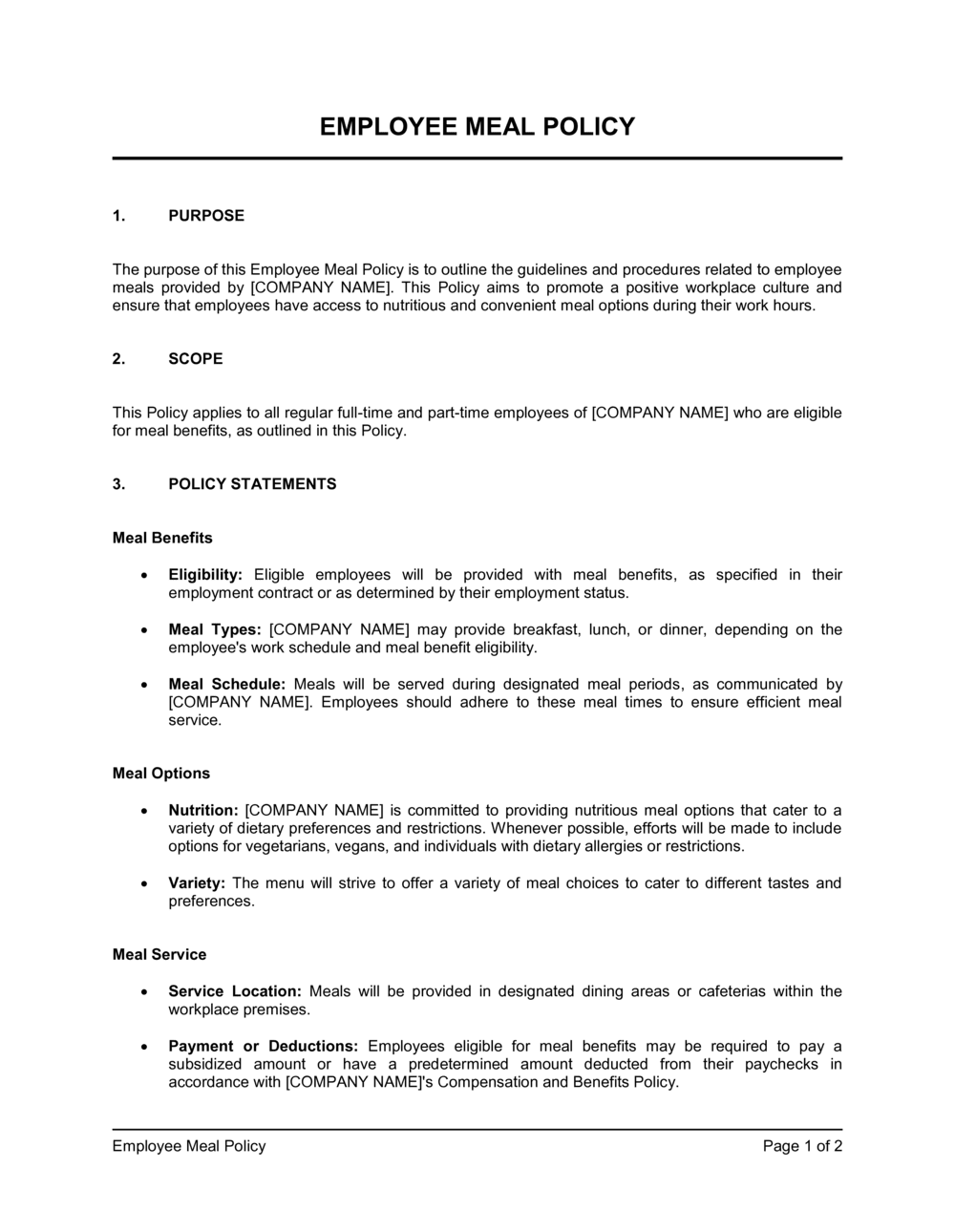
FreeEmployee Meal Policy Template

At a glance

What it is
An Employee Meal Policy is an HR document that defines when and how a business provides meals or meal allowances to its staff β€” covering eligibility rules, what is included, taxable versus non-taxable treatment, dietary accommodations, alcohol restrictions, and conduct expectations. This free Word download is editable online and exportable as PDF, ready for inclusion in your employee handbook or new-hire onboarding packet.
When you need it
Use it when your business offers complimentary meals, shift meals, or meal allowances to employees β€” particularly before scaling your team, opening a new location, or preparing for a payroll or tax audit where meal benefit treatment must be documented.
What's inside
Policy scope and eligibility criteria, a description of what meals and beverages are covered, taxable income rules and IRS de minimis guidance, dietary accommodation procedures, alcohol and conduct rules, and the process for reporting or resolving policy violations.

What is an Employee Meal Policy?

An Employee Meal Policy is an HR and operations document that defines the terms under which a business provides meals or meal allowances to its staff. It specifies who is eligible, what food and beverages are covered, the dollar value or item scope of the benefit, how meals are recorded through the POS or expense system, and the rules governing conduct, dietary accommodations, and alcohol. Critically, it also documents the tax classification of the benefit β€” establishing whether meals qualify for the IRS Section 119 convenience-of-the-employer exclusion or must be reported as taxable wages on employee W-2s. This free Word download can be edited online and exported as PDF for inclusion in your employee handbook or new-hire packet.

Why You Need This Document

Without a written meal policy, food cost variance becomes unexplainable, inconsistent enforcement breeds resentment between shifts, and the tax-free status of your staff meal program is impossible to substantiate during a payroll audit. In a restaurant or hotel context, an undocumented meal benefit can be reclassified as taxable wages retroactively β€” creating back-tax liability plus penalties for every year the benefit was provided. Beyond tax risk, the absence of clear rules on dollar limits, alcohol exclusions, and comp-recording procedures puts individual managers in the position of making judgment calls that lead to complaints and, in licensed-premises environments, genuine legal exposure. This template gives you a defensible, consistently enforceable policy in under an hour β€” covering every dimension your kitchen managers, HR team, and payroll provider need to administer the benefit correctly from day one.

Which variant fits your situation?

If your situation is…Use this template
Restaurant or cafe with a staff meal served before each shiftEmployee Meal Policy (Restaurant)
Corporate office providing catered lunches or a subsidized cafeteriaEmployee Benefits Policy
Hotel or resort with multi-outlet dining for staff across departmentsEmployee Meal Policy (Hospitality)
Reimbursing employees for meals during business travelTravel and Expense Policy
Providing a per-diem meal allowance to field or remote workersPer Diem Policy
Setting rules for client or team entertainment mealsBusiness Expense Policy
Documenting all food-related safety and handling rules for kitchen staffFood Safety Policy

Common mistakes to avoid

❌ No dollar cap on the meal benefit

Why it matters: Without a stated limit, employees and managers interpret 'staff meal' differently β€” one person orders a $9 staff dish while another orders a $35 entrΓ©e, making food cost variance impossible to explain.

Fix: Set a specific maximum value per meal per shift, displayed prominently in the policy and posted in the staff area.

❌ Assuming staff meals are automatically non-taxable

Why it matters: Cash allowances, off-premises meals, and meals without a documented convenience-of-the-employer rationale do not qualify for the IRS Section 119 exclusion β€” treating them as non-taxable creates payroll tax exposure.

Fix: Confirm classification with your payroll provider before rolling out the benefit, and document the business reason for each meal type provided.

❌ No comp-recording or logging requirement

Why it matters: Unrecorded staff meals inflate food cost variance, skew inventory, and remove the documentation trail needed to substantiate the tax exclusion during a payroll audit.

Fix: Require every staff meal to be logged through the POS under a designated comp code before the employee begins eating.

❌ Vague conduct expectations about where meals are consumed

Why it matters: Without a designated eating area in writing, staff eat in guest-facing spaces or storage areas, creating hygiene, brand, and liability issues β€” and disciplinary action becomes difficult without a written rule to point to.

Fix: Name the specific area or areas where staff meals may be consumed and include this in the orientation walk-through, not just the written policy.

The 10 key sections, explained

Purpose and scope

Eligibility criteria

What is provided

Taxable vs. non-taxable treatment

Dietary accommodations

Alcohol and prohibited items

Ordering and redemption procedures

Conduct expectations

Abuse, violations, and consequences

Policy review and acknowledgment

How to fill it out

  1. 1

    Set the scope and eligible locations

    Enter your company name and list every location or outlet where the policy applies. Specify whether the same rules apply to all sites or whether location-specific addenda will override certain terms.

    πŸ’‘ If you operate multiple brands or concepts under one company, call out each brand by name β€” staff working across locations need to know which rules apply where.

  2. 2

    Define eligibility by shift length and employment type

    Fill in the minimum qualifying shift length (commonly 5 or 6 hours) and list which employment categories are covered β€” full-time, part-time, seasonal, and temporary. Address probationary period eligibility explicitly.

    πŸ’‘ Check your state or provincial labor law for any mandated meal break rules β€” your eligibility threshold should be consistent with, not lower than, the legal minimum break entitlement.

  3. 3

    Specify what is covered and the dollar cap

    List the items included in the staff meal β€” a fixed staff menu, a dollar value from the regular menu, or a combination. Enter the maximum dollar value per meal per shift.

    πŸ’‘ A specific dollar cap (e.g., $12) is far easier to enforce consistently than a general menu section β€” it also simplifies food cost tracking.

  4. 4

    Complete the taxable vs. non-taxable section

    Confirm with your payroll provider or accountant whether your meal program qualifies for the IRS Section 119 exclusion or a state equivalent. Enter the applicable rule and note any cash allowances that must be treated as taxable wages.

    πŸ’‘ Document the business reason for each meal benefit type (e.g., 'keeping kitchen staff on-site during peak service') β€” this is the key evidence for the convenience-of-the-employer exclusion.

  5. 5

    Write the dietary accommodation request process

    Name the contact (HR manager or direct supervisor) who receives accommodation requests, set a notice window (commonly 3–5 business days), and describe the review and response process.

    πŸ’‘ Include a brief statement that the company will not require medical documentation for religiously motivated dietary restrictions β€” this avoids ADA and Title VII friction.

  6. 6

    Explicitly list excluded items and alcohol rules

    Name every category of item not covered by the staff meal benefit, with particular attention to alcoholic beverages. Reference your company's broader alcohol policy for on-shift conduct.

    πŸ’‘ If your venue serves alcohol, have your legal or compliance team review the exclusion language β€” licensed premises have heightened liability exposure if staff alcohol consumption during or before a shift is not clearly prohibited.

  7. 7

    Set the ordering and comp-recording procedure

    Describe when and how employees place their staff meal order, which POS code or manager authorization records it, and whether takeaway is permitted. Link the comp-recording requirement to your food cost reconciliation process.

    πŸ’‘ A dedicated staff meal POS button or comp code makes end-of-day food cost reporting automatic β€” without it, staff meals are often absorbed into waste or comps and never reconciled.

  8. 8

    Collect signed acknowledgments and store on file

    Add the policy to your new-hire onboarding packet and require a dated acknowledgment signature before the employee's first qualifying shift. Store copies in each employee's personnel file.

    πŸ’‘ Use Business in a Box eSign to timestamp acknowledgments and link the signed copy directly to the employee record β€” paper sign-off sheets are regularly lost during management transitions.

Frequently asked questions

What is an employee meal policy?

An employee meal policy is an HR document that defines the terms under which a business provides meals or meal allowances to its staff. It covers who is eligible, what is included, how much the benefit is worth per shift, how it is recorded, and the rules for conduct and dietary accommodations. It is most common in restaurants, hotels, catering companies, and any employer with an on-site cafeteria or food service operation.

Are staff meals taxable income?

It depends on how and where the meal is provided. Under IRS Section 119, meals furnished on the employer's business premises for the convenience of the employer are generally excludable from the employee's taxable income. Cash meal allowances, off-premises meals, and meals without a documented business justification typically do not qualify for the exclusion and must be reported as taxable wages. Confirm the classification with your payroll provider before implementing a new meal benefit.

Does a restaurant have to offer staff meals?

No federal law requires restaurants to provide staff meals as a benefit. Some state and local wage laws require unpaid or paid meal breaks after a certain number of hours worked, but the content of the meal is not mandated. Staff meals are a business decision β€” widely used in hospitality to reduce turnover and ensure staff are fed during long service periods β€” but they are not a legal entitlement in most US jurisdictions.

How do I handle dietary restrictions and food allergies in the policy?

Include a clear accommodation request process: name the contact who receives requests, set a reasonable notice window (typically 3–5 business days), and commit to making reasonable adjustments within the kitchen's capabilities. For medically documented allergies, the obligation is higher β€” consult your HR advisor on ADA requirements. Avoid requiring medical documentation for religiously motivated dietary restrictions, as this can create Title VII friction.

What should be excluded from the staff meal benefit?

At minimum, explicitly exclude alcoholic beverages, premium or specialty items above the policy's dollar cap, dessert items not on the staff menu, and any item designated for paying guests. On licensed premises, the alcohol exclusion is particularly important β€” your liability exposure increases significantly if an employee consumes alcohol during or immediately before a shift and an incident follows.

Can employees share their staff meal with guests or family members?

No β€” and this should be stated explicitly in the policy. Allowing staff meals to be shared with non-employees undermines the business rationale for the benefit, inflates food cost, and can jeopardize the convenience-of-the-employer tax exclusion. Treat sharing as a policy violation subject to the same disciplinary process as other infractions.

How often should an employee meal policy be reviewed?

Review it annually at minimum, and any time there is a significant change in menu pricing, tax rules affecting fringe benefit treatment, or a shift in your workforce composition (e.g., adding a large seasonal cohort). Re-issue acknowledgment forms to all employees whenever a material change is made so your records reflect who has seen the current version.

Do I need a separate policy for meal allowances versus on-site meals?

You can address both in one document with clearly separated sections, but the tax treatment differs enough that the distinction must be explicit. On-site shift meals may qualify for the Section 119 exclusion; cash allowances and off-premises reimbursements almost always do not. If your business uses both mechanisms, label each separately in the policy and document the different payroll treatment for each type.

How do I enforce the policy fairly across multiple locations?

Start with a single master policy that sets universal minimums β€” eligibility threshold, dollar cap, alcohol exclusion, comp-recording requirement β€” then allow location-specific addenda for site-level operational differences. Train every manager on the non-negotiable rules before roll-out, and designate one person per location as the policy owner responsible for consistent application and monthly comp-log review.

How this compares to alternatives

vs Travel and Expense Policy

A travel and expense policy governs meal reimbursements when employees are away from their primary work location on business travel, typically using a per-diem rate or receipt-based reimbursement. An employee meal policy covers on-site or shift-based meals provided as a recurring employment benefit. The two documents address different scenarios and different tax treatments β€” both are needed if your business involves travel as well as on-site meal benefits.

vs Employee Benefits Policy

An employee benefits policy covers the full suite of non-wage compensation β€” health insurance, retirement contributions, PTO, and more. An employee meal policy is a focused, operational document dedicated to food benefits, written at the level of detail needed by managers and kitchen staff who enforce it daily. For large employers, the meal policy is typically an addendum referenced within the broader benefits policy.

vs Employee Handbook

An employee handbook is an umbrella document covering all workplace policies. An employee meal policy is a standalone module that provides the operational specificity β€” dollar caps, comp codes, exclusion lists, accommodation procedures β€” that a handbook's general benefits section cannot. In practice, the meal policy is appended to the handbook and cross-referenced rather than embedded in it.

vs Food Safety Policy

A food safety policy governs hygiene standards, handling procedures, and regulatory compliance in food preparation and service. An employee meal policy governs the entitlement, conduct, and tax treatment of meals provided to staff. The two documents are complementary β€” a kitchen operation typically needs both β€” but they address entirely different management questions.

Industry-specific considerations

Restaurants and cafes

Pre-shift staff meals are standard practice; the policy must address shift meal timing, staff menu composition, and POS comp-code recording to keep food cost reconciliation accurate.

Hotels and resorts

Multi-department teams spanning housekeeping, front desk, and F&B require a policy that applies consistently across outlets while allowing for department-level scheduling differences.

Corporate offices and campuses

Subsidized cafeteria programs and catered team lunches raise convenience-of-the-employer tax questions; a written policy is the primary documentation for the IRS exclusion.

Catering and events

Event-day staff often work irregular hours and locations; the policy must define eligibility for temporary and contract workers and clarify whether off-premises meals are reimbursable.

Template vs pro β€” what fits your needs?

PathBest forCostTime
Use the templateSingle-location restaurants, cafes, or small on-site teams setting up a staff meal benefit for the first timeFree30–60 minutes
Template + professional reviewMulti-location operators, businesses with cash meal allowances, or any employer uncertain about taxable vs. non-taxable classification$150–$400 (payroll advisor or HR consultant review)1–3 days
Custom draftedLarge hospitality groups, unionized workplaces, or businesses operating across multiple states with differing wage and hour rules$500–$1,500 (employment counsel or senior HR consultant)1–2 weeks

Glossary

Staff Meal
A meal provided by the employer to an employee, typically before or during a work shift, as a condition of employment or as a benefit.
De Minimis Fringe Benefit
A benefit so small in value that accounting for it is impractical β€” qualifying meals are excluded from an employee's taxable income under IRS rules.
Meal Allowance
A fixed dollar amount an employer credits to an employee to purchase food, either on-site or at approved vendors, during or adjacent to a work shift.
Taxable Meal Benefit
A meal or meal subsidy that does not meet IRS de minimis or convenience-of-employer exclusions and must therefore be reported as taxable wages.
Convenience of the Employer
An IRS standard under which meals furnished on business premises for the employer's operational benefit β€” such as keeping staff on-site during peak service β€” may be excluded from taxable income.
Dietary Accommodation
An adjustment to the standard meal offering to meet an employee's documented medical, religious, or allergen-related dietary requirement.
Eligibility Period
The minimum hours worked per shift or employment status (full-time, part-time, or temporary) that qualifies an employee for a meal benefit.
Policy Acknowledgment
A signed or electronically confirmed statement by the employee confirming they have read and understood the meal policy terms.
Shift Meal
A specific meal provided at a set time tied to the employee's scheduled work shift, distinct from a general food allowance or per-diem arrangement.
Comping
The practice of providing food or beverages at no charge β€” in this context, the internal process by which staff meals are recorded and removed from the sales ledger.

Part of your Business Operating System

This document is one of 3,000+ business & legal templates included in Business in a Box.

  • Fill-in-the-blanks β€” ready in minutes
  • 100% customizable Word document
  • Compatible with all office suites
  • Export to PDF and share electronically

Create your document in 3 simple steps.

From template to signed document β€” all inside one Business Operating System.
1
Download or open template

Access over 3,000+ business and legal templates for any business task, project or initiative.

2
Edit and fill in the blanks with AI

Customize your ready-made business document template and save it in the cloud.

3
Save, Share, Send, Sign

Share your files and folders with your team. Create a space of seamless collaboration.

Save time, save money, and create top-quality documents.

β˜…β˜…β˜…β˜…β˜…

"Fantastic value! I'm not sure how I'd do without it. It's worth its weight in gold and paid back for itself many times."

Managing Director Β· Mall Farm
Robert Whalley
Managing Director, Mall Farm Proprietary Limited
β˜…β˜…β˜…β˜…β˜…

"I have been using Business in a Box for years. It has been the most useful source of templates I have encountered. I recommend it to anyone."

Business Owner Β· 4+ years
Dr Michael John Freestone
Business Owner
β˜…β˜…β˜…β˜…β˜…

"It has been a life saver so many times I have lost count. Business in a Box has saved me so much time and as you know, time is money."

Owner Β· Upstate Web
David G. Moore Jr.
Owner, Upstate Web

Run your business with a system β€” not scattered tools

Stop downloading documents. Start operating with clarity. Business in a Box gives you the Business Operating System used by over 250,000 companies worldwide to structure, run, and grow their business.

Free Forever PlanΒ Β·Β No credit card required