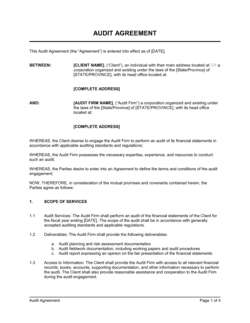
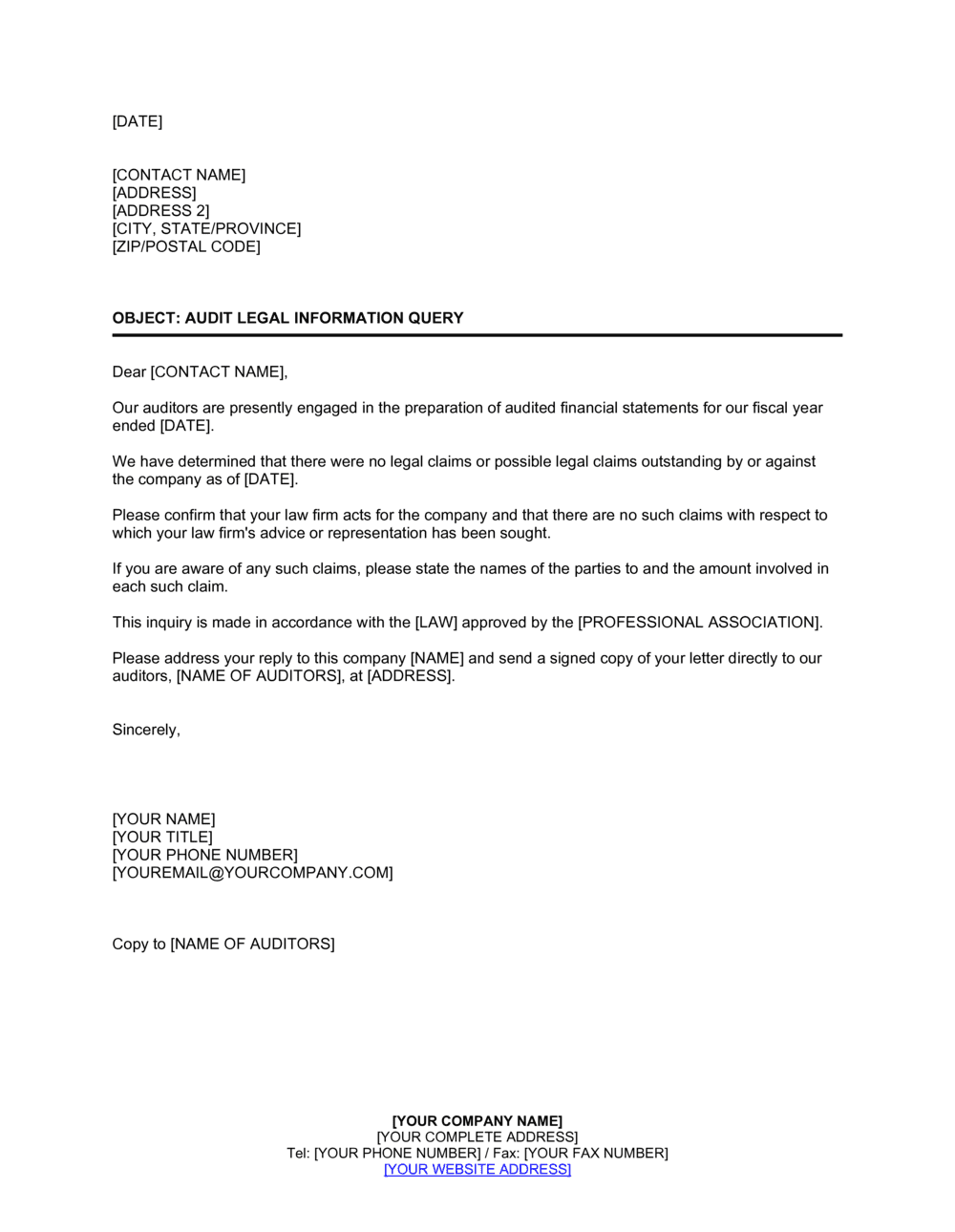
Audit Information Legal Query Template

Free Word download • Edit online • Save & share with Drive • Export to PDF

1 page20–30 min to fillDifficulty: StandardSignature requiredLegal review recommended
Learn more ↓
FreeAudit Information Legal Query Template

At a glance

What it is
An Audit Information Legal Query is a formal, binding written request issued by an auditor, legal counsel, or authorized representative to a client, third party, or opposing party demanding the production of specific financial records, documents, and disclosures relevant to an ongoing audit or legal proceeding. This free Word download is fully editable online and can be exported as PDF for immediate dispatch.
When you need it
Use it when an auditor or legal team needs documentary evidence of financial transactions, contingent liabilities, pending litigation, or account balances from a client entity or third-party custodian. It is also used by legal counsel to obtain audit-related disclosures prior to issuing an opinion or completing due diligence.
What's inside
Identification of the requesting and responding parties, the specific legal or audit authority under which the query is issued, an itemized list of documents and information required, response deadline and delivery instructions, confidentiality obligations, and signature blocks for both parties.

What is an Audit Information Legal Query?

An Audit Information Legal Query is a formal, binding written request issued by an auditor, legal counsel, or authorized regulatory representative to a client, third party, or financial institution compelling the production of specific documents, account confirmations, and financial disclosures required to complete an audit engagement or support a legal proceeding. Unlike an informal document request, it cites the professional standard or statutory authority — such as ISA 505, AU-C Section 505, or the Companies Act — under which the demand is made, requires a certified response, and creates an enforceable record of the request and the respondent's obligations. It is a cornerstone tool in statutory audits, M&A due diligence, regulatory examinations, and any engagement where documentary evidence must be independently verified rather than accepted solely on management's word.

Why You Need This Document

Proceeding without a formal audit information legal query exposes both the auditor and the engaging organization to significant professional and legal risk. Auditors who rely on informal email requests rather than documented, certified confirmations violate audit standards that require evidence of the procedures performed — a gap that can result in professional sanctions, audit opinion withdrawal, or liability if financial statements are later found to be materially misstated. For organizations on the receiving side of an audit, failing to issue a properly structured query to third parties means contingent liabilities, threatened litigation, and off-balance-sheet obligations may go undisclosed, producing an audit opinion that does not reflect the true financial position. In enforcement and M&A contexts, the absence of a formal query and a certified response leaves no evidentiary record to rely upon if the information is later disputed. This template gives auditors and legal counsel the structured, standards-aligned starting point they need to issue defensible queries, track responses, and document alternative procedures — in a fraction of the time it takes to draft from scratch.

Which variant fits your situation?

If your situation is…Use this template
Requesting account balance confirmations from a bank or financial institutionBank Confirmation Letter
Querying a client's legal counsel about pending or threatened litigationLegal Representation Confirmation Letter
Requesting document production in a formal legal dispute or investigationLegal Document Request Letter
Confirming accounts receivable balances directly with a debtorAccounts Receivable Confirmation Letter
Obtaining management representations at the close of an audit engagementManagement Representation Letter
Requesting financial statements and records in an M&A due diligence processDue Diligence Request List
Compelling a third party to respond to an audit query under legal authorityStatutory Audit Information Request

Common mistakes to avoid

❌ Open-ended scope language

Why it matters: Phrases like 'all relevant documents' allow respondents to determine their own scope of compliance, almost always producing incomplete responses that require multiple follow-up rounds.

Fix: Replace open-ended language with numbered, specific requests tied to named accounts, date ranges, and document types. Each request should be answerable with a yes/no or a specific document.

❌ Omitting the non-response consequence clause

Why it matters: Without a stated consequence, respondents treat the deadline as advisory. Auditors who cannot document timely follow-up on non-responses may face professional standards violations.

Fix: State explicitly that non-response will trigger alternative audit procedures and be noted in audit documentation — and follow through if the deadline passes without a reply.

❌ Restricting litigation disclosure to filed claims only

Why it matters: Audit standards require disclosure of threatened and contemplated proceedings, not just filed ones. A response that omits a threatened $2M claim can result in a materially misstated audit opinion.

Fix: Explicitly list 'pending, threatened, and contemplated' proceedings in the query language and confirm the same wording in any follow-up sent to the client's legal counsel.

❌ Accepting an unsigned or uncertified response

Why it matters: An unsigned response has limited evidentiary value and cannot be relied upon to support an audit conclusion if the information is later disputed or contradicted.

Fix: Return any unsigned response to the respondent immediately and request a signed, certified version before incorporating the information into audit workpapers.

❌ Sending the query to the wrong contact

Why it matters: A query sent to the client's project contact instead of the authorized financial officer or legal counsel may not reach the individual with authority to certify the response — invalidating the confirmation.

Fix: Confirm the correct authorized signatory and their direct contact details with the client before dispatch, and address the query by name and title.

❌ Mismatching the query period with the engagement letter

Why it matters: If the query covers a different period than the audit engagement letter, any information obtained outside the agreed scope may be inadmissible or may expose the firm to scope-creep liability.

Fix: Cross-reference the audit period stated in the engagement letter before finalizing the query, and ensure exact date alignment between the two documents.

The 10 key clauses, explained

Identification of Parties and Audit Authority

In plain language: Names the requesting auditor or legal counsel, the responding party, and the specific legal or professional standard authorizing the query.

Sample language
This Audit Information Legal Query is issued by [AUDITOR/FIRM NAME] ('Requesting Party') on behalf of [CLIENT ENTITY NAME] ('Client') to [RESPONDING PARTY NAME] ('Respondent') pursuant to [APPLICABLE STANDARD / STATUTORY AUTHORITY], for the audit period ending [DATE].

Common mistake: Citing the wrong professional standard or omitting the statutory authority entirely — if the respondent cannot verify the legal basis for the request, they may lawfully decline to respond.

Scope and Period Under Examination

In plain language: Defines the exact financial period covered by the query and the specific accounts, transactions, or subject matter in scope.

Sample language
This query relates to the financial period from [START DATE] to [END DATE] and encompasses all transactions, balances, and events material to [ACCOUNT / SUBJECT MATTER] as recorded in the books of [ENTITY NAME].

Common mistake: Using an open-ended scope such as 'all relevant records' without specifying accounts or periods — this invites selective compliance and weakens enforceability.

Itemized Information Request

In plain language: Lists each specific document, record, confirmation, or explanation being requested, numbered for tracking and follow-up.

Sample language
The Responding Party is requested to provide: (1) Confirmation of outstanding balance of $[AMOUNT] as of [DATE]; (2) Copies of all loan agreements entered into between [DATE] and [DATE]; (3) Details of any pending legal claims involving [ENTITY NAME] as of [DATE].

Common mistake: Bundling multiple unrelated items into a single numbered request — this makes it easy for the respondent to answer part of a request and treat the whole item as complete.

Contingent Liabilities and Pending Litigation Disclosure

In plain language: Specifically requests disclosure of all known or threatened legal claims, regulatory investigations, or contingent obligations that could affect the financial statements.

Sample language
Please confirm whether, as of [DATE], [ENTITY NAME] is subject to any pending, threatened, or contemplated legal proceedings, claims, assessments, or governmental investigations. For each matter, state: the nature of the claim, the parties involved, the amount claimed, and management's assessment of probable outcome.

Common mistake: Limiting this clause to 'filed' lawsuits only — threatened and contemplated claims are equally required disclosures under most audit standards and must be explicitly captured.

Confidentiality and Permitted Use

In plain language: Restricts the use of information provided in response to the query to the stated audit or legal purpose, and prohibits disclosure to unauthorized parties.

Sample language
All information provided in response to this query shall be used solely for the purposes of the audit of [ENTITY NAME] for the period ending [DATE] and shall not be disclosed to third parties without prior written consent, except as required by law or professional standards.

Common mistake: Omitting this clause when requesting sensitive financial data — without it, the responding party has no written assurance that their information will not be shared beyond the audit team.

Response Deadline and Delivery Instructions

In plain language: States the date by which the response must be received and the method of delivery — email, secure portal, or physical mail — to a named recipient.

Sample language
The Responding Party is requested to return the completed response and all supporting documentation to [NAME], [TITLE], at [EMAIL / ADDRESS] no later than [DATE]. Responses received after this date may require the Requesting Party to apply alternative audit procedures.

Common mistake: Setting a deadline without specifying what happens if it is missed — auditors who fail to state the consequence of non-response lose leverage and delay completion of fieldwork.

Non-Response and Alternative Procedures Notice

In plain language: Notifies the respondent that failure to reply by the deadline will trigger alternative audit procedures, which may result in qualifications or adverse findings.

Sample language
If no response is received by [DATE], the Requesting Party reserves the right to apply alternative audit procedures and to note the non-response in the audit documentation. A non-response may be treated as an indicator of risk in the audit opinion.

Common mistake: Treating this as a formality and softening the language to avoid conflict — a clearly stated consequence is the single most effective mechanism for securing timely responses.

Representations and Accuracy Certification

In plain language: Requires the respondent to certify that the information provided is accurate, complete, and not misleading to the best of their knowledge.

Sample language
By signing below, the Responding Party certifies that the information provided in response to this query is accurate and complete as of [DATE] and does not omit any information that would be material to the audit of [ENTITY NAME].

Common mistake: Accepting an unsigned response without a certification — unsigned responses carry no accountability, and their evidentiary value in disputes or regulatory reviews is significantly lower.

Governing Law and Jurisdiction

In plain language: Specifies which jurisdiction's laws govern the query and any disputes arising from non-compliance or misrepresentation in the response.

Sample language
This Audit Information Legal Query is governed by the laws of [STATE / PROVINCE / COUNTRY]. Any dispute arising from non-compliance with this query shall be subject to the exclusive jurisdiction of the courts of [JURISDICTION].

Common mistake: Omitting a governing law clause when the audit spans multiple jurisdictions — without it, the enforceable legal obligations of the respondent are ambiguous.

Signature and Authorization Block

In plain language: Provides execution lines for the requesting party and, where required, the responding party to acknowledge receipt and confirm the authority of the signatories.

Sample language
Issued by: [AUDITOR / AUTHORIZED REPRESENTATIVE NAME], [TITLE], [FIRM NAME], Date: [DATE]. Acknowledged by: [RESPONDENT NAME], [TITLE], [ENTITY NAME], Date: [DATE].

Common mistake: Having a junior staff member sign the query without verifying they hold authority to bind the requesting firm — responses directed to unauthorized signatories create chain-of-custody problems in enforcement.

How to fill it out

  1. 1

    Identify all parties and confirm audit authority

    Enter the full legal names of the requesting firm, the client entity, and the responding party. Cite the specific professional standard (e.g., ISA 505, AU-C Section 505) or statutory provision authorizing the query.

    💡 Confirm the respondent's registered legal name against company registry records before issuing — a name mismatch can void service of process if enforcement becomes necessary.

  2. 2

    Define the audit period and scope precisely

    State the exact start and end dates of the financial period under examination. Specify the accounts, balances, or subject matter in scope rather than using generic language like 'all financial records'.

    💡 Align the period exactly with the engagement letter — a mismatch between the query scope and the engagement letter scope creates gaps an opposing party can exploit.

  3. 3

    Draft the itemized information request

    Number each item in the request list sequentially. Each numbered item should cover exactly one document type, balance confirmation, or disclosure — never combine two distinct requests in a single numbered entry.

    💡 Use a tracking spreadsheet keyed to each numbered request to monitor responses — this makes follow-up correspondence and alternative-procedures documentation far faster.

  4. 4

    Include the contingent liabilities and litigation disclosure clause

    Explicitly request disclosure of all pending, threatened, and contemplated legal proceedings and regulatory investigations. For each matter, specify the required response fields: nature, parties, amount claimed, and management's probability assessment.

    💡 Send this portion of the query directly to the client's external legal counsel as a separate confirmation letter — lawyers respond more completely when the request is addressed specifically to them.

  5. 5

    Set a firm response deadline and delivery method

    Enter a specific calendar date — not a relative reference like 'within 10 business days' — and name the individual and method to which the response should be directed. State the consequence of non-response explicitly.

    💡 Allow at least 10 business days for standard queries and 15 business days for complex multi-account requests — unrealistically short deadlines generate incomplete responses.

  6. 6

    Add the confidentiality and permitted use clause

    Confirm that the information will be used solely for the stated audit purpose and will not be disclosed to unauthorized parties except as required by law or professional standards.

    💡 For queries sent to regulated financial institutions, confirm whether their internal policy requires a data-processing agreement before they will respond — this is increasingly common under GDPR and similar regimes.

  7. 7

    Obtain authorized signatures before dispatch

    Have the query signed by a partner, principal, or authorized representative of the requesting firm. Where the query requires acknowledged receipt, include a signature line for the respondent and request return of the signed acknowledgment.

    💡 Use a dated electronic signature platform to timestamp dispatch and receipt — this creates an enforceable record of when the response deadline started running.

  8. 8

    File and track all responses in the audit workpapers

    Store the original query, all responses, and any follow-up correspondence in the audit file keyed to the relevant audit program step. Document the date received, who responded, and whether the response was complete.

    💡 Flag any partial responses in the workpapers immediately and initiate follow-up within 48 hours — delays in chasing incomplete responses are the most common cause of audit deadline overruns.

Frequently asked questions

What happens if the respondent does not reply by the deadline?

Non-response requires the auditor to apply alternative audit procedures to obtain the necessary evidence by other means. The non-response must be documented in the audit workpapers and may be noted in the audit report if it affects the auditor's ability to form an opinion. Depending on jurisdiction and the statutory basis for the query, willful non-compliance can expose the respondent to regulatory sanction or civil liability. Auditors should send a formal follow-up notice before treating a response as definitively refused.

What professional standards govern audit information queries?

In the United States, AU-C Section 505 (External Confirmations) under GAAS governs third-party confirmation procedures. Internationally, ISA 505 sets the equivalent standard under IFAC. For queries directed at legal counsel regarding litigation, ISA 501 and AU-C Section 501 apply. Regulatory audits may be governed by additional standards such as PCAOB AS 2310 for US public company audits. Always confirm which standard applies to your specific engagement before issuing the query.

How this compares to alternatives

vs Management Representation Letter

A management representation letter is a written assertion provided by the client's own management confirming the completeness and accuracy of information given to auditors. An audit information legal query is directed at a third party or compels the client to produce specific documents under a formal request mechanism. Both are required in a complete audit, but they serve different evidentiary roles — representations from management carry inherent limitation because they come from an interested party.

vs Legal Document Request Letter

A legal document request letter is a general-purpose letter asking a party to produce documents in connection with a legal matter. An audit information legal query is specifically structured for audit engagements, cites professional audit standards as its authority, requires certified responses, and is designed to satisfy audit documentation requirements under GAAS or IFRS. Use the audit query when the request is part of a formal audit; use the document request letter for other legal proceedings.

vs Due Diligence Request List

A due diligence request list is an informal checklist of documents and information sought in an M&A or investment transaction. An audit information legal query is a formal, binding instrument that requires a certified response and creates enforceable obligations. The due diligence list is appropriate for cooperative transactions where the target is motivated to provide information; the audit query is appropriate when a certified, legally defensible response is required.

vs Engagement Letter

An engagement letter defines the contractual terms of the audit relationship — scope, fees, responsibilities, and limitations — before fieldwork begins. An audit information legal query is a working document issued during fieldwork to compel production of specific evidence. The engagement letter creates the authority for the query; the query exercises that authority. Both documents should be aligned on audit period and scope to avoid enforceability gaps.

Industry-specific considerations

Financial Services

Regulatory audit queries from banking examiners compel production of loan files, trading records, and AML documentation under statutory authority with tight statutory deadlines.

Healthcare

Audit queries in healthcare must account for HIPAA privacy restrictions — information requests involving patient data require specific authorization language and redaction protocols.

Professional Services

Accounting and law firms use audit information queries both as issuers (on behalf of audit clients) and as respondents when their own client files are subsumed into an audit.

Manufacturing

Inventory confirmation queries and supplier payment record requests are standard in manufacturing audits, particularly where physical stock counts are supplemented by third-party confirmations.

Technology / SaaS

Software revenue recognition audits routinely require formal queries to confirm subscription contract terms, deferred revenue balances, and customer acceptance certificates with enterprise clients.

Real Estate

Title confirmations, mortgage balance queries, and lease income verifications are issued as formal audit queries to lenders, tenants, and title companies in real estate portfolio audits.

Jurisdictional notes

United States

External confirmation procedures are governed by AU-C Section 505 under GAAS and PCAOB AS 2310 for public company audits. The Sarbanes-Oxley Act imposes criminal liability for knowingly falsifying audit documentation or obstruction of an audit. Litigation disclosure queries to legal counsel are governed by ABA Statement of Policy on Lawyers' Responses to Auditors' Requests for Information, which constrains what attorneys may disclose without client consent.

Canada

Canadian audit confirmations follow CAS 505 (External Confirmations), consistent with ISA 505. The Canada Business Corporations Act and provincial Business Corporations Acts give auditors statutory rights to access company records and compel officer responses. Quebec-based entities may require bilingual (French/English) queries for compliance with the Charter of the French Language. Legal counsel responses to audit queries are subject to solicitor-client privilege considerations under Canadian common law and civil law in Quebec.

United Kingdom

UK auditors operate under ISA (UK) 505 and have statutory information rights under the Companies Act 2006, including the right to require officers, employees, and advisers to provide information reasonably required for the audit. Willful obstruction of an auditor is a criminal offense under the Companies Act. Lawyers responding to audit queries must balance their duty to the client against the auditor's statutory rights, and typically provide limited responses consistent with the ICAEW guidance on solicitors' letters.

European Union

EU statutory audits are governed by Regulation (EU) No 537/2014 and Directive 2006/43/EC, both of which give auditors rights to access records and information. GDPR applies to any audit query involving personal data — respondents handling personal data must confirm the legal basis for transferring that data to the auditor. Member state implementations vary: Germany, France, and the Netherlands each have domestic audit legislation supplementing the EU framework. Cross-border audit queries within the EU may require coordination between national competent authorities.

Template vs lawyer — what fits your deal?

PathBest forCostTime
Use the templateStandard third-party confirmations, bank balance queries, and routine document requests in straightforward statutory auditsFree30–60 minutes per query
Template + legal reviewQueries involving sensitive contingent liabilities, litigation disclosures, or multi-entity audit engagements$300–$800 (legal counsel review)1–2 days
Custom draftedRegulatory examinations, cross-border audits, enforcement proceedings, or situations involving suspected fraud$1,500–$5,000+1–2 weeks

Glossary

Audit Query
A formal written request from an auditor or legal representative asking a party to produce specific documents, confirm facts, or explain discrepancies.
Contingent Liability
A potential financial obligation that depends on the outcome of a future event, such as pending litigation or a tax dispute, that must be disclosed in audited financial statements.
Audit Evidence
The information and documentation an auditor collects to support the conclusions expressed in an audit opinion.
Third-Party Confirmation
A direct written response from an independent party — such as a bank, lawyer, or debtor — confirming specific financial information as part of an audit.
Materiality Threshold
The dollar amount or percentage above which a misstatement or omission would be considered significant enough to influence the decisions of financial statement users.
Scope of Audit
The boundaries defining which financial periods, entities, accounts, and transactions are subject to examination in a given audit engagement.
Engagement Letter
A contract between an auditor and client that defines the terms, objectives, and limitations of the audit engagement before fieldwork begins.
Professional Skepticism
An auditing standard requiring the auditor to maintain a questioning mindset and critically assess audit evidence rather than accepting representations at face value.
Management Representation
Written assertions provided by client management confirming the completeness and accuracy of information supplied to auditors during an engagement.
Audit Trail
A documented, chronological record of financial transactions and supporting evidence that allows an auditor to trace each entry back to its source.
Non-Response
The failure of a queried party to return requested information by the specified deadline, which requires the auditor to apply alternative audit procedures.

Part of your Business Operating System

This document is one of 3,000+ business & legal templates included in Business in a Box.

  • Fill-in-the-blanks — ready in minutes
  • 100% customizable Word document
  • Compatible with all office suites
  • Export to PDF and share electronically

Create your document in 3 simple steps.

From template to signed document — all inside one Business Operating System.
1
Download or open template

Access over 3,000+ business and legal templates for any business task, project or initiative.

2
Edit and fill in the blanks with AI

Customize your ready-made business document template and save it in the cloud.

3
Save, Share, Send, Sign

Share your files and folders with your team. Create a space of seamless collaboration.

Save time, save money, and create top-quality documents.

★★★★★

"Fantastic value! I'm not sure how I'd do without it. It's worth its weight in gold and paid back for itself many times."

Managing Director · Mall Farm
Robert Whalley
Managing Director, Mall Farm Proprietary Limited
★★★★★

"I have been using Business in a Box for years. It has been the most useful source of templates I have encountered. I recommend it to anyone."

Business Owner · 4+ years
Dr Michael John Freestone
Business Owner
★★★★★

"It has been a life saver so many times I have lost count. Business in a Box has saved me so much time and as you know, time is money."

Owner · Upstate Web
David G. Moore Jr.
Owner, Upstate Web

Run your business with a system — not scattered tools

Stop downloading documents. Start operating with clarity. Business in a Box gives you the Business Operating System used by over 250,000 companies worldwide to structure, run, and grow their business.

Start free · No credit card required