Due Diligence Request List Template

Free download • Use as a template • Print or share

3 pages25–35 min to useDifficulty: ComplexSignature requiredLegal review recommended
Learn more ↓
FreeDue Diligence Request List Template

At a glance

What it is
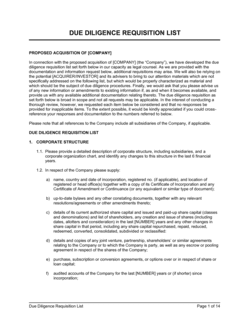
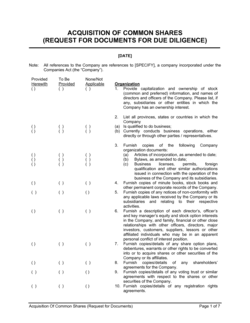
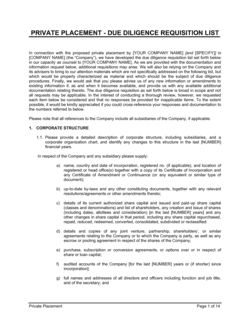
A Due Diligence Request List is a structured document issued by a buyer, investor, or lender to a target company, requesting the specific records, contracts, filings, and data needed to evaluate a transaction. This free Word download organizes requests by category — financial, legal, IP, HR, tax, and compliance — and can be edited online and exported as PDF for delivery to the target's counsel or management team.
When you need it
Use it immediately after signing a letter of intent or term sheet to formally open the diligence phase of an acquisition, merger, equity investment, or debt financing. It defines the scope of information the requesting party requires before committing to closing.
What's inside
Categorized document requests covering corporate structure and governance, financial statements and projections, material contracts, intellectual property, employment and benefits, litigation and regulatory compliance, tax records, environmental matters, and insurance — each with a status tracking column for outstanding, received, and under review items.

What is a Due Diligence Request List?

A Due Diligence Request List is a formal document issued by a buyer, investor, or lender to a target company that defines the full scope of records, contracts, financial statements, and compliance documentation required to evaluate a proposed transaction before committing to close. Organized by subject-matter category — corporate governance, financials, material contracts, intellectual property, employment, litigation, tax, and insurance — it creates a shared record of what has been requested, what has been produced, and what remains outstanding. It functions as the operational backbone of the diligence process, transforming a verbal agreement to share information into an enforceable, trackable document request with defined deadlines and confidentiality obligations.

Why You Need This Document

Entering a transaction without a structured due diligence request list is one of the most expensive procedural errors a buyer can make. Without a formal list, document collection defaults to email exchanges and informal conversations — creating no record of what was requested, no accountability for what was withheld, and no baseline for indemnification claims when undisclosed liabilities surface after closing. Change-of-control clauses go undetected in mid-tier contracts, contractor IP assignments are never confirmed, and state tax nexus exposure remains invisible until the first post-closing audit. A signed, numbered request list gives your legal team a defensible record of every item sought and every item produced, and gives the target's counsel no room to argue that a material issue was outside the agreed diligence scope. For sellers, a complete data room organized against a standard request list signals readiness, compresses the diligence timeline, and removes document gaps as a buyer negotiating lever at closing. This template gives both sides a common framework from day one of the diligence period.

Which variant fits your situation?

If your situation is…Use this template
Acquiring an entire business or majority equity stakeM&A Due Diligence Request List
Minority equity investment or venture capital roundVenture Capital Due Diligence Checklist
Commercial real estate purchase or leaseReal Estate Due Diligence Checklist
Secured business loan or credit facilityLender Due Diligence Request List
Technology or IP asset acquisitionIP Due Diligence Checklist
Merger requiring regulatory approvalRegulatory Due Diligence Checklist
Franchise purchase or territory acquisitionFranchise Due Diligence Checklist

Common mistakes to avoid

❌ Using a generic checklist not tailored to the deal type

Why it matters: A checklist designed for a stock acquisition applied to an asset purchase will miss critical requests — such as title to specific assets, assumed liabilities, and assignment of individual contracts — that are irrelevant in a stock deal but essential in an asset deal.

Fix: Identify the deal structure (stock purchase, asset purchase, merger, or investment) before issuing the list and remove or add entire categories accordingly. An M&A attorney should review the tailored list before it is sent.

❌ Accepting representations in lieu of actual documents

Why it matters: A seller's verbal or written assurance that 'no material litigation is pending' is not a substitute for a signed litigation certificate from outside counsel. Undisclosed claims surface post-closing and the buyer's only remedy is an indemnification claim — which may be capped or disputed.

Fix: Require documentary evidence for every request. If a specific document does not exist — such as a missing IP assignment — require a written representation from the seller's counsel explaining the gap and negotiate an indemnity or escrow holdback to cover the risk.

❌ Failing to track document production in a single log

Why it matters: When document status is managed across email threads, Slack messages, and informal calls, items believed complete are frequently missing or outdated. Closing checklists reviewed at the last minute reveal gaps that could have been filled weeks earlier.

Fix: Designate one version of the request list as the master tracking document from day one. Update it after every data room upload and share the updated version with both deal teams weekly.

❌ Missing change-of-control clauses in mid-tier contracts

Why it matters: A change-of-control consent requirement in a single mid-tier SaaS license or distribution agreement can give the counterparty the right to terminate — or extract concessions — at the moment the transaction closes, destroying value the buyer paid for.

Fix: Review every contract in the data room for change-of-control, assignment, and consent-to-assign language, not just the top-revenue agreements. Flag each instance and determine whether consent must be obtained pre-closing or whether the risk can be managed by indemnity.

❌ Setting an unrealistic production deadline

Why it matters: Demanding full document production within five business days forces the target to produce incomplete or disorganized materials, which increases review time and miss rates for the requesting team.

Fix: Build a phased production schedule — priority documents (financials, cap table, material contracts) in Week 1, secondary documents (HR, IP, tax, insurance) in Weeks 2–3 — with a final completeness certification before the end of the diligence period.

❌ Omitting open-source software disclosure requests

Why it matters: Copyleft open-source licenses such as GPL require any software that incorporates them to be distributed under the same license, potentially forcing the acquirer to open-source proprietary code — a material IP impairment that can derail a technology acquisition.

Fix: Include an explicit request for a complete open-source software bill of materials (SBOM), the applicable license for each component, and a statement on whether any copyleft-licensed code is incorporated into commercial products.

The 10 key clauses, explained

Scope and transaction identification

In plain language: Identifies the parties, the transaction being evaluated, and the purpose of the request list so there is no ambiguity about what the document governs.

Sample language
This Due Diligence Request List is submitted by [BUYER / INVESTOR NAME] ('Requesting Party') to [TARGET COMPANY NAME] ('Company') in connection with the proposed [ACQUISITION / INVESTMENT / FINANCING] described in the Letter of Intent dated [DATE] ('Transaction').

Common mistake: Omitting the LOI or term sheet reference date. Without it, disputes arise over whether requests fall within the agreed diligence scope, and the target may refuse to produce documents it considers outside the deal.

Corporate structure and governance documents

In plain language: Requests the company's formation documents, ownership records, board minutes, and shareholder agreements to confirm legal existence, authority, and equity structure.

Sample language
Please provide: (a) certificate of incorporation and all amendments; (b) current bylaws or operating agreement; (c) cap table as of [DATE]; (d) all shareholder, voting, or investor rights agreements; (e) board and stockholder meeting minutes for the past [3] years.

Common mistake: Requesting only the current certificate of incorporation without amendments. Historical amendments often contain anti-dilution provisions, authorized share changes, or special class rights that materially affect valuation.

Financial statements and accounting records

In plain language: Requests audited or reviewed financial statements, management accounts, projections, and accounting policies to allow the requesting party to assess financial performance and quality of earnings.

Sample language
Please provide: (a) audited financial statements for fiscal years [YEAR-2] through [YEAR]; (b) unaudited interim statements for the period ending [DATE]; (c) financial projections for [YEAR+1] through [YEAR+3] with supporting assumptions; (d) a schedule of all off-balance-sheet liabilities.

Common mistake: Accepting management-prepared statements without requesting the underlying trial balance or general ledger access. Adjusted EBITDA figures frequently normalize out recurring costs, overstating true operating performance.

Material contracts and commercial agreements

In plain language: Requests copies of all significant contracts — customer, vendor, license, and partnership agreements — to identify change-of-control triggers, assignment restrictions, and concentration risks.

Sample language
Please provide: (a) all customer contracts representing more than [5]% of annual revenue; (b) all supplier or vendor agreements with annual spend exceeding $[AMOUNT]; (c) all partnership, distribution, or reseller agreements; (d) any contract containing a change-of-control, consent-to-assign, or right-of-first-refusal provision.

Common mistake: Setting the revenue-concentration threshold too high and missing mid-tier contracts that collectively contain assignment restrictions. A single consent-to-assign clause in an overlooked contract can block a closing.

Intellectual property

In plain language: Requests IP ownership records, patent and trademark registrations, license agreements, and open-source usage to confirm the company owns or controls the IP that drives its value.

Sample language
Please provide: (a) a schedule of all patents, trademarks, copyrights, and domain names, with registration numbers and jurisdictions; (b) all IP assignment agreements from founders, employees, and contractors; (c) all inbound and outbound IP license agreements; (d) a list of all open-source software incorporated into the company's products and the applicable licenses.

Common mistake: Overlooking contractor IP assignment agreements. Work created by independent contractors does not automatically vest in the company under US or UK law — missing assignments can leave core product IP in private hands.

Employment, benefits, and HR matters

In plain language: Requests employment agreements, compensation schedules, benefit plans, and HR policies to identify change-of-control payouts, key-person dependencies, and post-closing retention risks.

Sample language
Please provide: (a) a headcount schedule with titles, compensation, and start dates as of [DATE]; (b) all employment agreements, offer letters, and severance agreements for employees earning more than $[AMOUNT] annually; (c) all equity incentive plans and outstanding option/restricted stock schedules; (d) all employee benefit plan summaries and current carrier agreements.

Common mistake: Missing single-trigger change-of-control acceleration provisions in equity plans. If all outstanding options vest automatically on closing, the resulting dilution and payroll tax liability can materially reduce net proceeds to the seller.

Litigation, claims, and regulatory compliance

In plain language: Requests disclosure of all pending or threatened legal actions, regulatory investigations, and consent orders to assess contingent liabilities and compliance standing.

Sample language
Please provide: (a) a list of all pending or threatened litigation, arbitration, or regulatory proceedings, with counsel names and status; (b) all correspondence from regulatory agencies in the past [3] years; (c) all consent decrees, settlement agreements, and injunctions to which the Company is a party; (d) counsel's assessment of material contingent liabilities.

Common mistake: Accepting a representation that 'there is no material litigation' without requiring a written litigation hold confirmation and outside counsel certification. Undisclosed claims that surface post-closing routinely trigger indemnification disputes.

Tax records and filings

In plain language: Requests filed tax returns, correspondence with tax authorities, and transfer pricing documentation to identify unpaid liabilities, audits in progress, and exposure from aggressive tax positions.

Sample language
Please provide: (a) federal, state, and local income tax returns for the past [3] years; (b) all tax authority correspondence, audit reports, and notices of deficiency; (c) all tax sharing, tax indemnity, or tax allocation agreements; (d) a schedule of net operating loss carryforwards and their expiration dates.

Common mistake: Requesting only federal returns and missing state and local tax exposure. Sales tax nexus liability in US states where the company has economic presence — but has not filed or collected — has become a leading source of post-closing indemnification claims.

Insurance coverage

In plain language: Requests current insurance policies and claims history to confirm adequate coverage and identify gaps that the buyer will need to address post-closing.

Sample language
Please provide: (a) certificates of insurance for all current policies, including general liability, D&O, E&O, cyber, and key-person coverage; (b) a schedule of all claims made or pending in the past [3] years with amounts paid or reserved; (c) any notice of coverage denial, cancellation, or non-renewal received in the past [2] years.

Common mistake: Failing to request the underlying policy documents, not just certificates. Certificates confirm a policy exists but do not disclose exclusions, sublimits, or claims-made versus occurrence triggers that could leave the buyer unprotected post-closing.

Status tracking and confidentiality obligations

In plain language: Includes a tracking column for each request item — outstanding, received, or under review — and incorporates the confidentiality obligations from the non-disclosure agreement governing the diligence process.

Sample language
Each item shall be marked as: (O) Outstanding — not yet provided; (R) Received — uploaded to the data room; (U) Under Review — received and currently being analyzed. All documents provided hereunder are subject to the Non-Disclosure Agreement dated [DATE] between the parties.

Common mistake: Managing document status by email thread instead of within the request list itself. Without a single source of truth, items get marked complete in email while the requesting party's counsel has a different record — causing closing delays and disputes.

How to fill it out

  1. 1

    Identify the parties and transaction reference

    Enter the requesting party's full legal name, the target company's full legal name, and the date and title of the governing LOI or term sheet. This anchors every request to a specific transaction and prevents scope disputes.

    💡 Confirm the target's exact registered legal name from its certificate of incorporation before inserting it — trade names on websites are frequently different from the entity under which contracts and IP are held.

  2. 2

    Tailor the request categories to the transaction type

    Remove categories that do not apply — for example, a software company acquisition rarely requires environmental requests, while a manufacturing target always does. Add industry-specific categories such as regulatory licenses for healthcare or FCC filings for telecom.

    💡 Send a preliminary category list to the target's counsel before issuing the full request list — agreement on scope upfront reduces objections and accelerates document production.

  3. 3

    Set specific dollar and percentage thresholds

    Replace placeholder amounts — such as contracts representing more than [X]% of revenue or spend exceeding $[AMOUNT] — with figures calibrated to the target's actual revenue scale. Thresholds that are too low create unnecessary volume; thresholds too high miss material items.

    💡 A common starting point is 5% of trailing-twelve-month revenue for customer contract thresholds and $50,000 annually for vendor contract thresholds, adjusted up for larger targets.

  4. 4

    Define the response deadline and data room instructions

    Enter the date by which initial document production is expected, the name and access instructions for the virtual data room, and the format requirements (e.g., searchable PDFs, native Excel files for financial models).

    💡 Stage the deadline — request corporate and financial documents in Week 1, contracts and IP in Week 2, HR and litigation in Week 3 — to avoid overwhelming the target team and to let your review proceed in parallel.

  5. 5

    Incorporate the NDA reference

    Insert the date and parties of the executed non-disclosure agreement in the confidentiality section. This ensures the target understands its obligations before uploading sensitive documents.

    💡 If the NDA has not yet been signed when you issue the request list, add a note that document production is conditioned on execution of the NDA, and attach a draft.

  6. 6

    Activate the status tracking columns

    Mark every item as Outstanding (O) before issuing the list. As the target uploads documents, update each line to Received (R) or Under Review (U). Assign a team member to own each category section.

    💡 Review the tracking log in every weekly deal-team call — items that remain Outstanding for more than five business days after the deadline should trigger a formal follow-up letter.

  7. 7

    Issue the list to the target's designated contact

    Deliver the signed request list to the target's legal counsel or designated deal contact, not to a general company email address. Include a cover letter summarizing the deadline, data room access details, and the escalation path for disputes.

    💡 Numbering every line item in the request list — even sub-items — lets both sides reference specific requests precisely in correspondence and eliminates the ambiguity of 'the third document in Section 4.'

  8. 8

    Log follow-up items and supplemental requests

    As review progresses, add supplemental requests as numbered additions to the original list rather than in separate emails. This keeps a clean single record of everything requested, outstanding, and received.

    💡 Supplemental requests that arise from document review are often the most material — budget time in the diligence schedule for at least one round of follow-up requests before the response deadline closes.

Frequently asked questions

What is a due diligence request list?

A due diligence request list is a formal document issued by a buyer, investor, or lender to a target company that specifies every category of record, contract, and data needed to evaluate a transaction before closing. It organizes requests by subject matter — financial, legal, IP, HR, tax, and compliance — and includes a status column to track document production. It is typically issued after a letter of intent is signed and governs the information-gathering phase of the deal.

When should a due diligence request list be issued?

Issue it immediately after executing a letter of intent or term sheet — typically within three to five business days of signing. Delaying the list compresses the diligence period, forcing rushed review and increasing the risk of missing material issues. In competitive auction processes, buyers often prepare the request list before the LOI is signed so it can be delivered on day one.

What categories should a due diligence request list cover?

A complete list covers ten standard categories: corporate structure and governance, financial statements and projections, material contracts, intellectual property, employment and benefits, litigation and regulatory matters, tax records, environmental compliance, insurance, and any industry-specific regulatory filings. The weight given to each category varies by transaction type — IP is critical for technology acquisitions, while environmental diligence dominates manufacturing deals.

What is the difference between a due diligence request list and a due diligence report?

A due diligence request list is the document the buyer sends to the seller to collect information. A due diligence report is the analysis document the buyer's advisors produce after reviewing the collected materials — summarizing findings, flagging risks, and recommending deal adjustments. The request list is the input; the report is the output. Both are distinct from the disclosure schedules, which are prepared by the seller.

Does a due diligence request list need to be signed?

In most transactions, the request list is signed by or on behalf of the requesting party to confirm it is the authoritative version and to formally commence the diligence period under the LOI. The target's acknowledgment of receipt — by signature, countersignature, or written confirmation — is also standard practice. Signature confirms the scope of requests is agreed and establishes the baseline for any disputes about what was and was not requested.

How long does the due diligence process typically take?

For small-to-mid-market transactions, the diligence period typically runs 30 to 60 days from LOI signing. Complex deals — large enterprises, regulated industries, or cross-border transactions — routinely extend to 90 days or longer. The length depends on the volume of documents, the responsiveness of the target, the number of supplemental requests raised during review, and any regulatory notification periods that must run concurrently.

What happens if the target refuses to produce a requested document?

The requesting party should first issue a written follow-up referencing the specific line-item number and the original deadline. If production is still withheld, the parties' counsel typically negotiate whether the item is outside scope, subject to privilege, or legitimately unavailable. For material gaps — such as a missing IP assignment or an undisclosed lawsuit — the buyer may condition closing on production, negotiate a price reduction, require an indemnity escrow holdback, or in extreme cases, exercise any right to terminate under the LOI's diligence contingency.

Can a seller use a due diligence request list to prepare a data room in advance?

Yes — sellers in auction processes or any anticipated sale should use a standard request list as a data room preparation guide months before going to market. Pre-organizing documents by the categories buyers universally request dramatically reduces the time between LOI signing and diligence completion, signals organizational readiness to buyers, and reduces the likelihood that missing documents become negotiating leverage against the seller at closing.

Is a due diligence request list confidential?

The request list itself is typically treated as confidential under the same NDA that governs the transaction, since it reveals the buyer's analytical priorities and deal structure. More importantly, every document produced in response to the list is confidential. The NDA should be executed before the list is issued so that document production is automatically covered by its terms from the first upload to the data room.

How this compares to alternatives

vs Non-Disclosure Agreement

An NDA establishes the confidentiality framework that must be in place before any due diligence documents are shared. The due diligence request list is issued and fulfilled under the NDA's protection. The NDA is a prerequisite; the request list is the mechanism that actually drives document collection. Both documents are required in every transaction.

vs Letter of Intent

A letter of intent records the agreed commercial terms of a proposed transaction and typically grants a period of exclusivity for the buyer to complete diligence. The due diligence request list is issued after the LOI is signed and operationalizes the diligence period the LOI defines. The LOI establishes the right to diligence; the request list executes it.

vs Purchase Agreement

A purchase agreement is the definitive binding contract that closes the transaction — incorporating representations, warranties, and indemnification obligations based on what diligence revealed. The due diligence request list drives the information-gathering that shapes those representations. Gaps found during diligence directly inform purchase price adjustments, escrow holdbacks, and indemnity carve-outs in the purchase agreement.

vs Disclosure Schedule

A disclosure schedule is prepared by the seller and attached to the purchase agreement to list known exceptions to the seller's representations and warranties. The due diligence request list is prepared by the buyer and directs what information the seller must produce. They are complementary documents that flow in opposite directions — the request list demands information; the disclosure schedule discloses it.

Industry-specific considerations

Technology / SaaS

IP ownership chain for all code, open-source software inventory, data privacy and GDPR compliance, SaaS contract auto-renewal and churn clauses, and cloud infrastructure cost structures are the highest-priority diligence categories.

Healthcare / Life Sciences

FDA clearances, HIPAA compliance programs, third-party billing records, clinical trial agreements, and state medical licensing are mandatory diligence items that have no equivalent in other sectors and require specialized reviewers.

Manufacturing

Environmental permits and historical site contamination, equipment titles and lease terms, supply chain concentration risk, union agreements, and OSHA compliance records are the categories that most frequently reveal material liabilities in manufacturing acquisitions.

Financial Services

Regulatory licenses and capital adequacy requirements, FINRA or FCA examination history, AML and KYC program documentation, and any consent orders or enforcement actions are non-negotiable diligence items that can prevent a transaction from closing without regulatory approval.

Retail / E-commerce

Sales tax nexus analysis across all states with economic presence, consumer data privacy compliance (CCPA, GDPR), platform dependency risk in marketplace agreements, and return and refund liability reserves are the most transaction-relevant diligence focus areas.

Professional Services

Client contract concentration and assignment restrictions, professional liability claims history, non-solicitation enforceability for key producers, and billing rate benchmarking against industry standards are the primary value and risk drivers in professional services acquisitions.

Jurisdictional notes

United States

US diligence typically requires state-by-state analysis for sales tax nexus, employment law compliance, and environmental permits, since requirements vary significantly across all 50 states. IP diligence must confirm written assignments from all employees and contractors under applicable work-for-hire doctrine. Hart-Scott-Rodino Act filing thresholds apply to transactions above approximately $119.5M (adjusted annually) and impose a mandatory waiting period before closing.

Canada

Canadian diligence requires review of federal and provincial regulatory requirements separately, with particular attention to Quebec's distinct employment, language, and civil law framework. PIPEDA and provincial privacy legislation (notably Quebec Law 25) impose data handling obligations that must be assessed if the target holds personal information. Competition Act pre-merger notification is required for transactions meeting applicable size-of-parties and size-of-transaction thresholds.

United Kingdom

UK due diligence includes review of Companies House filings, PSC (persons with significant control) registers, and any FCA or sector-specific regulatory authorizations held by the target. Post-Brexit, data transfers between the UK and EU require UK GDPR adequacy or standard contractual clause analysis. The CMA (Competition and Markets Authority) has jurisdiction to review transactions that meet UK turnover thresholds, with mandatory notification for qualifying mergers.

European Union

GDPR compliance is a mandatory diligence category for any EU-based target or any target processing personal data of EU residents — reviewers must assess lawful processing bases, data subject rights procedures, and any supervisory authority correspondence. EU merger control may require notification to the European Commission or national competition authorities depending on the turnover thresholds of the parties. Employment diligence must account for strong statutory protections, mandatory information and consultation requirements, and works council obligations in countries including Germany, France, and the Netherlands.

Template vs lawyer — what fits your deal?

PathBest forCostTime
Use the templateBuyers or investors conducting diligence on small businesses or early-stage companies where transaction value is below $1M and deal complexity is lowFree1–2 hours to customize and issue
Template + legal reviewMid-market acquisitions or equity investments between $1M and $10M where material contracts, IP, or regulatory compliance are central to value$500–$2,000 for attorney review and customization1–3 days
Custom draftedLarge or complex transactions above $10M, regulated industry targets, cross-border deals, or any acquisition where post-closing indemnification exposure is material$3,000–$15,000+ for full M&A counsel engagement1–3 weeks

Glossary

Due Diligence
The process by which a buyer, investor, or lender investigates a target company's financial, legal, operational, and compliance position before entering a binding transaction.
Data Room
A secure physical or virtual repository where the target company organizes and shares confidential documents with the requesting party during diligence.
Letter of Intent (LOI)
A non-binding preliminary agreement between buyer and seller that outlines key transaction terms and typically triggers the formal due diligence process.
Material Contract
Any agreement whose loss, breach, or expiration would have a significant negative effect on the target company's business, revenue, or operations.
Representations and Warranties
Contractual statements made by a party about the current state of facts — such as the accuracy of financial statements — that form the basis of the buyer's reliance in closing.
Indemnification
A contractual obligation by one party to compensate the other for losses arising from a breach of representations, warranties, or other specified events.
Cap Table
A schedule of all equity holders in a company, showing ownership percentages, share classes, options outstanding, and the dilution effect of proposed transactions.
Encumbrance
A lien, pledge, mortgage, or other claim on an asset that restricts the owner's ability to freely transfer it without first satisfying the underlying obligation.
Change of Control Clause
A contract provision that grants one party a right to terminate, accelerate, or renegotiate the agreement if ownership of the other party changes beyond a specified threshold.
Working Capital
Current assets minus current liabilities, used as a measure of short-term operational liquidity and often the subject of a post-closing purchase price adjustment.
Disclosure Schedule
A document attached to a purchase agreement listing known exceptions to the seller's representations and warranties, so the buyer cannot later claim breach on disclosed items.
Escrow
Funds or assets held by a neutral third party pending fulfillment of transaction conditions, commonly used to secure indemnification obligations after closing.

Part of your Business Operating System

This document is one of 3,000+ business & legal templates included in Business in a Box.

  • Fill-in-the-blanks — ready in minutes
  • 100% customizable Word document
  • Compatible with all office suites
  • Export to PDF and share electronically

Create your document in 3 simple steps.

From template to signed document — all inside one Business Operating System.
1
Download or open template

Access over 3,000+ business and legal templates for any business task, project or initiative.

2
Edit and fill in the blanks with AI

Customize your ready-made business document template and save it in the cloud.

3
Save, Share, Send, Sign

Share your files and folders with your team. Create a space of seamless collaboration.

Save time, save money, and create top-quality documents.

★★★★★

"Fantastic value! I'm not sure how I'd do without it. It's worth its weight in gold and paid back for itself many times."

Managing Director · Mall Farm
Robert Whalley
Managing Director, Mall Farm Proprietary Limited
★★★★★

"I have been using Business in a Box for years. It has been the most useful source of templates I have encountered. I recommend it to anyone."

Business Owner · 4+ years
Dr Michael John Freestone
Business Owner
★★★★★

"It has been a life saver so many times I have lost count. Business in a Box has saved me so much time and as you know, time is money."

Owner · Upstate Web
David G. Moore Jr.
Owner, Upstate Web

Run your business with a system — not scattered tools

Stop downloading documents. Start operating with clarity. Business in a Box gives you the Business Operating System used by over 250,000 companies worldwide to structure, run, and grow their business.

Start free · No credit card required