1
Identify the parties and their roles
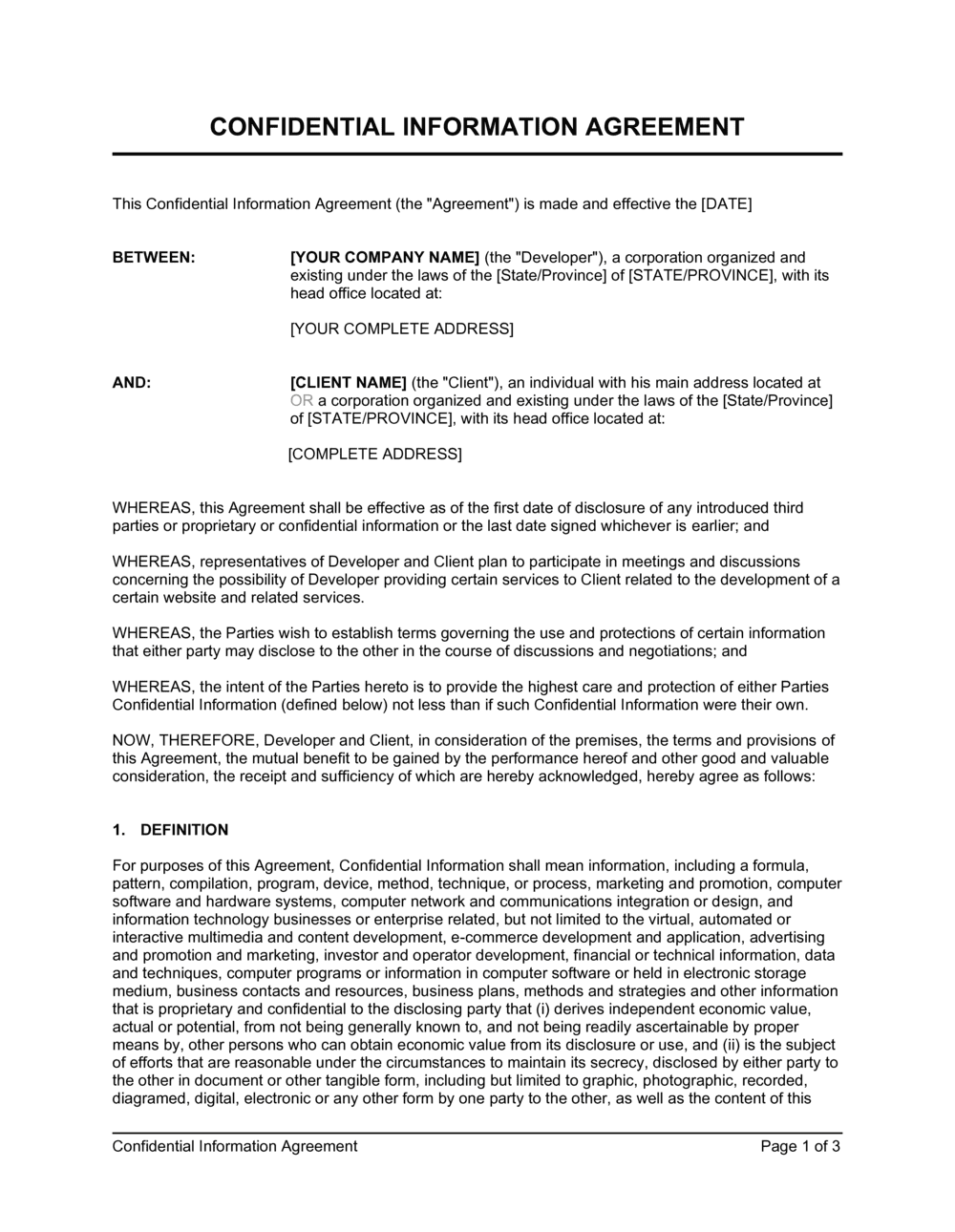
Enter each party's full legal name and entity type. Decide whether the agreement is one-way (one disclosing party, one receiving party) or mutual (both parties share and receive). Label them accordingly throughout the document.
💡 Use registered entity names — not trade names or brand names — to ensure enforceability against the correct legal person.
2
Define the confidential information precisely
Fill in the definition clause to cover all categories relevant to your situation: technical data, business plans, customer lists, financial information, product roadmaps. Decide whether oral disclosures are included and whether they must be confirmed in writing within a set period.
💡 Broader definitions protect more but can create ambiguity. Add a specific list of included categories in a schedule if your situation involves distinct types of sensitive information.
3
State the permitted purpose
Write a specific, narrow description of the business purpose for sharing the information — e.g., 'evaluating a potential software development subcontracting arrangement' rather than 'exploring a business relationship.'
💡 The narrower the stated purpose, the harder it is for the receiving party to justify using the information for a different project or opportunity.
4
Set the term and survival periods
Enter the agreement's start date, its active term, and the separate survival periods for ordinary confidential information and trade secrets. Typical ranges: 2–3 years for general commercial confidentiality, indefinite for trade secrets.
💡 If you are sharing technical IP or formulas that qualify as trade secrets, explicitly designate them as such and confirm that obligations survive indefinitely, consistent with the Defend Trade Secrets Act in the US and equivalent statutes elsewhere.
5
Confirm the return-or-destruction procedure
Fill in the timeframe for return or destruction upon request — 10 business days is standard — and confirm that written certification is required. Specify whether electronic copies stored on backup servers are included.
💡 Address cloud storage and backup systems explicitly. Receiving parties often retain data in automated backups long after they believe they have complied, creating unexpected liability.
6
Choose governing law and dispute resolution
Select a governing jurisdiction that has a genuine connection to at least one party and where courts are familiar with commercial confidentiality disputes. Choose between court litigation and arbitration based on the commercial relationship and desired confidentiality of any future proceedings.
💡 Arbitration keeps the dispute itself confidential — which is often more valuable than any damages award when protecting trade secrets is the primary concern.
7
Execute before sharing any information
Both parties must sign before any confidential information changes hands. Signing after disclosure may leave pre-signature disclosures unprotected unless you include a retroactive coverage clause.
💡 Include a clause stating the agreement covers confidential information shared in the 30 days before execution if preliminary discussions have already begun.
8
Store the executed copy and log disclosures
Save the signed agreement in a secure, retrievable location — Business in a Box Drive is suitable — and keep a dated log of the specific materials disclosed under it, with file names and disclosure dates.
💡 A disclosure log transforms an abstract claim of breach into a specific, documented inventory that courts and arbitrators find far more persuasive.