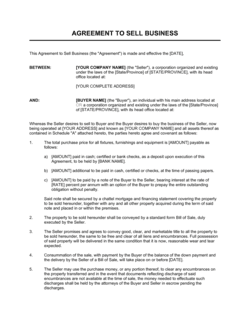
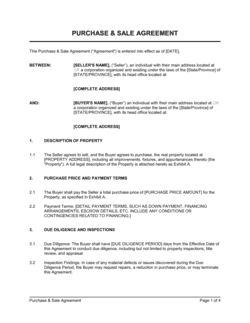
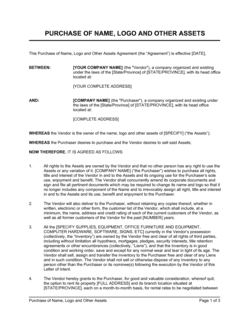
Asset Purchase Agreement For a Telecom Business Template

Free Word download • Edit online • Save & share with Drive • Export to PDF

42 pages45 min – 1h to fillDifficulty: ExpertSignature requiredLegal review recommended
Learn more ↓
FreeAsset Purchase Agreement For a Telecom Business Template

At a glance

What it is
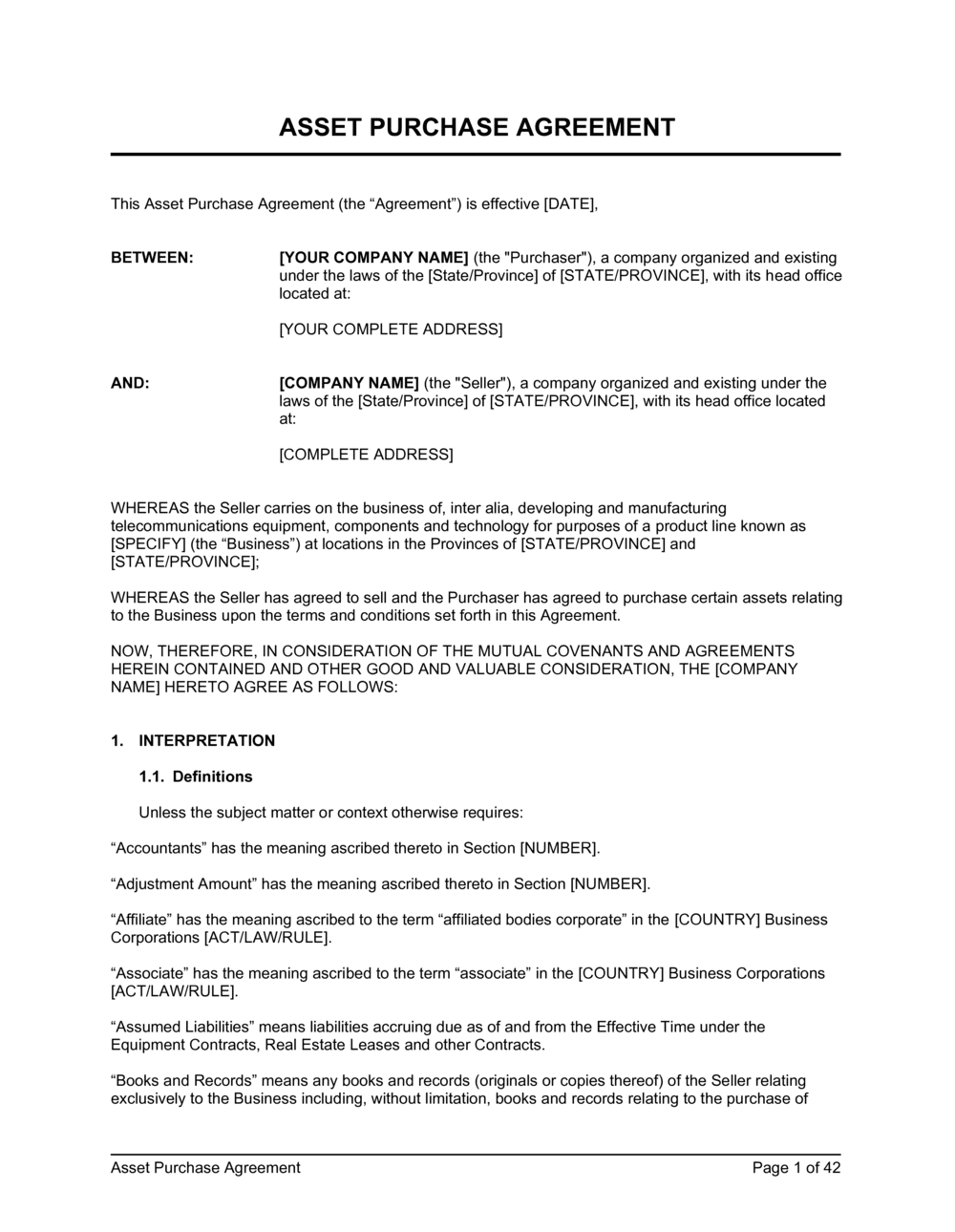
An Asset Purchase Agreement for a Telecom Business is a legally binding contract under which a buyer acquires specific assets of a telecommunications company — such as spectrum licenses, network infrastructure, customer contracts, and equipment — rather than purchasing the company's equity or legal entity. This free Word download gives you a structured, attorney-ready starting point you can edit online and export as PDF for execution at closing.
When you need it
Use it when a buyer and seller have agreed in principle on a telecom asset acquisition and need a binding document that transfers title, allocates liabilities, and satisfies regulatory conditions precedent. It is equally appropriate for a full-network acquisition or a targeted purchase of a subscriber base and supporting infrastructure from a regional carrier.
What's inside
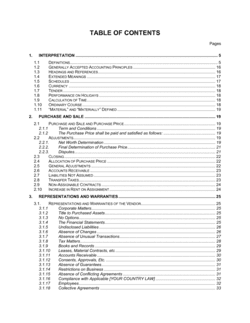
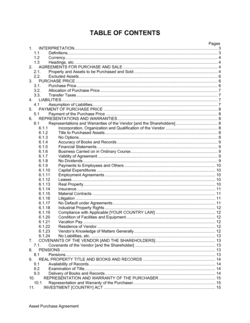
Identified purchased assets and excluded assets, purchase price and payment mechanics, assumed and excluded liabilities, representations and warranties by both parties, regulatory and FCC or CRTC filing conditions, employee and customer contract treatment, closing deliverables, and post-closing indemnification obligations.

What is an Asset Purchase Agreement for a Telecom Business?

An Asset Purchase Agreement for a Telecom Business is a legally binding contract under which a buyer acquires specific, enumerated assets of a telecommunications company — including spectrum licenses, network infrastructure, customer contracts, and equipment — rather than purchasing the seller's corporate stock or assuming its full legal identity. Because the buyer selects precisely which assets it takes and which liabilities it assumes, this structure gives acquirers far more control over post-closing exposure than a share purchase. The agreement governs every stage of the transaction from signing through regulatory approval to the transfer of title at closing, and it forms the authoritative record of what was sold, at what price, and on what conditions.

Why You Need This Document

Without a properly structured asset purchase agreement, a telecom acquisition exposes both parties to significant financial and regulatory risk. The buyer has no enforceable protection against inheriting undisclosed pre-closing liabilities — tax arrears, regulatory fines, or employment claims — that the asset-purchase structure is specifically designed to exclude. The seller has no documented release from obligations that transfer to the buyer, leaving it exposed to customer and supplier claims long after closing. Critically, transferring FCC or CRTC spectrum licenses without a signed agreement containing the required assignment instruments and regulatory conditions is a compliance violation that can result in license revocation for both parties. This template provides the clause-by-clause framework that transaction counsel, regulatory filings, and closing mechanics all depend on — giving you a defensible starting point that reflects how telecom asset deals are actually structured and executed.

Which variant fits your situation?

If your situation is…Use this template
Acquiring the entire legal entity, including its liabilities and equityStock Purchase Agreement
Purchasing only spectrum licenses from a telecom operatorSpectrum License Transfer Agreement
Acquiring a telecom tower portfolio under a sale-leaseback structureTower Asset Purchase and Leaseback Agreement
Buying out a business partner's share of a telecom joint ventureBusiness Purchase Agreement
Transferring customer contracts without full infrastructure acquisitionContract Assignment Agreement
Acquiring software and IP assets only from a telecom technology companyIntellectual Property Purchase Agreement
Establishing deal terms before drafting the definitive agreementLetter of Intent (M&A)

Common mistakes to avoid

❌ Vague asset schedules without item-level detail

Why it matters: Disputes over whether a specific license, router, or customer contract was included in the deal are expensive and can result in post-closing arbitration costing more than the asset itself.

Fix: Attach fully itemized schedules listing every license by FCC call sign, every equipment item by serial number, and every customer contract by account identifier before the agreement is signed.

❌ No purchase-price adjustment for subscriber count changes

Why it matters: Telecom subscriber bases routinely shift 5–15% between signing and closing due to churn. An unadjusted fixed price means one party absorbs that risk entirely.

Fix: Include a defined subscriber-count measurement at closing with a per-subscriber price adjustment formula and a neutral accountant dispute-resolution mechanism.

❌ Outside date set shorter than regulatory timelines

Why it matters: FCC license assignment applications take 90–180 days on average. An outside date of 60 days creates a termination right before the regulatory condition can possibly be satisfied.

Fix: Set the outside date at 180–270 days from signing for spectrum-license transfers, with an automatic 60-day extension if the FCC application is still pending.

❌ Identical survival periods for all representations

Why it matters: Treating an FCC license-validity representation the same as a routine operational warranty means fundamental title defects can become time-barred before they are discovered.

Fix: Use tiered survival: 18 months for general operational representations, 6 years (or the statute of limitations) for fundamental representations covering title, authority, and license compliance.

❌ No FCC eligibility representation from the buyer

Why it matters: If the buyer is found ineligible to hold the assigned licenses after closing, the FCC can revoke the transfer — unwinding the transaction and leaving both parties without recourse.

Fix: Include an explicit buyer representation confirming FCC eligibility and a covenant requiring the buyer to notify the seller immediately of any change in eligibility status between signing and closing.

❌ Omitting WARN Act liability allocation

Why it matters: In an asset acquisition where the buyer does not hire all seller employees, federal and state WARN Act obligations can attach to either or both parties — and penalties run to 60 days' back pay and benefits per affected employee.

Fix: Explicitly allocate WARN Act liability in the employee matters clause, require the seller to issue any required notices, and indemnify the buyer for any seller failure to comply.

The 10 key clauses, explained

Identification of purchased and excluded assets

In plain language: Lists precisely which assets transfer to the buyer — spectrum licenses, network equipment, customer contracts, IP, and real property leases — and explicitly carves out what stays with the seller.

Sample language
Subject to the terms hereof, Seller agrees to sell, assign, and transfer to Buyer at Closing all of Seller's right, title, and interest in and to the Purchased Assets listed in Schedule 1.1, free and clear of all Liens, excluding the Excluded Assets set forth in Schedule 1.2.

Common mistake: Describing assets by category only without attaching detailed schedules. Vague descriptions lead to post-closing disputes over whether specific licenses, contracts, or equipment were included in the deal.

Purchase price, payment mechanics, and adjustments

In plain language: States the total consideration, how and when it is paid (cash at closing, deferred, or earnout), and the formula for adjusting the price based on subscriber counts or working capital at closing.

Sample language
The aggregate purchase price for the Purchased Assets is $[AMOUNT] (the 'Base Purchase Price'), subject to adjustment pursuant to Section [X] based on the Closing Subscriber Count. The Base Purchase Price shall be paid by wire transfer of immediately available funds at Closing.

Common mistake: Agreeing on a purchase price without a working-capital or subscriber-count adjustment mechanism. Telecom subscriber bases fluctuate between signing and closing, and an unadjusted price can result in significantly overpaying or underpaying.

Assumed and excluded liabilities

In plain language: Specifies exactly which seller obligations the buyer takes on and confirms that all other liabilities — including pre-closing taxes, litigation, and pension obligations — remain with the seller.

Sample language
Buyer shall assume only the liabilities set forth in Schedule 2.1 ('Assumed Liabilities'). Buyer shall not assume or be liable for any Excluded Liabilities, including any obligations arising from Seller's operations prior to the Closing Date.

Common mistake: Leaving the assumed-liabilities schedule blank or over-inclusive. Successor liability rules in some jurisdictions can hold a buyer responsible for the seller's pre-closing employment or environmental obligations even when the contract says otherwise.

Regulatory approvals and FCC/CRTC conditions precedent

In plain language: Identifies all required government consents — FCC license assignments, state PUC filings, or CRTC approvals — and makes closing conditional on obtaining them within a specified outside date.

Sample language
The obligations of the parties to consummate the Closing are conditioned upon receipt of FCC consent to the assignment of the Licenses listed in Schedule 3.1, which the parties shall file for within [15] business days of execution. If such consent is not obtained by the Outside Date of [DATE], either party may terminate this Agreement.

Common mistake: Setting an outside date that is too short for regulatory timelines. FCC license assignment applications routinely take 90–180 days; a 60-day outside date creates unnecessary termination risk.

Representations and warranties of the seller

In plain language: The seller's factual statements about license validity, equipment condition, subscriber contract status, absence of undisclosed liabilities, title to assets, and compliance with telecom regulations — forming the primary basis for post-closing indemnity.

Sample language
Seller represents and warrants to Buyer as of the Execution Date and as of the Closing Date that: (a) each License is in full force and effect; (b) there are no pending FCC proceedings that would adversely affect any License; (c) the Customer Contracts listed in Schedule 4.1 are enforceable; and (d) the Network Equipment is in good working condition, ordinary wear excepted.

Common mistake: Accepting seller representations without knowledge qualifiers tied to a defined knowledge group. An unqualified representation that 'no litigation is pending' creates indemnity exposure for the seller even for matters they genuinely did not know about.

Representations and warranties of the buyer

In plain language: The buyer's confirmations of legal authority to enter the transaction, availability of financing, and FCC eligibility to hold the licenses being assigned.

Sample language
Buyer represents and warrants that: (a) Buyer is duly organized and has full authority to execute this Agreement; (b) Buyer has or will have at Closing sufficient funds to pay the Purchase Price; and (c) Buyer holds or will hold at Closing all FCC qualifications required to be assigned the Licenses.

Common mistake: Omitting an FCC eligibility representation from the buyer. If the buyer is later found ineligible to hold a license, the regulatory condition fails and the transaction unwinds — often at significant cost to both parties.

Employee matters and WARN Act obligations

In plain language: Addresses which employees the buyer will offer positions to, who is responsible for pre-closing payroll and benefits, and which party bears WARN Act notice obligations if a facility closes.

Sample language
Buyer shall offer employment to the employees listed in Schedule 6.1 effective as of the Closing Date. Seller shall be solely responsible for all compensation, benefits, and WARN Act obligations arising from the employment or termination of any employee prior to the Closing Date.

Common mistake: Failing to allocate WARN Act liability explicitly. In an asset deal where the buyer does not offer positions to all seller employees, the 60-day WARN notice obligation may fall on the seller, the buyer, or both — depending on the transaction structure.

Post-closing non-compete and non-solicit covenants

In plain language: Prevents the seller from re-entering the telecom market in the acquired territory for a defined period and from soliciting transferred customers or employees after closing.

Sample language
For a period of [3] years following the Closing Date, Seller shall not, directly or indirectly, engage in any Competing Telecom Business within [GEOGRAPHIC AREA], nor solicit any Transferred Customer or Transferred Employee of Buyer.

Common mistake: Using a geographic scope that mirrors the seller's entire historical footprint rather than the specific territory covered by the purchased assets. Courts strike down overbroad non-competes, leaving the buyer with no restriction at all.

Indemnification, survival periods, and caps

In plain language: Sets out each party's obligation to compensate the other for post-closing losses from breached representations, defines how long claims can be brought (survival), and caps the total indemnity exposure.

Sample language
Seller shall indemnify Buyer for losses arising from any breach of Seller's representations, subject to a deductible of $[X] and an aggregate cap of [Y]% of the Purchase Price. General representations survive for [18] months; fundamental representations (title, authority, FCC compliance) survive for [6] years.

Common mistake: Setting the same survival period for all representations. Fundamental representations — title, license validity, and authority — should survive for the statute of limitations or at least 6 years; operational representations can be capped at 18–24 months.

Closing deliverables and conditions

In plain language: Lists what each party must deliver at closing — bills of sale, license assignment instruments, FIRPTA certificates, payoff letters, and officer's certificates — and confirms the conditions each delivery satisfies.

Sample language
At Closing, Seller shall deliver: (a) executed Bills of Sale for all Purchased Assets; (b) executed FCC License Assignment Instruments; (c) an officer's certificate confirming representations remain true; and (d) payoff and lien-release letters for all Liens on the Purchased Assets.

Common mistake: Drafting a generic closing checklist without telecom-specific instruments. FCC license assignments require specific FCC Form 603 filings and executed instruments that differ from standard real-property or equipment transfer documents.

How to fill it out

  1. 1

    Identify and schedule all purchased and excluded assets

    Create a comprehensive Schedule 1.1 listing every asset by category — spectrum licenses by call sign and frequency band, network equipment by serial number, customer contracts by account number range, and IP by registration number. Simultaneously build Schedule 1.2 for all excluded assets.

    💡 Request the seller's FCC license database printout and reconcile it against the schedule before signing — discrepancies found post-signing are expensive to correct.

  2. 2

    Agree on the purchase price and adjustment mechanism

    Insert the base purchase price and define the adjustment metric — typically Closing Subscriber Count or Closing Working Capital. Set the measurement date, the calculation methodology, and the dispute-resolution procedure if the parties disagree on the final figure.

    💡 Define 'subscriber' precisely — active, billing, and connected subscribers all mean different things — to prevent a post-closing adjustment dispute.

  3. 3

    Draft the assumed and excluded liabilities schedules

    List every obligation the buyer is taking on in Schedule 2.1. Confirm that all pre-closing taxes, litigation, and employment liabilities are expressly excluded. Review successor-liability rules in the governing jurisdiction before finalizing.

    💡 Have your tax counsel confirm whether the asset purchase structure eliminates or merely reduces the risk of inherited sales-tax liabilities in the seller's operating states.

  4. 4

    Map all required regulatory approvals

    Identify every license that requires FCC consent (Form 603), state PUC notification or approval, and any CRTC filing. List each approval in the conditions-precedent section with the responsible party and the outside date.

    💡 File the FCC Form 603 within 15 business days of signing to maximize time before the outside date — late filings are the single most common cause of telecom deal extensions.

  5. 5

    Negotiate representations and warranty scope

    Agree on which seller representations are qualified by materiality or seller's knowledge, and define the knowledge group (typically the CEO, CFO, and head of engineering). Confirm the buyer's FCC eligibility representations are included.

    💡 Consider purchasing representations and warranties insurance for deals above $10M — it shifts indemnity risk to an insurer and allows the seller to distribute proceeds at closing.

  6. 6

    Address employee matters and WARN Act allocation

    Produce Schedule 6.1 listing employees the buyer intends to hire. Assign WARN Act liability to the party whose actions trigger the obligation. Confirm the seller pays all pre-closing wages, accrued PTO, and benefits through the closing date.

    💡 If the buyer is hiring fewer than 50% of the seller's telecom employees, review WARN Act thresholds at both the federal and applicable state level — some state WARN laws have lower employee-count triggers.

  7. 7

    Set indemnification baskets, caps, and survival periods

    Agree on a deductible (basket) and aggregate cap expressed as a percentage of the purchase price. Set differential survival periods — 18 months for general reps, 6 years for fundamental reps covering title and license validity.

    💡 In telecom deals, FCC compliance representations should be treated as fundamental given the cost of a license revocation — extend their survival accordingly.

  8. 8

    Prepare and execute closing deliverables

    Compile all closing instruments — Bills of Sale, FCC License Assignment Instruments, officer's certificates, payoff letters, and non-compete agreements — and circulate for execution before the closing date. Confirm lien releases are in hand before releasing funds.

    💡 Use a closing checklist circulated to all counsel at least 5 business days before closing — last-minute missing documents are the most preventable cause of delayed closings.

Frequently asked questions

What is an asset purchase agreement for a telecom business?

An asset purchase agreement for a telecom business is a legally binding contract under which a buyer acquires specific assets of a telecommunications company — such as spectrum licenses, network infrastructure, customer contracts, and equipment — without acquiring the seller's legal entity or its pre-existing liabilities. It defines precisely what transfers, how much the buyer pays, which obligations the buyer assumes, and the regulatory approvals required before closing.

What is the difference between an asset purchase and a stock purchase in a telecom deal?

In an asset purchase, the buyer selects specific assets and assumes only specified liabilities, leaving the seller's entity and most historical obligations behind. In a stock purchase, the buyer acquires the entire legal entity — including all undisclosed liabilities, historical tax exposure, and pending litigation. Telecom buyers often prefer asset purchases to avoid inheriting regulatory violations or legacy environmental and employment liabilities.

Does the FCC need to approve a telecom asset purchase?

Yes, if the purchased assets include FCC-licensed spectrum, broadcast licenses, or common-carrier authorizations, the transfer requires FCC consent via Form 603 before it can be consummated. Closing without FCC consent is a violation that can result in license revocation. State public utility commissions may also require separate notification or approval depending on the services involved and the applicable state.

What assets are typically included in a telecom asset purchase agreement?

A standard telecom asset purchase typically covers spectrum licenses, network equipment (towers, routers, switches, fiber), customer contracts and subscriber agreements, IP and proprietary software, real-property leases for towers and data centers, and the seller's goodwill in the acquired territory. Excluded assets commonly include cash, accounts receivable for pre-closing periods, excluded IP, and corporate records of the seller.

How is the purchase price determined in a telecom asset deal?

Telecom asset purchases are typically priced on a per-subscriber basis, a spectrum-value basis (dollars per MHz-POP), or a multiple of EBITDA attributable to the acquired assets. Most agreements include a price-adjustment mechanism tied to subscriber count or working capital at closing, so the final consideration reflects actual conditions rather than projections made weeks or months earlier during negotiation.

What liabilities does a buyer inherit in a telecom asset purchase?

The buyer assumes only the liabilities expressly listed in the assumed- liabilities schedule — typically ongoing service contracts, equipment leases, and future obligations under transferred customer agreements. However, successor liability doctrines in some jurisdictions can expose an asset buyer to the seller's employment, environmental, or tax obligations regardless of contract language. Legal counsel should review applicable state law before the agreement is finalized.

How long does it take to close a telecom asset purchase?

Most telecom asset purchases close 120–270 days after signing, depending primarily on the FCC license assignment review timeline. Simple transfers of equipment and customer contracts without licensed spectrum can close in 30–60 days. Deals involving multiple spectrum licenses across different geographic markets or requiring state PUC approval in several jurisdictions routinely take 6–9 months from execution to closing.

Do I need a lawyer to complete an asset purchase agreement for a telecom business?

Yes — a telecom asset purchase agreement involves FCC regulatory compliance, spectrum license transfer mechanics, successor liability analysis, and post-closing indemnification that require specialized legal and regulatory expertise. A template provides a sound structural starting point, but transaction counsel with telecom M&A experience should review and customize the agreement before execution, particularly for deals involving spectrum licenses valued above $500K.

What happens if the FCC does not approve the license transfer before the outside date?

If the FCC consent is not received by the outside date specified in the agreement, either party typically has the right to terminate without penalty — unless the failure is attributable to one party's breach of its regulatory-filing obligations. To manage this risk, parties should set a realistic outside date of 180–270 days, file the FCC application within 15 business days of signing, and include an automatic extension provision if the application is still pending at the outside date.

How this compares to alternatives

vs Stock Purchase Agreement

A stock purchase agreement transfers ownership of the entire legal entity — including all liabilities, tax history, and regulatory violations. An asset purchase agreement transfers only specified assets, giving the buyer control over which obligations it assumes. Telecom buyers typically prefer asset deals to avoid inherited FCC compliance issues and legacy employment liabilities, though a stock deal is simpler when the seller holds licenses not easily transferred by assignment.

vs Business Purchase Agreement

A general business purchase agreement is designed for straightforward commercial acquisitions without sector-specific regulatory requirements. The telecom-specific asset purchase agreement adds FCC and CRTC approval conditions, spectrum license assignment mechanics, subscriber-count adjustment provisions, and WARN Act allocation — all of which a generic template omits. Use the telecom-specific form whenever licensed spectrum or regulated services are part of the deal.

vs Letter of Intent to Purchase a Business

A letter of intent sets out the preliminary agreed terms — price, structure, exclusivity, and due-diligence period — before the binding definitive agreement is drafted. It is typically non-binding (except for exclusivity and confidentiality) and does not transfer any assets. The asset purchase agreement is the definitive binding document that supersedes the LOI and governs the actual transaction.

vs Asset Purchase Agreement (General)

A general asset purchase agreement covers standard commercial asset transfers — equipment, IP, customer lists — without regulatory conditions. The telecom version adds FCC or CRTC consent conditions, spectrum-license assignment instruments, subscriber-count adjustments, and telecom-specific representations about license validity and regulatory compliance that a general template does not include.

Industry-specific considerations

Wireless and Mobile Carriers

Spectrum license transfers require FCC Form 603 filings, and subscriber-count adjustments are standard given mobile churn rates of 1–3% per month between signing and closing.

Internet Service Providers

Asset deals typically cover fiber infrastructure, CPE inventory, and subscriber agreements; pole-attachment and conduit-access agreements must be confirmed assignable before closing.

Cable and Broadband Operators

Franchise agreements with municipalities may require local government consent to assignment, adding a third-party approval condition alongside any FCC filing.

Enterprise and Private Network Operators

Private-network spectrum and point-to-point license transfers are faster than commercial spectrum deals but still require FCC consent; equipment valuations often dominate the purchase price.

Jurisdictional notes

United States

FCC consent via Form 603 is required for assignment of any FCC-licensed spectrum, broadcast, or common-carrier authorization. State public utility commissions in states like California (CPUC), New York (NYPSC), and Texas (PUC of Texas) may require separate notice or approval for transfer of regulated telecom assets. Successor liability exposure for sales tax and employment obligations varies by state — California and New York impose the broadest buyer liability.

Canada

Transfers of spectrum licenses regulated under the Radiocommunication Act require ISED (Innovation, Science and Economic Development Canada) consent, and the process is broadly analogous to FCC Form 603. CRTC approval is required for transfers of broadcasting undertakings and certain telecom carrier assets. Quebec's language requirements under the Charter of the French Language apply to employment-related documents in the transaction. Competition Bureau review is triggered for deals above the threshold under the Competition Act.

United Kingdom

Spectrum license transfers in the UK require Ofcom consent under the Wireless Telegraphy Act 2006; Ofcom publishes tradeable spectrum bands where secondary market transfers are permitted. The Competition and Markets Authority (CMA) may review telecom asset acquisitions that meet merger control thresholds. TUPE (Transfer of Undertakings Protection of Employment) regulations automatically transfer employees associated with the acquired business to the buyer, making employee matters a critical clause even in asset deals.

European Union

Each EU member state's National Regulatory Authority (NRA) governs spectrum license transfers; there is no single pan-EU consent process. Deals meeting EU merger regulation thresholds require European Commission notification. GDPR obligations attach to any transfer of customer data — transferred subscriber databases must be documented in a Data Processing Agreement and customers may need to be notified. Employment transfers are governed by the Acquired Rights Directive, which provides protections analogous to UK TUPE.

Template vs lawyer — what fits your deal?

PathBest forCostTime
Use the templateSmall asset transfers — subscriber-book acquisitions under $250K with no licensed spectrum involvedFree1–3 days to complete
Template + legal reviewMid-market telecom asset deals involving FCC-licensed spectrum, multiple states, or purchase prices of $250K–$5M$2,000–$7,500 for transaction counsel review and customization1–2 weeks
Custom draftedComplex spectrum acquisitions, multi-jurisdiction deals, private equity roll-ups, or transactions above $5M requiring regulatory strategy$15,000–$75,000+ for full telecom M&A counsel4–12 weeks

Glossary

Purchased Assets
The specific items of property — licenses, equipment, contracts, and IP — that the buyer is acquiring, as enumerated in the agreement schedules.
Excluded Assets
Assets of the seller that are expressly carved out of the transaction and remain with the seller after closing.
Assumed Liabilities
Obligations of the seller that the buyer agrees to take on as part of the deal, such as ongoing service contracts or equipment leases.
Excluded Liabilities
All debts, claims, and obligations of the seller that the buyer explicitly does not assume — a key protection of the asset purchase structure.
Spectrum License
A government-issued authorization permitting the holder to transmit radio frequency signals within defined bands, geographic areas, and power limits.
FCC Consent
Approval from the Federal Communications Commission required before a spectrum license or FCC-regulated facility can be assigned to a new owner.
Representations and Warranties
Factual statements made by each party about their legal authority, the condition of assets, and the absence of undisclosed liabilities — forming the basis for post-closing indemnity claims.
Indemnification
A contractual obligation by one party to compensate the other for losses arising from a breach of representations, warranties, or covenants after closing.
Closing Conditions
Specific events or approvals — such as regulatory consent, third-party consents, or financing — that must occur before either party is obligated to complete the transaction.
Purchase Price Adjustment
A mechanism that modifies the final consideration paid based on working capital, subscriber counts, or other metrics measured at or near closing.
Non-Compete Covenant
A post-closing restriction preventing the seller from operating a competing telecom business within a defined geography and time period.
Material Adverse Effect (MAE)
A contractual standard defining the threshold of negative change in a business or asset that allows a party to terminate the agreement or seek price adjustment before closing.

Part of your Business Operating System

This document is one of 3,000+ business & legal templates included in Business in a Box.

  • Fill-in-the-blanks — ready in minutes
  • 100% customizable Word document
  • Compatible with all office suites
  • Export to PDF and share electronically

Create your document in 3 simple steps.

From template to signed document — all inside one Business Operating System.
1
Download or open template

Access over 3,000+ business and legal templates for any business task, project or initiative.

2
Edit and fill in the blanks with AI

Customize your ready-made business document template and save it in the cloud.

3
Save, Share, Send, Sign

Share your files and folders with your team. Create a space of seamless collaboration.

Save time, save money, and create top-quality documents.

★★★★★

"Fantastic value! I'm not sure how I'd do without it. It's worth its weight in gold and paid back for itself many times."

Managing Director · Mall Farm
Robert Whalley
Managing Director, Mall Farm Proprietary Limited
★★★★★

"I have been using Business in a Box for years. It has been the most useful source of templates I have encountered. I recommend it to anyone."

Business Owner · 4+ years
Dr Michael John Freestone
Business Owner
★★★★★

"It has been a life saver so many times I have lost count. Business in a Box has saved me so much time and as you know, time is money."

Owner · Upstate Web
David G. Moore Jr.
Owner, Upstate Web

Run your business with a system — not scattered tools

Stop downloading documents. Start operating with clarity. Business in a Box gives you the Business Operating System used by over 250,000 companies worldwide to structure, run, and grow their business.

Start free · No credit card required