1
Identify the parties with their full legal entity names
Enter the seller's and buyer's registered legal names, entity types (LLC, corporation, sole proprietorship), and states or provinces of organization. Confirm names against corporate registry filings before signing.
💡 Request a certificate of good standing from the seller's state of organization to verify the entity is active and in good standing before you proceed.
2
Build a detailed schedule of purchased assets
List every asset being transferred in Schedule A with descriptions specific enough to identify each item — serial numbers for equipment, registration numbers for vehicles, title numbers for IP, and SKU lists for inventory.
💡 Conduct a physical walkthrough of all tangible assets before drafting the schedule. Items discovered post-closing that were assumed to be included but aren't listed cause the most common post-deal disputes.
3
Define excluded assets and liabilities explicitly
List in the body of the agreement every asset the seller retains and every liability the buyer is not assuming. Be specific — generic language like 'all pre-closing liabilities are excluded' is a starting point but courts look for express itemization.
💡 Run a UCC lien search and tax clearance check on the seller before closing to surface any undisclosed security interests or tax liens against the assets.
4
Set the purchase price, currency, and payment mechanics
Enter the total price, the currency, the payment method (wire transfer is standard), the account details, and any deposit or holdback structure. If payment is in installments, attach a schedule with dates and amounts.
💡 For transactions above $100,000, include a purchase price allocation among asset categories — it is required by the IRS (Form 8594) and CRA for tax reporting and creates clarity on depreciation treatment.
5
Negotiate and complete the representations and warranties
Review each seller warranty against the due diligence findings. Where the seller cannot make a full warranty — for example, if there is a known pending dispute — negotiate a specific disclosure rather than deleting the warranty entirely.
💡 A disclosure schedule attached to the warranty section is cleaner than negotiating blanket carve-outs. It preserves the warranty framework while accurately capturing known exceptions.
6
Identify contracts and consents required for assignment
Review every contract, lease, or license associated with the purchased assets and confirm whether it can be assigned without consent. List those requiring consent as conditions to closing.
💡 Contact counterparties for consent early — waiting until the week of closing frequently delays or derails transactions when a landlord or software licensor does not respond in time.
7
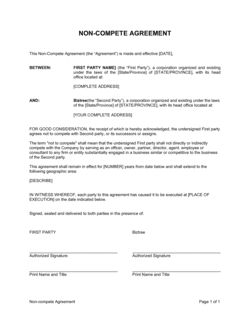
Calibrate the non-compete scope to the deal
Set the geographic area to match where the seller's business actually operated and the duration to match the value of the goodwill transferred — 12 to 24 months is the typical range for small business asset deals.
💡 In California, Minnesota, and several EU jurisdictions, post-sale non-competes are enforceable only if the seller received genuine consideration for the goodwill. Tie the non-compete consideration to a specific dollar amount in the price allocation.
8
Set closing conditions, date, and deliverable checklist
Enter the target closing date and list every document each party must deliver — bill of sale, assignment agreements, officer certificate, wire confirmation, and any regulatory approvals. Confirm each item can realistically be ready by the closing date.
💡 Use a closing checklist as a separate exhibit. It keeps both parties accountable and provides a clear record of what was delivered if a post-closing dispute arises.