1
Enter the parties' legal names and effective date
Insert the full registered legal name of both the client entity and the accounting professional or firm. Use the entity name as it appears in corporate registry filings, not a trade name or abbreviation.
💡 Confirm the client's legal entity type — LLC, corporation, sole proprietor — before drafting, as it affects how the agreement is signed and who has authority to bind the entity.
2
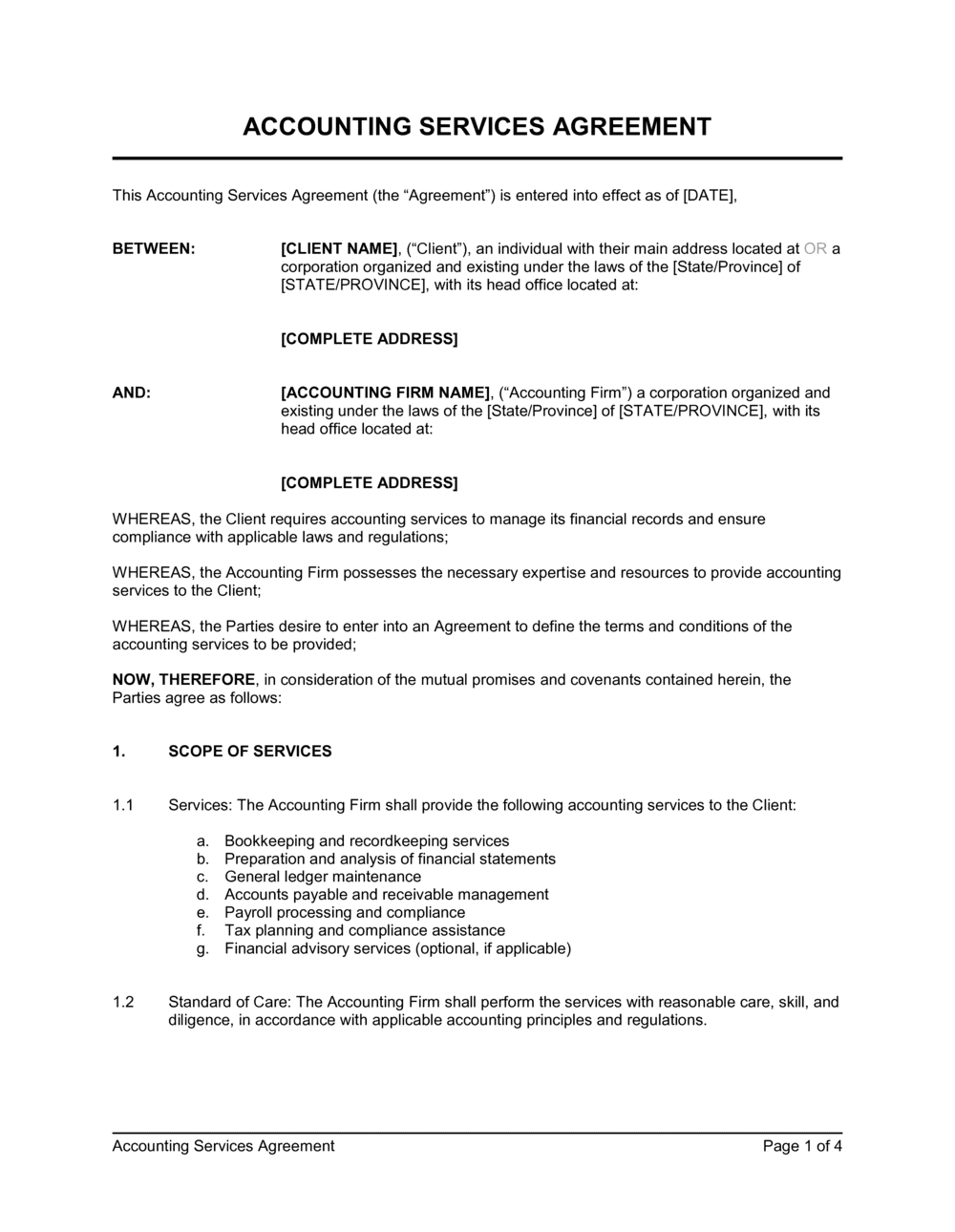
Define the scope of services with a specific task list
List every service to be performed — monthly bookkeeping, payroll processing, quarterly tax estimates, annual returns — as individual line items. Then add an explicit exclusions clause for services not included.
💡 Attach a Schedule A with the full task list rather than embedding it in the body clause. This lets you adjust scope without amending the main agreement.
3
Set the fee structure and payment schedule
Choose between a monthly retainer, hourly rate, or per-project flat fee. State the invoice date, due date (typically Net 15 for accounting services), late-fee rate, and the point at which services may be suspended for non-payment.
💡 For hourly arrangements, specify whether travel time, research time, and sub-contractor fees are billable — leaving these undefined leads to the most common fee disputes.
4
Establish the term and notice period
Decide whether this is a fixed-term engagement (e.g., one tax season) or a month-to-month arrangement. Set a notice period of 30 days for most recurring engagements and define the specific trigger events for immediate termination for cause.
💡 Month-to-month with 30-day notice is the most common structure for small business accounting engagements and gives both parties flexibility without locking them in unnecessarily.
5
Add the client responsibilities clause
List the specific documents, data, and access the client must provide — bank statements, receipts, payroll records, login credentials — and specify the turnaround time within which the client must respond to information requests.
💡 Including a response deadline (e.g., 'Client shall provide requested records within 5 business days') gives the accountant documented grounds to adjust deadlines if the client delays.
6
Set the limitation of liability and indemnification terms
Insert a liability cap equal to fees paid in the prior 12 months. Add an indemnification clause confirming the client holds the accountant harmless for errors caused by inaccurate or incomplete information provided by the client.
💡 Liability caps below the fees earned are almost never enforced — courts view them as unconscionable. Cap at 12 months of fees as a practical minimum.
7
Choose governing law and dispute resolution method
Select the state or province where the accounting professional's practice is located as the governing law. Choose between binding arbitration (faster and less expensive) or litigation in a specified court.
💡 Arbitration clauses that require disputes to be resolved in the accountant's home city deter low-value nuisance claims from clients in other locations.
8
Execute before work begins
Both parties must sign the agreement — and the client must have received and reviewed it — before any accounting services are rendered. Signature after services begin creates consideration problems that can affect enforceability of key clauses.
💡 Use an e-signature platform to timestamp execution and create an audit trail. Send the executed copy to both parties immediately so there is no dispute about what version was signed.