- Selection Criteria
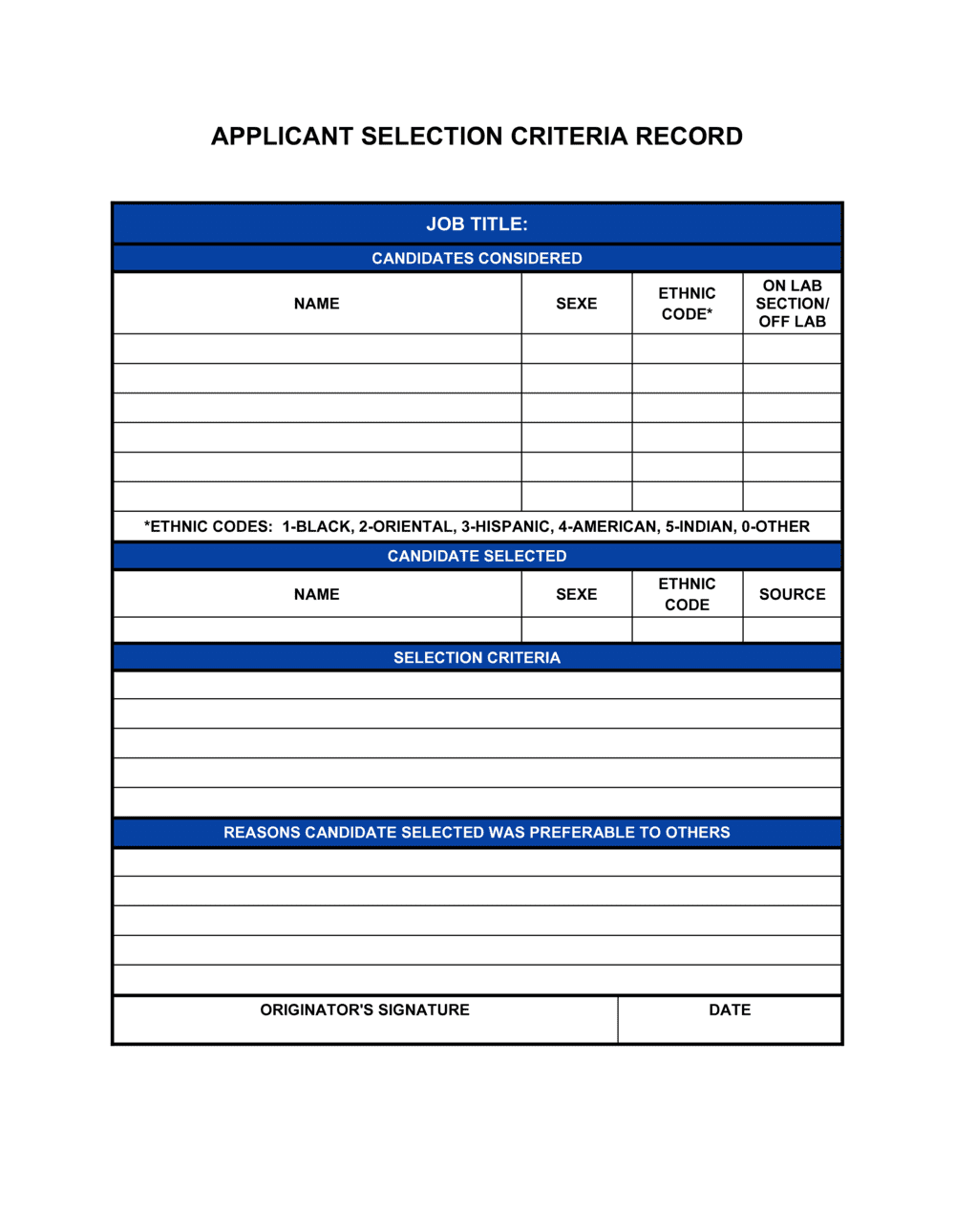
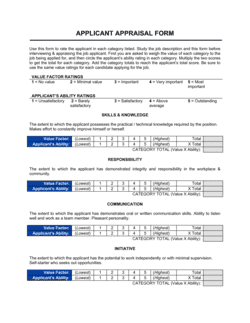
- The specific, job-related skills, qualifications, experience, and attributes used to evaluate and compare candidates for a position.
- Mandatory Criterion
- A selection requirement that every candidate must meet to be considered — failing a mandatory criterion results in automatic disqualification.
- Desirable Criterion
- A selection attribute that is valued but not required — candidates who meet desirable criteria are ranked more favorably among those who satisfy all mandatory requirements.
- Weighting
- A numerical value assigned to each criterion that reflects its relative importance to role performance, used to calculate a weighted total score per candidate.
- Structured Interview
- An interview format in which every candidate is asked the same predetermined questions, scored against the same criteria, to ensure consistency and reduce evaluator bias.
- Adverse Impact
- A pattern in hiring outcomes where a neutral-seeming selection criterion disproportionately screens out candidates from a protected group, potentially constituting unlawful indirect discrimination.
- Protected Characteristic
- An attribute — such as race, sex, age, religion, disability, national origin, or pregnancy — that employment law prohibits employers from using as a basis for hiring decisions.
- Hiring Panel
- Two or more evaluators who independently score candidates against the same criteria, reducing individual bias and providing a defensible consensus decision.
- Merit Principle
- The standard, required in many public-sector and government-contractor contexts, that appointments be made solely on the basis of demonstrated ability, qualifications, and suitability.
- Retention Period
- The minimum time an employer must keep recruitment records after a hiring decision — typically 1–3 years depending on jurisdiction and whether a discrimination complaint was filed.
- Reasonable Adjustment
- A modification to the selection process — extended time, alternative format, accessible venue — made to accommodate a candidate with a disability without lowering the standard of assessment.