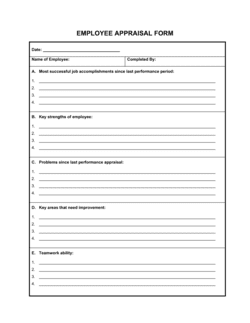
Applicant Appraisal Form_Evaluation Template

Free Word download • Edit online • Save & share with Drive • Export to PDF

2 pages20–30 min to fillDifficulty: StandardSignature requiredLegal review recommended
Learn more ↓
FreeApplicant Appraisal Form_Evaluation Template

At a glance

What it is
An Applicant Appraisal Form Evaluation is a structured document used by hiring managers and HR professionals to record, score, and compare candidates against defined competency criteria during a recruitment process. This free Word download gives you a consistent, legally defensible framework for evaluating applicants that you can edit online and export as PDF for your hiring files.
When you need it
Use it whenever you are interviewing candidates for an open role and need a documented, consistent basis for selection decisions — especially in organizations subject to equal-opportunity employment obligations or where hiring decisions may later be challenged.
What's inside
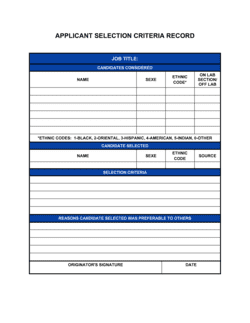
Candidate identification details, role and department information, scored competency ratings with written justifications, interviewer observations, an overall recommendation section, and a signature block for the evaluating manager. The form creates an auditable record of each hiring decision.

What is an Applicant Appraisal Form Evaluation?

An Applicant Appraisal Form Evaluation is a structured assessment document that hiring managers and HR professionals complete during or after a job interview to score a candidate against predefined, job-related competencies. It captures behavioral observations, numerical ratings, minimum-qualification verification, and a formal hiring recommendation — all signed and dated by the evaluating manager. Unlike informal interview notes, a completed appraisal form creates a consistent, legally attributable record of why a specific candidate was selected or declined, grounded in documented evidence rather than memory or impression.

Why You Need This Document

Without a structured appraisal form, every hiring decision rests on undocumented impressions that are nearly impossible to defend if a rejected candidate files an equal-opportunity complaint or discrimination claim. Employment tribunals, the EEOC, and equivalent bodies in Canada, the UK, and the EU routinely request written evidence that selection criteria were job-related and applied consistently — informal notes and verbal accounts rarely satisfy that standard. A signed, completed appraisal form also protects against internal challenges: when a department head questions why a finalist was passed over, or when a new hire underperforms and the process is reviewed, the form provides a clear, attributable basis for the decision. This template gives you a defensible, repeatable evaluation framework that takes 15 minutes to customize per role and creates the audit trail your organization needs before the first interview is ever scheduled.

Which variant fits your situation?

If your situation is…Use this template
Evaluating candidates after a structured panel interviewApplicant Appraisal Form Evaluation
Screening applicants at the initial resume review stageResume Screening Checklist
Assessing performance of a current employee at year endEmployee Performance Appraisal
Evaluating a candidate during a probationary period after hireProbationary Period Evaluation Form
Scoring candidates against a defined technical skills rubricSkills Assessment Form
Collecting structured feedback from multiple interviewersPanel Interview Feedback Form
Comparing finalists side by side for a senior leadership roleCandidate Comparison Matrix

Common mistakes to avoid

❌ Using generic, non-role-specific competencies

Why it matters: Competencies like 'good attitude' or 'team player' are impossible to score consistently and provide no defense against an EEO complaint because they cannot be tied to actual job requirements.

Fix: Extract competencies directly from the job description and map each one to a specific duty. Every competency on the form should be answerable with a behavioral example.

❌ Recording only numerical scores without written evidence

Why it matters: In a discrimination claim, a score of 2 with no supporting notes is indistinguishable from bias — the employer has no documented basis to show the decision was job-related.

Fix: Require evaluators to write at least one specific behavioral observation per competency before submitting the form. Treat a score without evidence as incomplete.

❌ Completing comparative rankings mid-process

Why it matters: Ranking candidate A as 'strongest' before interviewing candidates B and C anchors all subsequent evaluations — a well-documented form of evaluator bias that inflates early candidates' scores.

Fix: Lock the comparative ranking section and only open it once all scheduled interviews for the role are complete.

❌ Filing the appraisal form without a signature

Why it matters: An unsigned form cannot be attributed to a specific evaluator, making it legally unreliable as evidence in a hiring dispute and unacceptable as an audit record in most HR compliance frameworks.

Fix: Make signature a mandatory completion step — do not accept or file any form that does not carry the evaluator's handwritten or verified electronic signature and date.

❌ Using 'not a cultural fit' as a standalone decline reason

Why it matters: This phrase is one of the most scrutinized justifications in EEO investigations because it is subjective, undefined, and frequently correlates with protected characteristics when examined statistically.

Fix: Define 'culture fit' as a specific, observable competency — for example, 'collaborative work style, evidenced by cross-functional project examples' — and score it the same way as every other criterion.

❌ Not setting a document retention period

Why it matters: In the US, EEOC regulations require employers to retain applicant records for at least 1 year; UK Equality Act guidance recommends 6 months to 1 year; Canadian human rights legislation varies by province. Destroying records too early can be treated as evidence of intent to conceal.

Fix: Add a retention notice to the form specifying the minimum retention period for your jurisdiction — typically 1–3 years — and implement a destruction schedule that triggers only after that period expires.

The 10 key clauses, explained

Candidate and Role Identification

In plain language: Records the applicant's full name, the position applied for, the department, the interview date, and the name and title of the evaluating manager.

Sample language
Candidate: [CANDIDATE FULL NAME] | Position: [JOB TITLE] | Department: [DEPARTMENT NAME] | Interview Date: [DATE] | Evaluated by: [EVALUATOR NAME], [TITLE]

Common mistake: Omitting the specific role or department when the form is reused across multiple positions — mixing appraisal records creates audit confusion and can expose the employer to EEO challenges.

Evaluation Criteria and Competency Framework

In plain language: Lists the specific competencies or selection criteria against which the candidate is scored, mapped to the requirements of the role.

Sample language
Competencies assessed: (1) Technical Knowledge — [ROLE-SPECIFIC SKILLS]; (2) Communication; (3) Problem-Solving; (4) Cultural Fit; (5) Leadership Potential. Each competency is rated on a scale of 1 (Does Not Meet Requirements) to 5 (Exceeds Requirements).

Common mistake: Using generic competencies that are not linked to the actual job description — a mismatch makes the scores impossible to defend if a rejected candidate challenges the decision.

Scoring Rubric and Rating Scale

In plain language: Defines what each score level means, so that different evaluators apply the scale consistently across candidates.

Sample language
1 — Does Not Meet Requirements: Little or no evidence of competency. 3 — Meets Requirements: Clear, consistent evidence. 5 — Exceeds Requirements: Exceptional evidence; significantly above role expectations.

Common mistake: Leaving the rating scale undefined and letting evaluators interpret it subjectively — a 3 from one manager and a 3 from another may describe entirely different performance levels.

Evidence and Behavioral Observations

In plain language: Provides space for the evaluator to record specific examples or quotes from the interview that justify each competency score.

Sample language
Evidence for [COMPETENCY]: '[SPECIFIC BEHAVIORAL EXAMPLE OR QUOTE FROM CANDIDATE]. This demonstrates [SKILL/BEHAVIOR] because [REASON].'

Common mistake: Recording only scores without written observations — if a rejected candidate files a discrimination complaint, numerical scores alone provide no audit trail to demonstrate the decision was job-related.

Minimum Qualification Verification

In plain language: Confirms that the candidate meets non-negotiable prerequisites for the role, such as required licenses, certifications, or legal right to work.

Sample language
Does the candidate meet all mandatory qualifications for [JOB TITLE]? Verified: [ ] Yes [ ] No. If No, specify missing requirement: [DESCRIPTION]. Right to work confirmed: [ ] Yes [ ] No [ ] Pending verification.

Common mistake: Skipping the right-to-work verification field on the appraisal form — employers in the US, UK, and Canada face significant penalties for failing to verify work authorization before hiring.

Comparative Ranking Against Other Candidates

In plain language: Allows the evaluator to position this candidate relative to others interviewed for the same role, based on aggregated scores.

Sample language
Relative ranking among candidates interviewed for [JOB TITLE] (as of [DATE]): [ ] Strongest candidate [ ] Competitive [ ] Below leading candidates [ ] Not recommended for progression.

Common mistake: Completing this field before all candidates have been interviewed — premature comparative rankings anchor evaluators on early impressions and introduce bias against later interviewees.

Overall Recommendation

In plain language: States the evaluator's hiring recommendation — hire, hold for second round, or decline — with a written summary justification.

Sample language
Recommendation: [ ] Proceed to offer [ ] Second-round interview [ ] Hold pending other candidates [ ] Do not proceed. Justification: [2–4 sentence summary referencing specific competency scores and evidence].

Common mistake: Writing 'not a cultural fit' as the sole justification for declining — this phrase is frequently scrutinized in EEO complaints and must be supported by specific, job-related behavioral evidence.

Conflict of Interest Declaration

In plain language: Requires the evaluator to disclose any personal or professional relationship with the candidate that could affect the objectivity of the appraisal.

Sample language
I confirm that I have no personal, financial, or professional relationship with [CANDIDATE FULL NAME] that would impair my objective evaluation of their suitability for [JOB TITLE]. [ ] Confirmed [ ] Conflict declared — see attached disclosure.

Common mistake: Omitting a conflict-of-interest declaration entirely — when a hired candidate later underperforms, an undisclosed relationship between the evaluator and candidate can create both legal and HR governance liability.

Evaluator Signature and Date

In plain language: Captures the evaluating manager's signature and the date the form was completed, creating a dated, attributable record of the hiring decision.

Sample language
Evaluator Signature: _________________________ | Printed Name: [EVALUATOR FULL NAME] | Title: [TITLE] | Date Completed: [DATE]

Common mistake: Allowing the form to be completed and filed unsigned — an unsigned appraisal has no legal attribution and cannot be relied upon to defend a challenged hiring decision.

Retention and Confidentiality Notice

In plain language: Advises that the completed form is a confidential HR document, states how long it will be retained, and restricts access to authorized personnel only.

Sample language
This form is confidential and must be retained in the candidate's recruitment file for a minimum of [X] years from the date of the hiring decision, in accordance with [APPLICABLE EMPLOYMENT LAW / COMPANY POLICY]. Access is restricted to HR and authorized hiring managers.

Common mistake: Failing to specify a retention period — in most jurisdictions, employment records including rejected-applicant files must be retained for 1–3 years, and a missing policy exposes the employer to destruction-of-evidence claims.

How to fill it out

  1. 1

    Align the competency framework to the job description

    Before any interviews take place, extract 4–6 core competencies directly from the job description and enter them into the evaluation criteria section. Each competency should map to a specific duty or requirement in the role.

    💡 Run the competency list past the hiring manager before the first interview — misaligned criteria are the most common reason appraisal forms fail to hold up under review.

  2. 2

    Define the rating scale in writing before interviewing begins

    Complete the scoring rubric section so every interviewer on the panel is calibrated to the same definitions. Distribute the completed rubric to all evaluators before their first interview.

    💡 A 30-minute calibration session with all panel members before the first interview reduces inter-rater score variance significantly.

  3. 3

    Complete candidate and role identification fields immediately

    Enter the candidate's full name, the exact job title, department, interview date, and your name and title at the top of the form before the interview starts.

    💡 Pre-populate the role and department fields if you are running multiple interviews for the same position — it eliminates mis-filed appraisals.

  4. 4

    Verify minimum qualifications before scoring competencies

    Work through the minimum qualification verification section first. If a candidate does not meet a mandatory prerequisite, note this and stop the evaluation — do not proceed to competency scoring for an ineligible candidate.

    💡 Record right-to-work verification status on every form, even for roles where it seems obvious — omitting it creates a compliance gap.

  5. 5

    Record behavioral evidence during or immediately after the interview

    For each competency, write a 1–3 sentence note capturing a specific example the candidate provided — the situation, action, and result. Assign the score only after recording the evidence, not before.

    💡 If you cannot identify a specific behavioral example to support a score, the evidence is insufficient — probe further or record a lower score.

  6. 6

    Complete the comparative ranking only after all candidates are interviewed

    Return to the comparative ranking section once every shortlisted candidate has been evaluated. Rank candidates based on aggregated scores rather than on initial impressions.

    💡 Sort completed appraisals by total score before assigning relative rankings to avoid anchoring on the first candidate you interviewed.

  7. 7

    Write the overall recommendation with a specific justification

    Select the recommendation outcome and write 2–4 sentences referencing specific competency scores and behavioral examples. Avoid subjective language — tie every statement back to a job-related criterion.

    💡 If recommending 'do not proceed,' be especially precise — cite the specific competency gap and the evidence behind it.

  8. 8

    Sign, date, and file the completed form

    Sign and date the form on the day you complete it. File it in the candidate's confidential recruitment record, separate from any employee personnel file, and retain it for the period required by the applicable employment law in your jurisdiction.

    💡 Scan and store a digital copy immediately — paper-only appraisal records are frequently lost during office moves or system migrations and cannot be retrieved when needed for a complaint.

Frequently asked questions

What is an applicant appraisal form evaluation?

An applicant appraisal form evaluation is a structured document that hiring managers and HR professionals use to score and record their assessment of job candidates against predefined, job-related competencies. It creates a consistent, auditable record of each hiring decision, replacing informal interview notes with a standardized format that supports both effective selection and legal defensibility. Completed forms are retained as part of the candidate's recruitment file.

Is an applicant appraisal form legally required?

No jurisdiction mandates a specific appraisal form, but equal employment opportunity laws in the US, Canada, the UK, and the EU require that hiring decisions be made on non-discriminatory, job-related grounds. A completed appraisal form is the primary evidence an employer can produce to demonstrate compliance. Without one, defending a challenged hiring decision becomes significantly harder and more expensive.

How long should I retain completed applicant appraisal forms?

Retention requirements vary by jurisdiction. In the US, EEOC regulations require employers with 15 or more employees to retain all applicant records for at least 1 year from the date of the hiring decision. In the UK, the Information Commissioner's Office recommends 6 months to 1 year for unsuccessful candidates. Canadian requirements vary by province. A conservative best practice is to retain all applicant appraisal records for at least 2 years regardless of jurisdiction.

Can I use the same appraisal form for different roles?

You can use the same form template, but you must customize the competency criteria for each distinct role. An appraisal form that scores a software engineer and an accountant against identical criteria produces scores that are neither meaningful nor defensible — the competencies must reflect the actual duties and requirements of the specific position being filled.

What is the difference between an applicant appraisal form and an employee performance appraisal?

An applicant appraisal form is used during the recruitment process to evaluate external candidates before hire. An employee performance appraisal is used after hire to assess an existing employee's on-the-job performance, typically on an annual or semi-annual basis. Both use competency scoring, but they serve different legal and operational purposes and should be stored in separate files.

How many evaluators should complete an appraisal form for each candidate?

For roles where the hiring decision may be scrutinized — senior positions, high-volume recruitment, or roles in regulated industries — at least two independent evaluators should each complete a separate form, then compare results. This panel approach reduces individual evaluator bias, improves score reliability, and creates a stronger audit trail. For very small businesses, a single evaluator is common but adds risk.

What scoring scale should I use on an applicant appraisal form?

A 1-to-5 scale is the most widely used format — 1 indicates the candidate does not meet the requirement, 3 indicates they meet it adequately, and 5 indicates they significantly exceed it. A 1-to-4 scale is also common when organizations want to eliminate a neutral midpoint and force evaluators toward a positive or negative assessment. Whichever scale you choose, define each level in writing before any interviews begin.

Can an applicant request access to their appraisal form?

In the UK and EU, individuals have the right under data protection law to request access to personal data held about them, which can include interview notes and appraisal scores. In Canada, PIPEDA gives similar access rights in federally regulated contexts. In the US, there is no general federal right of access to private-sector hiring records, though some state laws differ. Employers should store appraisal forms as confidential HR records and consult legal counsel before responding to any subject access request.

Does an applicant appraisal form need to be signed?

Yes — the evaluator's signature and date are essential. An unsigned form cannot be attributed to a specific individual, making it legally unreliable as evidence if a hiring decision is later challenged. Electronic signatures are generally acceptable under e-signature laws in the US (ESIGN Act), Canada (PIPEDA / provincial statutes), UK (Electronic Communications Act), and EU (eIDAS Regulation), provided they meet the applicable authentication standard.

How this compares to alternatives

vs Employee Performance Appraisal

An employee performance appraisal evaluates an existing staff member's on-the-job output, behaviors, and development against agreed targets — typically annually. An applicant appraisal form evaluates an external candidate before any employment relationship exists. The two documents serve entirely different HR functions and must be stored separately.

vs Job Application Form

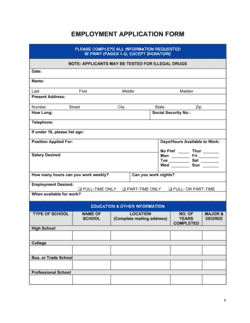
A job application form collects self-reported information from the candidate — work history, education, and references. An applicant appraisal form is completed by the evaluator after the interview to score the candidate against job-related criteria. The application form feeds into candidate shortlisting; the appraisal form documents the final selection decision.

vs Reference Check Form

A reference check form captures structured feedback from a candidate's previous employers or professional contacts to verify stated experience. An applicant appraisal form records the evaluator's direct assessment from the interview itself. Both feed into the hiring decision, but they represent different evidence sources and should be retained together in the recruitment file.

vs Offer Letter

An offer letter is issued to the selected candidate after the hiring decision is made and confirmed. An applicant appraisal form is completed during or immediately after the interview to document the basis for that decision. The appraisal form is the internal record that justifies the offer; the offer letter is the external communication that initiates the employment relationship.

Industry-specific considerations

Technology / SaaS

Technical competency rubrics cover coding assessments, system design, and problem-solving; appraisal forms are often paired with take-home test scores to create a multi-signal evaluation record.

Healthcare

Mandatory credential and license verification fields are critical; appraisal forms must document that clinical qualifications were confirmed before any recommendation to hire is made.

Financial Services

Regulatory fitness-and-propriety checks, FINRA or FCA registration requirements, and background screening outcomes must be cross-referenced on the appraisal form before a hiring recommendation is finalized.

Professional Services

Client-facing competencies such as written communication, presentation quality, and stakeholder management carry higher scoring weights; panel interview structures with multiple senior evaluators are standard.

Manufacturing

Safety certification verification and physical capability assessments are embedded in the minimum qualification section; union agreement requirements may constrain how selection criteria are defined and applied.

Retail / Hospitality

High-volume hiring makes a standardized appraisal form essential for consistency; simplified 3-point scales and abbreviated competency lists are common to enable rapid evaluation across large candidate pools.

Jurisdictional notes

United States

EEOC regulations (29 CFR Part 1602) require employers with 15 or more employees to retain all applicant records for at least 1 year from the hiring decision date, or 2 years for federal contractors. Appraisal criteria must be validated as job-related to withstand disparate-impact analysis under Title VII. Several states — including California, New York, and Illinois — impose additional restrictions on the types of information that may be collected or considered during the evaluation process.

Canada

Federal and provincial human rights codes prohibit selection decisions based on protected grounds including race, sex, disability, and age. PIPEDA and provincial privacy statutes restrict the collection and retention of personal information about applicants; consent and purpose-limitation requirements apply. Quebec's Act respecting the protection of personal information in the private sector imposes additional obligations, and appraisal forms used in Quebec must be available in French.

United Kingdom

The Equality Act 2010 prohibits discrimination on nine protected characteristics at every stage of recruitment, including candidate evaluation. Under UK GDPR, applicant appraisal records are personal data and must be processed lawfully, with a documented lawful basis and a defined retention period — typically 6 months to 1 year for unsuccessful candidates per ICO guidance. Candidates may submit subject access requests for their evaluation records.

European Union

GDPR classifies interview notes and evaluation scores as personal data subject to data minimization, purpose limitation, and storage limitation principles. Employers must have a documented lawful basis for processing applicant appraisal data — typically legitimate interest or contractual necessity. Several member states, including Germany and France, impose additional works-council consultation or co-determination requirements before standardized selection tools are introduced.

Template vs lawyer — what fits your deal?

PathBest forCostTime
Use the templateSmall businesses, HR teams, and hiring managers conducting standard domestic recruitment for non-regulated rolesFree15–30 minutes to customize per role
Template + legal reviewOrganizations in regulated industries, those running high-volume hiring, or employers in jurisdictions with active EEO enforcement$300–$800 for an HR or employment counsel review2–5 business days
Custom draftedLarge enterprises, government contractors, or employers operating across multiple jurisdictions with distinct anti-discrimination frameworks$1,500–$5,000+ for bespoke design and legal sign-off2–4 weeks

Glossary

Competency Rating
A numerical or categorical score assigned to a candidate's demonstrated ability in a specific skill or behavioral area during the evaluation process.
Structured Interview
An interview format in which every candidate is asked the same predetermined questions and assessed against the same scoring criteria.
Adverse Impact
A legally significant disparity in selection rates between protected groups — for example, where a hiring criterion disproportionately screens out candidates of a particular race, gender, or age.
Selection Criterion
A defined, job-related requirement — skill, qualification, or behavioral competency — used to assess and rank candidates consistently.
Evaluator Bias
Systematic distortion in candidate scoring caused by personal preferences, stereotypes, or cognitive shortcuts rather than objective job-related evidence.
Hiring Panel
A group of two or more evaluators who independently score candidates and then compare results to reach a collective hiring recommendation.
Reference Check
A formal inquiry made to a candidate's previous employers or professional contacts to verify stated experience and assess past performance.
Weighted Scoring
A scoring method that assigns different importance levels to competencies — for example, giving technical skills a 40% weighting and communication a 20% weighting — so that the total score reflects role priorities.
EEO Compliance
Adherence to Equal Employment Opportunity laws that prohibit discrimination in hiring on the basis of race, color, religion, sex, national origin, age, or disability.
Offer Justification
A documented rationale explaining why the selected candidate was chosen over other applicants, referencing appraisal scores and competency evidence.
Shortlisting
The process of narrowing a pool of applicants to a smaller set of candidates who meet the minimum criteria and will proceed to interview.

Part of your Business Operating System

This document is one of 3,000+ business & legal templates included in Business in a Box.

  • Fill-in-the-blanks — ready in minutes
  • 100% customizable Word document
  • Compatible with all office suites
  • Export to PDF and share electronically

Create your document in 3 simple steps.

From template to signed document — all inside one Business Operating System.
1
Download or open template

Access over 3,000+ business and legal templates for any business task, project or initiative.

2
Edit and fill in the blanks with AI

Customize your ready-made business document template and save it in the cloud.

3
Save, Share, Send, Sign

Share your files and folders with your team. Create a space of seamless collaboration.

Save time, save money, and create top-quality documents.

★★★★★

"Fantastic value! I'm not sure how I'd do without it. It's worth its weight in gold and paid back for itself many times."

Managing Director · Mall Farm
Robert Whalley
Managing Director, Mall Farm Proprietary Limited
★★★★★

"I have been using Business in a Box for years. It has been the most useful source of templates I have encountered. I recommend it to anyone."

Business Owner · 4+ years
Dr Michael John Freestone
Business Owner
★★★★★

"It has been a life saver so many times I have lost count. Business in a Box has saved me so much time and as you know, time is money."

Owner · Upstate Web
David G. Moore Jr.
Owner, Upstate Web

Run your business with a system — not scattered tools

Stop downloading documents. Start operating with clarity. Business in a Box gives you the Business Operating System used by over 250,000 companies worldwide to structure, run, and grow their business.

Free Forever Plan · No credit card required