1
Identify the employer and each eligible employee
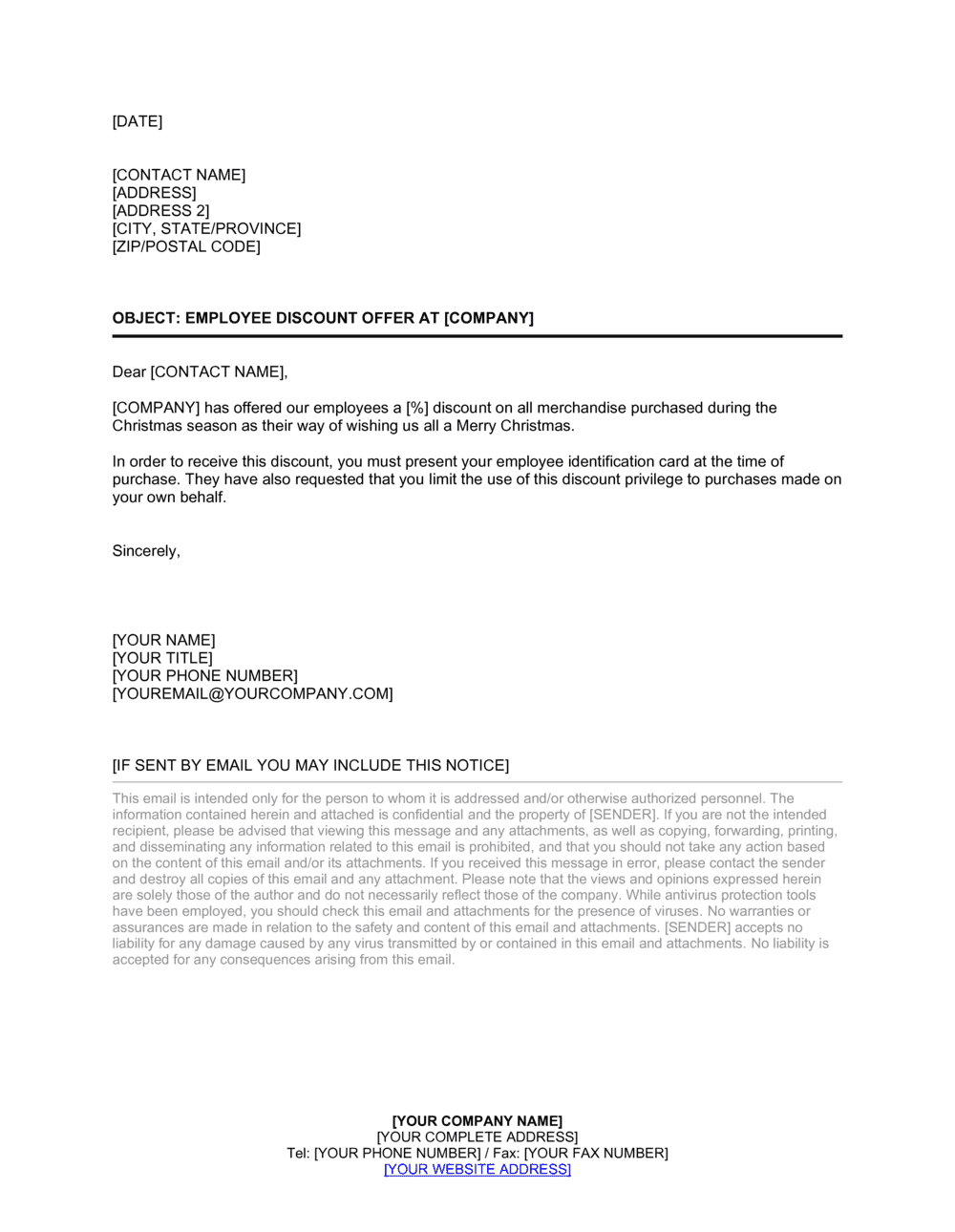
Enter your company's full legal name and the employee's legal name and job title. If issuing to multiple employees, generate a separate signed copy for each individual rather than a group letter.
💡 Match the employer name to your payroll records — mismatches create problems if a dispute escalates to an employment tribunal.
2
Set the discount rate and define eligible products
Enter the specific percentage discount and list the product or service categories it covers. Explicitly exclude items such as gift cards, clearance merchandise, and limited-edition or pre-order stock.
💡 A defined exclusion list prevents far more disputes than a broad eligibility clause — name specific categories or SKU ranges if your product mix is complex.
3
Enter the offer period with precise start and end dates
Insert exact calendar dates for the offer window and confirm the offer expires automatically on the end date with no carryover.
💡 Set the end date at least two days after Christmas to capture post-holiday purchases, but close the window before your January sale begins to avoid stacking discounts.
4
Define the spending cap and transaction limits
Enter the maximum aggregate dollar value of purchases eligible for the discount and any per-transaction or frequency limits. Both a dollar ceiling and a transaction cap together provide the tightest control.
💡 A cap equal to two to three times the employee's average weekly wage is a common benchmark that feels meaningful without creating significant margin exposure.
5
Complete the eligibility conditions
Specify the minimum tenure required and confirm the 'actively employed and in good standing' condition applies on each purchase date, not just the offer date.
💡 If your business has seasonal or temporary workers, explicitly state whether they qualify — ambiguity in eligibility is the most litigated element of discount programs.
6
Review the tax acknowledgment clause
Confirm the applicable tax law reference for your jurisdiction — IRS Section 132 for the US, Section 319 of the Income Tax Act for Canada, or HMRC guidance for the UK — and verify your payroll team is prepared to handle any required reporting.
💡 In the US, employee discounts on retail merchandise are generally excludable up to the employer's gross profit percentage. Discounts above that threshold must be reported as income — confirm the threshold with your payroll provider before issuing.
7
Obtain the employee's signed acceptance before the offer period opens
Distribute the offer and collect a signed copy from each employee at least five business days before the offer start date. File the signed original in the employee's HR record.
💡 For distributed or remote teams, use an electronic signature tool that timestamps acceptance — this eliminates disputes about whether terms were received and reviewed.
8
Store signed copies and track usage against the spending cap
Retain a signed copy in each employee's personnel file for at least three years after the offer period closes. Instruct your point-of-sale or e-commerce system to flag purchases against the individual cap.
💡 A simple spreadsheet tracking each employee's cumulative discount usage during the period is sufficient for most small and medium businesses and satisfies audit requirements.