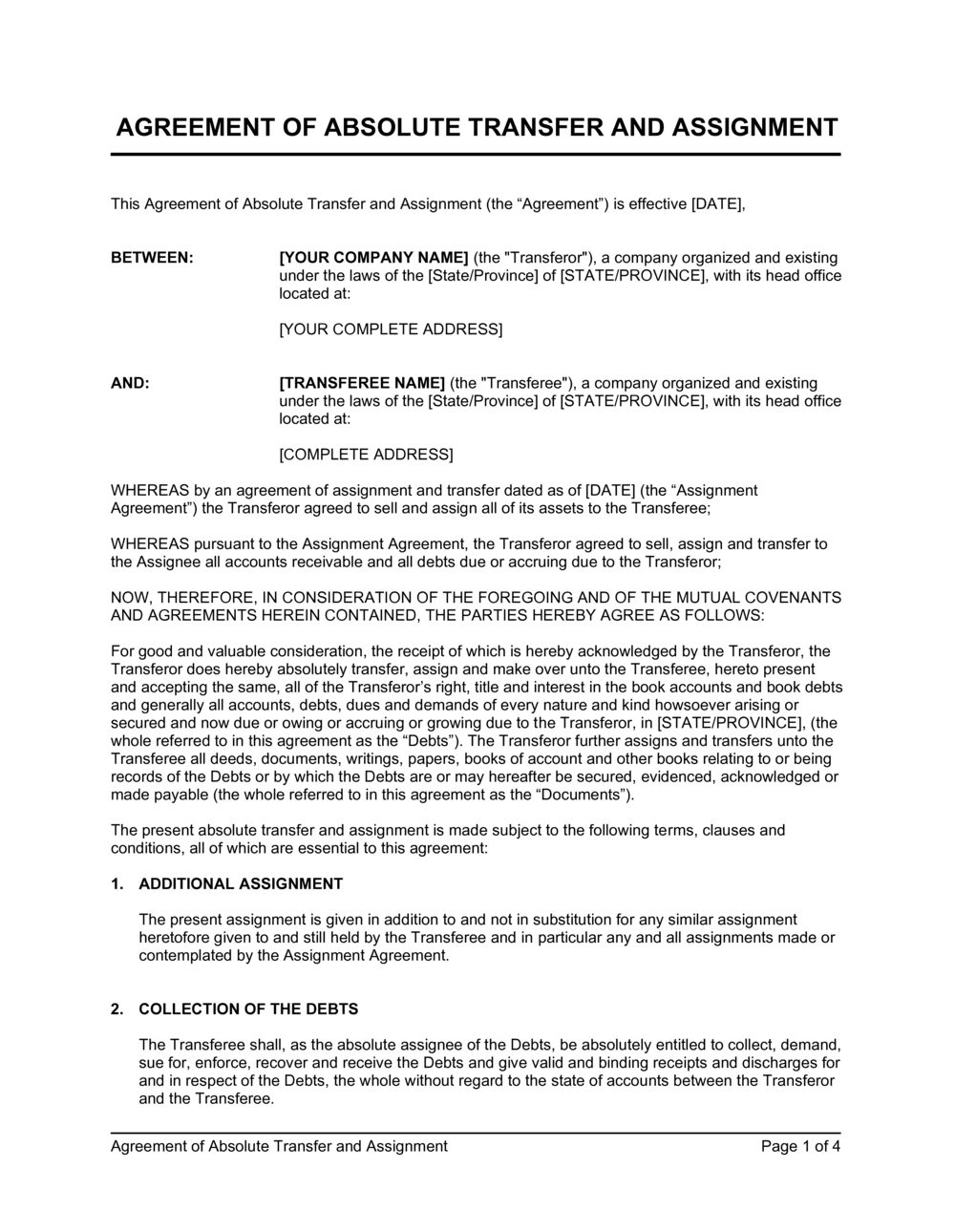
- Assignor
- The party who currently holds the rights or interests and is permanently transferring them to another party under this agreement.
- Assignee
- The party receiving the transferred rights, title, or interests — who steps into the assignor's position after execution.
- Absolute Assignment
- A transfer of rights that is complete, unconditional, and irrevocable — the assignor retains no interest or right of reversion once the transfer is executed.
- Consideration
- The value exchanged for the assignment — typically a cash payment, but may also be debt forgiveness, equity, or other agreed value.
- Anti-Assignment Clause
- A provision in the underlying contract being assigned that prohibits transfer without the other party's prior written consent — must be checked before executing any assignment.
- Novation
- A related but distinct concept where the original party is completely replaced by a new party with the other contracting party's consent, extinguishing the original obligation entirely.
- Chose in Action
- A personal right to property that can only be enforced through legal action — such as a debt, judgment, or claim — which can itself be the subject of an absolute assignment.
- Representations and Warranties
- Statements of fact made by each party at the time of signing — if untrue, they give the other party grounds to seek damages or rescission.
- Indemnification
- A contractual obligation by which one party agrees to compensate the other for specified losses, claims, or liabilities arising from the assigned asset or the transfer itself.
- Governing Law
- The jurisdiction whose laws control interpretation and enforcement of the agreement — chosen by the parties and stated explicitly in the agreement.
- Closing Conditions
- Prerequisites that must be satisfied before the transfer becomes effective — such as third-party consents, regulatory approvals, or payment receipt.