Agreement for Chairman of Board of Directors Template

Free Word download • Edit online • Save & share with Drive • Export to PDF

9 pages30–40 min to fillDifficulty: ComplexSignature requiredLegal review recommended
Learn more ↓
FreeAgreement for Chairman of Board of Directors Template

At a glance

What it is
An Agreement for Chairman of Board of Directors is a legally binding contract between a corporation and the individual appointed to chair its board. It sets out the chairman's specific duties, term of appointment, compensation, expense reimbursement, confidentiality obligations, and termination conditions in a single enforceable document. This free Word download can be edited online and exported as PDF for immediate execution by both parties.
When you need it
Use it whenever a board formally appoints a chairman — whether an independent chair, a non-executive chair, or a founder transitioning from CEO to chairman. It is equally essential when the role carries significant compensation, equity, or advisory responsibilities that need to be clearly documented and separated from the company's bylaws.
What's inside
Appointment and term clause, defined duties and board leadership responsibilities, compensation and equity structure, expense reimbursement, confidentiality and non-disclosure obligations, non-compete and non-solicitation restrictions, indemnification and D&O insurance coverage, and termination and resignation procedures.

What is an Agreement for Chairman of Board of Directors?

An Agreement for Chairman of Board of Directors is a legally binding contract between a corporation and the individual appointed to preside over its board. It defines the chairman's specific duties and authority, term of appointment, compensation structure (retainer, equity, and expense reimbursement), confidentiality and non-disclosure obligations, conflict-of-interest requirements, indemnification rights, and the conditions under which either party may end the relationship. Unlike the company's bylaws — which address the chairman's role in general governance terms — this agreement creates enforceable, individualized obligations between the two specific parties and provides the detail needed to resolve disputes without resorting to the courts or shareholder resolutions.

Why You Need This Document

Without a dedicated chairman agreement, the role exists only within the company's bylaws and corporate statutes — documents that rarely address compensation, confidentiality, equity treatment on departure, or the boundary between the chairman's authority and the CEO's operational mandate. When these gaps are left open, they surface at the worst possible moments: a departing chairman disputes whether unvested equity accelerates; a board cannot remove a non-performing chairman because no cause standard was defined; boardroom discussions about an acquisition leak because no confidentiality obligation extended beyond the statutory minimum. A properly executed Chairman Agreement closes all of these gaps before they become governance crises, gives the chairman clarity on what they are being asked to do and compensated for, and gives the board a clear, documented basis for enforcement if the relationship breaks down.

Which variant fits your situation?

If your situation is…Use this template
Appointing an independent chairman separate from the CEO roleAgreement for Chairman of Board of Directors
Engaging a non-executive director without a chairman titleNon-Executive Director Agreement
Hiring a CEO who also serves temporarily as board chairExecutive Employment Agreement
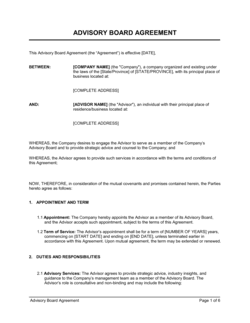
Appointing an independent advisor with board observation rightsAdvisory Board Agreement
Adding a new board member below chairman levelBoard of Directors Agreement
Retaining a senior consultant in a strategic oversight capacityConsulting Agreement
Documenting equity compensation tied to the chairman appointmentStock Option Agreement

Common mistakes to avoid

❌ Blurring the chairman's duties with CEO authority

Why it matters: Overlapping duty definitions create governance disputes about who has the final word on strategic decisions, board agendas, and external communications — often surfacing publicly during a crisis.

Fix: Draft a concise division-of-responsibilities clause that explicitly reserves operational management to the CEO and limits the chairman to board leadership and oversight functions.

❌ No Schedule A listing existing directorships

Why it matters: Without a baseline record of the chairman's other board positions at signing, the company cannot enforce the conflict-of-interest clause against roles the chairman held before the agreement was executed.

Fix: Attach and initial a Schedule A at signing listing every current directorship, advisory role, and significant ownership interest held by the chairman.

❌ Omitting equity treatment on termination

Why it matters: When a chairman departs mid-vesting cycle, the absence of a clause addressing unvested equity triggers disputes that can delay a board transition and create legal costs disproportionate to the grant's value.

Fix: Include an explicit provision stating whether unvested equity is forfeited, accelerated, or pro-rated on termination without cause, and whether the same applies on resignation.

❌ Selecting a governing law that conflicts with the incorporation jurisdiction

Why it matters: Mandatory corporate law provisions — fiduciary duty standards, removal procedures, and indemnification limits — in the state or country of incorporation apply regardless of the contractual governing law choice.

Fix: Use the jurisdiction of incorporation as the governing law. If the chairman is based elsewhere, add a clause addressing employment tax treatment in the chairman's location separately.

❌ Applying an executive-level non-compete to a non-executive chairman

Why it matters: Courts apply heightened scrutiny to restrictive covenants on non-employees who receive no salary. A broad non-compete on a part-time, fee-paid chairman is routinely struck down, voiding the restriction entirely.

Fix: Limit the non-compete to 12 months, the specific industry the company operates in, and the geographic markets where the chairman has actual client or competitive knowledge.

❌ No D&O insurance coverage floor in the indemnification clause

Why it matters: An indemnification promise backed by an underfunded or lapsed D&O policy is effectively unenforceable — leaving the chairman personally exposed to governance-related claims.

Fix: State a minimum coverage amount in the agreement and require the company to provide annual confirmation of the policy's active status and coverage limit to the chairman.

The 10 key clauses, explained

Appointment and term

In plain language: Identifies the company and the chairman by their full legal names, confirms the formal appointment, and states the term length, commencement date, and renewal or election conditions.

Sample language
[COMPANY LEGAL NAME] ('Company') hereby appoints [CHAIRMAN FULL NAME] ('Chairman') as Chairman of its Board of Directors effective [START DATE], for an initial term of [X] year(s), renewable upon re-election by the shareholders in accordance with the Company's articles of incorporation.

Common mistake: Tying the chairman's term directly to a specific board resolution date rather than to the shareholder election cycle — creating a mismatch that requires a contract amendment every year.

Duties and responsibilities

In plain language: Defines the chairman's specific obligations — presiding over board meetings, setting agendas, leading governance processes, liaising between the board and CEO, and representing the company to stakeholders.

Sample language
The Chairman shall: (a) preside over all meetings of the Board of Directors; (b) set the agenda for each meeting in consultation with the CEO; (c) ensure effective communication between the Board and management; and (d) represent the Company at [SPECIFIED EXTERNAL ENGAGEMENTS].

Common mistake: Describing duties so vaguely that the chairman's scope overlaps with the CEO's operational authority — creating ambiguity that leads to governance disputes.

Time commitment

In plain language: States the minimum expected time the chairman will dedicate to the role — board meeting days, committee work, preparation, and any additional strategic engagements.

Sample language
The Chairman is expected to dedicate approximately [X] days per month to the role, including attendance at [X] board meetings per year, committee participation, and preparation time. Significant additional engagements require mutual written agreement.

Common mistake: Omitting a time commitment clause entirely, leaving the company unable to enforce availability expectations or justify a change of leadership if the chairman becomes passive.

Compensation and expense reimbursement

In plain language: Sets out the chairman's retainer fee or annual cash compensation, any equity grants, meeting attendance fees, and the process for reimbursing reasonable business expenses.

Sample language
The Company shall pay the Chairman an annual retainer of $[AMOUNT], payable in equal [monthly/quarterly] installments. The Chairman shall also receive [X] stock options / restricted stock units under the Company's [EQUITY PLAN NAME]. Reasonable, pre-approved business expenses shall be reimbursed within [30] days of submission.

Common mistake: Granting equity to the chairman in the body of the agreement without referencing a separate option or RSU agreement — creating two conflicting instruments governing the same grant.

Confidentiality and non-disclosure

In plain language: Prohibits the chairman from disclosing or using the company's confidential information — board deliberations, financial data, strategic plans, and M&A discussions — during and after the appointment.

Sample language
The Chairman shall not, during or after the term of this Agreement, disclose or use any Confidential Information of the Company for any purpose other than fulfilling duties under this Agreement. 'Confidential Information' includes board minutes, financial data, strategic plans, and any non-public information relating to the Company's business or affairs.

Common mistake: Excluding board deliberations and M&A discussions from the definition of Confidential Information on the assumption they are already protected — leaving the company with no contractual remedy if boardroom discussions are disclosed.

Non-compete and non-solicitation

In plain language: Restricts the chairman from competing with the company or soliciting its employees or clients during the appointment and for a defined period afterward.

Sample language
During the term and for [12] months following termination, the Chairman shall not: (a) serve as a director, officer, or advisor to any Competing Business within [GEOGRAPHIC AREA / INDUSTRY SCOPE]; or (b) solicit any employee or client of the Company.

Common mistake: Applying the same broad non-compete to a non-executive chairman that would be used for an executive — courts scrutinize restrictions on non-employees more closely and routinely void overbroad clauses.

Indemnification and D&O insurance

In plain language: Commits the company to indemnify the chairman against claims arising from good-faith actions in the role and to maintain adequate D&O insurance coverage throughout the term.

Sample language
The Company shall indemnify the Chairman to the fullest extent permitted by applicable law for all liabilities, costs, and expenses incurred in connection with any claim arising from the Chairman's good-faith performance of duties under this Agreement. The Company shall maintain D&O insurance with minimum coverage of $[AMOUNT] during the term.

Common mistake: Omitting a specific D&O insurance coverage floor — leaving the chairman with a theoretical indemnity but no guarantee the company carries sufficient insurance to honor it.

Conflicts of interest and other directorships

In plain language: Requires the chairman to disclose any actual or potential conflicts of interest and restricts or regulates simultaneous directorships at competing companies.

Sample language
The Chairman shall promptly disclose to the Board any actual or potential conflict of interest as soon as it arises. The Chairman shall not simultaneously serve on the board of a Competing Business without prior written consent of the Board. Current directorships are listed in Schedule A.

Common mistake: Failing to attach a Schedule A listing the chairman's existing directorships at execution — making it impossible to distinguish newly acquired conflicting positions from pre-existing ones that were consented to.

Termination and resignation

In plain language: Specifies the notice period for resignation, the grounds and process for removal by the board or shareholders, the consequences of termination with or without cause, and any post-termination payments.

Sample language
Either party may terminate this Agreement by giving [30] days' written notice. The Company may terminate for Cause immediately without notice or compensation. Upon termination without Cause, the Chairman shall receive a pro-rated retainer for the notice period. All vested equity rights survive termination.

Common mistake: No provision for what happens to unvested equity on termination — creating a dispute each time a chairman departs mid-cycle over whether unvested grants are forfeited or accelerated.

Governing law and dispute resolution

In plain language: States the jurisdiction whose corporate and contract law governs the agreement and the mechanism for resolving disputes — arbitration, mediation, or litigation.

Sample language
This Agreement shall be governed by the laws of [STATE / PROVINCE / COUNTRY]. Any dispute arising under this Agreement shall first be subject to mediation. If unresolved within [30] days, disputes shall be referred to binding arbitration under the [AAA / JAMS / ICC] Rules in [CITY].

Common mistake: Selecting a governing law jurisdiction that differs from where the company is incorporated — creating a conflict between contractual law and mandatory corporate law provisions that cannot be contracted out of.

How to fill it out

  1. 1

    Enter the company's full legal name and the chairman's details

    Use the company's registered legal name — not a trade name — and the chairman's full legal name as it appears on government-issued ID. Confirm both match the board resolution authorizing the appointment.

    💡 Cross-reference the company's certificate of incorporation to ensure the exact entity name is used — discrepancies between the contract and corporate records can complicate indemnification claims.

  2. 2

    Set the term, commencement date, and renewal mechanism

    Define the initial term length (typically 1–3 years), the exact start date, and whether renewal is automatic, subject to shareholder re-election, or requires a separate board vote.

    💡 Align the term with your company's annual general meeting cycle so renewal corresponds naturally to the shareholder election process.

  3. 3

    Define duties with clear boundaries from the CEO's role

    List the chairman's specific responsibilities — presiding over meetings, agenda-setting, stakeholder representation — and explicitly exclude operational management functions that belong to the CEO.

    💡 A one-paragraph 'division of responsibilities' summary shared with both the chairman and CEO at signing prevents governance boundary disputes before they arise.

  4. 4

    Set compensation, equity grants, and expense parameters

    Enter the annual retainer amount, payment frequency, any equity grant details, and the expense reimbursement process. Reference the relevant equity plan by name rather than embedding grant terms in the body of this agreement.

    💡 State the currency explicitly for any chairman based in a country different from the company's home jurisdiction to avoid ambiguity on retainer payments.

  5. 5

    Tailor the confidentiality and non-compete provisions

    Confirm that board deliberations, M&A discussions, and strategic plans are explicitly included in the definition of Confidential Information. Set the non-compete duration and geographic or industry scope proportionate to the chairman's actual access to competitive intelligence.

    💡 For non-executive chairmen with limited operational access, a 12-month post-appointment non-compete is typically more defensible than a 24-month restriction.

  6. 6

    Confirm indemnification scope and D&O insurance minimums

    State that indemnification applies to the fullest extent permitted by applicable law and specify the minimum D&O coverage level the company must maintain. Have your insurer confirm the current policy limit before execution.

    💡 Ask the company's insurance broker to confirm in writing that the D&O policy covers the chairman's role specifically — some policies require endorsement for non-employee directors.

  7. 7

    Attach Schedule A listing existing directorships

    List all current board memberships and advisory roles held by the chairman at the time of signing. This baseline record distinguishes pre-consented positions from future conflicts.

    💡 Have the chairman update Schedule A annually as part of the board's conflict-of-interest review process.

  8. 8

    Execute before the chairman's first board meeting

    Both parties must sign the agreement before the chairman presides over their first meeting. Retroactive execution creates questions about the enforceability of confidentiality and IP obligations during the uncontracted period.

    💡 Use a countersignature structure: the board's authorized signatory (typically the company secretary or CEO) signs first, then the chairman countersigns — creating a clear execution record.

Frequently asked questions

What is a Chairman of Board of Directors Agreement?

A Chairman of Board of Directors Agreement is a legally binding contract between a corporation and the individual appointed to chair its board. It documents the chairman's duties, term, compensation, confidentiality obligations, conflict-of-interest rules, indemnification rights, and termination conditions. It serves as the primary governance document for the chairman's role, supplementing the company's bylaws and articles of incorporation without replacing them.

Is a separate agreement required for a board chairman?

Not always legally required, but highly advisable. A company's bylaws typically outline the chairman's basic authority to preside over meetings, but they rarely address compensation, confidentiality, non-compete restrictions, equity treatment, or indemnification in the detail needed to avoid disputes. A separate chairman agreement fills those gaps and creates a clear, enforceable record of agreed terms.

What is the difference between a chairman and a CEO?

The chairman leads the board of directors — setting agendas, presiding over board meetings, and ensuring effective governance oversight of management. The CEO runs the company's day-to-day operations and reports to the board. They can be the same person (combined chair-CEO model) or separate individuals. Most governance codes and institutional investors prefer separation to avoid conflicts of interest in oversight.

What compensation is typical for a board chairman?

Non-executive chairman compensation varies widely by company size and stage. Early-stage companies often pay retainers of $20,000–$60,000 per year plus equity. Mid-market companies typically pay $60,000–$150,000. Public company chairmen at large-cap firms may receive $300,000 or more in total annual compensation including equity. The agreement should specify the retainer, any per-meeting fees, equity grants, and expense reimbursement separately.

Can a chairman of the board be removed before the end of their term?

Yes. Removal procedures depend on a combination of the company's bylaws, applicable corporate law, and the terms of the chairman agreement. Most agreements permit the board or shareholders to remove the chairman with notice or for cause. The agreement should specify what constitutes cause, what notice period applies, and whether any compensation or equity acceleration is triggered on removal without cause.

Does a board chairman owe fiduciary duties to the company?

Yes. As a board member, a chairman owes the same fiduciary duties of care and loyalty to the corporation as any other director in most jurisdictions. These duties exist independently of the chairman agreement and are imposed by corporate law — not by contract. The agreement can reinforce these obligations and define specific conduct standards, but cannot reduce the underlying statutory duties.

Should a board chairman agreement include a non-compete clause?

It depends on the chairman's access to sensitive competitive information and the applicable jurisdiction. A non-compete is more defensible when the chairman is deeply involved in strategy, M&A, or client relationships. It must be reasonable in duration (typically 12 months), geographic scope, and industry breadth to be enforceable. Several jurisdictions require financial compensation to the chairman in exchange for post-term restrictions.

What indemnification should a board chairman receive?

The agreement should indemnify the chairman to the fullest extent permitted by applicable corporate law for liabilities and costs arising from good-faith actions taken in the role. Indemnification should be backed by a D&O insurance policy with a stated minimum coverage level. Without insurance coverage, a contractual indemnification promise is only as good as the company's ability to fund a defense or settlement from its own balance sheet.

Do I need a lawyer to draft a board chairman agreement?

For straightforward appointments at private companies, a well-structured template is a sound starting point. Legal review is recommended whenever the chairman receives significant equity, the role involves regulated industry obligations (financial services, healthcare), the company is publicly traded, or the chairman is based in a jurisdiction with mandatory worker or director protections. A 2–3 hour legal review typically costs $500–$1,200 and is worthwhile given the governance stakes.

How this compares to alternatives

vs Board of Directors Agreement

A general Board of Directors Agreement governs a standard board member's obligations, compensation, and duties. A Chairman Agreement covers all of the same ground but adds provisions specific to the presiding leadership role — agenda-setting authority, CEO liaison responsibilities, enhanced time commitment expectations, and typically a higher retainer. Use the general agreement for ordinary directors and this template for the chairman specifically.

vs Executive Employment Agreement

An Executive Employment Agreement governs a full-time C-suite employee — with salary, benefits, HR obligations, and employment law protections. A Chairman Agreement typically governs a non-employee or non-executive relationship with a retainer rather than a salary, no employment benefits, and no at-will or wrongful dismissal protections. Confusing the two structures creates tax misclassification risk and unintended employment law obligations.

vs Consulting Agreement

A Consulting Agreement engages an independent contractor for defined project-based deliverables. A Chairman Agreement is role-based and governance-focused — the chairman exercises fiduciary duties and board authority that a consultant does not. Using a consulting agreement for a board chairman creates legal and tax classification problems and fails to address the governance-specific obligations the role carries.

vs Advisory Board Agreement

An Advisory Board Agreement engages external advisors for informal guidance — typically with small equity grants and no governance authority. A Chairman Agreement confers actual board leadership authority, fiduciary duties, and formal decision-making responsibilities. Advisory board members attend meetings at their discretion; a chairman is obligated to preside and is accountable to shareholders in a way advisors are not.

Industry-specific considerations

Technology / SaaS

IP boundary clauses are critical when the chairman has an active technology background; equity compensation typically structured as RSUs or options tied to the company's standard equity plan.

Financial Services

Regulatory fit and propriety requirements must be addressed; FCA, SEC, or FINRA obligations may attach to the chairman role, requiring specific compliance representations in the agreement.

Healthcare

HIPAA confidentiality obligations and anti-kickback statute compliance representations are typically added; the chairman's other board memberships require careful conflict-of-interest mapping.

Manufacturing

Trade secret and supply chain confidentiality protections are especially important; non-compete scope often needs to be defined by product category rather than broad industry to survive enforcement.

Jurisdictional notes

United States

Chairman agreements are governed by state corporate law — Delaware, Nevada, and California each have distinct indemnification standards and removal procedures. Non-compete enforceability varies sharply by state; California effectively bans them for non-employees. D&O insurance is not legally mandated but is standard practice. Federal securities law imposes additional obligations on chairmen of public companies under Sarbanes-Oxley.

Canada

Canadian corporate law (CBCA and provincial equivalents) imposes statutory fiduciary duties and due diligence obligations on all directors, including the chairman, that cannot be waived by contract. In Quebec, agreements must be in French for provincially regulated entities. Non-compete clauses must be reasonable in scope and duration, and courts have increasingly scrutinized restrictions on non-salaried board roles.

United Kingdom

The UK Corporate Governance Code recommends a clear written agreement for the chairman's role covering time commitment, duties, and independence standards. A non-executive chairman is not an employee, so employment law protections do not apply — but tax and NIC treatment of the retainer must be assessed individually. Post-Brexit, UK companies are no longer subject to EU governance directives, but FRC guidelines remain influential for listed companies.

European Union

EU member states vary significantly in board structure — Germany and the Netherlands use a two-tier system (supervisory board and management board) that changes the chairman's role and the applicable agreement structure. The EU Shareholder Rights Directive II requires enhanced disclosure of chairman remuneration at listed companies. GDPR applies to any personal data processed in connection with the chairman's role and should be addressed in the confidentiality provisions.

Template vs lawyer — what fits your deal?

PathBest forCostTime
Use the templatePrivate companies appointing a non-executive chairman with standard retainer compensation and no complex equity structureFree30–60 minutes
Template + legal reviewCompanies granting significant equity, operating in regulated industries, or appointing a chairman based in a different jurisdiction$500–$1,2002–5 days
Custom draftedPublic companies, PE-backed boards, cross-border appointments, or chairman roles with material severance and change-of-control provisions$2,000–$6,000+1–3 weeks

Glossary

Chairman of the Board
The individual elected or appointed to lead and preside over a company's board of directors, distinct from the CEO who manages day-to-day operations.
Non-Executive Chairman
A board chairman who does not hold an executive management role in the company — providing independent oversight rather than operational leadership.
Fiduciary Duty
The legal obligation of a board member to act in the best interests of the corporation and its shareholders, including duties of care and loyalty.
Indemnification
A contractual obligation by the company to defend and cover losses incurred by the chairman arising from actions taken in good faith on the company's behalf.
D&O Insurance
Directors and Officers liability insurance that covers legal costs and damages arising from claims against board members for alleged wrongful acts in their governance roles.
Term of Appointment
The defined period during which the chairman serves in the role, which may run concurrently with board membership terms or be set independently.
Non-Solicitation Clause
A post-appointment restriction preventing the departing chairman from recruiting the company's employees or clients for a defined period after the relationship ends.
Cause (for Removal)
Specific documented grounds — such as fraud, gross negligence, or a material breach of the agreement — that allow the company to remove the chairman without triggering severance or a notice period.
Chair Retainer
A fixed periodic fee paid to the chairman in exchange for their services, separate from per-meeting attendance fees or equity compensation.
Conflict of Interest
A situation where the chairman's personal financial interests, other board memberships, or business relationships could improperly influence decisions made on behalf of the company.
Corporate Governance
The system of rules, practices, and processes by which a company is directed and controlled, including the structure and responsibilities of the board.

Part of your Business Operating System

This document is one of 3,000+ business & legal templates included in Business in a Box.

  • Fill-in-the-blanks — ready in minutes
  • 100% customizable Word document
  • Compatible with all office suites
  • Export to PDF and share electronically

Create your document in 3 simple steps.

From template to signed document — all inside one Business Operating System.
1
Download or open template

Access over 3,000+ business and legal templates for any business task, project or initiative.

2
Edit and fill in the blanks with AI

Customize your ready-made business document template and save it in the cloud.

3
Save, Share, Send, Sign

Share your files and folders with your team. Create a space of seamless collaboration.

Save time, save money, and create top-quality documents.

★★★★★

"Fantastic value! I'm not sure how I'd do without it. It's worth its weight in gold and paid back for itself many times."

Managing Director · Mall Farm
Robert Whalley
Managing Director, Mall Farm Proprietary Limited
★★★★★

"I have been using Business in a Box for years. It has been the most useful source of templates I have encountered. I recommend it to anyone."

Business Owner · 4+ years
Dr Michael John Freestone
Business Owner
★★★★★

"It has been a life saver so many times I have lost count. Business in a Box has saved me so much time and as you know, time is money."

Owner · Upstate Web
David G. Moore Jr.
Owner, Upstate Web

Run your business with a system — not scattered tools

Stop downloading documents. Start operating with clarity. Business in a Box gives you the Business Operating System used by over 250,000 companies worldwide to structure, run, and grow their business.

Free Forever Plan · No credit card required