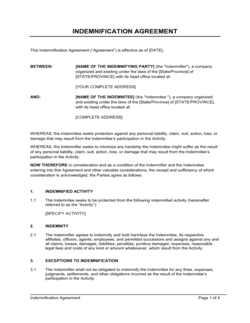
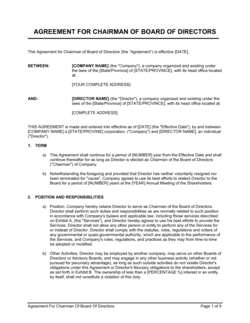
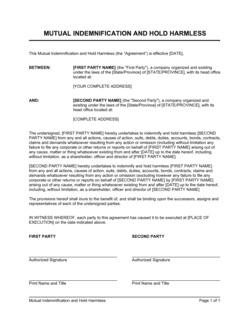
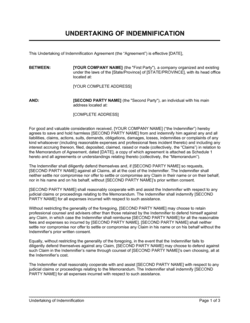
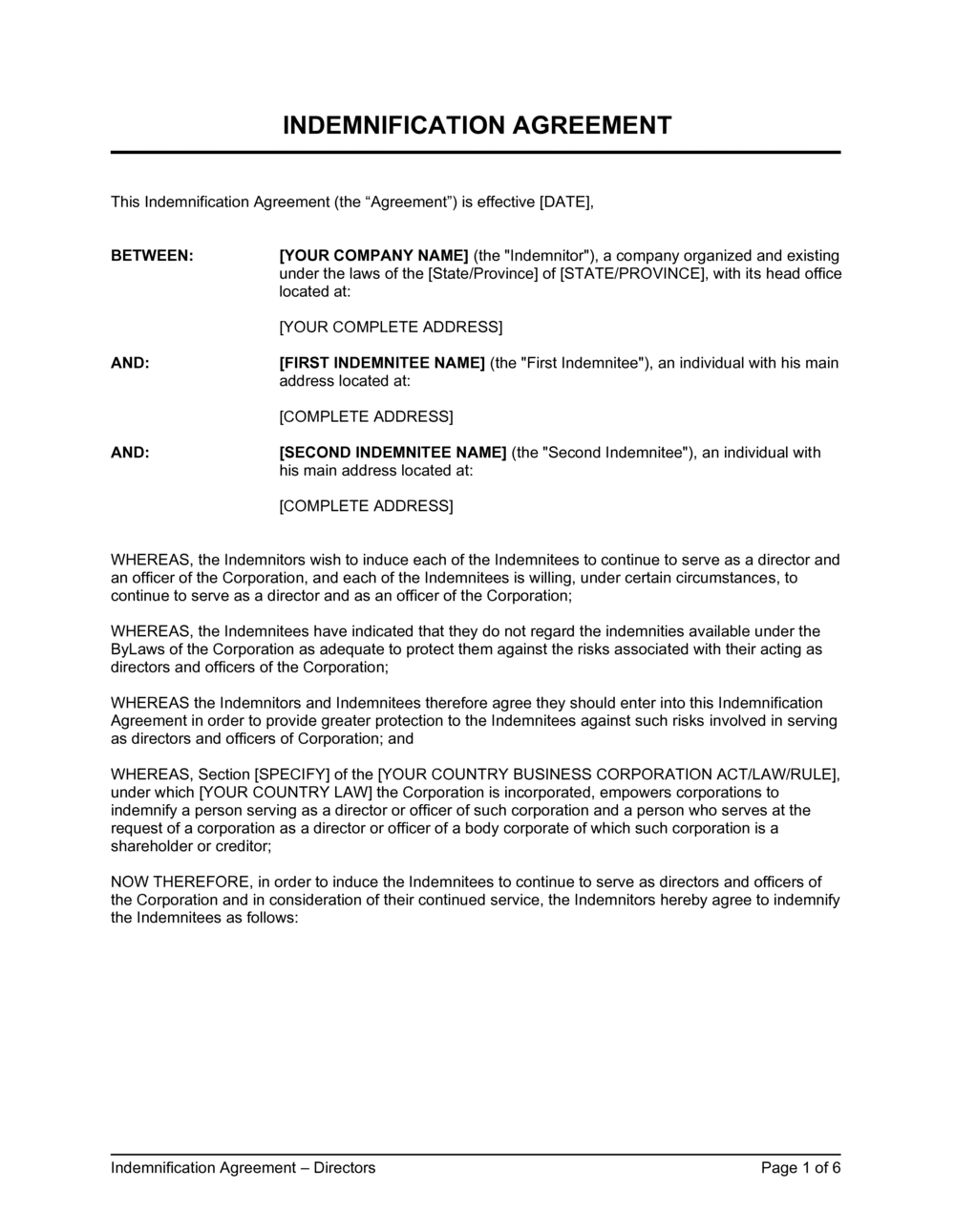
Indemnification Agreement For Directors Template

Free Word download • Edit online • Save & share with Drive • Export to PDF

6 pages25–35 min to fillDifficulty: ComplexSignature requiredLegal review recommended
Learn more ↓
FreeIndemnification Agreement For Directors Template

At a glance

What it is
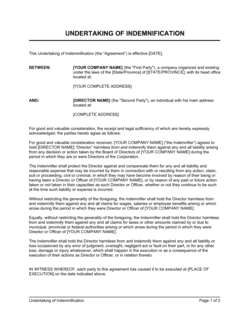
An Indemnification Agreement for Directors is a legally binding contract between a corporation and each individual board member that obligates the company to cover legal costs, judgments, settlements, and related expenses arising from the director's good-faith service on the board. This free Word download gives you a structured, enforceable starting point you can edit online and export as PDF to execute before a director joins or as a supplement to existing D&O insurance coverage.
When you need it
Use it when onboarding a new board member, when a company's D&O insurance coverage has gaps or exclusions, or when a director requests contractual assurance of indemnification before agreeing to serve. It is also standard practice for startups and growth-stage companies that cannot yet afford comprehensive D&O policies.
What's inside
Indemnification scope covering third-party claims and derivative suits, advancement of expenses pending resolution, exclusions for bad faith or fraud, D&O insurance coordination, a notice and claims procedure, and governing law and dispute resolution provisions.

What is an Indemnification Agreement for Directors?

An Indemnification Agreement for Directors is a legally binding contract between a corporation and an individual board member that obligates the company to cover the director's legal costs, judgments, settlements, fines, and related expenses arising from their good-faith service on the board. Unlike the indemnification language typically found in corporate bylaws — which a future board can amend or repeal without the director's consent — a standalone agreement creates a direct contractual right that survives board composition changes, corporate restructurings, and M&A transactions. It supplements D&O insurance by filling gaps in coverage and providing a direct enforcement mechanism when the insurer denies a claim or the policy lapses.

Why You Need This Document

Without a director indemnification agreement, qualified candidates may decline board seats — particularly in startups and growth-stage companies that cannot yet afford comprehensive D&O coverage. The personal financial exposure of board service is real: derivative suits, regulatory investigations, and shareholder class actions routinely generate legal costs exceeding $500,000 before resolution, regardless of whether the director was at fault. Bylaw indemnification provisions offer some protection, but they can be weakened by a hostile shareholder vote or rendered meaningless if the company is acquired and dissolved. A standalone agreement locks in the company's obligation, requires successor entities to honor it, and gives the director a direct legal claim if the company refuses to advance expenses. This template gives you a court-tested structure that addresses advancement of expenses, D&O insurance coordination, change of control, and enforceable exclusions — the four elements most commonly missing from bylaw-only approaches.

Which variant fits your situation?

If your situation is…Use this template
Protecting a director serving on a startup board without D&O insurance in placeIndemnification Agreement for Directors
Covering officers as well as directors under a single agreementIndemnification Agreement for Directors and Officers
Indemnifying a director serving on a nonprofit or charity boardNonprofit Director Indemnification Agreement
Providing indemnification to an advisory board member with limited governance authorityAdvisory Board Member Agreement
Documenting D&O insurance coverage as the primary protection mechanismD&O Insurance Summary and Coverage Schedule
Confirming indemnification rights already referenced in corporate bylawsCorporate Bylaws Template
Protecting a director during a specific M&A transaction or due diligence periodDirector Indemnification Side Letter

Common mistakes to avoid

❌ Relying solely on bylaw indemnification provisions

Why it matters: Bylaws can be amended by a future board or shareholder vote, potentially eliminating or weakening indemnification protections for current directors without their consent.

Fix: Execute a standalone contractual indemnification agreement that expressly states it supplements and cannot be amended without the director's written consent.

❌ Omitting the advancement of expenses obligation

Why it matters: Litigation costs arise immediately — a director who must pay out-of-pocket for years while awaiting reimbursement faces financial hardship that discourages good-faith board participation.

Fix: Include a mandatory advancement clause requiring payment within 30 days of a written request, conditioned only on a simple undertaking to repay if indemnification is ultimately denied.

❌ No change-of-control successor obligation

Why it matters: If the company is acquired and wound up, a director facing a derivative suit may have no solvent entity to enforce the indemnification agreement against.

Fix: Require any M&A transaction to include an assumption of indemnification obligations by the successor entity as a closing condition.

❌ Using overbroad exclusion language

Why it matters: Exclusions drafted with phrases like 'any violation of law' or 'any improper act' can be interpreted to exclude conduct the parties never intended to exclude, gutting the agreement's protection.

Fix: Limit exclusions to specifically enumerated categories — actual fraud, willful misconduct, adjudged liability for personal benefit — using language mirroring the applicable corporation statute.

❌ Failing to coordinate with the D&O insurance policy

Why it matters: Without a coordination clause, disputes arise over which obligation pays first, and the company may end up paying amounts that insurance would have covered.

Fix: Review the D&O policy's 'other insurance' and 'priority of payment' provisions and draft the coordination clause to match — specifying that insurance pays first and contractual indemnification fills the gap.

❌ No notice provision or overly punitive notice forfeiture

Why it matters: A missing notice procedure leaves the company with no structured process to evaluate claims; a forfeiture-on-late-notice clause is unenforceable in most jurisdictions unless actual prejudice is shown.

Fix: Include a reasonable notice window (60 days from receipt of the proceeding notice) with a cure period, and limit the remedy for late notice to demonstrated prejudice rather than automatic forfeiture.

The 10 key clauses, explained

Recitals and Purpose

In plain language: States why the agreement exists — to induce qualified individuals to serve on the board by providing protection beyond what the bylaws alone guarantee.

Sample language
WHEREAS, [COMPANY NAME] (the 'Company') desires to attract and retain highly qualified individuals to serve as directors and recognizes that adequate protection from personal liability is essential to that purpose; NOW, THEREFORE, in consideration of [DIRECTOR NAME]'s service on the Board of Directors, the parties agree as follows.

Common mistake: Omitting the recitals entirely and jumping straight to operative clauses. Recitals establish the consideration and intent that courts use to interpret ambiguous provisions later.

Indemnification for Third-Party Claims

In plain language: Obligates the company to indemnify the director against judgments, settlements, fines, and legal costs arising from third-party lawsuits related to board service.

Sample language
The Company shall indemnify [DIRECTOR NAME] to the fullest extent permitted by law against all Expenses, judgments, penalties, fines, and amounts paid in settlement actually and reasonably incurred in connection with any Proceeding brought by a third party by reason of the fact that [DIRECTOR NAME] is or was a director of the Company.

Common mistake: Limiting coverage to 'final judgments' only. Directors incur significant legal costs in proceedings that settle or are dismissed — those costs should be covered regardless of outcome.

Indemnification for Derivative Actions

In plain language: Covers the director's legal costs when shareholders sue the corporation through a derivative action and the director is named as a defendant.

Sample language
The Company shall indemnify [DIRECTOR NAME] against all Expenses incurred in connection with any Proceeding by or in the right of the Company to procure a judgment in its favor in which [DIRECTOR NAME] is a party by reason of their service as a director, provided that no indemnification shall be made if [DIRECTOR NAME] is adjudged liable to the Company unless a court determines that indemnification is nonetheless appropriate.

Common mistake: Using the same language for derivative and third-party claims. Derivative suits are subject to stricter statutory limits in most jurisdictions — courts can deny indemnification even where third-party coverage would apply.

Advancement of Expenses

In plain language: Requires the company to pay the director's legal costs in advance of a final outcome, subject to a written undertaking to repay if indemnification is ultimately denied.

Sample language
The Company shall advance all Expenses incurred by [DIRECTOR NAME] in connection with any Proceeding within [30] days of a written request, provided that [DIRECTOR NAME] delivers an undertaking to repay such amounts if it is ultimately determined that they are not entitled to indemnification under this Agreement or applicable law.

Common mistake: Setting the repayment undertaking requirement so broad that it discourages directors from requesting advances. The undertaking should be a simple written promise, not a secured obligation or bond.

Exclusions from Indemnification

In plain language: Lists the circumstances under which the company is not required to indemnify — including fraud, intentional misconduct, and acts taken in bad faith for personal benefit.

Sample language
No indemnification shall be provided under this Agreement for: (a) acts or omissions involving actual fraud or willful misconduct; (b) conduct adjudged to be in bad faith or opposed to the best interests of the Company; (c) transactions from which [DIRECTOR NAME] derived an improper personal benefit; or (d) any Proceeding initiated by [DIRECTOR NAME] without prior Board approval.

Common mistake: Drafting exclusions so broadly that they swallow the indemnification grant. Courts will interpret ambiguous exclusions against the drafter — specificity on each exclusion category is essential.

D&O Insurance Coordination

In plain language: Addresses the relationship between contractual indemnification and D&O insurance — specifying which pays first and what happens if the insurer denies coverage.

Sample language
The Company shall use commercially reasonable efforts to maintain D&O insurance in amounts and on terms reasonably satisfactory to the Board. To the extent that D&O insurance provides coverage for a claim, the Company's indemnification obligations under this Agreement are secondary and shall apply only to amounts not covered by insurance proceeds actually paid.

Common mistake: Treating contractual indemnification and D&O insurance as interchangeable. Insurance policies contain exclusions, coverage gaps, and sub-limits that the contractual agreement must address explicitly.

Notice and Claims Procedure

In plain language: Specifies how and when the director must notify the company of a claim, and the process for the company to evaluate and respond to an indemnification request.

Sample language
As a condition to receiving indemnification, [DIRECTOR NAME] shall notify the Company in writing of any Proceeding within [60] days of receiving notice thereof. The Company shall determine [DIRECTOR NAME]'s entitlement to indemnification within [90] days of receiving a completed written request accompanied by relevant documentation.

Common mistake: Setting a strict notice period with forfeiture as the penalty for late notice. Courts in many jurisdictions refuse to enforce notice-as-condition provisions unless the company demonstrates actual prejudice from the delay.

Determination of Entitlement

In plain language: Establishes who decides whether the director's conduct meets the standard required for indemnification — the board, independent legal counsel, or a court.

Sample language
Entitlement to indemnification shall be determined by: (a) a majority vote of disinterested directors, even if less than a quorum; (b) independent legal counsel selected by the Board; or (c) a court of competent jurisdiction. If no determination is made within [90] days, the Director shall be presumed entitled to indemnification.

Common mistake: Allowing the full board — including directors with a conflict of interest — to determine entitlement. Interested directors must be excluded from the determination, or the decision is vulnerable to challenge.

Change of Control

In plain language: Protects the director's indemnification rights if the company is acquired, merged, or ceases to exist after the agreement is executed.

Sample language
The rights of [DIRECTOR NAME] under this Agreement shall survive any merger, acquisition, dissolution, or reorganization of the Company and shall inure to the benefit of [DIRECTOR NAME]'s heirs, executors, and administrators. The Company shall require any successor entity to assume and honor the obligations of this Agreement as a condition of any Change of Control transaction.

Common mistake: No successor obligation — the most common gap in director indemnification agreements. If the company is acquired and wound up, a director with no change-of-control clause may have no solvent entity to enforce against.

Governing Law and Dispute Resolution

In plain language: Specifies which jurisdiction's law governs the agreement and how disputes over indemnification entitlement are resolved.

Sample language
This Agreement is governed by the laws of the State of [STATE] without regard to conflict-of-law principles. Any dispute arising under this Agreement shall be resolved by binding arbitration in [CITY, STATE] under the rules of the [AAA / JAMS], except that either party may seek injunctive relief in any court of competent jurisdiction.

Common mistake: Defaulting to litigation without specifying venue. Indemnification disputes between a director and an acquired or restructured company often involve multi-state entities — an explicit forum selection clause prevents satellite litigation over jurisdiction.

How to fill it out

  1. 1

    Identify the parties with legal precision

    Enter the company's full registered legal name, state or jurisdiction of incorporation, and the director's full legal name. If the director serves in multiple capacities (director and officer), note each role explicitly.

    💡 Cross-reference your articles of incorporation for the exact entity name — using a trade name creates an enforceability risk if the indemnifying party is contested.

  2. 2

    Define 'Expenses' and 'Proceeding' broadly

    Ensure the definitions of Expenses and Proceeding cover attorneys' fees, court costs, expert witness fees, travel costs, and any regulatory investigation — not just formal lawsuits. Use expansive language: 'any threatened, pending, or completed action, suit, arbitration, investigation, or administrative hearing.'

    💡 SEC investigations, state AG inquiries, and internal investigations can cost more than litigation and are frequently excluded from narrow definitions.

  3. 3

    Set the advancement of expenses timeline

    Insert the number of days within which the company must advance expenses after receiving a written request — 30 days is standard. Draft the undertaking to repay as a simple unsecured written promise, not a bond or collateral requirement.

    💡 A repayment undertaking that requires collateral functionally denies the advance — directors cannot typically post security while also defending themselves in costly litigation.

  4. 4

    Draft exclusions with specific, enumerated conduct

    List each exclusion as a separate lettered clause with precisely defined conduct: 'actual fraud,' 'willful misconduct,' 'adjudged liable for an improper personal benefit.' Avoid catch-all phrases like 'any illegal act.'

    💡 Vague exclusions get litigated. Every word in an exclusion clause has been tested in courts — use language that mirrors the statutory exclusions in your governing state's corporation code.

  5. 5

    Coordinate with existing D&O insurance policy

    Review your current D&O policy's coverage limits, exclusions, and priority-of-payment provisions before completing the insurance coordination clause. The agreement should address what happens when the insurer denies coverage or the policy lapses.

    💡 Ask your insurance broker for a coverage gap analysis before executing the agreement — contractual indemnification often fills gaps the D&O policy doesn't cover.

  6. 6

    Specify the entitlement determination mechanism

    Choose a determination method — disinterested directors, independent legal counsel, or court — and set a response deadline of no more than 90 days. Include a presumption of entitlement if the company fails to respond within the deadline.

    💡 Independent legal counsel is the most defensible determination method when a controlling shareholder or related party is involved in the disputed decision.

  7. 7

    Add a change-of-control successor obligation

    Insert a clause requiring any successor entity in an M&A transaction to assume the company's indemnification obligations under this agreement as a condition of closing.

    💡 In M&A due diligence, acquirers often attempt to limit or exclude director indemnification obligations — this clause gives the director contractual standing to enforce against the successor.

  8. 8

    Execute before the director's first board meeting

    Both the company (by an authorized officer who is not the director being indemnified) and the director must sign the agreement before any board activity begins. Countersignature by the corporate secretary confirms board authorization.

    💡 Store executed originals in the company's corporate minute book and provide the director with a fully executed copy — not just a signature page.

Frequently asked questions

What is a director indemnification agreement?

A director indemnification agreement is a binding contract between a corporation and an individual board member that obligates the company to cover the director's legal costs, judgments, settlements, and related expenses arising from their good-faith service on the board. It provides contractual protections that go beyond what most bylaws guarantee and cannot be unilaterally removed by a future board vote. Indemnification agreements are standard practice for public companies and increasingly common in startups and growth-stage private companies.

Why do directors need an indemnification agreement if the company has D&O insurance?

D&O insurance policies contain exclusions, coverage gaps, sublimits, and conditions that can leave directors personally exposed — particularly in cases involving related-party transactions, regulatory investigations, or claims filed after the policy lapses. A contractual indemnification agreement fills those gaps by creating a direct obligation from the company to the director that is independent of insurance coverage. Directors routinely request both as a condition of board service.

What expenses does a director indemnification agreement typically cover?

A well-drafted agreement covers attorneys' fees, court costs, expert witness fees, travel and investigation expenses, settlement amounts, and final judgments — arising from third-party lawsuits, derivative suits, regulatory investigations, and administrative proceedings. The scope depends on how broadly "Expenses" and "Proceeding" are defined in the agreement. Agreements that limit coverage to final judgments only leave directors exposed for the majority of costs incurred before resolution.

Can a company refuse to indemnify a director?

Yes — indemnification is typically denied when a director acted in bad faith, committed actual fraud or willful misconduct, or was adjudged liable for a transaction from which they derived an improper personal benefit. Most corporation statutes also prohibit indemnification for derivative suit liability unless a court determines it is appropriate. The agreement should enumerate these exclusions precisely, using language that mirrors the applicable corporation code, to avoid disputes over their scope.

What is the difference between mandatory and permissive indemnification?

Mandatory indemnification is required by statute when a director is successful on the merits — the company must pay regardless of what the agreement says. Permissive indemnification applies to situations where the director did not fully prevail; the company may indemnify if the director acted in good faith, but is not legally required to do so unless the contract says otherwise. A standalone indemnification agreement typically converts permissive indemnification into a contractual obligation, giving directors significantly stronger protection.

Does an indemnification agreement need to be approved by the board?

Yes — the company's execution of the agreement must be authorized by the board, typically by a resolution of disinterested directors. The director being indemnified should not participate in the authorizing vote. In some jurisdictions, shareholder approval may be required for agreements that exceed the indemnification permitted by the corporation statute. Corporate counsel should confirm authorization requirements under the applicable state or provincial law before execution.

What happens to a director's indemnification rights if the company is sold?

Without a change-of-control clause, a director's contractual rights may not bind the acquiring entity — particularly if the company is merged into the acquirer or dissolved after closing. A properly drafted agreement requires any successor to assume the indemnification obligations as a condition of the transaction. Directors should confirm this obligation is addressed in any M&A term sheet or merger agreement, not only in the indemnification agreement itself.

Is an indemnification agreement enforceable if it exceeds what the bylaws provide?

Generally yes — most corporation statutes expressly permit companies to provide greater indemnification by contract than the statute or bylaws require, up to the maximum permitted by law. The agreement cannot, however, indemnify conduct that the statute categorically prohibits — such as liability for securities law violations in some jurisdictions. Consider consulting a corporate attorney to confirm the agreement's scope is within the statutory maximum for your jurisdiction.

How does advancement of expenses work in practice?

When a director is named in a lawsuit or investigation, they submit a written request for advancement along with an undertaking to repay if indemnification is ultimately denied. The company must then pay the director's legal costs — typically within 30 days — as they are incurred throughout the proceeding. If the director is ultimately found not entitled to indemnification, they must repay the advanced amounts. The undertaking is generally an unsecured promise; requiring security would defeat the purpose of advancement.

How this compares to alternatives

vs D&O Insurance Policy

D&O insurance is a third-party policy that reimburses directors and the company for covered wrongful act claims up to the policy limit, subject to exclusions and deductibles. A director indemnification agreement is a direct contractual obligation from the company to the director that fills coverage gaps, survives policy lapses, and cannot be unilaterally canceled. Most experienced directors require both.

vs Corporate Bylaws Indemnification Provision

Bylaw indemnification provisions can be amended or repealed by a future board or shareholder vote without the director's consent. A standalone indemnification agreement is a binding contract that requires the director's consent to modify. For any director who serves beyond the tenure of the current board, a separate agreement is materially stronger protection.

vs Advisory Board Member Agreement

An advisory board member agreement covers a person who provides informal guidance without formal governance authority or fiduciary duties — a very different legal exposure profile. A director indemnification agreement covers formal board members with voting power, fiduciary duties, and real legal liability. Advisors rarely need indemnification coverage of the same scope as formal directors.

vs Indemnification Agreement for Officers

An officer indemnification agreement covers executive officers — CEO, CFO, General Counsel — who face liability for operational decisions rather than board-level governance decisions. Directors and officers face overlapping but distinct claims; many companies execute both agreements for individuals who hold dual director-officer roles, with each agreement tailored to the respective capacity.

Industry-specific considerations

Technology / SaaS

Startup boards routinely use director indemnification agreements as a substitute for D&O insurance in early stages, and to protect investor-appointed board members from exposure related to financing decisions.

Financial Services

Directors in banking and fintech face heightened regulatory exposure from FINRA, SEC, and FDIC proceedings — indemnification agreements must explicitly address regulatory investigation costs and civil money penalties where permitted.

Healthcare

Healthcare company boards face FDA enforcement actions, HIPAA-related suits, and CMS audit exposure — indemnification agreements should extend to administrative proceedings and include coverage for compliance-related investigations.

Private Equity and Venture Capital

PE and VC sponsors routinely require portfolio companies to execute director indemnification agreements before their representatives join the board, with explicit change-of-control provisions to survive the eventual exit.

Jurisdictional notes

United States

Director indemnification is governed primarily by state corporation law. Delaware General Corporation Law §145 is the most widely referenced statute and permits broad indemnification by contract up to the statutory maximum. California Corporations Code §317 imposes stricter limits — particularly for derivative suit liability. Several states prohibit indemnification of criminal fines or securities law penalties regardless of contract language. Companies should ensure the agreement references the specific statute of the state of incorporation.

Canada

The Canada Business Corporations Act (CBCA) and provincial corporate statutes (including Ontario's OBCA) permit indemnification of directors acting honestly and in good faith with a view to the corporation's best interests. Mandatory indemnification applies when a director is substantially successful on the merits. Quebec's Civil Code imposes distinct standards, and federally incorporated companies must comply with CBCA provisions even if their agreement is more permissive. Court approval may be required for certain derivative proceeding indemnification.

United Kingdom

The Companies Act 2006 (sections 232–238) restricts a company's ability to exempt directors from liability but permits qualifying third-party indemnity provisions (QTPIs) that cover third-party claims, legal costs, and regulatory proceedings. Indemnification for fines imposed by courts, regulatory penalties, and defense costs in unsuccessful criminal proceedings is prohibited. Directors of UK companies should ensure the agreement qualifies as a QTPI and is disclosed in the annual report under CA 2006 §236.

European Union

EU member states apply national company law to director indemnification — there is no unified EU standard. Germany, France, and the Netherlands each have distinct rules on permissible indemnification scope, particularly for regulatory fines and antitrust penalties. Many EU jurisdictions require that indemnification be authorized by shareholders, not just the board. Directors serving on EU-regulated entity boards (banking, insurance, investment firms) face additional restrictions under sector-specific directives, including MiFID II and the Banking Recovery and Resolution Directive.

Template vs lawyer — what fits your deal?

PathBest forCostTime
Use the templateEarly-stage startups onboarding their first independent directors with no existing D&O insuranceFree30 minutes
Template + legal reviewGrowth-stage companies adding investor-appointed board members, or any company with an existing D&O policy requiring coordination$500–$1,5002–5 days
Custom draftedPublic companies, regulated industries, or M&A scenarios where director liability exposure is material and complex$2,000–$8,000+1–3 weeks

Glossary

Indemnification
A contractual obligation by one party to compensate another for specified losses, legal costs, or liabilities they incur.
Advancement of Expenses
The company's obligation to pay a director's legal costs as they are incurred during a proceeding, before the final outcome is determined.
D&O Insurance
Directors and Officers liability insurance — a policy that reimburses directors and the company for losses arising from wrongful acts claims, typically purchased alongside a contractual indemnification agreement.
Derivative Suit
A lawsuit brought by shareholders on behalf of the corporation against directors or officers, alleging harm to the company itself rather than to individual shareholders.
Good Faith
Acting honestly and with a reasonable belief that the action taken was in, or not opposed to, the best interests of the corporation — the standard typically required to qualify for indemnification.
Proceeding
Any threatened, pending, or completed action, suit, arbitration, investigation, or administrative hearing that may give rise to an indemnification claim.
Undertaking to Repay
A written promise by the director to repay advanced expenses if it is ultimately determined they are not entitled to indemnification.
Mandatory vs. Permissive Indemnification
Mandatory indemnification is required by law or contract when a director prevails; permissive indemnification is discretionary and depends on a good-faith determination by the board or a court.
Change of Control Provision
A clause that preserves the director's indemnification rights even if the company is acquired, merged, or dissolved after the agreement is executed.
Subrogation
The company's right to step into the director's shoes and pursue recovery from third parties — such as an insurer — after paying out an indemnification claim.
Corporate Opportunity Doctrine
A fiduciary rule requiring directors to offer the corporation any business opportunity that falls within its line of business before pursuing it personally — a common source of indemnification claims.

Part of your Business Operating System

This document is one of 3,000+ business & legal templates included in Business in a Box.

  • Fill-in-the-blanks — ready in minutes
  • 100% customizable Word document
  • Compatible with all office suites
  • Export to PDF and share electronically

Create your document in 3 simple steps.

From template to signed document — all inside one Business Operating System.
1
Download or open template

Access over 3,000+ business and legal templates for any business task, project or initiative.

2
Edit and fill in the blanks with AI

Customize your ready-made business document template and save it in the cloud.

3
Save, Share, Send, Sign

Share your files and folders with your team. Create a space of seamless collaboration.

Save time, save money, and create top-quality documents.

★★★★★

"Fantastic value! I'm not sure how I'd do without it. It's worth its weight in gold and paid back for itself many times."

Managing Director · Mall Farm
Robert Whalley
Managing Director, Mall Farm Proprietary Limited
★★★★★

"I have been using Business in a Box for years. It has been the most useful source of templates I have encountered. I recommend it to anyone."

Business Owner · 4+ years
Dr Michael John Freestone
Business Owner
★★★★★

"It has been a life saver so many times I have lost count. Business in a Box has saved me so much time and as you know, time is money."

Owner · Upstate Web
David G. Moore Jr.
Owner, Upstate Web

Run your business with a system — not scattered tools

Stop downloading documents. Start operating with clarity. Business in a Box gives you the Business Operating System used by over 250,000 companies worldwide to structure, run, and grow their business.

Start free · No credit card required