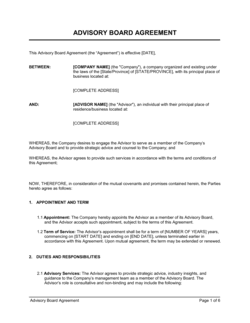
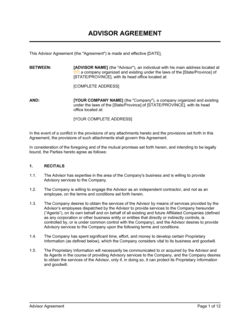
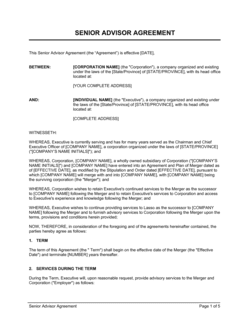
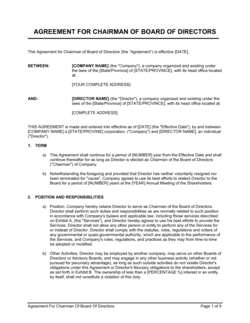
Board Advisor Agreement Template

Free Word download β€’ Edit online β€’ Save & share with Drive β€’ Export to PDF

3 pagesβ€’25–30 min to fillβ€’Difficulty: Complexβ€’Signature requiredβ€’Legal review recommended
Learn more ↓
FreeBoard Advisor Agreement Template

At a glance

What it is
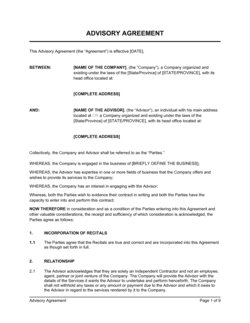
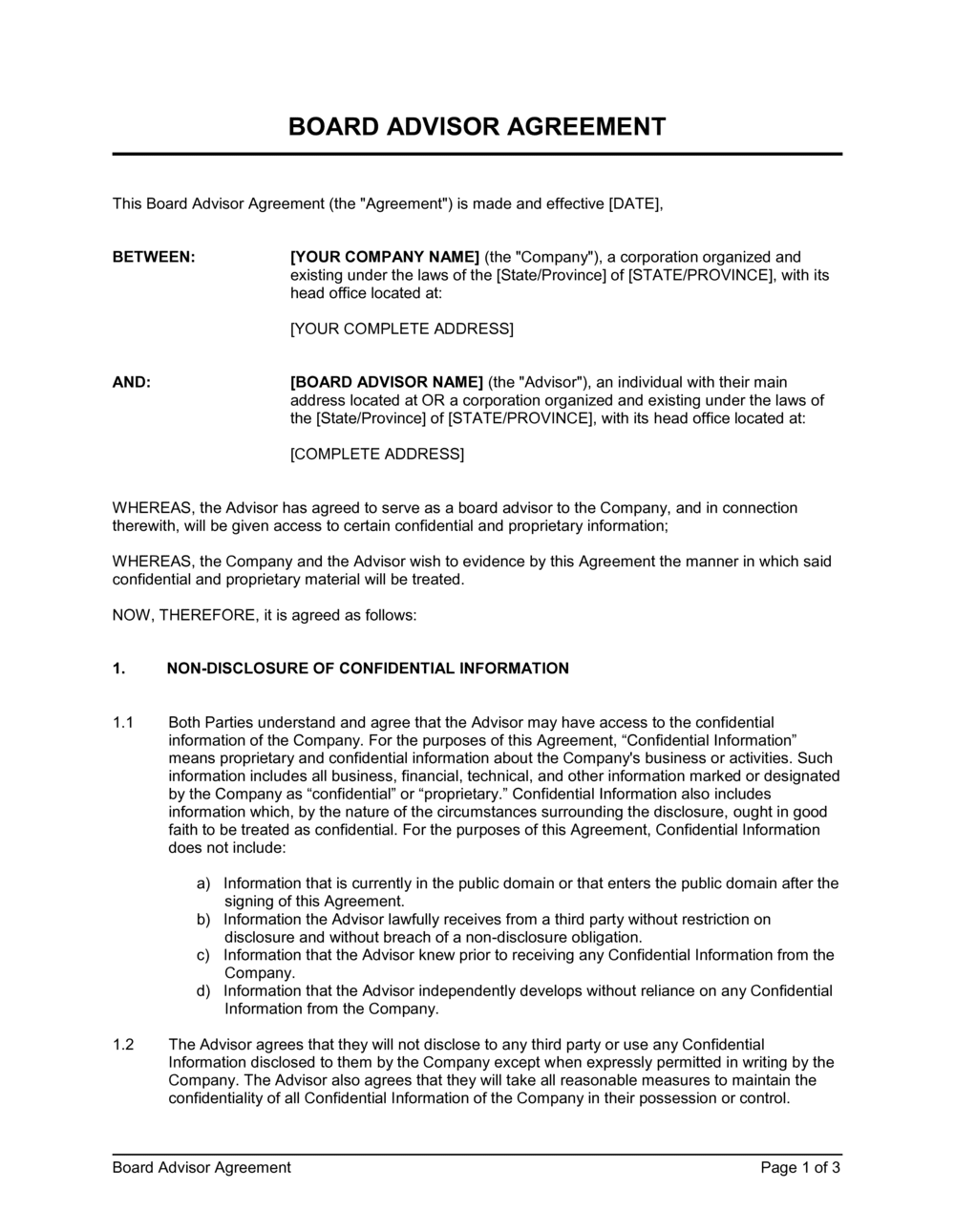
A Board Advisor Agreement is a binding contract between a company and an individual advisor who provides strategic guidance, introductions, or domain expertise in exchange for equity, cash compensation, or both. This free Word download gives you a structured, attorney-reviewed starting point covering scope of services, compensation, confidentiality, IP assignment, and termination β€” ready to edit online and export as PDF for countersignature.
When you need it
Use it before a new advisor attends their first meeting, makes any introduction, or receives any equity grant. Verbal advisor arrangements regularly end in disputes over vesting schedules, IP ownership, and confidentiality obligations β€” a signed agreement prevents all three.
What's inside
Advisor duties and time commitment, compensation structure with equity vesting schedule, confidentiality and non-disclosure obligations, IP assignment, conflict-of-interest disclosure, term and termination conditions, and governing law with dispute resolution.

What is a Board Advisor Agreement?

A Board Advisor Agreement is a legally binding contract between a company and an individual advisor who provides strategic guidance, introductions, or domain expertise in a non-employee, non-director capacity. Unlike a consulting agreement β€” which governs deliverables and fees β€” an advisor agreement defines a relationship: the advisor's expected time commitment, their compensation (almost always an equity option grant with a vesting schedule), confidentiality obligations, IP assignment, conflict-of-interest disclosures, and the conditions under which either party can exit cleanly. It is the foundational document for any advisory board, protecting both the company's sensitive information and the advisor's expectation of earning their equity over time.

Why You Need This Document

Operating without a signed board advisor agreement is one of the most common and costly oversights at early-stage companies. Without it, there is no enforceable confidentiality obligation β€” an advisor who leaves can share your product roadmap or customer pipeline with a competitor. There is no IP assignment β€” a framework, sales methodology, or technical concept the advisor develops in connection with your business may belong to them personally. There is no defined vesting schedule β€” a dispute over whether an advisor earned their full grant after six months of inconsistent participation can cloud your cap table and complicate due diligence at your next funding round. Investors reviewing your Series A or acquisition target will request documentation of every equity grant; an undocumented advisor relationship delays or derails that process. This template gives you a professional, attorney-reviewed starting point that closes all of those gaps in under 30 minutes.

Which variant fits your situation?

If your situation is…Use this template
Bringing on an unpaid advisor compensated solely with equityBoard Advisor Agreement (Equity Only)
Engaging a paid consultant who also joins an advisory boardConsulting Agreement with Advisory Role
Appointing a formal board director with governance responsibilitiesBoard of Directors Agreement
Retaining a subject-matter expert for a single project with no equityIndependent Contractor Agreement
Establishing a full advisory board charter with multiple advisorsAdvisory Board Charter
Onboarding an advisor with access to sensitive technical IPNon-Disclosure Agreement
Compensating an advisor with a cash retainer instead of equityRetainer Agreement

Common mistakes to avoid

❌ Issuing equity before a current 409A valuation

Why it matters: Options granted below fair market value are treated as deferred compensation under IRC Section 409A, triggering immediate income tax and a 20% excise tax penalty for the advisor in addition to company reporting obligations.

Fix: Commission or update a 409A valuation before issuing any option grant. Most valuation firms turn around an advisory board grant in 5–10 business days.

❌ Leaving the time commitment undefined

Why it matters: An advisor with no stated minimum commitment can remain on the advisory board indefinitely without contributing, while the company has no contractual basis to terminate vesting for non-performance.

Fix: Include a specific monthly or annual hour estimate and a minimum meeting attendance requirement, with a provision that persistent non-performance constitutes grounds for termination.

❌ No IP assignment clause

Why it matters: An advisor who develops a sales methodology, technical concept, or strategic framework without an assignment clause may retain personal ownership β€” creating an ownership dispute that surfaces at due diligence.

Fix: Include a broad, present-tense IP assignment covering all work product created in connection with the advisory services, regardless of whether it was created on company equipment or time.

❌ Silent on unvested equity treatment at termination

Why it matters: Without explicit language, a departing advisor may claim the entire grant vests on termination or that unvested shares constitute an accrued obligation β€” disputes that are expensive to resolve and can cloud a cap table.

Fix: State explicitly that all unvested options are forfeited immediately on the termination date, and that vested options must be exercised within a defined window (typically 90 days).

❌ Overly broad exclusivity restricting experienced advisors

Why it matters: Prohibiting an advisor from advising any company in a loosely defined industry will cause experienced advisors who serve multiple portfolios to decline the role or breach the agreement unknowingly.

Fix: Limit the conflict restriction to direct competitors β€” companies offering the same product to the same customer segment β€” and require disclosure rather than prohibition for adjacent industries.

❌ Signing after the advisor has already participated

Why it matters: An advisor who attends meetings, makes introductions, or accesses confidential information before signing the agreement has given no new consideration for the restrictive covenants signed after the fact β€” potentially voiding the IP assignment and confidentiality clauses.

Fix: Execute the agreement before the advisor's first meeting or introduction. If circumstances require a later signature, document a specific new benefit provided as fresh consideration at the time of signing.

The 10 key clauses, explained

Parties, recitals, and effective date

In plain language: Identifies the company and the advisor as legal parties, states the purpose of the relationship, and records the date the agreement takes effect.

Sample language
This Board Advisor Agreement ('Agreement') is entered into as of [DATE] ('Effective Date') by and between [COMPANY LEGAL NAME], a [STATE] [ENTITY TYPE] ('Company'), and [ADVISOR FULL NAME] ('Advisor').

Common mistake: Using a trade name instead of the registered legal entity for the company β€” if the entity name doesn't match cap table records, equity grants may be attributed to the wrong legal person.

Scope of services and time commitment

In plain language: Defines what the advisor is expected to do β€” attending meetings, making introductions, reviewing materials β€” and how many hours per month they are committing.

Sample language
Advisor shall provide advisory services to the Company as reasonably requested, including attending up to [NUMBER] advisory board meetings per year and committing approximately [X] hours per month to Company-related matters.

Common mistake: Leaving the time commitment undefined. Without a stated minimum, an advisor can claim the role without contributing meaningfully, while the company cannot invoke the time-commitment clause to justify early vesting termination.

Equity compensation and vesting schedule

In plain language: States the number of shares or options granted, the exercise price, and the vesting schedule β€” including the cliff period and the treatment of unvested equity on termination.

Sample language
The Company shall grant Advisor an option to purchase [NUMBER] shares of Company common stock at an exercise price of $[PRICE] per share, vesting over [24] months with a [6]-month cliff, subject to the terms of the Company's [PLAN NAME] Equity Incentive Plan.

Common mistake: Issuing equity before the 409A valuation is current. In the US, options granted below fair market value trigger immediate ordinary income tax and a 20% excise tax penalty under IRC Section 409A.

Cash compensation (if any)

In plain language: Records any cash retainer, per-meeting fee, or expense reimbursement the advisor will receive in addition to or instead of equity.

Sample language
In addition to the equity grant, the Company shall pay Advisor a monthly retainer of $[AMOUNT], payable on the [DAY] of each month, together with reimbursement of pre-approved expenses within [30] days of submission.

Common mistake: Omitting an expense reimbursement cap. Advisors who travel to conferences or client meetings can accumulate significant costs β€” a monthly or annual cap and a pre-approval requirement prevent surprises.

Confidentiality

In plain language: Prohibits the advisor from disclosing or using the company's confidential information β€” strategy, financials, technology, customer data β€” during and after the engagement.

Sample language
Advisor agrees to hold all Confidential Information of the Company in strict confidence and not to disclose or use such information for any purpose other than fulfilling the advisory services, both during and for [3] years after the termination of this Agreement.

Common mistake: Not defining 'Confidential Information' and relying on a blanket 'everything is confidential' approach. Courts apply a reasonableness test β€” an overbroad definition risks making the entire confidentiality clause unenforceable.

Intellectual property assignment

In plain language: Assigns to the company all work product, ideas, introductions, and developments the advisor creates in connection with the advisory role.

Sample language
Advisor agrees that all work product, inventions, and developments conceived or created by Advisor in connection with the advisory services are the sole property of the Company and are hereby irrevocably assigned to the Company.

Common mistake: No IP assignment clause at all. An advisor who develops a product concept, sales framework, or technical architecture without an assignment clause may retain personal ownership β€” creating a dispute at acquisition or funding.

Conflict of interest and exclusivity

In plain language: Requires the advisor to disclose any existing or future relationships with competitors and, if applicable, restricts them from advising competing companies during the engagement.

Sample language
Advisor represents that Advisor has disclosed all existing material business relationships, including advisory roles, directorships, and equity positions. Advisor shall promptly disclose any future relationship that reasonably constitutes a conflict of interest with the Company's business.

Common mistake: Including a broad exclusivity clause that prevents the advisor from advising any company in a broadly defined space. Most experienced advisors serve multiple companies β€” excessive restrictions will cause them to decline or breach the agreement.

Term and termination

In plain language: States the initial length of the engagement β€” typically one to two years β€” and allows either party to terminate with written notice, with provisions for what happens to vested and unvested equity on exit.

Sample language
This Agreement shall commence on the Effective Date and continue for [12] months unless earlier terminated. Either party may terminate this Agreement upon [30] days' written notice. Upon termination, vested options shall remain exercisable for [90] days; all unvested options shall be forfeited immediately.

Common mistake: Not specifying the fate of unvested equity on termination. If the agreement is silent, the advisor may claim entitlement to accelerated vesting or argue that equity is a deferred compensation obligation β€” creating a costly dispute.

Independent contractor status

In plain language: Confirms the advisor is not an employee, agent, or partner of the company, and is not entitled to employee benefits, workers' compensation, or tax withholding.

Sample language
Advisor is an independent contractor and not an employee, partner, or agent of the Company. The Company shall not withhold taxes on behalf of Advisor. Advisor is solely responsible for all applicable taxes on compensation received under this Agreement.

Common mistake: Treating the advisor as an employee in practice β€” reimbursing daily expenses, assigning an email address, or integrating them into internal systems β€” while calling them a contractor. The substance of the relationship, not the label, determines tax and employment classification.

Governing law and dispute resolution

In plain language: Specifies which jurisdiction's law governs the agreement and how disputes are resolved β€” arbitration, mediation, or litigation.

Sample language
This Agreement shall be governed by the laws of the State of [STATE], without regard to conflict of law principles. Any dispute arising under this Agreement shall be resolved by binding arbitration administered by [AAA / JAMS] in [CITY], except that either party may seek injunctive relief in any court of competent jurisdiction.

Common mistake: Choosing governing law in a state with no connection to either party. Delaware is a common choice for incorporated companies but may be inconvenient for dispute resolution if neither the company nor the advisor is located there.

How to fill it out

  1. 1

    Enter the legal entity name and the advisor's full name

    Use the company's exact registered corporate name β€” not a brand or DBA β€” and the advisor's legal name as it appears on government-issued ID. Record the effective date.

    πŸ’‘ Cross-reference your state or provincial corporate registry to confirm the exact entity name before execution β€” mismatches create cap table and tax complications.

  2. 2

    Define the scope of services and monthly time commitment

    List the specific advisory activities expected β€” meeting attendance, introductions, product feedback, investor introductions β€” and state a monthly hour estimate. Two to four hours per month is typical for most advisory roles.

    πŸ’‘ A defined time commitment gives you grounds to terminate for non-performance before the cliff if the advisor goes dark after signing.

  3. 3

    Set the equity grant details

    Enter the number of shares or options, the exercise price based on your most recent 409A valuation, the vesting schedule (commonly 2 years with a 6-month cliff), and the name of the equity incentive plan governing the grant.

    πŸ’‘ Issue the option grant on the same day as the agreement β€” a gap between the agreement date and the grant date can create a mismatch in vesting start dates that requires a plan amendment to fix.

  4. 4

    Complete the cash compensation block, if applicable

    If paying a cash retainer or per-meeting fee, enter the amount, payment frequency, and any expense reimbursement cap. If the advisor is equity-only, mark this section as 'None' rather than leaving it blank.

    πŸ’‘ State the currency explicitly for advisors located outside your home jurisdiction to avoid foreign exchange disputes.

  5. 5

    Tailor the confidentiality duration and scope

    Set the post-termination confidentiality period β€” typically 2 to 3 years for most roles. Define 'Confidential Information' to include financials, customer data, product roadmaps, and proprietary technology without being so broad as to cover public knowledge.

    πŸ’‘ Exclude from the definition anything the advisor can demonstrate they knew independently before the engagement β€” this keeps the clause enforceable and avoids unnecessary disputes.

  6. 6

    Add conflict-of-interest disclosures

    Have the advisor list all current advisory roles, directorships, and equity positions in companies that could be considered competitors or in adjacent markets. Attach as a schedule or exhibit to the agreement.

    πŸ’‘ Request an updated disclosure annually β€” competitive landscapes change, and a new advisory role the advisor picks up in Year 2 may create a material conflict your agreement should address.

  7. 7

    Set the term, termination notice, and post-termination equity treatment

    State the initial term (12 or 24 months is standard), the written notice period for termination (30 days is common), the post-termination option exercise window (90 days is typical), and whether any acceleration applies on a change of control.

    πŸ’‘ If the company is pre-Series A, consider including single-trigger acceleration on change of control for advisors β€” it makes the role more attractive without significant dilution cost.

  8. 8

    Sign before the advisor attends any meeting or receives any equity

    Both parties must execute the agreement before the advisor participates in any company activity. Countersignature after any meeting, introduction, or equity issuance weakens the enforceability of the IP assignment and confidentiality clauses.

    πŸ’‘ Use a digital signature platform to timestamp execution and store the fully countersigned copy with your corporate records alongside the corresponding equity plan documents.

Frequently asked questions

What is a board advisor agreement?

A board advisor agreement is a binding contract between a company and an individual who provides strategic guidance, introductions, or domain expertise in a non-employee, non-director advisory capacity. It defines the advisor's duties and time commitment, their compensation β€” typically an equity grant with a vesting schedule β€” confidentiality obligations, IP assignment, and termination conditions. It protects both the company and the advisor by recording agreed terms before any work begins.

How much equity should an advisor receive?

Typical advisory equity ranges from 0.1% to 0.5% of fully diluted shares for early-stage companies, depending on the advisor's seniority, network value, and expected time commitment. The FAST (Founder/Advisor Standard Template) framework benchmarks advisory grants at 0.25% for a standard role and 0.5% for a strategic role at the idea or seed stage, declining as the company grows. Equity is almost always delivered as options, not restricted stock, to avoid immediate tax events for the advisor.

What vesting schedule is standard for advisors?

The most common advisor vesting schedule is 2 years with a 6-month cliff, meaning no equity vests in the first 6 months and the remaining balance vests monthly over the following 18 months. Some companies use a 1-year monthly vesting schedule with no cliff for shorter-term engagements. A vesting schedule aligned to the advisory term incentivizes continued contribution and gives the company a clean exit if the relationship ends early.

Is a board advisor agreement legally required?

No law requires a written board advisor agreement, but operating without one exposes the company to significant risk. Without a signed agreement, there is no enforceable confidentiality obligation, no IP assignment, no defined vesting schedule, and no clear basis for terminating the relationship. Investors conducting due diligence on a funding round will typically require documentation of all equity grants β€” including advisory grants β€” before closing.

What is the difference between a board advisor and a board director?

A board director holds a formal governance seat, has fiduciary duties to the company and its shareholders, votes on major decisions, and carries personal liability for board decisions. A board advisor has no governance authority, owes no fiduciary duty, and cannot vote on company matters. Advisors provide guidance informally; directors govern formally. Most early-stage companies build an advisory board of 3–6 advisors before formalizing a board of directors.

Can an advisor work for a competitor?

Whether an advisor can advise competing companies depends entirely on what the agreement says. Blanket exclusivity provisions β€” prohibiting any work in a broadly defined industry β€” are often impractical and will deter experienced advisors who serve multiple portfolios. Best practice is to require disclosure of current and future advisory relationships and prohibit work only for direct competitors offering the same product to the same customer segment, while permitting adjacent or complementary companies with disclosure.

What happens to advisor equity when the company is acquired?

The treatment of unvested advisor equity on acquisition depends on what the agreement says and the terms of the equity plan. Many advisor agreements include a single-trigger acceleration clause β€” all unvested equity vests immediately upon a change of control. Others require the acquirer to continue the vesting schedule or provide cash settlement. Without an explicit acceleration provision, the acquirer can typically cancel unvested advisor options without compensation.

Do board advisors pay taxes on their equity?

Tax treatment depends on the form of the equity grant and the jurisdiction. In the US, stock options granted at fair market value (as confirmed by a 409A valuation) are not taxable on grant or vesting β€” the advisor owes income tax only when they exercise and sell. Options granted below fair market value trigger ordinary income tax and a 20% penalty under IRC Section 409A. Advisors should consult a tax advisor before exercising options or receiving restricted stock grants.

How long should an advisory engagement last?

Most board advisor agreements run 1 to 2 years, with the option to renew by mutual agreement. A 12-month initial term with automatic renewal provisions is common for early-stage companies that want flexibility. The term should align with the vesting schedule β€” an advisor on a 2-year vesting schedule should have at least a 2-year initial term, otherwise the vesting schedule and the contract term create conflicting incentives.

How this compares to alternatives

vs Independent Contractor Agreement

An independent contractor agreement governs a project-based or ongoing service relationship where the individual delivers defined work product for a fee. A board advisor agreement is relationship-based β€” the advisor provides guidance, introductions, and judgment rather than deliverables. Advisors are typically compensated with equity; contractors are compensated with cash. Misclassifying a heavily engaged advisor as an independent contractor can create employment law exposure.

vs Consulting Agreement

A consulting agreement defines a scope of work, deliverables, and a fee schedule for professional services. A board advisor agreement defines a strategic relationship with a time commitment and equity compensation but no specific deliverables. Use a consulting agreement when you need defined outputs; use an advisor agreement when you need ongoing strategic access and introductions. Many experienced advisors hold both simultaneously.

vs Non-Disclosure Agreement

An NDA covers confidentiality obligations only β€” it does not address equity, scope of work, IP assignment, or termination. An advisor agreement includes confidentiality as one of several clauses. Use a standalone NDA for initial conversations before an advisory relationship is formalized; replace it with the full advisor agreement once terms are agreed. The advisor agreement supersedes the NDA for all matters within its scope.

vs Board of Directors Agreement

A board of directors agreement appoints a formal governance director with voting rights, fiduciary duties, and potential personal liability for board decisions. A board advisor agreement creates a non-governing advisory role with no voting rights and no fiduciary obligations. Directors are typically compensated with cash retainers and option grants sized significantly larger than advisor grants, reflecting their governance responsibilities and liability exposure.

Industry-specific considerations

Technology / SaaS

Technical advisors with domain expertise in AI, cybersecurity, or developer tooling are compensated with option grants from the company's equity incentive plan, subject to a 409A valuation as a prerequisite.

Healthcare / MedTech

Physician and regulatory advisors often require enhanced confidentiality covering patient data and clinical trial information, along with conflict-of-interest disclosures addressing hospital affiliations and research funding.

Financial Services / Fintech

Advisor agreements in regulated financial services must address compliance obligations, FINRA or FCA registration implications, and restrictions on sharing non-public market or customer data.

Consumer Goods / Retail

Advisors with retailer relationships or distribution network access are frequently compensated with a combination of cash retainer and equity, with non-solicitation provisions protecting key retail partnerships.

Jurisdictional notes

United States

Equity option grants must be priced at fair market value as determined by a current 409A valuation β€” grants below FMV trigger IRC Section 409A penalties for the advisor. The independent contractor classification should be consistent with IRS and state labor agency standards; California's AB5 test is particularly strict. Non-compete provisions in advisor agreements are unenforceable in California and several other states.

Canada

Canadian securities law requires that equity grants to advisors comply with applicable prospectus exemptions under National Instrument 45-106, most commonly the 'accredited investor' or 'employee, director, officer or consultant' exemptions. Quebec advisors require a French-language agreement or a French translation for provincially regulated matters. Non-solicitation provisions are enforceable if reasonable in scope and duration.

United Kingdom

Equity grants to UK-based advisors through an Enterprise Management Incentive (EMI) scheme may qualify for favorable capital gains tax treatment if structured correctly, but EMI eligibility is restricted to trading companies below a Β£30M gross assets threshold. Restrictive covenants in advisor agreements β€” including confidentiality and non-solicitation β€” are enforceable if reasonable and supported by adequate consideration.

European Union

GDPR applies when a company shares personal data of customers, employees, or third parties with an EU-based advisor β€” the confidentiality clause should reference applicable data protection obligations. Equity grant rules vary significantly by member state; France, Germany, and the Netherlands each have distinct tax treatments for options. Non-compete and non-solicitation enforceability also varies, with France requiring financial compensation for post-termination restrictions.

Template vs lawyer β€” what fits your deal?

PathBest forCostTime
Use the templateEarly-stage companies onboarding standard advisors with equity grants under $50K in valueFree30 minutes
Template + legal reviewAdvisors with access to sensitive IP, advisors in regulated industries, or grants exceeding $50K in value$300–$8002–5 days
Custom draftedHigh-profile advisors with complex equity arrangements, acceleration provisions, or multi-jurisdiction enforceability requirements$1,500–$4,000+1–2 weeks

Glossary

Advisor
An individual engaged by a company to provide strategic guidance, introductions, or expertise in a non-employee, non-director capacity.
Vesting Schedule
The timeline over which an advisor earns their equity grant β€” commonly 2 years with a 6-month cliff for advisory roles.
Cliff
The minimum period an advisor must serve before any equity vests β€” if they leave before the cliff, no shares are earned.
Option Grant
The right to purchase company shares at a fixed exercise price, typically the fair market value on the grant date, used to compensate advisors without an immediate cash outlay.
IP Assignment
A clause transferring ownership of any work product, introductions, or developments the advisor creates in connection with their role to the company.
Conflict of Interest
A situation in which the advisor's personal interests or relationships with third parties β€” including competitors β€” could compromise their objectivity.
Confidential Information
Non-public information the company shares with the advisor β€” including financials, product roadmaps, and customer data β€” that the advisor is prohibited from disclosing.
409A Valuation
An independent appraisal of a private company's common stock fair market value, required by the US IRS to set a defensible exercise price for option grants.
Acceleration
A provision that causes unvested equity to vest immediately upon a defined trigger β€” typically a change of control or acquisition of the company.
At-Will Termination
A contract provision allowing either party to end the advisory relationship at any time, with or without cause, upon written notice.
SAFE
Simple Agreement for Future Equity β€” an instrument sometimes used to compensate advisors in very early-stage companies before a priced equity round.

Part of your Business Operating System

This document is one of 3,000+ business & legal templates included in Business in a Box.

  • Fill-in-the-blanks β€” ready in minutes
  • 100% customizable Word document
  • Compatible with all office suites
  • Export to PDF and share electronically

Create your document in 3 simple steps.

From template to signed document β€” all inside one Business Operating System.
1
Download or open template

Access over 3,000+ business and legal templates for any business task, project or initiative.

2
Edit and fill in the blanks with AI

Customize your ready-made business document template and save it in the cloud.

3
Save, Share, Send, Sign

Share your files and folders with your team. Create a space of seamless collaboration.

Save time, save money, and create top-quality documents.

β˜…β˜…β˜…β˜…β˜…

"Fantastic value! I'm not sure how I'd do without it. It's worth its weight in gold and paid back for itself many times."

Managing Director Β· Mall Farm
Robert Whalley
Managing Director, Mall Farm Proprietary Limited
β˜…β˜…β˜…β˜…β˜…

"I have been using Business in a Box for years. It has been the most useful source of templates I have encountered. I recommend it to anyone."

Business Owner Β· 4+ years
Dr Michael John Freestone
Business Owner
β˜…β˜…β˜…β˜…β˜…

"It has been a life saver so many times I have lost count. Business in a Box has saved me so much time and as you know, time is money."

Owner Β· Upstate Web
David G. Moore Jr.
Owner, Upstate Web

Run your business with a system β€” not scattered tools

Stop downloading documents. Start operating with clarity. Business in a Box gives you the Business Operating System used by over 250,000 companies worldwide to structure, run, and grow their business.

Start freeΒ Β·Β No credit card required