Board Resolution Approving Unanimous Shareholders Agreement Template

Free Word download • Edit online • Save & share with Drive • Export to PDF

1 page20–30 min to fillDifficulty: StandardSignature requiredLegal review recommended
Learn more ↓
FreeBoard Resolution Approving Unanimous Shareholders Agreement Template

At a glance

What it is
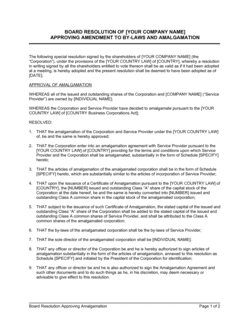
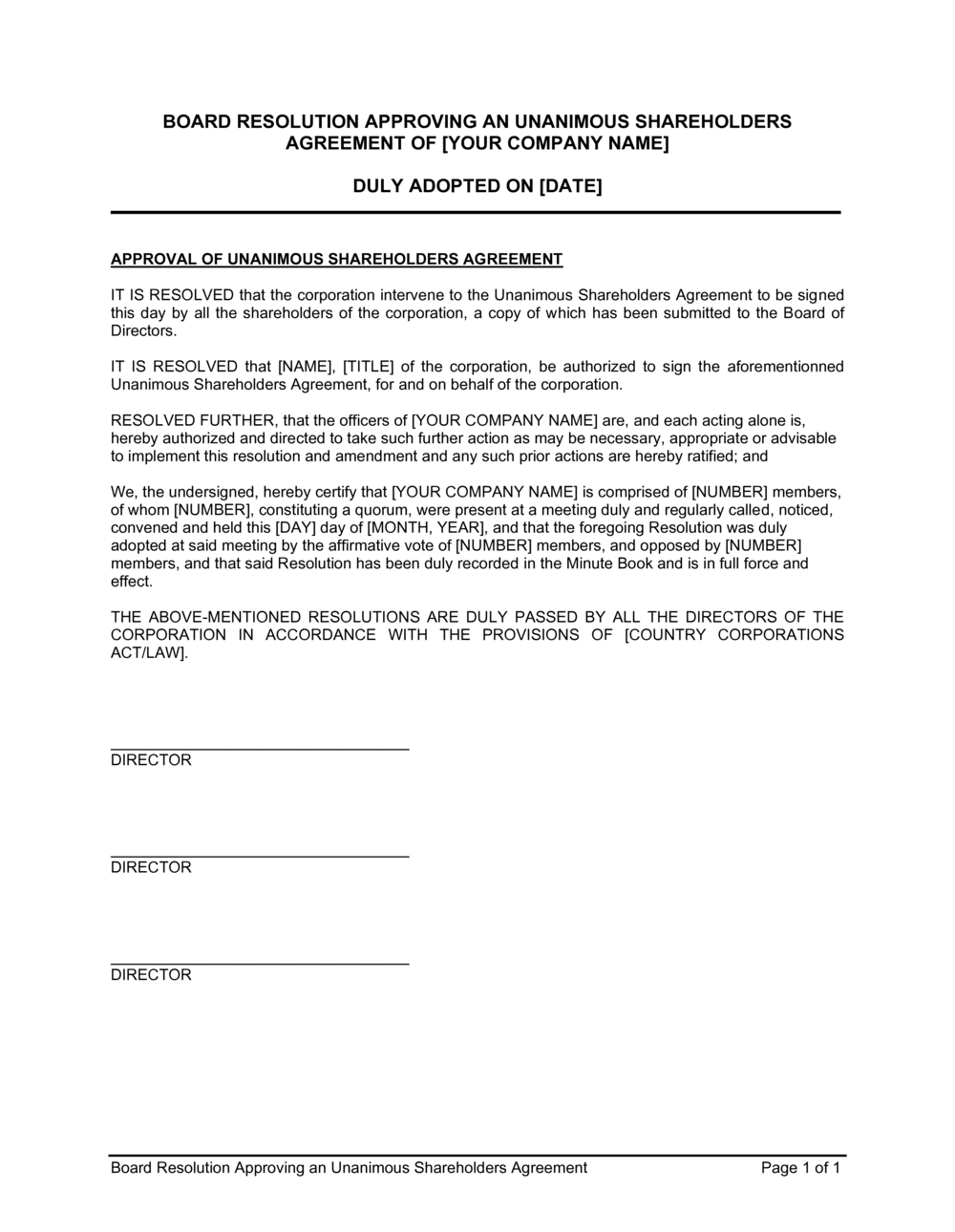
A Board Resolution Approving a Unanimous Shareholders Agreement is a formal corporate record in which the board of directors officially resolves to approve, and authorize execution of, a unanimous shareholders agreement (USA) that governs how the corporation is controlled, managed, and owned. This free Word download gives you a structured, lawyer-ready template you can edit online and export as PDF for signing and filing with your corporate records.
When you need it
Use it whenever shareholders have negotiated a unanimous shareholders agreement and the board must formally adopt and authorize it before the document takes effect. It is also needed when an existing USA is being amended, restated, or terminated and board-level approval is required under the corporation's constating documents or applicable statute.
What's inside
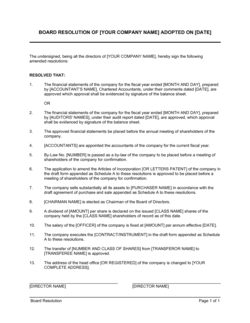
Recitals identifying the corporation and the proposed agreement, a resolution formally approving the unanimous shareholders agreement, authorization for one or more officers to execute the document on behalf of the corporation, confirmation of board authority, and signature blocks for all directors.

What is a Board Resolution Approving a Unanimous Shareholders Agreement?

A Board Resolution Approving a Unanimous Shareholders Agreement is a formal corporate record in which the directors of a corporation vote to accept, authorize, and direct execution of a unanimous shareholders agreement (USA) — the foundational governance contract that governs how the corporation is controlled, managed, and owned by its shareholders. The resolution creates a documented chain of authority connecting the board's decision to the underlying agreement, confirming that the board reviewed the document, determined it was in the corporation's best interests, and empowered a specific officer to execute it on the corporation's behalf. In most jurisdictions, the resolution is passed either at a duly convened board meeting or as a written consent signed by all directors in lieu of a meeting.

Why You Need This Document

Executing a unanimous shareholders agreement without a corresponding board resolution leaves a critical gap in the corporate record. Lenders, institutional investors, and acquirers conducting due diligence routinely require a certified copy of the board resolution as evidence that the corporation's execution of the USA was properly authorized — a missing resolution is among the most common pre-closing deficiencies in financing and M&A transactions, and remediation requires tracking down directors who may no longer be available. Beyond closing requirements, the resolution protects the corporation by documenting that directors discharged their duty to review the agreement before it came into force, creating a reference point if shareholders later dispute the version of the USA that governs their rights. This template gives you a structured, lawyer-ready resolution that covers every required element — recitals, operative approval, officer authorization, filing obligations, and signature blocks — so your minute book reflects the full picture of how and when the agreement was adopted.

Which variant fits your situation?

If your situation is…Use this template
Approving a USA at the time of incorporation with founding shareholdersBoard Resolution Approving Unanimous Shareholders Agreement
Approving an amendment or restatement of an existing shareholders agreementBoard Resolution Approving Amendment to Shareholders Agreement
Approving a standard (non-unanimous) shareholders agreement for a majority classShareholders Agreement
Adopting the underlying unanimous shareholders agreement itselfUnanimous Shareholders Agreement
Approving a shareholder buy-sell or shotgun arrangementBuy-Sell Agreement
Documenting board approval of a general corporate matter unrelated to shareholder agreementsBoard Resolution (General)
Recording shareholder consent to the same agreement without a formal meetingShareholders Resolution

Common mistakes to avoid

❌ Attaching a draft rather than the final form of the USA

Why it matters: If the resolution approves a document that differs from the version shareholders actually sign, the board's authorization may not cover the executed agreement — creating a gap in the corporate record that can void restrictive covenants or transfer restrictions.

Fix: Finalize all negotiation before the board resolution is signed. Attach only the execution-form agreement as Schedule A, and date the schedule consistently with the resolution.

❌ Passing a written resolution with less than unanimous director consent

Why it matters: In Canada, the US (under most state statutes), and the UK, a written resolution in lieu of meeting is valid only if signed by all directors entitled to vote. A resolution signed by a majority — even a supermajority — outside of a formal meeting is void.

Fix: Either convene a proper board meeting with quorum and record minutes, or ensure every director signs the written resolution before treating it as adopted.

❌ Failing to reference or attach the USA when recording board approval

Why it matters: A resolution that approves 'a shareholders agreement' without identifying or attaching it creates ambiguity about which document was authorized — particularly problematic if multiple drafts circulated during negotiation.

Fix: Reference the agreement by its full title, date, and parties, and attach a complete copy as a labelled schedule. This eliminates version disputes and satisfies lender or investor due diligence requirements.

❌ Not checking whether articles or bylaws require shareholder approval as well

Why it matters: A board resolution alone does not substitute for a shareholder vote if the corporation's constating documents require one. Acting without required shareholder approval can render both the resolution and the underlying USA voidable.

Fix: Review the articles, bylaws, and any existing shareholders agreement before relying solely on board approval. Where shareholder consent is required, pass a concurrent shareholders resolution adopting the agreement.

❌ Using a generic board resolution form not tailored to unanimous shareholders agreements

Why it matters: A general board resolution omits the specific recitals, schedule reference, and filing obligations that distinguish a USA adoption resolution from routine corporate approvals — weakening its evidentiary value in a dispute.

Fix: Use a resolution template specifically designed for unanimous shareholders agreement approvals, with recitals, an attached schedule, and explicit filing and notification obligations.

❌ Failing to update the minute book promptly after execution

Why it matters: A resolution that is not filed in the minute book within a reasonable time creates gaps in the corporate record, raises red flags on legal due diligence in financing or M&A transactions, and may leave shareholders without formal notice of the agreement's adoption.

Fix: Direct the corporate secretary by resolution to file the document within a specific number of business days and note the filing date on the resolution itself.

The 9 key clauses, explained

Preamble and date

In plain language: Identifies the corporation by full legal name, the date the resolution is adopted, and whether it is passed at a meeting or by written consent in lieu of meeting.

Sample language
The undersigned, being all of the directors of [CORPORATION FULL LEGAL NAME] (the 'Corporation'), a corporation incorporated under the laws of [JURISDICTION], hereby resolve as follows, effective [DATE]:

Common mistake: Using a trade name or abbreviation instead of the full registered corporate name. A mismatch between the resolution and corporate registry records can invalidate the board's authority and delay closings.

Recitals (whereas clauses)

In plain language: Sets out the background facts — that the shareholders have negotiated a unanimous shareholders agreement, that it is in the corporation's best interest to approve it, and that the board has authority to do so.

Sample language
WHEREAS the shareholders of the Corporation have negotiated and agreed upon the terms of a Unanimous Shareholders Agreement dated [DATE] (the 'Agreement'); and WHEREAS the board of directors has reviewed the Agreement and determined it is in the best interests of the Corporation to approve and authorize its execution;

Common mistake: Omitting the recitals entirely in favour of a bare resolution. Without factual context, the resolution is harder to interpret and may not satisfy the evidentiary requirements of lenders or counterparties reviewing the minute book.

Approval of the unanimous shareholders agreement

In plain language: The operative resolution formally approving the unanimous shareholders agreement — this is the core clause that triggers the board's binding acceptance of the document.

Sample language
BE IT RESOLVED that the Unanimous Shareholders Agreement among the Corporation and its shareholders, in the form presented to the board and attached hereto as Schedule 'A', is hereby approved and adopted by the Corporation.

Common mistake: Approving a described version of the agreement rather than attaching the final executed form as a schedule. If the attached document later differs from the signed copy, enforceability of the resolution is called into question.

Authorization to execute

In plain language: Grants one or more named officers the authority to sign and deliver the unanimous shareholders agreement and any ancillary documents on behalf of the corporation.

Sample language
BE IT FURTHER RESOLVED that [OFFICER TITLE], [OFFICER NAME], is hereby authorized and directed to execute and deliver the Agreement and any certificates, instruments, or other documents as may be necessary or desirable to give effect to the foregoing, on behalf of the Corporation.

Common mistake: Failing to name a specific officer or title, using only 'an officer of the Corporation.' Without a specific named signatory, counterparties and financial institutions may reject the authorization as insufficiently definite.

Confirmation of board authority

In plain language: States that the board has reviewed the agreement, that a quorum was present or all directors have signed, and that the resolution is within the board's statutory and bylaw authority.

Sample language
BE IT FURTHER RESOLVED that the board of directors confirms that this resolution is within the powers conferred upon the board by the Corporation's bylaws and applicable corporate statute, and that all necessary approvals have been obtained.

Common mistake: Skipping this clause when the corporation's articles or USA restrict board authority on shareholder matters. If the board is acting outside its authority, the resolution may be void — the confirmation clause forces a review of the constating documents before signing.

Ratification of prior acts

In plain language: Retroactively ratifies any acts taken by officers or directors in connection with negotiating or preparing the unanimous shareholders agreement prior to the resolution date.

Sample language
BE IT FURTHER RESOLVED that all actions taken by the officers and directors of the Corporation in connection with the negotiation, preparation, and execution of the Agreement prior to the date hereof are hereby ratified, confirmed, and approved.

Common mistake: Including a blanket ratification without limiting it to acts related to the specific transaction. An unlimited ratification clause can unintentionally validate unrelated prior acts that were not authorized.

Filing and notice obligations

In plain language: Directs the corporate secretary or officers to file the resolution in the minute book, deliver copies to shareholders, and take any other steps required by applicable corporate statute.

Sample language
BE IT FURTHER RESOLVED that the Secretary of the Corporation is directed to file a copy of this resolution in the minute book of the Corporation and to deliver notice of the Agreement's adoption to all shareholders in accordance with applicable law.

Common mistake: Omitting this clause and relying on informal practice. Failure to update the minute book or notify shareholders of a USA's adoption can render the agreement unenforceable against shareholders who claim they had no formal notice.

Omnibus authorization

In plain language: A catch-all clause authorizing the officers to do anything else reasonably necessary to carry out the resolutions — signing ancillary documents, making filings, or giving notices.

Sample language
BE IT FURTHER RESOLVED that any officer of the Corporation is hereby authorized and directed to execute and deliver all such further documents, instruments, and agreements, and to do all such further acts and things, as may be necessary or desirable to carry out the intent of the foregoing resolutions.

Common mistake: Relying on the omnibus clause as a substitute for specific authorization clauses. Courts in several jurisdictions require that the specific transaction be identified — a pure omnibus clause without operative resolutions above it provides insufficient authority.

Director signatures

In plain language: Signature blocks for each director, with printed name, title, and date — confirming unanimous written consent or attendance at a duly constituted meeting.

Sample language
IN WITNESS WHEREOF the undersigned, being all of the directors of the Corporation, have executed this Resolution as of the date first written above. ___________________________ [DIRECTOR NAME], Director

Common mistake: Collecting only a majority of signatures when the resolution is styled as a written resolution in lieu of meeting. In most jurisdictions, a written resolution must be signed by all directors — not merely a quorum — to be valid without a formal meeting.

How to fill it out

  1. 1

    Insert the corporation's full legal name and jurisdiction

    Enter the corporation's complete registered name exactly as it appears in the corporate registry. Include the governing jurisdiction — the province, state, or country of incorporation.

    💡 Cross-check the registered name against your latest annual return or certificate of incorporation before drafting — one word difference (e.g., 'Inc.' vs. 'Incorporated') can create enforceability questions.

  2. 2

    Confirm the date and method of adoption

    Choose whether the resolution is passed at a duly convened board meeting (with quorum) or as a written resolution in lieu of meeting. Enter the effective date of adoption in the preamble.

    💡 If using a written resolution, verify that all directors — not just a majority — will sign. Most corporate statutes require unanimity for written resolutions in lieu of meeting.

  3. 3

    Attach the final form of the unanimous shareholders agreement

    Attach the fully negotiated, execution-form unanimous shareholders agreement as Schedule A. Reference it by the exact title and date used in the agreement itself.

    💡 Do not attach a near-final or marked-up draft. If the schedule is not the final version, re-issue the resolution after the agreement is finalized to avoid version mismatch disputes.

  4. 4

    Name the authorized officer and title

    In the authorization clause, insert the full name and title of the officer authorized to sign the agreement on behalf of the corporation — typically the CEO, President, or Corporate Secretary.

    💡 Check that the named officer's appointment has itself been documented by board resolution. An officer acting under an undocumented appointment can face challenges from third parties.

  5. 5

    Review the board authority and quorum

    Confirm that the board's approval of the unanimous shareholders agreement is permitted under the articles, bylaws, and any existing shareholder agreements. Note the quorum requirement and ensure it is met.

    💡 Some constating documents require shareholder approval — not just board approval — before a USA takes effect. Check the articles before relying on the board resolution alone.

  6. 6

    Complete the ratification and filing clauses

    Limit the ratification clause to acts taken specifically in connection with this agreement. Direct the corporate secretary to file the resolution and deliver copies to shareholders.

    💡 Set a deadline for the secretary to complete the filing — 'within 10 business days of execution' is a common standard in well-maintained minute books.

  7. 7

    Obtain signatures from all directors

    Circulate the resolution for signature by each director. If passing at a meeting, record attendance and the vote in the minutes rather than on the resolution form itself.

    💡 Use a sequential signing order for executed counterparts and confirm receipt of all signatures before the closing package is assembled — a missing director signature is one of the most common pre-closing deficiencies.

  8. 8

    File in the minute book and distribute copies

    Place the signed resolution, with Schedule A attached, in the corporation's minute book immediately after execution. Deliver certified copies to shareholders and any lender or investor requiring one as a condition of closing.

    💡 Some lenders and investors require a lawyer's certificate confirming the resolution is in full force — maintain a clean minute book so that certification can be issued without a remediation exercise.

Frequently asked questions

What is a board resolution approving a unanimous shareholders agreement?

A board resolution approving a unanimous shareholders agreement is a formal corporate record in which the directors of a corporation vote to accept and authorize execution of a unanimous shareholders agreement (USA) that governs control, management, and ownership of the corporation. It creates a documented chain of corporate authority between the board's decision and the shareholders' execution of the underlying agreement, which is essential for corporate governance, lender due diligence, and shareholder dispute resolution.

Do you need a board resolution to adopt a unanimous shareholders agreement?

In most jurisdictions, a unanimous shareholders agreement becomes binding on the corporation when all shareholders sign it, but corporate best practice — and the requirements of lenders, investors, and sophisticated counterparties — calls for a corresponding board resolution as well. The resolution confirms that the board reviewed and approved the agreement, authorizes an officer to execute it on the corporation's behalf, and creates a clean audit trail in the minute book. Omitting it can create due diligence deficiencies in financing and M&A transactions.

What is a unanimous shareholders agreement?

A unanimous shareholders agreement is a contract signed by every shareholder of a corporation that can restrict or transfer powers normally vested in the board of directors — including decisions about dividends, officer appointments, share transfers, and major transactions. It is a particularly important governance tool for closely held corporations and private companies where shareholders want direct control over management decisions rather than delegating them fully to the board. In Canada, the USA is a recognized statutory instrument under federal and provincial corporate statutes.

Can a board resolution be passed without a formal meeting?

Yes. Most corporate statutes and bylaws permit the board to pass a written resolution in lieu of a formal meeting, provided every director entitled to vote signs the resolution. This written consent procedure is common for routine approvals and closings where convening a meeting is impractical. The key requirement is unanimity — a written resolution signed by only a majority of directors is not valid as a resolution in lieu of meeting in most jurisdictions, even if a majority would have been sufficient at an actual meeting.

Who signs a board resolution approving a unanimous shareholders agreement?

All directors of the corporation must sign if the resolution is passed as a written resolution in lieu of meeting. If passed at a duly convened board meeting, the signatures of a quorum of directors present and voting in favour are sufficient, and the resolution is recorded in the meeting minutes. Separately, an officer authorized by the resolution — typically the CEO or President — signs the unanimous shareholders agreement itself on behalf of the corporation.

What happens if the board resolution and the unanimous shareholders agreement are inconsistent?

If the agreement attached to the resolution differs from the version shareholders actually execute, the board's authorization may not cover the executed document. This creates an authority gap that can be used to challenge the corporation's obligations under the agreement, particularly transfer restrictions, drag-along rights, and management provisions. To avoid this, finalize all negotiations before passing the resolution and attach the execution-form agreement as a labelled schedule.

Is a board resolution approving a USA required in the US?

The concept of a unanimous shareholders agreement as a statutory instrument is primarily a Canadian construct. In the US, the equivalent documents are shareholder agreements, voting agreements, and stockholder agreements, which may not require board approval as a matter of statute. However, most US corporate bylaws and lender requirements call for a board resolution authorizing execution of any material shareholder-level agreement, and the same best-practice principles apply — particularly for closely held corporations and venture-backed startups.

Should the unanimous shareholders agreement itself be filed publicly?

In Canada, a USA is generally not required to be filed on the public corporate registry, but it must be noted on the share certificates or share register to bind transferees. In the US, shareholder agreements are private documents and are not filed publicly except in specific circumstances (e.g., when required as a material contract exhibit for public companies under SEC rules). The board resolution, however, should always be kept in the minute book and made available to shareholders and authorized third parties on request.

How long does it take to prepare and execute this resolution?

Once the underlying unanimous shareholders agreement is in final form, preparing and executing the board resolution typically takes one to three business days — a few hours to customize the template, a review by counsel if required, and time to circulate for director signatures. The more time-consuming step is almost always finalizing the underlying shareholder agreement, not the resolution itself. A signed resolution should be filed in the minute book the same day as execution.

How this compares to alternatives

vs Unanimous Shareholders Agreement

The unanimous shareholders agreement is the substantive governance contract that all shareholders sign. The board resolution is the separate corporate record confirming that the board reviewed, approved, and authorized execution of that agreement on behalf of the corporation. You need both documents — the resolution without the underlying USA is a shell, and the USA without board authorization creates a gap in the corporate record.

vs Shareholders Resolution

A shareholders resolution is a formal decision made by the shareholders of a corporation, typically on matters that require shareholder-level approval under the bylaws or applicable statute. A board resolution is a decision made by the directors. For a unanimous shareholders agreement, best practice calls for both — a board resolution authorizing execution and a shareholders resolution or signature page confirming each shareholder's consent.

vs Board Resolution (General)

A general board resolution is a flexible template for authorizing routine corporate actions — opening bank accounts, appointing officers, or approving contracts. A board resolution specifically approving a unanimous shareholders agreement includes USA-specific elements: recitals referencing the agreement, an attached schedule, filing and notification obligations, and provisions tailored to the governance consequences of adopting a USA. Using a general resolution for a USA adoption creates evidentiary gaps.

vs Shareholders Agreement

A shareholders agreement is a contract among some or all shareholders that governs their relationship but does not necessarily bind or restrict the board. A unanimous shareholders agreement, by contrast, is signed by every shareholder and can transfer board powers directly to shareholders — a more powerful and more regulated instrument. The board resolution template here is designed specifically for the more formal unanimous variant.

Industry-specific considerations

Technology / SaaS

Venture-backed corporations use board resolutions to formalize USA adoption as a closing condition before preferred equity rounds, with drag-along and information rights provisions central to investor requirements.

Professional Services

Law firms, accounting firms, and consulting practices structured as closely held corporations rely on USAs — and the corresponding board approvals — to govern partner admission, profit distribution, and non-compete obligations.

Manufacturing

Family-owned and founder-led manufacturers use unanimous shareholders agreements to control succession, restrict share transfers to outside parties, and preserve family or founding-group control over strategic decisions.

Financial Services

Private equity and fintech holding corporations require board resolutions approving USA amendments as a condition precedent to each new investment tranche, with lender certification of the minute book as a standard closing deliverable.

Jurisdictional notes

United States

The United States does not have a statutory 'unanimous shareholders agreement' as a distinct instrument — the functional equivalent is a shareholder agreement, voting agreement, or stockholder agreement governed by state law (typically Delaware, Nevada, or the state of incorporation). Board authorization of such agreements is generally required by corporate bylaws and is standard practice for venture-backed corporations. Delaware's General Corporation Law (DGCL) §141(f) expressly permits written board consents in lieu of meetings signed by all directors.

Canada

Canada recognizes the unanimous shareholders agreement as a statutory instrument under the Canada Business Corporations Act (CBCA) and all provincial equivalents. A valid USA must be noted on the corporation's share certificates and register to bind transferees. The CBCA permits written director resolutions signed by all directors in lieu of a meeting. Quebec corporations governed by the Business Corporations Act (QCA) follow similar rules, but agreements must comply with Quebec civil law provisions that may differ from common-law jurisdictions.

United Kingdom

UK company law does not use the term 'unanimous shareholders agreement' but shareholders routinely enter into shareholders agreements binding all members. Under the Companies Act 2006, directors may pass written resolutions signed by all directors entitled to vote. A board resolution authorizing execution of a shareholders agreement should confirm compliance with the company's articles of association and any pre-existing shareholder consent requirements. UK private companies are not required to file shareholders agreements at Companies House.

European Union

EU member states each have their own corporate law governing shareholder agreements and board resolutions, with no harmonized EU instrument equivalent to the Canadian USA. In France, Germany, and the Netherlands, shareholder pacts are common in closely held companies and require board-level authorization consistent with the company's statutes. GDPR considerations apply when the agreement or related board records reference individual shareholders' personal data. Cross-border EU corporations should confirm whether the agreement must be notarized or filed under the applicable member state's company registry rules.

Template vs lawyer — what fits your deal?

PathBest forCostTime
Use the templateClosely held corporations with straightforward ownership structures where shareholders have already agreed on all USA termsFree1–2 hours
Template + legal reviewCorporations with multiple share classes, outside investors, or lender requirements for a clean minute book certification$300–$800 for a corporate lawyer review1–3 business days
Custom draftedComplex multi-party transactions, cross-border shareholders, or corporations subject to regulated-industry governance requirements$1,500–$5,000+ depending on transaction complexity1–2 weeks

Glossary

Unanimous Shareholders Agreement (USA)
A contract signed by all shareholders of a corporation that restricts, transfers, or modifies the powers of the board of directors and governs how the corporation is managed and owned.
Board Resolution
A formal written decision adopted by a corporation's board of directors, recorded in the minute book, that authorizes a specific corporate action.
Constating Documents
The foundational legal documents of a corporation — articles of incorporation, bylaws, and any unanimous shareholders agreement — that define its structure and governance rules.
Minute Book
A corporation's official binder or digital record containing all resolutions, share registers, officer and director lists, and other statutory corporate records.
Recital
Introductory 'whereas' clauses in a resolution or agreement that state the background facts and purpose, without themselves creating binding obligations.
Authorization Clause
The operative part of a board resolution that grants a named officer or director the authority to sign, execute, or deliver a specific document on behalf of the corporation.
Quorum
The minimum number or proportion of directors who must be present or consent for a board meeting or written resolution to be legally valid under the corporation's bylaws or applicable statute.
Written Resolution in Lieu of Meeting
A board resolution signed by all directors outside of a formal meeting, recognized as equivalent to a resolution passed at a duly convened meeting in most jurisdictions.
Transfer Restriction
A provision in a shareholders agreement — often approved by board resolution — that limits how and to whom shares may be sold, transferred, or pledged.
Drag-Along Right
A USA provision requiring minority shareholders to sell their shares on the same terms as the majority in an approved acquisition, binding on the corporation once the USA is in force.
Tag-Along Right
A USA provision giving minority shareholders the right to join a controlling-shareholder sale on the same economic terms, protecting them from being left behind.

Part of your Business Operating System

This document is one of 3,000+ business & legal templates included in Business in a Box.

  • Fill-in-the-blanks — ready in minutes
  • 100% customizable Word document
  • Compatible with all office suites
  • Export to PDF and share electronically

Create your document in 3 simple steps.

From template to signed document — all inside one Business Operating System.
1
Download or open template

Access over 3,000+ business and legal templates for any business task, project or initiative.

2
Edit and fill in the blanks with AI

Customize your ready-made business document template and save it in the cloud.

3
Save, Share, Send, Sign

Share your files and folders with your team. Create a space of seamless collaboration.

Save time, save money, and create top-quality documents.

★★★★★

"Fantastic value! I'm not sure how I'd do without it. It's worth its weight in gold and paid back for itself many times."

Managing Director · Mall Farm
Robert Whalley
Managing Director, Mall Farm Proprietary Limited
★★★★★

"I have been using Business in a Box for years. It has been the most useful source of templates I have encountered. I recommend it to anyone."

Business Owner · 4+ years
Dr Michael John Freestone
Business Owner
★★★★★

"It has been a life saver so many times I have lost count. Business in a Box has saved me so much time and as you know, time is money."

Owner · Upstate Web
David G. Moore Jr.
Owner, Upstate Web

Run your business with a system — not scattered tools

Stop downloading documents. Start operating with clarity. Business in a Box gives you the Business Operating System used by over 250,000 companies worldwide to structure, run, and grow their business.

Free Forever Plan · No credit card required