1
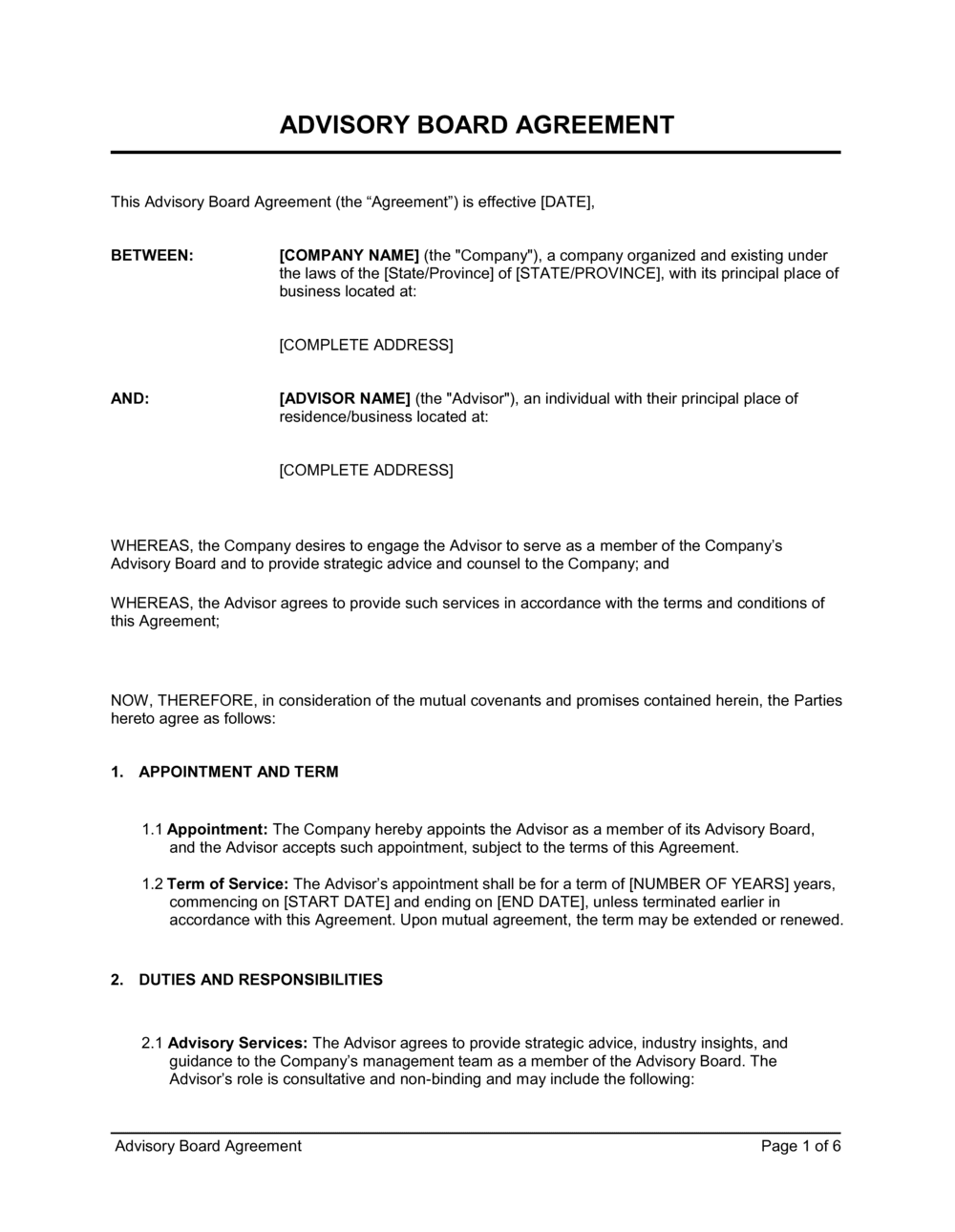
Identify the parties and the advisor's area of focus
Enter the company's full registered legal name and entity type, the advisor's legal name, and a one-sentence description of the advisory domain (e.g., 'go-to-market strategy,' 'regulatory affairs,' 'enterprise sales').
💡 Confirm the exact legal entity that will issue the equity — this must match your cap table and equity plan to avoid problems at due diligence.
2
Define the advisor's duties and expected time commitment
Specify the number of hours per month, quarterly meeting cadence, and any specific deliverables such as introductions, reviews, or attendance at board meetings.
💡 A 3–5 hour per month commitment with one quarterly check-in is the standard floor for equity-compensated advisors — anything less rarely justifies the cap-table dilution.
3
Set the compensation terms and equity grant details
Enter the equity grant as a fixed number of shares or options, the exercise price (use 409A fair market value for US options), and whether any cash retainer applies.
💡 Reference the separate option agreement and equity plan rather than restating all terms here — the advisory agreement should point to those documents, not duplicate them.
4
Configure the vesting schedule and termination of equity
Set the total vesting period (24 months is standard for advisors), the cliff length (6 months is common), and specify that unvested equity terminates immediately on agreement termination.
💡 Consider a no-cliff structure for advisors who are asked to deliver a high-value introduction or specific output within the first 90 days — the cliff creates a perverse incentive to disengage early.
5
Complete the confidentiality and IP assignment clauses
Define 'Confidential Information' specifically — list categories such as financials, customer data, technology, and product roadmap — and confirm that all work product created in the advisory role is assigned to the company.
💡 For technical or product advisors, add a schedule listing the specific areas of IP they may contribute to, so assignment scope is unambiguous.
6
Require conflict-of-interest disclosure
Ask the advisor to list all existing advisory, employment, or board relationships at signing, and include a forward-looking obligation to disclose future conflicts promptly.
💡 A simple attachment listing the advisor's current affiliations, signed at execution, is far easier to enforce than a general representation — and it signals seriousness to the advisor.
7
Set the term, renewal, and termination provisions
Choose the initial term (12 months is standard, renewable), the notice period for non-renewal (30 days), and the conditions for immediate termination for cause.
💡 Include breach of confidentiality, joining a direct competitor, and failure to meet the minimum time commitment as explicit cause triggers — vague 'material breach' language requires litigation to apply.
8
Execute before any equity is granted
Both parties must sign the agreement and the accompanying equity plan documents before any options appear on the cap table.
💡 In common-law jurisdictions, equity granted before a written agreement is signed may be treated as an unconditional gift without the accompanying vesting and forfeiture conditions.