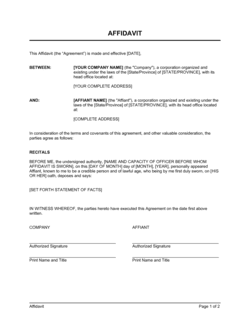
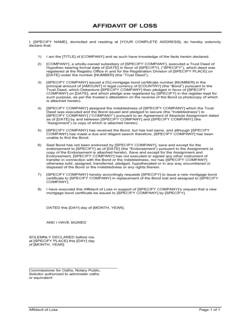
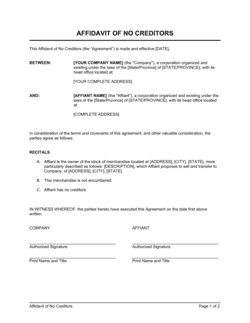
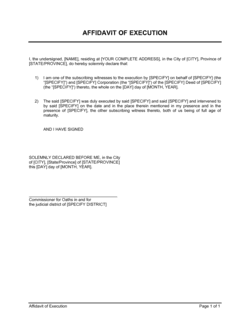
Affidavit of No Lien Template

Free Word download • Edit online • Save & share with Drive • Export to PDF

3 pages20–30 min to fillDifficulty: StandardSignature requiredLegal review recommended
Learn more ↓
FreeAffidavit of No Lien Template

At a glance

What it is
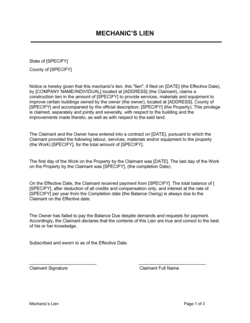
An Affidavit of No Lien is a sworn, notarized legal declaration in which a property owner or seller certifies under penalty of perjury that the property in question is free of any outstanding liens, mortgages, judgments, or other encumbrances. This free Word download gives you a professionally structured form you can edit online, sign before a notary, and attach to a closing package or title file in minutes.
When you need it
Use it at the close of a real estate transaction, construction project, or asset sale when the buyer, title company, or lender requires written confirmation that the property or asset carries no undisclosed debt obligations or claims. It is also used by contractors and subcontractors to certify that all suppliers and laborers have been paid in full.
What's inside
The affidavit covers the affiant's identity and ownership, a legal description of the property, a sworn declaration that no liens or encumbrances exist, representations regarding unpaid labor or materials, an indemnification clause, notarization, and signature blocks for all required parties.

What is an Affidavit of No Lien?

An Affidavit of No Lien is a sworn, notarized legal declaration in which a property owner, seller, or contractor certifies under penalty of perjury that a specific property or asset is free of all outstanding liens, mortgages, judgments, mechanic's claims, and other encumbrances. Because it is made under oath before a licensed notary public, every statement in the document carries personal legal accountability — a false declaration exposes the affiant to civil liability for any resulting losses and, in most jurisdictions, to criminal perjury charges. The affidavit typically accompanies a real estate closing package, a construction project close-out, or an asset sale, giving buyers, lenders, and title insurers a sworn representation that the title they are acquiring or insuring is clean.

Why You Need This Document

Without an executed affidavit of no lien, title companies will typically refuse to issue a title insurance policy, and lenders will not release funding at closing — effectively stopping the transaction in its tracks. A buyer who closes without one assumes the risk of inheriting undisclosed liens that attach to the property and survive the sale, often requiring costly litigation to discharge. For contractors, failing to execute a no-lien affidavit at project close-out leaves the door open for subcontractors or suppliers to file mechanic's liens weeks after the owner believed the project was complete. This template gives sellers, owners, and contractors a professionally structured, notarization-ready form that covers every material representation required by title companies, lenders, and construction lenders — reducing the time spent at closing and the legal exposure that follows when sworn statements are missing, incomplete, or improperly executed.

Which variant fits your situation?

If your situation is…Use this template
Seller certifying clear title at a real estate closingAffidavit of No Lien (Real Property)
Contractor certifying all subcontractors and suppliers are paidContractor's Affidavit of No Lien
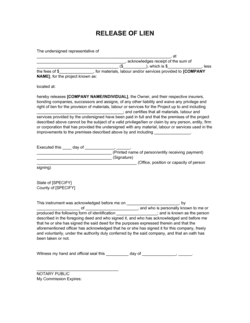
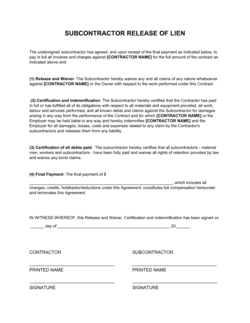
Waiving lien rights after payment has been receivedLien Waiver (Unconditional)
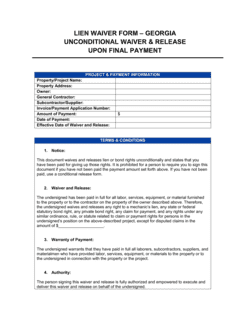
Conditionally releasing lien rights pending receipt of final paymentLien Waiver (Conditional)
Confirming no claims against a deceased person's estate propertyAffidavit of Heirship / Estate No-Lien
Certifying no mechanic's liens on a commercial construction projectMechanic's Lien Waiver and Release
Buyer requiring title to be free of encumbrances for asset purchaseAffidavit of Title

Common mistakes to avoid

❌ Signing without conducting a lien search

Why it matters: An affiant who swears to no outstanding liens without verifying the public record may be making a false statement. If an undisclosed lien surfaces post-closing, the affiant faces civil liability and potential perjury exposure.

Fix: Always order a full title and lien search — covering county records, judgment liens, and federal tax liens — before executing the affidavit. Resolve every open item or list it as a permitted exception.

❌ Using a street address instead of the legal property description

Why it matters: Title companies and courts require the exact recorded legal description to identify property. An affidavit citing only a street address may be rejected at closing or deemed legally insufficient in a dispute.

Fix: Pull the legal description verbatim from the recorded deed or title commitment and paste it directly into the affidavit without abbreviation or paraphrase.

❌ Failing to list permitted encumbrances as exceptions

Why it matters: Swearing that a property is free of all encumbrances when a utility easement or HOA restriction exists makes the sworn statement false — even if those encumbrances are publicly recorded and expected.

Fix: Include a clearly labeled exceptions clause and copy permitted encumbrances from the title commitment's Schedule B. 'None' is only acceptable when a clean title search confirms it.

❌ Notarization by an expired or interested notary

Why it matters: An affidavit notarized by an expired commission or by a notary who is also a party to the transaction is void in most jurisdictions, requiring the document to be re-executed and potentially delaying closing.

Fix: Verify the notary's commission expiration date before the appointment and confirm the notary has no financial interest in the transaction.

❌ Signing on behalf of an entity without documented authority

Why it matters: If an LLC member or corporate officer signs an affidavit without a board resolution or operating agreement authorizing them, the sworn statements may not bind the entity — and the title company may refuse to close.

Fix: Prepare and attach a certified board resolution or a certificate of authority from the operating agreement authorizing the specific signer to execute the affidavit on behalf of the entity.

❌ Omitting the federal tax lien search

Why it matters: Federal IRS tax liens attach to all real and personal property of a taxpayer and are filed with the federal court, not the county recorder. A county-only lien search will miss them entirely, and a missed federal lien can cloud title post-closing.

Fix: Run a separate federal tax lien search through the IRS FOIA portal or a third-party title search service as part of standard due diligence before executing the affidavit.

The 9 key clauses, explained

Affiant identification and authority

In plain language: States the full legal name, address, and ownership capacity of the person making the sworn declaration — confirming they have authority to make representations about the property.

Sample language
I, [AFFIANT FULL NAME], residing at [ADDRESS], being duly sworn, depose and state that I am the owner of record / authorized representative of [OWNER ENTITY NAME] with respect to the property described herein.

Common mistake: Using a trade name or DBA instead of the registered legal name of the owner. If the name on the affidavit does not match the deed or title record, title companies will reject the document and require a corrected one.

Legal description of the property

In plain language: Identifies the property with the exact legal description from the deed or county land records — lot number, block, subdivision, parcel ID, and county — not just a street address.

Sample language
The real property that is the subject of this Affidavit is legally described as: Lot [NUMBER], Block [NUMBER], [SUBDIVISION NAME], [COUNTY] County, [STATE], Parcel Identification Number: [PIN].

Common mistake: Substituting a street address for the legal description. A street address is not legally sufficient to identify real property — courts and title examiners require the precise recorded legal description.

Sworn declaration of no liens or encumbrances

In plain language: The core clause in which the affiant swears under penalty of perjury that no mortgages, judgments, tax liens, mechanic's liens, or other claims are outstanding against the property.

Sample language
Affiant hereby swears and affirms that, to the best of Affiant's knowledge and belief, the above-described property is free and clear of all liens, mortgages, judgments, tax obligations, mechanic's liens, and encumbrances of any nature whatsoever, except as follows: [NONE / LIST EXCEPTIONS].

Common mistake: Omitting an exceptions carve-out. Failing to list permitted encumbrances — such as a utility easement or a HOA covenant — renders the sworn statement technically false, exposing the affiant to perjury liability.

Representation regarding unpaid labor and materials

In plain language: Confirms that all contractors, subcontractors, laborers, and material suppliers who performed work or supplied goods to the property have been paid in full and have no basis to file a mechanic's lien.

Sample language
Affiant further states that all persons who have furnished labor, services, or materials to the above-described property have been paid in full, and no work remains outstanding that could give rise to a mechanic's or materialman's lien under applicable law.

Common mistake: Signing this clause without first collecting lien waivers from every subcontractor and supplier. The affiant swears to a fact they may not fully know — and if a subcontractor files a lien post-closing, the affiant faces both civil liability and a potential perjury claim.

Representation regarding judgments and legal proceedings

In plain language: Affirms that no unsatisfied court judgments or pending lawsuits (including lis pendens filings) affect the property or the affiant's ownership interest.

Sample language
Affiant represents that there are no unsatisfied judgments, decrees, or orders of any court, and no pending actions or proceedings in any court, that affect title to or the Affiant's interest in the above-described property.

Common mistake: Overlooking tax court proceedings or federal tax liens. IRS federal tax liens attach automatically to all property of a taxpayer and may not appear in a standard county lien search — always run a federal tax lien search before executing this clause.

Representation regarding tenancies and possession

In plain language: Discloses the current occupancy status of the property and confirms that no unrecorded lease, option, or right of possession exists that would survive the transfer.

Sample language
Affiant represents that the property is [VACANT / OWNER-OCCUPIED / subject to the lease described in Schedule A], and that no unrecorded leases, options to purchase, or rights of possession exist that are not reflected in the public record.

Common mistake: Failing to disclose month-to-month tenancies. Unrecorded oral leases can bind a successor owner in many jurisdictions even if not mentioned in the affidavit, creating post-closing disputes with buyers.

Indemnification and hold harmless

In plain language: Requires the affiant to indemnify the buyer, lender, and title company against any losses, costs, or claims that arise if the sworn statements in the affidavit turn out to be false or inaccurate.

Sample language
Affiant agrees to indemnify, defend, and hold harmless [BUYER NAME], [LENDER NAME], and [TITLE COMPANY NAME] from and against any and all claims, losses, damages, costs, and attorneys' fees arising out of or related to any breach of the representations made herein.

Common mistake: Capping indemnification at the purchase price. If a title company must pay out a claim on an insured policy, their loss can exceed the property value — an artificial cap may not be accepted by the title insurer.

Notarization and oath

In plain language: The affiant swears or affirms the truth of the statements before a licensed notary public, who acknowledges the signature, verifies identity, and affixes their seal.

Sample language
Subscribed and sworn to before me this [DAY] day of [MONTH], [YEAR], by [AFFIANT FULL NAME], personally known to me or proved to me on the basis of satisfactory evidence to be the person whose name is subscribed to the within instrument. [NOTARY SIGNATURE] [NOTARY SEAL] My commission expires: [DATE].

Common mistake: Using an expired notary commission or a notary who is also a party to the transaction. Both invalidate the notarization in most jurisdictions, and many title companies will reject the affidavit outright.

Governing law and jurisdiction

In plain language: Specifies which state or province's law governs the affidavit and any disputes arising from misrepresentations made within it.

Sample language
This Affidavit is made pursuant to and shall be governed by the laws of the State of [STATE]. Any dispute arising from the representations herein shall be subject to the exclusive jurisdiction of the courts of [COUNTY] County, [STATE].

Common mistake: Omitting the governing law clause entirely. Without it, a court must determine which jurisdiction's perjury statutes and lien laws apply — adding delay and uncertainty to any enforcement action.

How to fill it out

  1. 1

    Identify the affiant and confirm authority

    Enter the full legal name and address of the person signing. If the property is held by an LLC, corporation, or trust, confirm the signer has authority — by board resolution, operating agreement, or trust instrument — to make sworn representations on behalf of the entity.

    💡 Cross-reference the signer's name against the vesting deed in the county records before drafting to catch name discrepancies early.

  2. 2

    Insert the complete legal property description

    Pull the exact legal description from the recorded deed or the title commitment. Copy it verbatim — do not paraphrase or abbreviate. Include the parcel identification number (PIN) used by the county assessor.

    💡 Ask the title company or closing attorney for the legal description from their title search — this is the authoritative version and eliminates transcription errors.

  3. 3

    Conduct a full lien search before completing the no-lien declaration

    Run a title search covering mechanic's liens, judgment liens, tax liens, lis pendens, and federal tax liens in both the county recorder's office and the federal court system. Resolve every open item before signing.

    💡 Federal tax lien searches must be run separately through the IRS or a third-party search service — they do not appear in most standard county lien searches.

  4. 4

    Collect lien waivers from all contractors and suppliers

    Before completing the labor and materials clause, obtain unconditional lien waivers from every subcontractor, laborer, and material supplier who worked on the property. Keep these waivers on file as backup documentation.

    💡 Issue a final payment to each subcontractor via check and condition it on simultaneous exchange of an unconditional lien waiver — this creates a clean paper trail.

  5. 5

    List all permitted exceptions

    In the no-lien declaration clause, explicitly carve out any encumbrances that will survive closing — utility easements, HOA covenants, recorded restrictions, or the buyer's new mortgage. Never leave the exceptions field blank if any encumbrance exists.

    💡 Copy permitted exception language directly from the title commitment's Schedule B — this is the standard reference list used by title companies and lenders.

  6. 6

    Complete the indemnification block

    Enter the names of all parties being indemnified — typically the buyer, lender, and title company. Review the scope with your attorney if the property value is above $500K or the transaction is commercially structured.

    💡 For commercial transactions, the title company may supply its own indemnification language as a condition of issuing the policy — request their form early to avoid last-minute revisions.

  7. 7

    Sign before a licensed notary

    Execute the affidavit in the physical presence of a licensed notary public who is not a party to the transaction. Bring government-issued photo ID. The notary must affix their seal and confirm their commission expiration date.

    💡 Schedule notarization at least 48 hours before the closing date — last-minute notarization appointments are a common cause of closing delays.

  8. 8

    Deliver the executed affidavit to the title company or closing agent

    Provide the original wet-signed and notarized affidavit to the title company or closing attorney before the closing date. Retain a certified copy for your records and tax files.

    💡 Confirm in writing with the title company that the affidavit has been received and accepted before the closing date — verbal confirmation is not sufficient.

Frequently asked questions

What is an affidavit of no lien?

An affidavit of no lien is a sworn, notarized legal declaration in which a property owner or seller certifies under penalty of perjury that the subject property carries no outstanding liens, mortgages, judgments, or encumbrances. It is most commonly required at real estate closings, construction project completions, and asset sales where the buyer or lender needs written assurance that the title is clear before funds are released. Because it is made under oath, a false statement exposes the affiant to civil liability and potential criminal perjury charges.

When is an affidavit of no lien required?

Title companies typically require one as a condition of issuing title insurance at a real estate closing. Lenders commonly require it before funding a purchase or refinance loan. In construction, owners and general contractors use it at project close-out to confirm all subcontractors and suppliers have been paid and no mechanic's liens are pending. It is also used in business asset sales, estate settlements, and any transaction where one party needs to confirm that a property or asset is unencumbered.

Does an affidavit of no lien need to be notarized?

Yes, in virtually all jurisdictions. Because an affidavit is a sworn statement made under penalty of perjury, it must be executed before a licensed notary public who verifies the affiant's identity, witnesses the oath or affirmation, and affixes their official seal. An unnotarized affidavit of no lien is not legally valid and will be rejected by title companies, lenders, and courts. Some jurisdictions additionally require recording in the county land records.

What is the difference between an affidavit of no lien and a lien waiver?

An affidavit of no lien is a sworn declaration made by a property owner or seller confirming that no liens exist against the property. A lien waiver is a document signed by a contractor, subcontractor, or supplier giving up their right to file a mechanic's lien — typically in exchange for payment received. The two documents serve related but distinct purposes: the affidavit asserts that the title is clear; the lien waiver is the underlying proof that individual claimants have been paid and cannot assert a claim.

Can an LLC or corporation sign an affidavit of no lien?

Yes, but the affiant must be an authorized officer, member, or manager of the entity with documented authority to make sworn representations on its behalf. Title companies and lenders typically require a certified copy of the board resolution, operating agreement, or corporate authorization confirming that authority. The entity's legal name — not a trade name or DBA — must appear on the affidavit.

What happens if the affidavit of no lien contains a false statement?

Because the document is sworn under oath, a knowingly false statement constitutes perjury under the laws of most US states and equivalent criminal provisions in Canada, the UK, and the EU. Beyond criminal exposure, the affiant faces civil liability for any losses suffered by the buyer, lender, or title company as a result of the misrepresentation. In practice, most title companies require an indemnification clause precisely to create a civil recovery mechanism if undisclosed liens surface post-closing.

Does an affidavit of no lien cover mechanic's liens?

It typically includes a representation that all contractors, laborers, and material suppliers have been paid in full and have no basis to file a mechanic's lien. However, this representation alone does not prevent a subcontractor from filing a lien if they were not in fact paid — the affiant would then face personal liability. Best practice is to collect unconditional lien waivers from every contractor and supplier before signing this clause, so the sworn statement is backed by documented evidence.

Is an affidavit of no lien the same as an affidavit of title?

The two documents overlap significantly but are not identical. An affidavit of title is a broader sworn statement covering ownership, marital status, possession, judgments, and liens — used by sellers to provide comprehensive title representations at closing. An affidavit of no lien is specifically focused on the absence of financial claims and encumbrances. In many residential closings, a single affidavit of title incorporates a no-lien declaration; in commercial transactions and construction contexts, a standalone affidavit of no lien is more common.

Do I need a lawyer to complete an affidavit of no lien?

For straightforward residential transactions handled by an experienced title company, a well-drafted template is often sufficient with a notary's assistance. Legal review is strongly recommended when the property is held by an entity, when the transaction is commercial or above $500K, when there are known encumbrances to list as exceptions, or when a prior lien search surfaced unresolved items. A brief attorney review typically costs $150–$400 and can prevent a far more expensive post-closing title dispute.

How this compares to alternatives

vs Lien Waiver

A lien waiver is signed by a contractor or supplier relinquishing their right to file a mechanic's lien upon payment. An affidavit of no lien is signed by the property owner swearing that no liens exist. Both documents work together at closing — lien waivers create the factual basis that supports the owner's sworn no-lien declaration.

vs Affidavit of Title

An affidavit of title is a broader closing document covering ownership, marital status, possession rights, judgments, and encumbrances in a single sworn statement. An affidavit of no lien focuses exclusively on the absence of financial claims. In residential closings, the two are often combined; in commercial transactions and construction, a standalone no-lien affidavit is typically required separately.

vs Title Insurance Commitment

A title insurance commitment is issued by a title company after a professional title search and identifies all known encumbrances as exceptions to coverage. An affidavit of no lien is a sworn statement by the seller or owner — not a professional search. The affidavit supplements the title commitment by providing personal liability backing for any liens not caught in the search.

vs Deed of Release

A deed of release formally discharges a specific recorded lien or mortgage from the property title and is recorded in the county land records. An affidavit of no lien declares that no liens exist — it does not discharge one. If a lien exists, it must first be discharged by a deed of release before a no-lien affidavit can truthfully be executed.

Industry-specific considerations

Real Estate

Used at every residential and commercial closing as a condition of title insurance issuance; the affiant is typically the seller or the seller's closing attorney.

Construction

General contractors and owners execute no-lien affidavits at project close-out, backed by unconditional lien waivers from all subcontractors and material suppliers.

Financial Services

Mortgage lenders and refinancing institutions require a no-lien affidavit as a condition of funding, ensuring collateral is unencumbered before loan proceeds are disbursed.

Legal and Professional Services

Estate attorneys use no-lien affidavits when transferring inherited property to heirs, confirming the decedent's estate carries no outstanding creditor claims against the real property.

Jurisdictional notes

United States

Requirements vary significantly by state. In many states — including Florida, Illinois, and Texas — an affidavit of no lien is a standard closing requirement and must be notarized and recorded with the county clerk. Federal tax liens attach to all taxpayer property nationwide and are filed with the US District Court, requiring a separate federal lien search beyond the county recorder. Mechanic's lien statutes are entirely state-specific, with notice and filing deadlines ranging from 30 to 120 days after the last date of work.

Canada

Construction lien legislation is provincial — Ontario's Construction Act, BC's Builders Lien Act, and Alberta's Builders' Lien Act each set different holdback requirements, lien preservation deadlines, and discharge procedures. A sworn declaration of no liens is commonly required by title insurers (FCT, Stewart Title) at residential and commercial closings. In Quebec, the equivalent is a declaration under the Civil Code confirming no legal hypothecs (the Quebec equivalent of a lien) are registered against the immovable.

United Kingdom

England and Wales do not use a direct equivalent of the North American affidavit of no lien, but sellers are required to provide replies to standard requisitions on title — including confirmation of no outstanding charges — through the Law Society's property transaction forms (TA13). Charges must be formally discharged using Form DS1 and registered at HM Land Registry before completion. Scotland operates under a separate property law system where the Keeper of the Registers of Scotland maintains the Land Register and all recorded charges.

European Union

Property encumbrance law varies by member state. In Germany, all charges on real property (Grundpfandrechte) are recorded in the Grundbuch (land register), and a notarized declaration of no encumbrances is prepared by a Notar as part of the conveyancing process. In France, the notaire searches the Conservation des Hypothèques and provides a formal état des inscriptions. EU member states generally require all property charges to be registered publicly, making a comprehensive registry search the primary due diligence tool rather than a sworn affidavit.

Template vs lawyer — what fits your deal?

PathBest forCostTime
Use the templateSellers in straightforward residential closings handled by an experienced title company or closing attorneyFree20–30 minutes plus notary appointment
Template + legal reviewTransactions involving entity-held property, known encumbrances requiring exception language, or property values above $500K$150–$400 for a brief attorney review1–2 business days
Custom draftedComplex commercial transactions, construction project close-outs with multiple subcontractors, or cross-border property transfers$500–$2,000 depending on transaction complexity3–7 business days

Glossary

Lien
A legal claim or security interest held by a creditor against a property until a debt or obligation owed by the property owner is satisfied.
Encumbrance
Any claim, lien, mortgage, easement, or restriction that limits the owner's free use or transfer of a property.
Affiant
The person who makes and swears to the statements in an affidavit, accepting personal legal responsibility for the truth of those statements.
Notarization
The formal process by which a licensed notary public certifies the identity of a signer and witnesses their oath or affirmation before a document is executed.
Mechanic's Lien
A statutory lien that contractors, subcontractors, and material suppliers can file against a property when they have not been paid for labor or materials provided.
Clear Title
Ownership of real property that is free of any liens, defects, or encumbrances that could prevent transfer or financing.
Title Insurance
An insurance policy that protects buyers and lenders against financial loss from title defects, undisclosed liens, or ownership disputes discovered after closing.
Indemnification
A contractual obligation by which one party agrees to compensate another for any losses, damages, or claims arising from a specified event or misrepresentation.
Subordination
An agreement in which one lien holder agrees that its claim ranks below another lien holder's claim in priority of payment.
Lis Pendens
A recorded notice that a lawsuit has been filed affecting the title to a specific property, alerting potential buyers or lenders to the pending litigation.
Deed of Trust
A document used in some states in place of a mortgage, conveying title to a third-party trustee as security for a loan until it is repaid.

Part of your Business Operating System

This document is one of 3,000+ business & legal templates included in Business in a Box.

  • Fill-in-the-blanks — ready in minutes
  • 100% customizable Word document
  • Compatible with all office suites
  • Export to PDF and share electronically

Create your document in 3 simple steps.

From template to signed document — all inside one Business Operating System.
1
Download or open template

Access over 3,000+ business and legal templates for any business task, project or initiative.

2
Edit and fill in the blanks with AI

Customize your ready-made business document template and save it in the cloud.

3
Save, Share, Send, Sign

Share your files and folders with your team. Create a space of seamless collaboration.

Save time, save money, and create top-quality documents.

★★★★★

"Fantastic value! I'm not sure how I'd do without it. It's worth its weight in gold and paid back for itself many times."

Managing Director · Mall Farm
Robert Whalley
Managing Director, Mall Farm Proprietary Limited
★★★★★

"I have been using Business in a Box for years. It has been the most useful source of templates I have encountered. I recommend it to anyone."

Business Owner · 4+ years
Dr Michael John Freestone
Business Owner
★★★★★

"It has been a life saver so many times I have lost count. Business in a Box has saved me so much time and as you know, time is money."

Owner · Upstate Web
David G. Moore Jr.
Owner, Upstate Web

Run your business with a system — not scattered tools

Stop downloading documents. Start operating with clarity. Business in a Box gives you the Business Operating System used by over 250,000 companies worldwide to structure, run, and grow their business.

Free Forever Plan · No credit card required