Georgia Lien Waiver Form Template

Free Word download β€’ Edit online β€’ Save & share with Drive β€’ Export to PDF

2 pagesβ€’20–25 min to fillβ€’Difficulty: Standard
Learn more ↓
FreeGeorgia Lien Waiver Form Template

At a glance

What it is
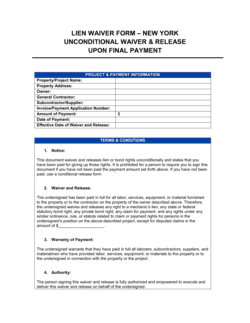
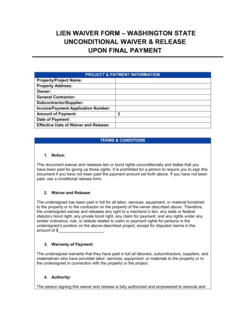
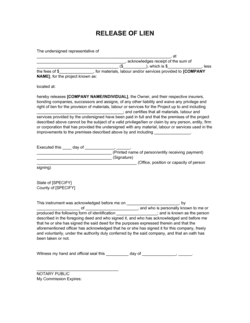
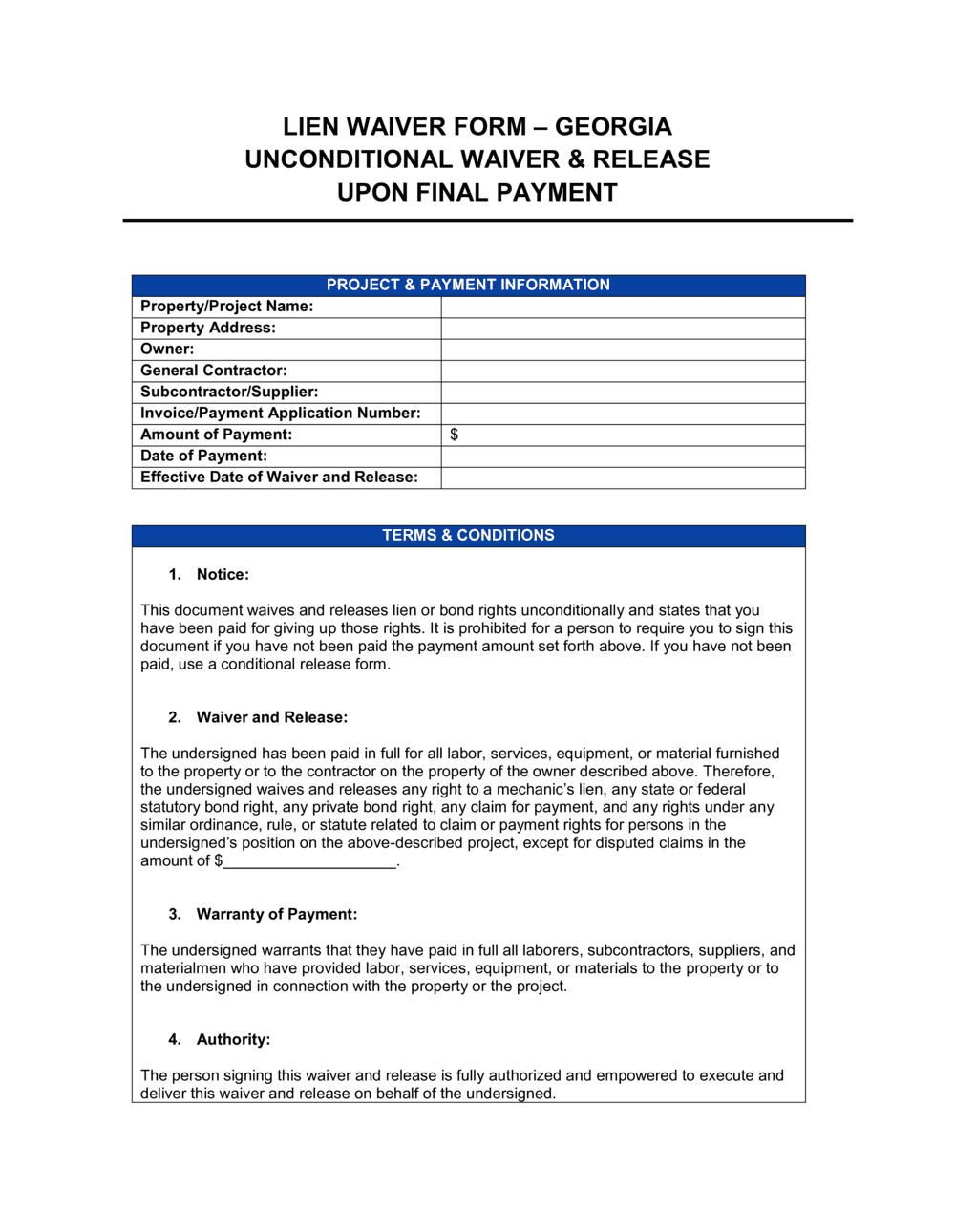
A Georgia Lien Waiver Form is a written document through which a contractor, subcontractor, or supplier waives their right to file a mechanics lien against a property in exchange for payment. This free Word download follows Georgia's statutory requirements under O.C.G.A. Β§ 44-14-366 and covers all four standard waiver types β€” conditional and unconditional, for both progress and final payments.
When you need it
Use it each time a payment is issued or received on a Georgia construction project. Property owners and general contractors typically require it before releasing funds; subcontractors and suppliers sign it to confirm they have been paid and are releasing their lien rights for that payment period.
What's inside
Project and property identification, claimant and customer details, payment amount and through-date, conditional or unconditional waiver language, exception carve-outs for unpaid amounts, and a notarization block as required under Georgia law.

What is a Georgia Lien Waiver Form?

A Georgia Lien Waiver Form is a written document in which a contractor, subcontractor, or material supplier formally releases their right to file a mechanics lien against a property in exchange for a specified payment. Georgia law under O.C.G.A. Β§ 44-14-366 prescribes four distinct waiver types β€” conditional and unconditional versions for both progress payments and final payments β€” each with mandatory form language and a notarization requirement. Signing the correct waiver type protects the claimant from inadvertently surrendering unpaid lien rights while giving property owners and lenders the title protection they need to release funds or close transactions.

Why You Need This Document

On any Georgia construction project, payments flow through multiple tiers β€” owner to GC, GC to subcontractors, subcontractors to suppliers β€” and each party retains the right to encumber the property's title until they are paid. Without a signed, notarized lien waiver at each payment exchange, unpaid claims can attach to the property silently, surfacing only when the owner attempts to sell, refinance, or obtain a certificate of occupancy. Title companies will not issue clean title insurance on a completed project without a complete set of executed waivers. For subcontractors and suppliers, using the wrong waiver type β€” particularly an unconditional waiver before a check has cleared β€” can permanently extinguish lien rights for payments never actually received. This template provides the statutory form language Georgia requires, covers all four waiver types in a single download, and eliminates the risk of using informal or non-compliant waiver language that courts and title companies will reject.

Which variant fits your situation?

If your situation is…Use this template
Payment is conditional β€” check has not yet clearedConditional Waiver on Progress Payment
Payment has been received and cleared in full for a draw periodUnconditional Waiver on Progress Payment
Final payment is conditional β€” final check has not yet clearedConditional Waiver on Final Payment
Final payment has been received and project is completeUnconditional Waiver on Final Payment
Project is in a different US state with its own statutory formsState-Specific Lien Waiver Form
Claimant wants to preserve rights to disputed or retainage amountsLien Waiver with Exceptions Addendum
Need to formally notify owner of unpaid balance before filing a lienPreliminary Notice / Notice to Owner

Common mistakes to avoid

❌ Signing an unconditional waiver before payment clears

Why it matters: If the check bounces or the wire is reversed after signing an unconditional waiver, the claimant has permanently surrendered their lien rights for a payment never actually received.

Fix: Always use a conditional waiver when payment has not yet cleared. Swap it for an unconditional waiver only after confirming funds in your account.

❌ Omitting the through date

Why it matters: A waiver without a through date is ambiguous about which work period it covers, making it difficult to establish what lien rights have been released and leaving future claims open to dispute.

Fix: Always enter a specific calendar date β€” e.g., 'April 30, 2026' β€” corresponding to the end of the pay period covered by the payment.

❌ Skipping notarization

Why it matters: Georgia law under O.C.G.A. Β§ 44-14-366 requires lien waivers to be notarized. An unnotarized waiver may not be enforceable and may not clear a title cloud in a closing or refinancing.

Fix: Have the claimant's signature notarized before delivering the waiver. Treat the notarization as a non-negotiable step in every payment exchange.

❌ Failing to list retainage in the exceptions field

Why it matters: Signing a progress payment waiver with no exceptions can be interpreted as releasing retainage that has not yet been paid, creating a costly dispute at project completion.

Fix: In the exceptions field, list the retained amount by dollar figure on every progress payment waiver until retainage is actually released.

The 9 key fields, explained

Project name and property address

Owner name

Claimant name and company

Customer / GC name

Payment amount

Through date

Waiver type designation

Exceptions and carve-outs

Notarization block

How to fill it out

  1. 1

    Select the correct waiver type

    Determine whether the payment has cleared (unconditional) or is still pending (conditional), and whether this is a progress or final payment. Check the correct box in the waiver type designation field before completing any other fields.

    πŸ’‘ When in doubt, use a conditional waiver β€” it protects the claimant until the funds actually clear and can always be replaced with an unconditional version afterward.

  2. 2

    Enter the project and property details

    Fill in the full project name and the complete street address of the property, including county. For subdivisions or commercial developments, include the lot or unit number as well.

    πŸ’‘ Cross-reference the property address against the original construction contract or the permit to ensure the address matches exactly.

  3. 3

    Identify all parties accurately

    Enter the property owner's legal name, the claimant's registered legal entity name, and the customer or GC making the payment. Use the exact names from your contract documents β€” not trade names or abbreviations.

    πŸ’‘ If the claimant is an LLC or corporation, include the entity type (e.g., 'ABC Plumbing, LLC') so the waiver matches the entity that holds lien rights.

  4. 4

    Enter the payment amount and through date

    Record the exact dollar amount of the payment being made, written out in both numerals and words. Set the through date to the last date of the pay period covered by this payment.

    πŸ’‘ Match the payment amount to the corresponding invoice or schedule of values line item β€” keeping a consistent paper trail makes future disputes much easier to resolve.

  5. 5

    List any exceptions explicitly

    If retainage has been withheld or any amounts are disputed, list them in the exceptions field by dollar amount. Do not leave this field blank if any amounts remain unpaid.

    πŸ’‘ State retainage as a dollar figure, not a percentage β€” '10% retainage' is ambiguous if the contract value changes.

  6. 6

    Have the claimant sign before a notary

    The claimant or an authorized officer of the claimant's entity must sign the waiver in the presence of a notary public. Complete the notarization block with the notary's signature, stamp, and commission expiration date.

    πŸ’‘ Many UPS Store, bank, and shipping locations offer walk-in notary services for a nominal fee β€” no appointment needed for straightforward document notarizations.

  7. 7

    Exchange with payment and retain copies

    Deliver the fully executed and notarized waiver to the paying party at the same time the payment is released. Both parties should retain signed copies for their project files.

    πŸ’‘ Scan and store the notarized original in a project folder immediately β€” physical documents are easily lost on busy job sites.

Frequently asked questions

What is a Georgia lien waiver form?

A Georgia lien waiver form is a document signed by a contractor, subcontractor, or supplier to release their right to file a mechanics lien against a property in exchange for a specified payment. Georgia law prescribes four statutory waiver types under O.C.G.A. Β§ 44-14-366: conditional and unconditional versions for both progress and final payments. Using the correct statutory form language β€” and notarizing it β€” is required for the waiver to be enforceable.

Does a Georgia lien waiver need to be notarized?

Yes. Georgia's lien waiver statute, O.C.G.A. Β§ 44-14-366, requires that lien waivers be executed in the presence of a notary public. An unnotarized waiver is generally not enforceable under Georgia law and will not satisfy a title company's requirements at closing. Always complete the notarization block with the notary's signature, seal, and commission expiration date before delivering the waiver.

What is the difference between a conditional and unconditional lien waiver?

A conditional waiver becomes effective only when the identified payment is actually received and clears. A claimant retains full lien rights if the payment fails for any reason. An unconditional waiver takes effect immediately upon signing, regardless of whether payment has been received. Claimants should sign conditional waivers when exchanging for a check and upgrade to unconditional only after confirming the funds have cleared their account.

When should a progress payment waiver be used versus a final payment waiver?

A progress payment waiver covers a partial payment made at a specific draw period during the project and releases lien rights only through the stated through date. A final payment waiver is signed at project completion when all amounts β€” including retainage β€” have been paid in full, and it releases all remaining lien rights. Using a final payment waiver before retainage is released waives your right to collect it.

Can a subcontractor waive lien rights for amounts not yet paid?

A subcontractor should never sign an unconditional waiver for amounts not yet received. Doing so permanently surrenders lien rights for that payment, even if the check is later returned or the wire reversed. Conditional waivers exist precisely to protect claimants in this situation β€” the waiver is contingent on actual receipt of funds.

Does a lien waiver eliminate all claims a subcontractor might have?

A lien waiver releases the claimant's right to file a mechanics lien against the specific property for the amounts covered. It does not necessarily eliminate breach-of-contract claims or claims for amounts listed in the exceptions field. If disputes remain over change orders or unpaid invoices, those should be explicitly listed as exceptions so the waiver does not inadvertently release them.

Are there penalties for using a non-statutory lien waiver form in Georgia?

Georgia does not automatically void a lien waiver that deviates from the statutory form, but courts will scrutinize non-statutory language closely, and title companies may refuse to accept it for closing purposes. Using the statutory form language established in O.C.G.A. Β§ 44-14-366 is the safest approach for all parties on any Georgia construction project.

Who typically prepares the lien waiver on a construction project?

In practice, the paying party β€” the general contractor or owner β€” often prepares the waiver form and presents it to the subcontractor or supplier to sign at payment time. However, the claimant signing the form should review it carefully before signing to confirm the waiver type, payment amount, through date, and exceptions all accurately reflect the transaction.

How long should lien waivers be retained after a project is complete?

Georgia's statute of limitations for mechanics lien actions is one year from the filing of the lien. As a best practice, retain all lien waivers for at least seven years after project completion β€” this aligns with standard construction document retention practices and covers most contract dispute windows. Store notarized originals, not just scanned copies.

How this compares to alternatives

vs Mechanics Lien Form

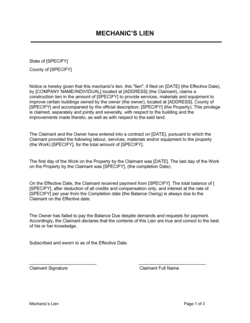
A mechanics lien form is filed with the county recorder to assert an unpaid claim against a property. A lien waiver releases that right in exchange for payment. The two documents are opposite sides of the same transaction β€” a lien is the claim; a waiver is its release. Use a waiver when payment has been made and a lien when it has not.

vs Preliminary Notice / Notice to Owner

A preliminary notice is sent at the start of a project to preserve the right to file a lien if payment is later withheld β€” it is a protective filing, not a release. A lien waiver is signed at payment to release those rights. The notice comes first; the waiver comes at payment time.

vs Final Lien Release

A final lien release is an unconditional waiver on final payment β€” it covers all work performed on the project and closes out all lien rights permanently. A progress payment waiver covers only a specific pay period. Use a final release only when all amounts, including retainage, have been paid in full.

vs Joint Check Agreement

A joint check agreement requires the GC to issue payment checks made out to both the subcontractor and their material supplier, ensuring the supplier is paid directly. A lien waiver documents the release of rights after payment occurs. The two are often used together on large projects to protect the owner from supplier liens.

Industry-specific considerations

Residential construction

Homebuilders and remodelers use progress payment waivers at each draw to protect the owner's title before releasing funds to subs and suppliers.

Commercial construction

Construction lenders require notarized waivers from all tier-one and often tier-two subcontractors as a condition of each loan draw disbursement.

Real estate development

Developers collect final unconditional waivers from all parties before closing or refinancing to deliver clean title to buyers and lenders.

Specialty and trade contractors

Electricians, plumbers, and HVAC contractors sign conditional waivers at payment time to protect their lien rights until checks clear, particularly on multi-prime projects.

Template vs pro β€” what fits your needs?

PathBest forCostTime
Use the templateContractors, subcontractors, and suppliers exchanging waivers on standard Georgia construction projectsFree5–10 minutes per waiver
Template + professional reviewProjects with complex retainage structures, disputed change orders, or multiple tiers of subcontractors$150–$400 for a construction attorney review1–2 business days
Custom draftedLarge commercial projects, design-build contracts, or situations involving title insurance requirements with specific waiver language$500–$1,500+3–5 business days

Glossary

Mechanics Lien
A legal claim filed against a property by a contractor, subcontractor, or supplier who has not been paid for work or materials, encumbering the title until the debt is resolved.
Conditional Waiver
A lien waiver that becomes effective only upon the actual receipt and clearance of the identified payment β€” the claimant retains lien rights until the funds clear.
Unconditional Waiver
A lien waiver that takes effect immediately upon signing, regardless of whether the payment has been received or cleared β€” used only after funds are confirmed.
Progress Payment
A partial payment made at a defined milestone or draw period during the course of a construction project, covering work completed through a specified date.
Final Payment
The last payment on a construction project, covering all remaining amounts owed including any retainage previously withheld.
Retainage
A percentage of each progress payment β€” typically 5–10% β€” withheld by the owner or GC and released upon satisfactory project completion.
Claimant
The contractor, subcontractor, or material supplier who holds or could hold lien rights and is signing the waiver.
Through Date
The specific date through which the waiver releases lien rights β€” work performed or materials delivered after this date are not covered by the waiver.
O.C.G.A. Β§ 44-14-366
The Georgia statute that prescribes the mandatory form language and notarization requirements for valid lien waivers on Georgia construction projects.
Title Cloud
Any unresolved claim, lien, or encumbrance against a property's title that complicates or prevents a clean sale, refinancing, or transfer.

Part of your Business Operating System

This document is one of 3,000+ business & legal templates included in Business in a Box.

  • Fill-in-the-blanks β€” ready in minutes
  • 100% customizable Word document
  • Compatible with all office suites
  • Export to PDF and share electronically

Create your document in 3 simple steps.

From template to signed document β€” all inside one Business Operating System.
1
Download or open template

Access over 3,000+ business and legal templates for any business task, project or initiative.

2
Edit and fill in the blanks with AI

Customize your ready-made business document template and save it in the cloud.

3
Save, Share, Send, Sign

Share your files and folders with your team. Create a space of seamless collaboration.

Save time, save money, and create top-quality documents.

β˜…β˜…β˜…β˜…β˜…

"Fantastic value! I'm not sure how I'd do without it. It's worth its weight in gold and paid back for itself many times."

Managing Director Β· Mall Farm
Robert Whalley
Managing Director, Mall Farm Proprietary Limited
β˜…β˜…β˜…β˜…β˜…

"I have been using Business in a Box for years. It has been the most useful source of templates I have encountered. I recommend it to anyone."

Business Owner Β· 4+ years
Dr Michael John Freestone
Business Owner
β˜…β˜…β˜…β˜…β˜…

"It has been a life saver so many times I have lost count. Business in a Box has saved me so much time and as you know, time is money."

Owner Β· Upstate Web
David G. Moore Jr.
Owner, Upstate Web

Run your business with a system β€” not scattered tools

Stop downloading documents. Start operating with clarity. Business in a Box gives you the Business Operating System used by over 250,000 companies worldwide to structure, run, and grow their business.

Free Forever PlanΒ Β·Β No credit card required