1
Identify the purpose and jurisdictional requirements
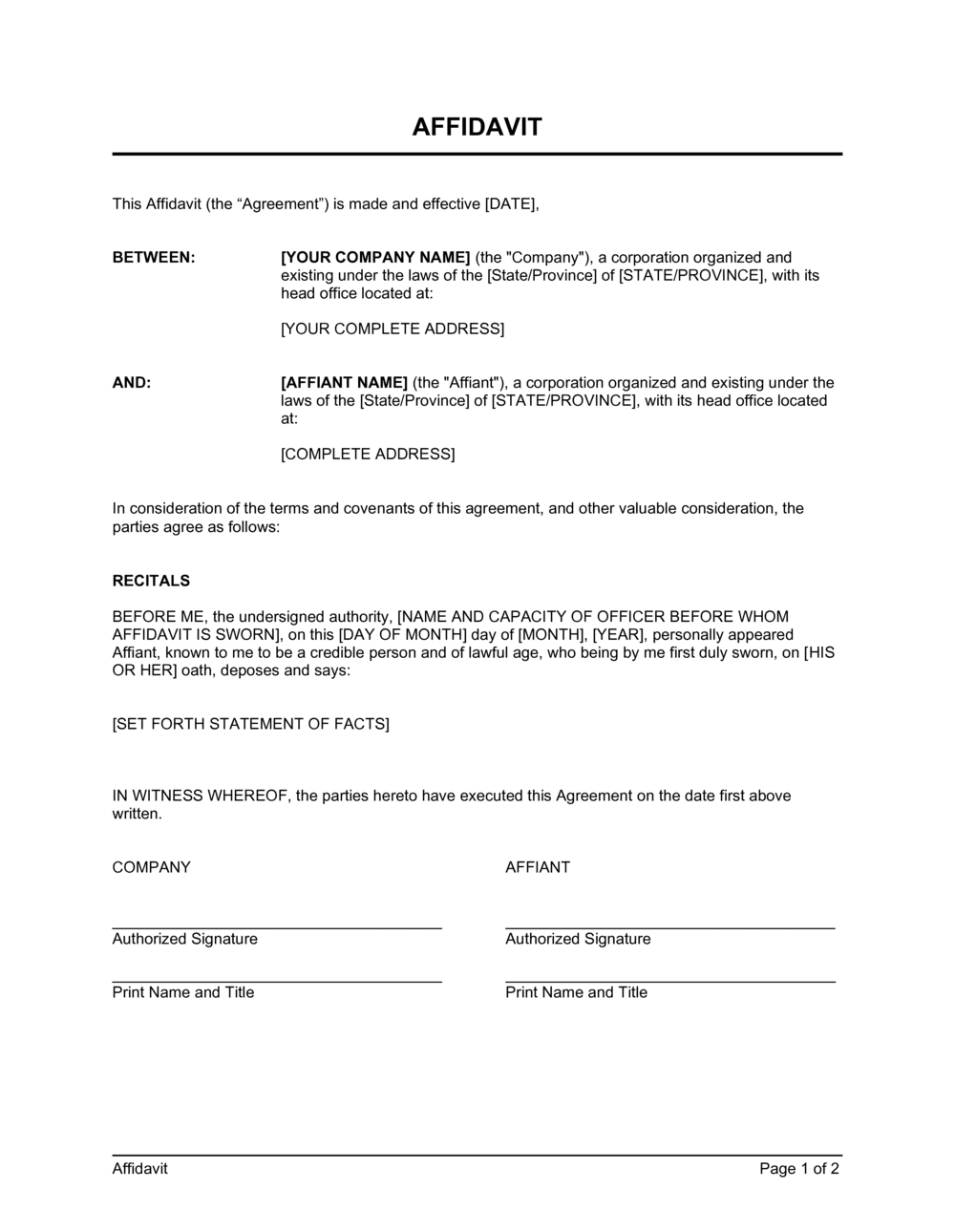
Determine the court, agency, or matter the affidavit will be filed with, and confirm the specific form and notarization requirements for that jurisdiction. Federal courts, state courts, and government agencies each have their own standards.
💡 Check the specific court's local rules or the agency's published instructions before drafting — requirements for jurat language and seal type vary significantly.
2
Complete the caption with the correct court and case details
Enter the full name of the court or authority, the matter or case name exactly as it appears on file, and the assigned case number. For pre-litigation affidavits, use a descriptive heading in place of a case number.
💡 Copy the caption directly from a previously filed document in the same matter to eliminate transcription errors.
3
Fill in the affiant's full legal identification
Enter the affiant's full legal name, current residential address, date of birth or age, and occupation. These details must match the government-issued ID the notary will verify at execution.
💡 If the affiant has recently changed their name, note the former name in parentheses to avoid identity challenges.
4
Draft the factual statements in numbered paragraphs
Write each fact as a separate numbered paragraph using plain, declarative sentences. Restrict each paragraph to one discrete fact within the affiant's personal knowledge. Avoid legal conclusions, argument, or hearsay.
💡 Read each paragraph aloud and ask: could a judge strike this as opinion or argument? If yes, reframe it as a direct observation — what you saw, heard, or did.
5
Attach and reference all supporting exhibits
Compile every supporting document referenced in the factual paragraphs. Label each Exhibit A, B, C in the order first mentioned and insert the reference — 'attached hereto as Exhibit A' — in the corresponding paragraph.
💡 Use only true copies of original documents as exhibits. Altered or incomplete copies can be challenged and will undermine the entire affidavit.
6
Review for hearsay and inadmissible statements
Review each numbered paragraph and flag any statement not based on the affiant's direct observation. Add 'on information and belief' and identify the source for any indirect knowledge, or remove the paragraph entirely.
💡 Opposing counsel will read the affidavit specifically looking for hearsay — a single objectionable paragraph can trigger a motion to strike the whole document.
7
Execute before a notary or commissioner of oaths
Bring the unsigned affidavit and government-issued photo ID to a notary public or commissioner of oaths. Do not pre-sign. The notary will verify identity, administer the oath, witness the signing, and complete the jurat with seal.
💡 Bring one additional copy for the notary to retain if required by local practice, and ask for a certified copy for your own records at the same appointment.
8
File or serve the executed affidavit promptly
File with the court or agency, or serve on the opposing party, within the deadline set by the relevant procedural rules. Retain a conformed copy with the file stamp as proof of timely filing.
💡 Set a calendar reminder for the filing deadline the moment you know it — late affidavits are typically rejected outright, with no discretion to accept them after the fact.