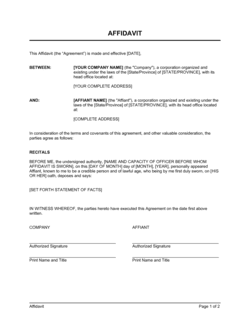
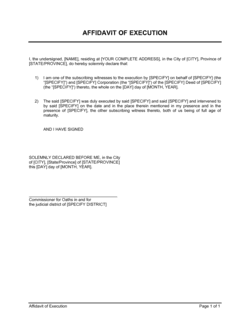
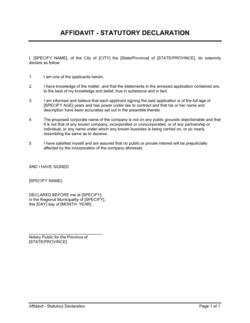
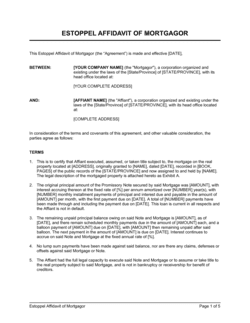
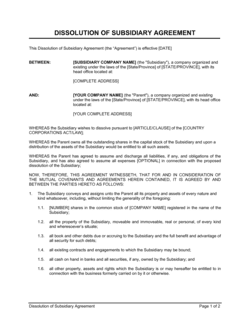
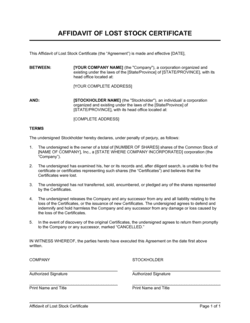
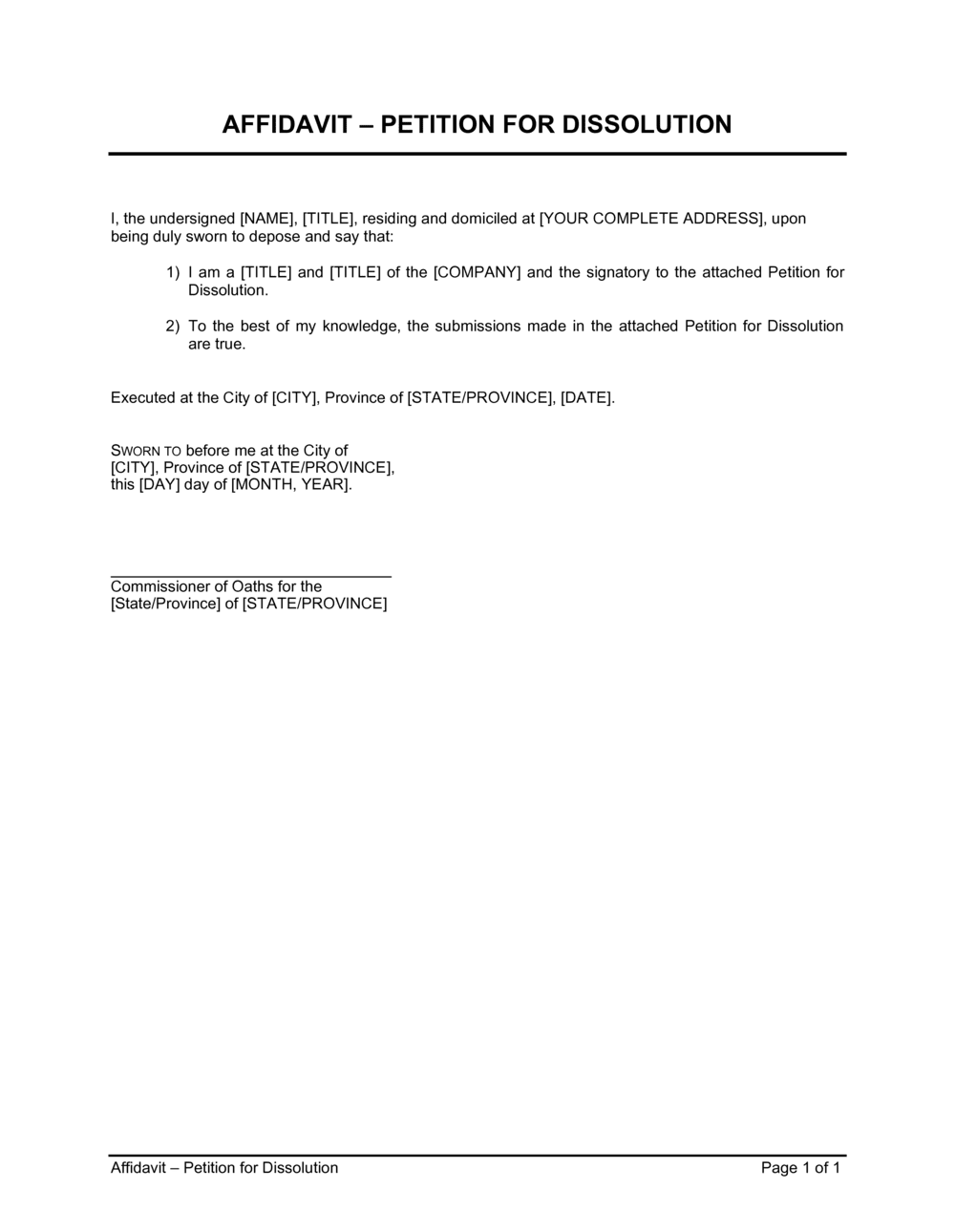
Affidavit Petition for Dissolution Template

Free Word download • Edit online • Save & share with Drive • Export to PDF

1 page20–30 min to fillDifficulty: StandardSignature requiredLegal review recommended
Learn more ↓
FreeAffidavit Petition for Dissolution Template

At a glance

What it is
An Affidavit Petition for Dissolution is a sworn legal document filed by an authorized representative of a business entity — corporation, LLC, or partnership — formally declaring the intent to dissolve and wind up the entity's affairs. This free Word download gives you a structured, court-ready starting point you can edit online and export as PDF to submit to the relevant state, provincial, or national registrar.
When you need it
Use it when a business has voted to dissolve voluntarily, when a statutory dissolution trigger has been met (e.g., a fixed term has expired), or when a court or regulatory body requires a sworn petition to initiate the formal winding-up process.
What's inside
Sworn identification of the petitioner and entity, grounds for dissolution, confirmation of member or shareholder authorization, statements on debt settlement and asset distribution, representations regarding pending litigation, and a notarized signature block with governing-law citation.

What is an Affidavit Petition for Dissolution?

An Affidavit Petition for Dissolution is a sworn legal document executed by an authorized representative of a business entity — corporation, LLC, or partnership — formally declaring under oath that all statutory requirements for dissolving the entity have been met and requesting that the relevant government authority or court approve the winding-up and deregistration. Unlike a standard registration form, an affidavit petition carries the weight of sworn testimony: the petitioner attests that the ownership vote was properly conducted, all known debts have been settled or provided for, pending litigation has been disclosed, and assets are ready for lawful distribution. The document is notarized before filing, making any material misrepresentation a serious legal exposure rather than a simple administrative error.

Why You Need This Document

Closing a business without a properly executed dissolution petition leaves the entity — and its former owners — exposed in ways that compound over time. An entity that continues to exist on the registry accumulates annual fees, franchise taxes, and filing obligations long after it ceases operating. Worse, creditors retain the right to sue the entity, and in many jurisdictions can reach former owners who received distributions while debts remained unpaid. The affidavit petition creates a documented, sworn record that the wind-up was conducted lawfully — that all creditors were notified, all taxes were cleared, all litigation was disclosed, and assets were distributed only after obligations were satisfied. Without it, there is no evidentiary record to defend against a claimant who surfaces two years after the business closed its doors. This template gives you a structured, court-ready starting point that enforces the correct sequence of steps, so the dissolution you complete today does not become a liability you carry indefinitely.

Which variant fits your situation?

If your situation is…Use this template
Voluntary dissolution initiated by shareholders or membersAffidavit Petition for Dissolution (Voluntary)
Administrative dissolution triggered by failure to file annual reportsApplication for Reinstatement or Dissolution Notice Response
Court-ordered or involuntary dissolution of a corporationPetition for Judicial Dissolution
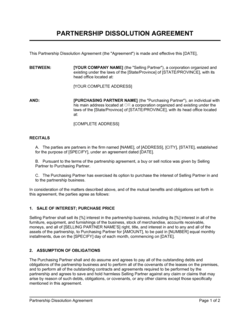
Dissolution of a general or limited partnershipPartnership Dissolution Agreement
Winding up an LLC with a formal member voteLLC Dissolution Agreement
Dissolving a nonprofit and distributing remaining charitable assetsNonprofit Dissolution Plan
Terminating a joint venture at project completionJoint Venture Termination Agreement

Common mistakes to avoid

❌ Filing before settling all tax obligations

Why it matters: Most jurisdictions will reject a dissolution filing if outstanding tax returns or balances remain. Even if initially accepted, tax authorities can later assess officers personally for unpaid corporate taxes after dissolution.

Fix: File all outstanding returns and pay all balances — or obtain a formal payment plan — before submitting the petition. Obtain a tax clearance certificate where required and attach it to the filing.

❌ Using the wrong entity name on the affidavit

Why it matters: A name that does not exactly match the registrar's records — even a missing comma or 'LLC' versus 'L.L.C.' — will cause the filing to be rejected, resetting the statutory timeline and potentially incurring additional fees.

Fix: Pull the entity's current record directly from the secretary of state's online database and copy the name field exactly, including punctuation and capitalization.

❌ Distributing assets to owners before creditors are fully paid

Why it matters: Pre-dissolution distributions to equity holders while creditors remain unpaid constitute fraudulent transfers in virtually every jurisdiction. Both the entity and the recipients can be sued to claw back the transferred funds.

Fix: Complete the full creditor notification process, wait for the statutory notice period to expire, resolve all known claims, and only then distribute residual assets to owners.

❌ Omitting known pending claims from the litigation disclosure

Why it matters: Signing an affidavit that falsely states no litigation is pending is perjury and can pierce the corporate veil, exposing former owners to personal liability for claims that survive dissolution.

Fix: Conduct a thorough review — accounts payable aging, email correspondence, demand letters, and any threatened claims — before completing the litigation disclosure section. When in doubt, disclose and address.

❌ Signing outside the presence of a notary

Why it matters: An affidavit signed without proper notarization is legally void. Registrars and courts will reject the filing outright, and in some jurisdictions a defective affidavit submission carries a penalty fee.

Fix: Schedule notarization before signing anything. Do not pre-sign the document and bring it to the notary — the notary must witness the act of signing.

❌ Failing to cancel state licenses, permits, and registrations after dissolution

Why it matters: Dissolved entities that retain active business licenses, tax registrations, or professional permits continue to accumulate annual fees, renewal obligations, and in some states, franchise taxes — even after the entity no longer operates.

Fix: After receiving the certificate of dissolution, systematically cancel all state and local licenses, employer identification numbers, sales tax permits, and any DBA registrations associated with the entity.

The 10 key clauses, explained

Petitioner identification and authority

In plain language: Identifies the individual signing the affidavit by full legal name and title, and confirms they are authorized to act on the entity's behalf under its governing documents or a formal resolution.

Sample language
I, [PETITIONER FULL NAME], [TITLE] of [ENTITY LEGAL NAME], a [ENTITY TYPE] organized under the laws of [STATE/PROVINCE/COUNTRY], do hereby solemnly swear that I am duly authorized to execute this Petition on behalf of the [ENTITY TYPE].

Common mistake: Signing as an individual rather than as an authorized representative of the entity. A personally signed affidavit without an explicit capacity statement can be rejected by the registrar as lacking standing.

Entity particulars

In plain language: States the entity's full registered legal name, registration number, date of formation, registered address, and the jurisdiction under whose laws it was formed.

Sample language
[ENTITY LEGAL NAME], [ENTITY TYPE], registered under file number [REGISTRATION NUMBER], formed on [FORMATION DATE], with a registered office at [REGISTERED ADDRESS], [CITY], [STATE/PROVINCE], [ZIP/POSTAL CODE].

Common mistake: Using a trade name or DBA rather than the exact registered legal name. A mismatch with the registrar's records will cause the petition to be rejected without explanation.

Grounds and basis for dissolution

In plain language: States the legal and factual basis for the dissolution — for example, a member vote, expiry of a fixed term, achievement of the entity's stated purpose, or a triggering event under the governing documents.

Sample language
The dissolution is sought on the following grounds: [REASON — e.g., a unanimous vote of the members taken on [DATE] in accordance with Article [X] of the Operating Agreement / expiration of the fixed term on [DATE]].

Common mistake: Citing only a general desire to close without referencing the specific authorization mechanism — board resolution, member vote percentage, or governing-document article. Registrars require the legal basis, not just the intent.

Authorization and consent

In plain language: Confirms that the dissolution was approved by the required majority of shareholders, members, or partners as mandated by the governing documents and applicable statute, and that the required vote or consent was properly documented.

Sample language
The dissolution was approved by [X]% of the [shareholders / members / partners] of [ENTITY LEGAL NAME] on [DATE], constituting the requisite [majority / supermajority] required under [GOVERNING DOCUMENT] and [APPLICABLE STATUTE].

Common mistake: Stating the vote occurred without specifying the percentage achieved or the quorum present. Many registrars and courts require the exact vote count to confirm statutory compliance.

Debt and liability settlement representations

In plain language: Swears that the entity has either paid all known debts and liabilities or has made adequate provision for their payment before distribution of any residual assets.

Sample language
As of the date of this Petition, [ENTITY LEGAL NAME] has [paid in full / made adequate provision for the payment of] all known debts, obligations, and liabilities, including taxes owed to [STATE/FEDERAL/PROVINCIAL] authorities.

Common mistake: Representing all debts as settled when contingent liabilities — pending invoices, disputed claims, or tax assessments — remain open. A false sworn statement on this clause exposes the petitioner to personal liability.

Pending litigation disclosure

In plain language: Discloses any active, threatened, or pending legal proceedings involving the entity and describes how they will be resolved, dismissed, or assumed before final dissolution.

Sample language
As of the date hereof, [ENTITY LEGAL NAME] [is not a party to any pending legal proceedings / is a party to the following proceedings: [DESCRIPTION], which will be [resolved / assumed by / transferred to] [PARTY] prior to final dissolution].

Common mistake: Omitting known pending claims to avoid complications. Courts and registrars treat non-disclosure as a material misrepresentation; undisclosed claims can survive dissolution and be pursued against former owners personally.

Asset distribution plan

In plain language: Describes how residual assets will be distributed after liabilities are settled, identifying the recipients (shareholders, members, or partners) and the basis for allocation — pro rata by ownership percentage or as otherwise agreed.

Sample language
Upon satisfaction of all liabilities, the remaining assets of [ENTITY LEGAL NAME] shall be distributed to its [shareholders / members / partners] on a pro-rata basis according to their respective ownership interests as set out in [GOVERNING DOCUMENT / SCHEDULE A].

Common mistake: Distributing assets before all creditors are paid or statutory notice periods have expired. Pre-creditor distributions create fraudulent transfer exposure for both the entity and the recipients.

Tax clearance and compliance representation

In plain language: Represents that the entity has filed all required tax returns and paid all outstanding tax obligations, or has obtained a tax clearance certificate from the applicable revenue authority.

Sample language
The [ENTITY TYPE] has filed all required federal, state/provincial, and local tax returns through [DATE] and has [paid all taxes due / obtained a tax clearance certificate dated [DATE] from [TAX AUTHORITY]].

Common mistake: Skipping this clause or leaving tax clearance as an afterthought. Many jurisdictions will not accept a dissolution filing without a tax clearance number, and unfiled returns can surface as personal assessments against officers after dissolution.

Effective date of dissolution

In plain language: States the intended effective date of dissolution — either the filing date, a specified future date, or the date the registrar issues the certificate of dissolution.

Sample language
The effective date of dissolution of [ENTITY LEGAL NAME] shall be [the date of filing of this Petition with the [REGISTRAR] / [SPECIFIC DATE] / the date of issuance of the Certificate of Dissolution by the [REGISTRAR]].

Common mistake: Leaving the effective date blank or ambiguous. An undefined effective date creates uncertainty about when the entity ceased to exist for tax, contract, and liability purposes.

Notarized signature and oath block

In plain language: The sworn declaration and notarization block where the petitioner signs under oath before a notary, attesting that all statements in the affidavit are true and correct to the best of their knowledge.

Sample language
Sworn and subscribed before me, a duly commissioned Notary Public, this [DAY] day of [MONTH], [YEAR]. [PETITIONER SIGNATURE] [PETITIONER NAME, TITLE]. Notary: [NOTARY NAME], Commission No. [NUMBER], Expires [DATE].

Common mistake: Signing the affidavit outside the presence of a notary or before a notary whose commission has expired. An improperly notarized affidavit is void and will be rejected outright by any court or government office.

How to fill it out

  1. 1

    Confirm authorization and obtain a board or member resolution

    Before completing the affidavit, ensure the dissolution has been formally approved by the required majority per your governing documents — articles of incorporation, operating agreement, or partnership agreement. Document the vote in a written resolution signed by all required parties.

    💡 Retain the signed resolution permanently. Registrars and courts may request it as supporting evidence even after dissolution is complete.

  2. 2

    Enter the entity's exact registered legal name and particulars

    Look up the entity's registration details on the applicable secretary of state or corporate registry website. Copy the legal name, registration number, and registered address character-for-character — do not rely on memory or a business card.

    💡 If the entity has changed its name or address since formation, verify which details appear in the current registry record, not which ones the business uses day-to-day.

  3. 3

    State the specific grounds and authorization for dissolution

    Identify the exact legal basis — unanimous member consent, supermajority shareholder vote, expiry of fixed term, or another triggering event — and cite the relevant article in your governing documents and the applicable state statute.

    💡 Check your state or provincial statute for the minimum required vote threshold. Some jurisdictions require a two-thirds supermajority rather than a simple majority for dissolution.

  4. 4

    Complete the debt, liability, and tax clearance sections

    Review all outstanding payables, pending invoices, loan balances, tax accounts, and any accrued liabilities. Obtain a tax clearance certificate from your state or federal revenue authority if required. Enter the clearance certificate number and date in the template.

    💡 Request tax clearance at least 6–8 weeks before your intended filing date — processing times vary widely and are a common cause of dissolution delays.

  5. 5

    Disclose all pending or threatened litigation

    List every known legal proceeding — lawsuits, regulatory investigations, arbitration claims, or creditor disputes — and describe how each will be resolved before the dissolution is finalized.

    💡 When in doubt, disclose. An omitted claim is far more damaging than a disclosed one: it can expose former officers to personal liability after the entity is gone.

  6. 6

    Describe the asset distribution plan

    Identify all remaining assets, confirm all creditors have been or will be paid, and set out the distribution to owners by name and percentage. Attach a Schedule A if the distribution is complex or involves non-cash assets.

    💡 Do not distribute assets until the statutory creditor notice period has run — in most US states this is 30–120 days from the date of the dissolution notice.

  7. 7

    Have the affidavit notarized before filing

    Sign the affidavit in the physical presence of a commissioned notary public. The notary must verify your identity with government-issued photo ID, witness your signature, and affix their seal and commission details.

    💡 Many UPS Stores, banks, and law offices offer notary services for $5–$15. Some jurisdictions now accept remote online notarization — check local rules before scheduling.

  8. 8

    File with the appropriate registrar and retain a certified copy

    Submit the notarized affidavit along with any required accompanying forms, fees, and the certificate of good standing to the secretary of state, corporate registry, or court clerk as required by your jurisdiction.

    💡 Request a stamped or certified copy of the filed petition at submission. You will need it to close bank accounts, notify creditors, and cancel business licenses.

Frequently asked questions

What is an affidavit petition for dissolution?

An affidavit petition for dissolution is a sworn legal document filed with a government registrar or court to formally initiate the winding-up and termination of a business entity. The petitioner — typically an officer, director, or managing member — swears under oath that the entity has met all statutory requirements for dissolution, including authorization by the required ownership majority, settlement of debts, and disclosure of any pending litigation. It is distinct from the articles of dissolution in that it is a sworn statement of facts rather than simply a registration form.

When is an affidavit petition for dissolution required?

It is typically required when a jurisdiction's dissolution statute or court rules mandate a sworn statement as part of the filing package. Some states and provinces require an affidavit when assets are being distributed to owners, when the dissolution involves a regulated entity (such as a professional corporation or licensed business), or when the petitioner is filing on behalf of an entity in which they are not the sole owner. Always check the specific requirements of the registrar in the entity's jurisdiction of formation before preparing the filing.

What is the difference between an affidavit petition for dissolution and articles of dissolution?

Articles of dissolution are the formal registration form submitted to the secretary of state or corporate registry that legally terminates the entity's registration. An affidavit petition is a sworn evidentiary statement that supports the articles — it attests to the facts underlying the dissolution, such as the ownership vote, debt settlement, and asset distribution. Some jurisdictions require both; others require only one. In court-supervised dissolutions, the affidavit petition is the primary document before the judge.

Does the affidavit petition for dissolution need to be notarized?

Yes, in virtually all jurisdictions. An affidavit is by definition a sworn statement, and notarization is the mechanism that authenticates the oath. The notary verifies the signer's identity, witnesses the signing, and affixes their seal. An un-notarized or improperly notarized affidavit will be rejected by any court or government office. Some jurisdictions now accept remote online notarization — confirm local rules before scheduling.

Can I dissolve my business if it still has outstanding debts?

Generally, no — most jurisdictions require that all known debts and liabilities be satisfied or adequately provided for before dissolution is complete. Distributing assets to owners while creditors remain unpaid constitutes a fraudulent transfer and can expose former owners to personal liability. The proper process is to notify creditors, allow the statutory notice period to run, pay all valid claims, and only then distribute residual assets. Some jurisdictions permit dissolution with a plan of distribution that addresses how remaining obligations will be handled.

Who must sign the affidavit petition for dissolution?

The affidavit must be signed by a person with actual authority to act on behalf of the entity — typically a current officer (CEO, president, or secretary) for a corporation, a managing member for an LLC, or a general partner for a partnership. The capacity must be stated explicitly on the document. If the entity's governing documents require a specific officer to execute dissolution filings, that individual must sign. Consider consulting a lawyer if there is any dispute about who holds authority, especially in multi-owner entities.

How long does the dissolution process typically take?

From the initial ownership vote to receipt of the certificate of dissolution, the process typically takes 4 to 16 weeks depending on the jurisdiction, whether tax clearance is required, and the registrar's current processing times. The statutory creditor notice period alone ranges from 30 days in some US states to 120 days in others. Jurisdictions with online filing systems — Delaware, Wyoming, and Alberta — tend to process faster than those requiring paper submissions.

What happens to the business's contracts and obligations after dissolution?

Dissolution does not automatically extinguish existing contracts or obligations. Most jurisdictions provide a wind-down period — typically 1 to 5 years — during which the dissolved entity retains limited legal capacity to collect receivables, pay debts, and defend or pursue litigation arising before dissolution. Creditors with valid claims can still pursue the entity or, in some circumstances, former owners who received post-dissolution distributions. Contracts should be formally terminated, assigned, or allowed to expire during the winding-up phase.

Do I need a lawyer to file an affidavit petition for dissolution?

For simple single-owner LLCs or sole proprietorships with no outstanding debts, pending litigation, or complex asset distribution, a well-prepared template combined with a brief consultation is often sufficient. A lawyer is strongly recommended when the entity has multiple owners who disagree, when litigation is pending, when significant assets are being distributed, when the entity operates in a regulated industry, or when personal liability exposure is a concern. A dissolution handled incorrectly can create years of ongoing liability — legal fees of $500–$2,000 at this stage are typically worthwhile.

What documents should I retain after dissolution is complete?

Retain the original signed and notarized affidavit petition, the certificate of dissolution issued by the registrar, all board or member resolutions authorizing dissolution, the final tax returns and tax clearance certificate, records of all creditor payments and notices, the final asset distribution schedule, and all corporate books and records. Most jurisdictions require business records to be retained for 5 to 7 years after dissolution. Store copies securely — these records are your evidence of a clean wind-up if any claim surfaces after the entity is gone.

How this compares to alternatives

vs Partnership Dissolution Agreement

A partnership dissolution agreement is a contract between the partners themselves governing how assets, liabilities, and responsibilities are divided upon winding up. An affidavit petition for dissolution is a sworn filing directed at a government registrar or court confirming that the dissolution has been properly authorized and executed. You typically need both: the agreement governs the internal arrangement; the affidavit petition completes the external deregistration.

vs Articles of Dissolution

Articles of dissolution are the standard registration form filed with the secretary of state to formally deregister an entity. An affidavit petition is a sworn evidentiary statement supporting that filing — attesting to facts such as the ownership vote, debt settlement status, and asset distribution. Some jurisdictions require only the articles; others require the affidavit as well, particularly for court-supervised or contested dissolutions.

vs Board Resolution to Dissolve

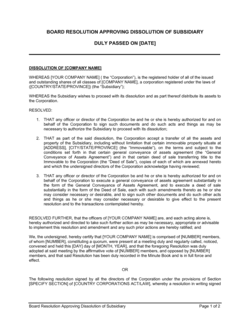
A board or member resolution to dissolve is the internal corporate action that authorizes dissolution — it is the decision. An affidavit petition is the sworn public filing that executes and memorializes that decision before a registrar or court. The resolution is evidence that the required vote occurred; the affidavit petition is the legal mechanism that triggers the formal winding-up process.

vs Business Closure Letter

A business closure letter is an informal notice sent to customers, suppliers, or employees announcing that the business is ceasing operations. It carries no legal weight for deregistration purposes. An affidavit petition for dissolution is a sworn legal document filed with a government authority and is legally required to terminate the entity's existence. A closure letter supplements communication; the affidavit petition accomplishes the legal act.

Industry-specific considerations

Technology / SaaS

IP ownership must be formally transferred or abandoned before dissolution, and any SaaS customer contracts must be terminated with statutory notice to avoid ongoing service obligations after the entity ceases to exist.

Professional Services

Licensed professional corporations — law firms, accounting practices, medical PCs — must notify their licensing board of dissolution and surrender professional licenses, often as a precondition to registrar acceptance of the petition.

Retail / E-commerce

Outstanding customer orders, gift cards, and return obligations must be addressed in the asset distribution plan, and sales tax accounts must be closed with the relevant state revenue authorities as part of the dissolution process.

Construction and Trades

Contractor licenses, bonding, and surety obligations tied to the entity must be cancelled or transferred, and any outstanding project warranties or lien claims must be resolved before the affidavit can truthfully represent all liabilities as settled.

Financial Services

Regulated entities such as investment advisers, broker-dealers, or lending companies must obtain regulatory approval or no-objection confirmation from their primary regulator — SEC, FINRA, or state banking authority — before or alongside the dissolution filing.

Nonprofit / Charitable Organizations

Nonprofit dissolutions require a specific plan for distributing remaining charitable assets to another qualified exempt organization, and the affidavit must reference IRS compliance and state attorney general notification, which is typically mandatory.

Jurisdictional notes

United States

Dissolution requirements vary significantly by state. Delaware, Wyoming, and Nevada have streamlined online processes; California requires a Tax Clearance Certificate from the Franchise Tax Board before dissolution is accepted for LLCs and corporations with outstanding tax obligations. Most states impose a creditor notice period of 30 to 120 days. Non-compliance with state-specific requirements can result in administrative reinstatement fees or personal liability for officers who distributed assets prematurely.

Canada

Federally incorporated companies dissolve under the Canada Business Corporations Act; provincially incorporated entities follow provincial legislation (e.g., Ontario's Business Corporations Act or Alberta's Business Corporations Act). A Certificate of Compliance or tax clearance from the CRA is typically required before Corporations Canada or a provincial registrar will accept the dissolution filing. Quebec requires French-language documentation for provincially regulated entities.

United Kingdom

In the UK, voluntary dissolution of a private company is typically achieved by striking off under the Companies Act 2006, using form DS01. A sworn affidavit is not standard for routine striking-off but is required in court-supervised winding-up proceedings. HMRC must be notified, and all tax accounts must be closed. Companies with employees, trading contracts, or assets generally must use a formal liquidation process rather than a simple striking-off application.

European Union

Dissolution procedures are governed by member-state law and vary substantially. Germany requires a notarial deed for GmbH dissolution and a creditor waiting period of one year before final deregistration. France mandates a dissolution decision published in an official gazette and registration with the Registre du Commerce. GDPR obligations do not automatically terminate on dissolution — data processor agreements and records of processing must be formally closed and data destroyed or transferred, with documentation retained.

Template vs lawyer — what fits your deal?

PathBest forCostTime
Use the templateSingle-owner LLCs or corporations with no outstanding debts, no pending litigation, and simple asset distribution in a jurisdiction with straightforward dissolution requirementsFree1–3 days (excluding tax clearance wait time)
Template + legal reviewMulti-owner entities, regulated industries, or entities with residual liabilities requiring a one-time attorney review before filing$500–$1,5001–2 weeks
Custom draftedContested dissolutions, court-supervised proceedings, entities with significant assets, pending litigation, or cross-border operations$2,000–$8,000+4–12 weeks

Glossary

Affidavit
A written statement of fact made under oath and signed before a notary public or other authorized officer, carrying legal weight equivalent to sworn testimony.
Dissolution
The formal legal process of terminating a business entity's existence, including settling debts, distributing assets, and deregistering with the applicable government authority.
Winding Up
The operational phase of dissolution during which the entity collects receivables, pays creditors, liquidates assets, and distributes any remainder to owners before final deregistration.
Petitioner
The individual — typically an officer, director, managing member, or authorized partner — who signs and submits the dissolution petition on behalf of the entity.
Articles of Dissolution
The formal filing submitted to the state or provincial secretary of state that legally terminates the entity's registration; the affidavit petition typically precedes or accompanies this filing.
Notarization
Authentication of a signature by a commissioned notary public who verifies the signer's identity and witnesses the oath, required for affidavits submitted to courts or government agencies.
Voluntary Dissolution
Dissolution initiated by the owners or governing body of the entity through a formal vote, as opposed to dissolution compelled by a court order or regulatory authority.
Statutory Minimum Notice
The legally required period during which creditors and claimants must be notified of the dissolution before the entity can be fully deregistered — typically 30 to 120 days depending on jurisdiction.
Residual Assets
Property, cash, or other assets remaining after all debts and liabilities of the entity have been fully satisfied, available for distribution to equity holders.
Certificate of Good Standing
A document issued by the registrar confirming that an entity has met all filing and tax obligations — often required before a dissolution petition will be accepted.
Registered Agent
The designated individual or company authorized to receive legal and government correspondence on behalf of an entity, including dissolution-related notices.

Part of your Business Operating System

This document is one of 3,000+ business & legal templates included in Business in a Box.

  • Fill-in-the-blanks — ready in minutes
  • 100% customizable Word document
  • Compatible with all office suites
  • Export to PDF and share electronically

Create your document in 3 simple steps.

From template to signed document — all inside one Business Operating System.
1
Download or open template

Access over 3,000+ business and legal templates for any business task, project or initiative.

2
Edit and fill in the blanks with AI

Customize your ready-made business document template and save it in the cloud.

3
Save, Share, Send, Sign

Share your files and folders with your team. Create a space of seamless collaboration.

Save time, save money, and create top-quality documents.

★★★★★

"Fantastic value! I'm not sure how I'd do without it. It's worth its weight in gold and paid back for itself many times."

Managing Director · Mall Farm
Robert Whalley
Managing Director, Mall Farm Proprietary Limited
★★★★★

"I have been using Business in a Box for years. It has been the most useful source of templates I have encountered. I recommend it to anyone."

Business Owner · 4+ years
Dr Michael John Freestone
Business Owner
★★★★★

"It has been a life saver so many times I have lost count. Business in a Box has saved me so much time and as you know, time is money."

Owner · Upstate Web
David G. Moore Jr.
Owner, Upstate Web

Run your business with a system — not scattered tools

Stop downloading documents. Start operating with clarity. Business in a Box gives you the Business Operating System used by over 250,000 companies worldwide to structure, run, and grow their business.

Free Forever Plan · No credit card required