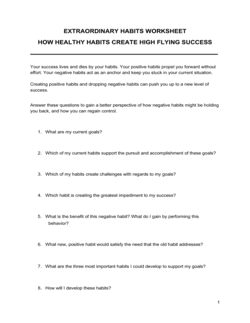
14 Habits Of Successful People Template

Free to read • Save or share with one click

Free14 Habits Of Successful People Template

At a glance

What it is
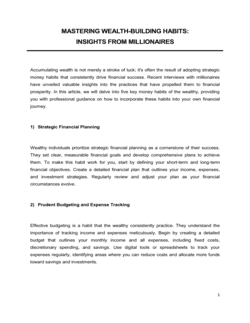
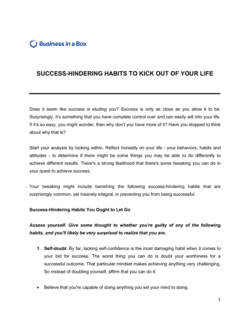
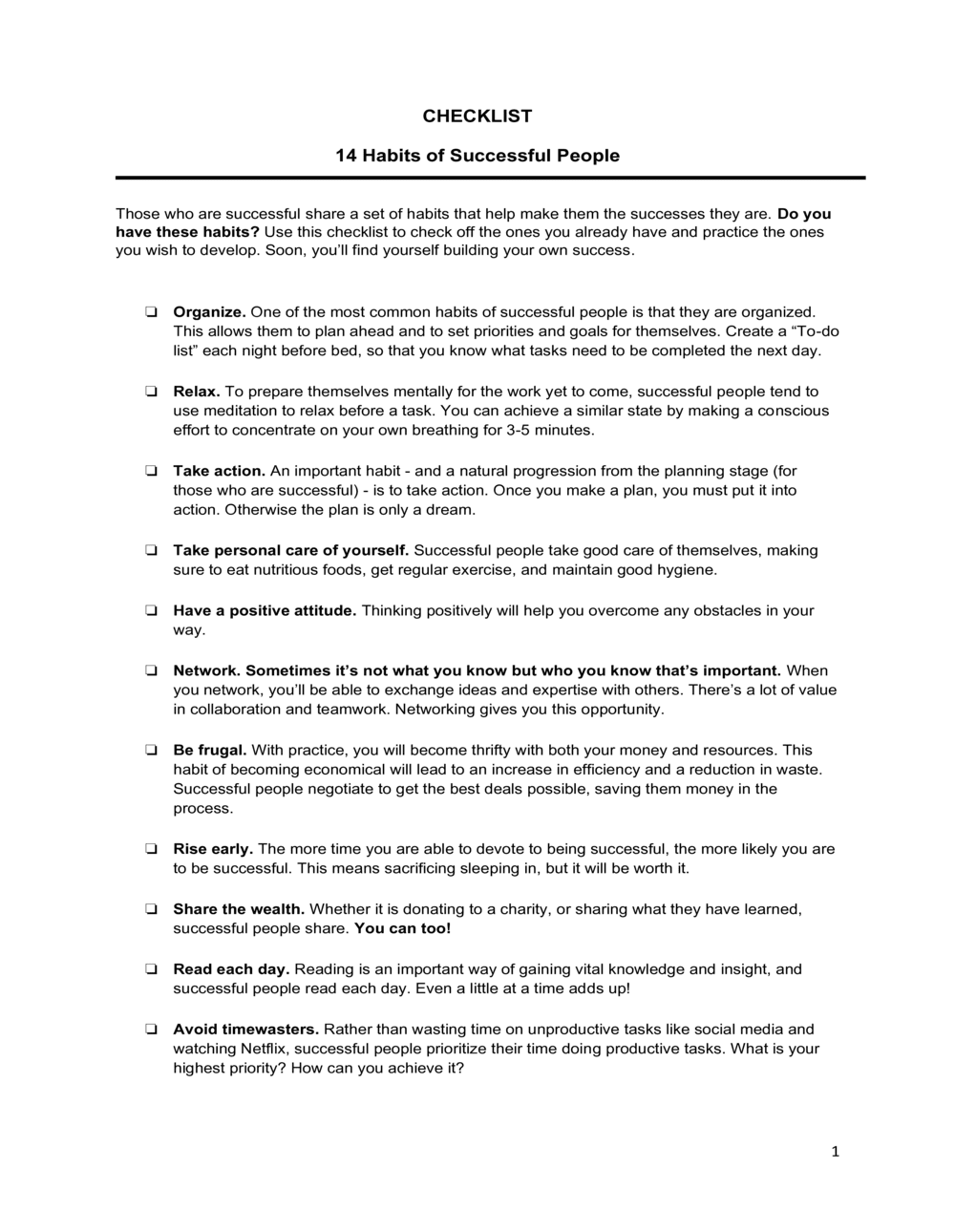
The 14 Habits of Successful People is a structured Word document that identifies, describes, and guides the application of fourteen proven behavioral habits shared by high-performing professionals and leaders. This free Word download gives you a ready-made framework you can edit, personalize, and distribute to individuals or teams, then export as PDF for coaching sessions, onboarding programs, or self-directed development.
When you need it
Use it when onboarding new hires, running leadership development workshops, building a personal productivity system, or coaching team members who need a concrete behavioral roadmap rather than abstract advice.
What's inside
Fourteen habit profiles covering mindset, time management, goal-setting, communication, continuous learning, and resilience — each with a plain- language explanation, practical application notes, and space to record personal commitments and progress.

What is a 14 Habits of Successful People document?

The 14 Habits of Successful People is a structured professional development document that identifies and describes fourteen behavioral patterns consistently observed in high-performing individuals across business, leadership, and entrepreneurship. Each habit is explained in plain language with practical application guidance, real-world examples, and a personal commitment section where the reader records specific implementation intentions and measurable targets. The document functions as both a self-directed coaching tool and a distributable resource for managers, trainers, and coaches who need a concrete behavioral framework — not a motivational poster — to drive genuine performance improvement.

Why You Need This Document

Without a structured habits framework, professional development conversations default to vague feedback like "be more proactive" or "improve your communication" — advice that produces no measurable behavior change because it lacks a behavioral definition and an implementation plan. The cost of that gap is visible in stalled careers, underperforming teams, and onboarding programs that fail to transfer practical skills. This template closes that gap by giving individuals a specific behavioral roadmap tied to daily actions, measurable metrics, and a personal commitment structure that creates accountability. Whether you are a manager coaching a high-potential employee, an HR professional building an onboarding curriculum, or an individual contributor ready to take deliberate control of your professional development, this document provides the foundation that generic advice never does.

Which variant fits your situation?

If your situation is…Use this template
Embedding habits into a structured onboarding experienceEmployee Onboarding Checklist
Tying habits to individual performance targetsIndividual Development Plan
Applying habits within a formal leadership curriculumLeadership Development Plan
Tracking daily habit completion over timeDaily Planner Template
Coaching a team member using habits as a behavioral baselineEmployee Performance Review Template
Running a group workshop around success habitsTraining Plan Template
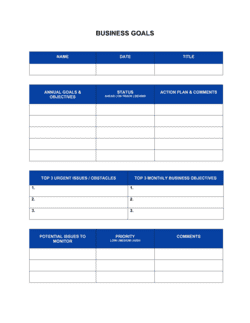
Setting measurable personal and professional goals tied to habitsSMART Goals Template

Common mistakes to avoid

❌ Trying to implement all fourteen habits at once

Why it matters: Attempting too many behavior changes simultaneously overwhelms cognitive resources and leads to abandoning all habits rather than building any. Research on habit formation points to two to three concurrent habits as the practical ceiling.

Fix: Use the personal commitment section to select exactly two to three habits for the first 30-day cycle. Add new habits only after the previous ones feel automatic.
❌ Treating the document as a reading exercise rather than an action plan

Why it matters: Reading about habits produces no behavior change without a specific implementation intention — what you will do, when, and where. The document becomes shelf-ware within a week.

Fix: Require completion of the personal commitment section before sharing with anyone else. Incomplete commitments should be returned for completion, not accepted.

❌ Skipping the measurement criteria for each habit

Why it matters: Habits without metrics cannot be tracked, and untracked habits drift back to baseline within 30 days. 'I will be more proactive' is not a commitment you can evaluate.

Fix: For each selected habit, define a specific, observable behavior and a daily or weekly count — '30 minutes of deep work before checking email, five days per week' is measurable.

❌ Distributing the document without personalizing it for the audience

Why it matters: Generic content produces generic engagement. A document that uses the reader's actual role, team name, and current challenges is far more likely to be applied than a blank template.

Fix: Spend ten minutes updating the introduction, placeholders, and at least one application note per habit section before sharing with any individual or group.

The 9 key sections, explained

Introduction and purpose

Habit 1 — Goal clarity

Habits 2–4 — Daily routines and time management

Habits 5–6 — Continuous learning and curiosity

Habits 7–8 — Communication and relationship building

Habits 9–10 — Resilience and accountability

Habits 11–12 — Health and energy management

Habits 13–14 — Long-term thinking and giving back

Personal commitment and action plan

How to fill it out

  1. 1

    Set the context for your audience

    Update the introduction with your name, team, or organization. Add a sentence or two explaining why you are sharing this document — onboarding, coaching, a workshop, or personal development.

    💡 A single sentence explaining 'why now' increases the likelihood that recipients actually read past the introduction.

  2. 2

    Review all fourteen habits before editing

    Read through every habit section before changing anything. This gives you a complete picture of the framework and prevents you from over-customizing early sections in isolation.

    💡 Note which two or three habits feel most foreign to your current behavior — those are usually the highest-leverage ones to prioritize.

  3. 3

    Customize examples and placeholders to your context

    Replace bracketed placeholders with specific names, roles, times, metrics, and goals relevant to you or the intended audience. Generic examples reduce engagement; specific ones drive action.

    💡 If distributing to a team, replace generic role labels with actual job titles used in your organization.

  4. 4

    Add your own application notes to each habit

    Below each habit description, add one or two sentences describing a concrete, real-world scenario where this habit applies in your specific role or industry.

    💡 Application notes written in first person ('When I receive a last-minute request, I will...') are significantly more likely to produce behavior change than third-person descriptions.

  5. 5

    Complete the personal commitment section

    Select two to three habits to focus on for the next 30 days. Write a specific commitment statement, define a measurable success metric, and name an accountability partner or mechanism.

    💡 Sharing your commitment with at least one other person increases follow-through by roughly 65%, according to goal-setting research.

  6. 6

    Export as PDF and distribute or file

    Save the completed document as a PDF for sharing in coaching sessions, onboarding packets, or personal reference. Keep the editable Word file for quarterly reviews.

    💡 Schedule a calendar reminder 30 days out to review your commitment section against actual behavior before the document gets forgotten.

Frequently asked questions

What are the 14 habits of successful people?

The fourteen habits covered in this framework include goal clarity, structured daily routines, time blocking, continuous learning, seeking feedback, active listening, intentional relationship building, accountability, resilience, proactive behavior, health and energy management, long-term thinking, mentoring others, and consistent self-reflection. Each habit is supported by behavioral research and observed consistently in high-performing professionals across industries.

How is this document used in a professional setting?

Managers use it as a coaching resource during one-on-ones and performance reviews. HR and L&D teams embed it in onboarding programs and leadership development curricula. Executive coaches distribute it between sessions as a structured self-improvement guide. Individual contributors use it to build a personal development plan grounded in concrete behaviors rather than vague aspirations.

How many habits should someone focus on at a time?

Two to three habits at a time is the practical ceiling supported by behavior change research. Attempting to implement all fourteen simultaneously overwhelms cognitive and willpower resources and typically results in abandoning all habits rather than building any. The personal commitment section of the template is designed to help you select and prioritize the highest-leverage habits for your current situation.

Can this template be used for team development, not just individuals?

Yes. Teams can select two or three shared habits to focus on collectively during a quarter and use the commitment section as a group accountability tool. The most effective team applications pair this document with a regular check-in cadence — weekly or bi-weekly — where team members report specific examples of applying the chosen habit rather than simply rating their effort.

How does this differ from a personal development plan?

A personal development plan maps specific skills, competencies, and career milestones over a 6–12 month horizon. The 14 Habits document focuses on daily behavioral patterns and mindsets that underpin all professional development. They are complementary: the habits provide the behavioral foundation; the development plan provides the directional goals and milestones to aim toward.

What format does this template come in?

The template is a free Word download that you can edit online or in Microsoft Word, then export as PDF for sharing. It includes placeholder text for personalization, a personal commitment section, and application notes for each of the fourteen habits.

How often should this document be reviewed?

A 30-day review cycle aligned to the personal commitment section is the recommended cadence for individuals actively implementing habits. For organizational use — onboarding or coaching programs — a quarterly review that refreshes the two to three priority habits based on current business challenges keeps the document relevant rather than static.

Are these habits applicable across industries?

The fourteen habits are behavioral and mindset-based, making them applicable across industries and roles. The application notes and examples should be customized to reflect the specific context — a sales professional's version of 'proactive behavior' looks different from a software engineer's — but the underlying habit is the same. The template's placeholder structure is designed to support this customization with minimal effort.

How this compares to alternatives

vs Individual Development Plan

An individual development plan maps specific skills, competencies, and career milestones over a defined timeline. The 14 Habits document focuses on the daily behavioral patterns that make achieving any development plan more likely. Use the habits document to establish behavioral foundations, then the IDP to set directional goals and milestones.

vs Leadership Development Plan

A leadership development plan targets the specific competencies required to move into or excel within a leadership role — delegation, strategic thinking, influencing without authority. The habits document is broader and more foundational, covering personal effectiveness patterns applicable to any professional role, not just leadership positions.

vs Employee Performance Review

A performance review assesses past results against defined role expectations and ratings scales. The habits document is forward-looking and prescriptive — it gives employees a behavioral framework to improve future performance. The two documents are most effective when used together: the review identifies gaps, and the habits document provides the behavioral roadmap to close them.

vs SMART Goals Template

A SMART goals template structures specific, measurable, achievable, relevant, and time-bound objectives. Habits are the behavioral patterns that make consistently pursuing and achieving goals possible. Goals define where you are going; habits define how you will get there. Both documents are used together in most effective individual and team development programs.

Industry-specific considerations

Professional Services

Used in consulting and law firms as part of associate development programs, where habits like deep work, client communication, and accountability directly translate to billable performance.

Technology / SaaS

Engineering and product teams apply the continuous learning and time-blocking habits to manage context-switching in fast-paced sprint environments.

Retail / E-commerce

Store managers and regional leads use the resilience and accountability habits to maintain consistent standards across high-turnover hourly teams.

Financial Services

Advisors and analysts apply goal clarity and long-term thinking habits to align their personal decision-making frameworks with the advice they give clients.

Template vs pro — what fits your needs?

PathBest forCostTime
Use the templateIndividuals, managers, and coaches who want a structured, ready-to-personalize habits guide without custom design or facilitationFree20–30 minutes to personalize
Template + professional reviewL&D teams embedding the framework into a broader onboarding or leadership program with custom branding and facilitation guides$200–$800 for an instructional designer or L&D consultant review3–5 days
Custom draftedOrganizations commissioning a proprietary habits framework aligned to a specific leadership model, competency architecture, or culture initiative$2,000–$8,000 for custom development2–6 weeks

Glossary

Keystone Habit
A single habit that triggers a chain reaction of other positive behaviors — for example, regular exercise often leads to better diet and sleep.
Growth Mindset
The belief that abilities and intelligence can be developed through effort, learning, and persistence, rather than being fixed traits.
Deliberate Practice
Focused, structured repetition of a specific skill with immediate feedback — distinct from simply putting in hours of undirected work.
Deep Work
Concentrated, distraction-free cognitive effort on a demanding task, producing output that is hard to replicate and high in value.
Time Blocking
Scheduling specific, fixed periods in the calendar for defined tasks, protecting that time from interruptions and reactive work.
Accountability Partner
A peer or mentor who regularly checks in on your progress toward stated goals and commitments, increasing follow-through.
Emotional Intelligence (EQ)
The ability to recognize, understand, and manage your own emotions and to perceive and influence the emotions of others.
Locus of Control
The degree to which a person believes they — rather than external forces — control the outcomes in their life and work.
Compound Effect
The principle that small, consistent improvements accumulate into significant results over time — 1% better each day compounds to roughly 37× improvement over a year.
Proactive Behavior
Anticipating future needs or problems and taking action in advance, rather than reacting after an issue has already occurred.

Part of your Business Operating System

This document is one of 3,000+ business & legal templates included in Business in a Box.

  • Fill-in-the-blanks — ready in minutes
  • Compatible with all office suites
  • Export to PDF and share electronically

Create your document in 3 simple steps.

From template to signed document — all inside one Business Operating System.
1
Download or open template

Access over 3,000+ business and legal templates for any business task, project or initiative.

2
Edit and fill in the blanks with AI

Customize your ready-made business document template and save it in the cloud.

3
Save, Share, Send, Sign

Share your files and folders with your team. Create a space of seamless collaboration.

Save time, save money, and create top-quality documents.

★★★★★

"Fantastic value! I'm not sure how I'd do without it. It's worth its weight in gold and paid back for itself many times."

Managing Director · Mall Farm
Robert Whalley
Managing Director, Mall Farm Proprietary Limited
★★★★★

"I have been using Business in a Box for years. It has been the most useful source of templates I have encountered. I recommend it to anyone."

Business Owner · 4+ years
Dr Michael John Freestone
Business Owner
★★★★★

"It has been a life saver so many times I have lost count. Business in a Box has saved me so much time and as you know, time is money."

Owner · Upstate Web
David G. Moore Jr.
Owner, Upstate Web

Run your business with a system — not scattered tools

Stop downloading documents. Start operating with clarity. Business in a Box gives you the Business Operating System used by over 250,000 companies worldwide to structure, run, and grow their business.

Free Forever Plan · No credit card required