Mastering Wealth Building Habits Insights From Millionaires Template

Free to read β€’ Save or share with one click

FreeMastering Wealth Building Habits Insights From Millionaires Template

At a glance

What it is
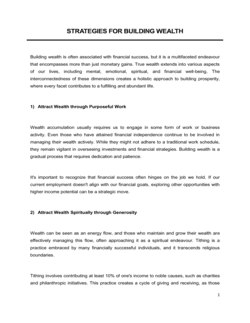
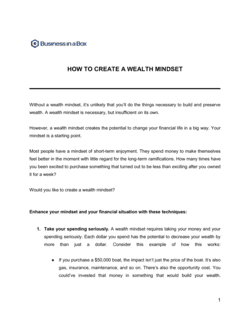
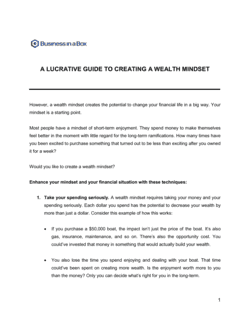
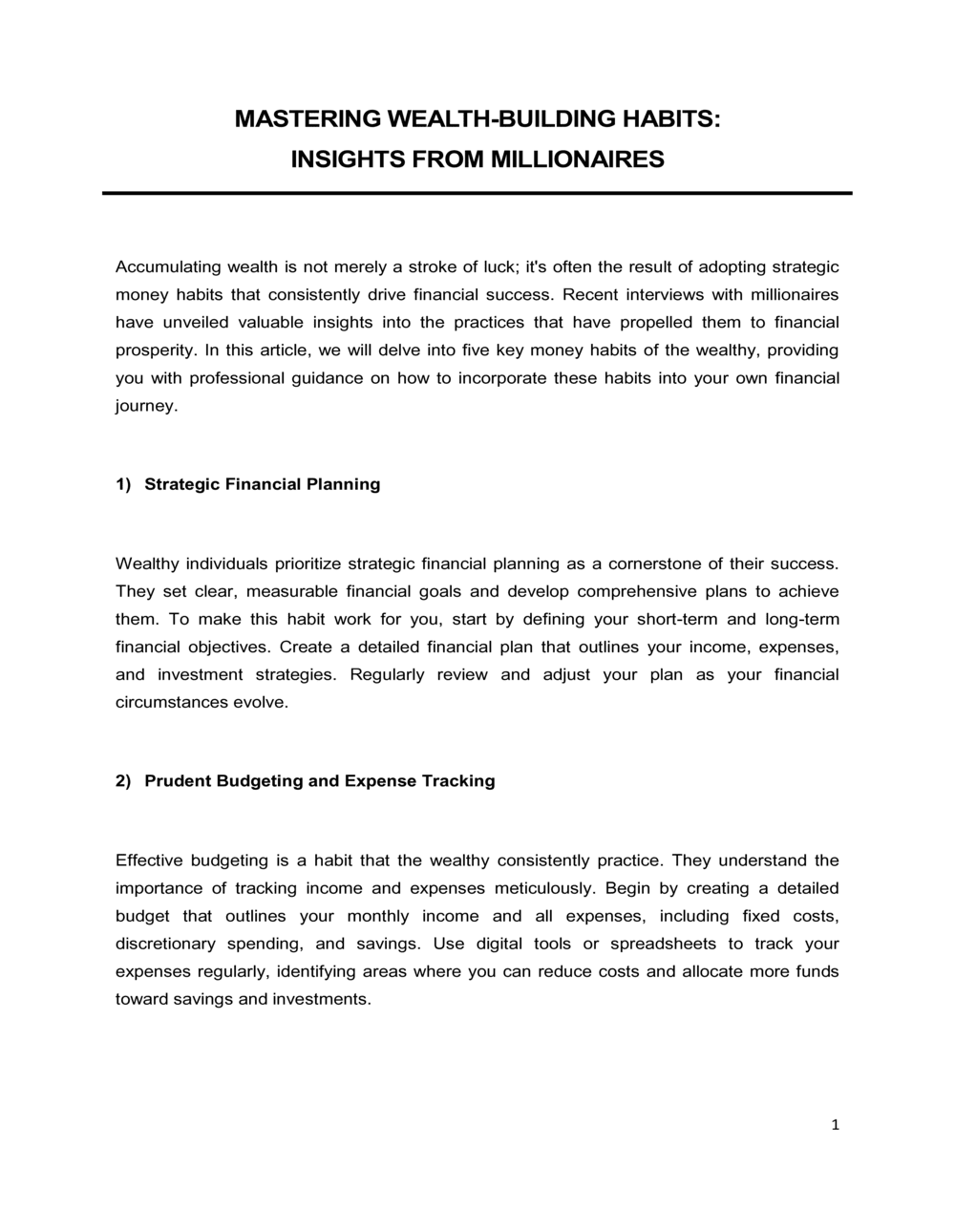
Mastering Wealth Building Habits Insights From Millionaires is a structured Word document that synthesizes the financial behaviors, mindset principles, and investment practices most commonly observed among high-net-worth individuals. This free Word download gives you a ready-to-customize framework you can edit online and export as PDF to guide personal or business wealth-building efforts.
When you need it
Use it when you are ready to move beyond general financial advice and want a concrete, actionable plan built around proven habits β€” whether starting your first savings program, scaling a business, or restructuring your personal finances after a major life event.
What's inside
Mindset foundations, income diversification strategies, savings and expense discipline frameworks, investment principles, goal-setting structures, accountability systems, and a personal wealth action plan template drawn from patterns documented across millionaire case studies.

What is Mastering Wealth Building Habits Insights From Millionaires?

Mastering Wealth Building Habits Insights From Millionaires is a structured operational guide that translates the financial behaviors, mindset principles, and investment practices most consistently documented among high-net-worth individuals into a personal action framework. The document moves from foundational beliefs and an honest financial baseline through income diversification, savings discipline, debt elimination, asset allocation, and milestone goal-setting β€” culminating in a 90-day action plan with an accountability system built in. It is designed to function as a living document, reviewed monthly and revised annually, rather than a one-time exercise.

Why You Need This Document

Most people consume financial advice without ever converting it into a system they actually execute. The gap between knowing and doing is behavioral, not informational β€” and without a documented framework, decisions about savings, spending, and investment default to habit and emotion rather than strategy. The consequences are concrete: lifestyle inflation absorbs income increases before they reach investment accounts, high-interest debt compounds faster than investment returns, and a decade passes without measurable net worth growth despite rising earnings. This template closes that gap by giving you a single document that connects your daily financial habits to your long-term wealth milestones, with a review cadence that keeps the system active. It is the operational layer that makes any financial goal executable.

Which variant fits your situation?

If your situation is…Use this template
Building a personal financial plan from scratchPersonal Financial Plan
Setting structured short- and long-term financial goalsFinancial Goal Setting Template
Tracking monthly income, expenses, and savings progressPersonal Budget Template
Planning investment allocation across asset classesInvestment Plan Template
Coaching individuals through a structured wealth programFinancial Coaching Plan
Aligning business profits with personal wealth strategyBusiness Financial Plan
Documenting a retirement savings and withdrawal strategyRetirement Planning Template

Common mistakes to avoid

❌ Skipping the financial baseline section

Why it matters: Without accurate starting figures, every target is disconnected from reality and progress cannot be measured. You cannot track a savings rate improvement you never measured.

Fix: Spend 60 minutes pulling actual statements before writing a single goal. Every number in the plan flows from the baseline.

❌ Setting income diversification goals without a sequenced build plan

Why it matters: Attempting to build three new income streams simultaneously splits attention and resources, typically resulting in none reaching meaningful income levels.

Fix: Identify one secondary income stream, build it to at least $500/month of stability, then plan the next. Document this sequence explicitly in the income diversification section.

❌ Ignoring lifestyle inflation as income rises

Why it matters: A salary increase that is fully absorbed by upgraded spending produces zero improvement in net worth β€” the single most common reason high earners accumulate little wealth over a decade.

Fix: Adopt a rule of committing at least 50% of every income increase to savings or investment before adjusting any spending category.

❌ Treating the completed document as a finished product

Why it matters: A wealth plan that is not reviewed monthly quickly becomes obsolete as income, expenses, market conditions, and goals change β€” leaving you executing an outdated strategy.

Fix: Schedule the first three monthly reviews in your calendar before you finish filling out the template. The review cadence is part of the system.

The 9 key sections, explained

Wealth Mindset Foundations

Current Financial Baseline

Income Diversification Strategy

Savings and Expense Discipline Framework

Debt Elimination Plan

Investment Principles and Asset Allocation

Wealth Goals and Milestone Timeline

Accountability and Review System

Personal Wealth Action Plan

How to fill it out

  1. 1

    Complete your financial baseline before touching any goals

    Pull your most recent bank, investment, and debt statements. Enter exact figures for total assets, total liabilities, monthly income, and fixed expenses. Calculate your current savings rate as a percentage of gross income.

    πŸ’‘ Most people overestimate their savings rate by 5–10 percentage points when estimating from memory β€” use actual statements.

  2. 2

    Define your wealth mindset principles in your own words

    Write two to four specific financial beliefs you commit to β€” for example, 'I invest before I spend' or 'I buy assets, not liabilities.' Make them concrete enough that you can measure compliance each month.

    πŸ’‘ Read your principles aloud. If they sound like someone else's rules rather than your own convictions, rewrite them until they reflect decisions you will actually make.

  3. 3

    Set a savings rate target and automate the transfer

    Choose a target savings rate β€” the minimum recommended starting point is 15% of gross income. Set up an automatic transfer on payday to a dedicated savings or investment account so the decision is removed from the equation.

    πŸ’‘ Start at whatever rate is sustainable, even if it is 5%. Behavioral consistency at a lower rate outperforms sporadic compliance at a higher one.

  4. 4

    Prioritize and schedule your debt paydown

    List every debt with its balance, interest rate, and minimum payment. Choose either the avalanche method (highest rate first) or snowball method (smallest balance first) and enter target payoff dates based on your available extra monthly payment.

    πŸ’‘ The avalanche method saves more in total interest paid; the snowball method produces faster motivational wins. Research suggests the snowball method produces higher completion rates for people who struggle with consistency.

  5. 5

    Document your investment allocation and contribution schedule

    Write down your target asset allocation percentages across equities, fixed income, real estate, and any alternatives. Specify which accounts hold each asset class and set up automatic monthly contributions.

    πŸ’‘ If you have no investment account yet, opening one with a $50 automatic monthly contribution is more valuable than spending another month researching the perfect allocation.

  6. 6

    Set milestone net worth targets with the required math

    Work backward from your financial independence number to calculate the monthly savings and investment return required to reach each milestone. Enter targets at 1, 3, 5, and 10 years.

    πŸ’‘ Use a compound interest calculator to validate your assumptions β€” the math is unforgiving, and early adjustments are far cheaper than late corrections.

  7. 7

    Build the 90-day action plan with specific deadlines

    Convert every strategy in the document into a sequenced action item with a date and named owner (even if that owner is always you). Group actions into 30-day blocks to make the sequence manageable.

    πŸ’‘ Limit the first 30-day block to three to five actions. Overloaded action plans are abandoned within the first two weeks.

  8. 8

    Schedule recurring reviews and identify an accountability partner

    Block time in your calendar for a monthly net worth update, a quarterly investment review, and an annual full-plan revision. Name one person β€” a coach, peer, or partner β€” who will hold you accountable to review dates.

    πŸ’‘ Share your net worth tracker with your accountability partner. Visible commitment to another person measurably increases follow-through.

Frequently asked questions

What is a wealth building habits guide?

A wealth building habits guide is a structured document that translates the financial behaviors of high-net-worth individuals into an actionable personal framework. It covers mindset principles, savings discipline, income diversification, debt elimination, investment strategy, and goal-setting milestones. Unlike general financial advice, it provides a sequential, documented system that an individual can follow, review, and adjust over time.

What habits do most millionaires have in common?

Research across millionaire case studies consistently identifies a small set of shared behaviors: paying themselves first before discretionary spending, maintaining savings rates above 20% of gross income, holding diversified investment portfolios across multiple asset classes, avoiding high-interest consumer debt, and building at least one source of passive or semi-passive income alongside active earnings. The behaviors are consistent; the specific vehicles vary by individual circumstance.

How is this template different from a personal budget?

A personal budget tracks monthly income and expenses. This wealth building template covers a much broader scope: mindset frameworks, multi-year net worth milestones, income diversification strategy, investment allocation, debt elimination sequencing, and an accountability system. A budget is one input into the savings discipline section of this template β€” not the equivalent of the full document.

What savings rate should I target?

Most financial independence frameworks recommend a minimum of 15–20% of gross income. Individuals targeting early financial independence β€” commonly defined as having assets that cover 25 times annual expenses β€” typically save and invest 30–50% of income. The right rate depends on your income level, current net worth, target timeline, and expected investment returns. The template includes a calculator section to work backward from your financial independence number to the required rate.

Can this template be used for business wealth building, not just personal finance?

Yes. The income diversification, investment allocation, and milestone sections apply directly to business owners who want to channel business profits into long-term personal wealth. The template includes a section on aligning business cash flow with personal wealth targets, and the action plan format is equally applicable to both personal and business financial strategy.

How long does it take to complete this template?

The financial baseline section requires 60–90 minutes if you gather all account statements first. The goal-setting and action plan sections take an additional 60–90 minutes. Most people complete a first full draft in a single 3-hour session. The document is designed to be revisited monthly, with each review taking 20–30 minutes once the initial framework is in place.

Do I need a financial advisor to use this template?

No. The template is designed to be completed independently using your own financial statements and publicly available compound interest calculators. A financial advisor adds value when your situation involves complex tax planning, significant investment assets above $500K, business sale proceeds, or estate planning. For most people in the wealth-building phase, the template itself provides sufficient structure.

What is the difference between this guide and a financial plan?

A financial plan is typically a formal document prepared by a licensed advisor covering tax strategy, insurance needs, estate planning, and investment recommendations. This wealth building habits guide focuses specifically on the behavioral and strategic layer β€” the habits, mindsets, and personal systems that determine whether any financial plan gets executed consistently. The two documents are complementary rather than interchangeable.

How this compares to alternatives

vs Personal Financial Plan

A personal financial plan is a comprehensive formal document covering insurance, tax, estate, and retirement in full detail β€” often prepared with an advisor. This wealth building habits guide focuses specifically on the behavioral layer: the daily, monthly, and annual habits that determine whether any financial plan gets executed. Both are useful; this template is the execution companion to a formal plan.

vs Personal Budget Template

A personal budget tracks monthly income and expenses to prevent overspending. This wealth building template treats monthly budgeting as one input into a broader wealth system that also covers mindset, investment strategy, debt elimination, income diversification, and multi-year milestones. A budget is a control tool; this is a growth framework.

vs Business Financial Plan

A business financial plan documents a company's projected revenues, costs, and capital requirements for investors or lenders. This wealth building guide is a personal document focused on the individual owner's net worth, habits, and long-term financial independence β€” distinct from the business entity's plan, though the two should be coordinated.

vs Strategic Planning Template

A strategic plan sets organizational goals, initiatives, and KPIs for a business. This wealth building habits guide applies a similarly structured planning approach to personal financial strategy. The format and logic are analogous, but the subject matter is individual net worth rather than company performance.

Industry-specific considerations

Entrepreneurship and Small Business

Business owners use this framework to separate personal wealth from business cash flow, structure owner compensation strategically, and build investment portfolios alongside the business as an asset.

Financial Coaching and Advisory

Financial coaches use the template as a client onboarding and goal-setting tool, providing a structured framework that clients can work through between sessions and review at regular check-ins.

Real Estate Investment

Real estate investors use the income diversification and asset allocation sections to model how rental income integrates with broader portfolio strategy and tracks toward net worth milestones.

Technology and SaaS

Tech professionals with high but variable compensation β€” equity, bonuses, and RSUs β€” use the template to build savings and investment discipline around irregular income events rather than base salary alone.

Template vs pro β€” what fits your needs?

PathBest forCostTime
Use the templateIndividuals building foundational wealth habits, small business owners, and anyone in the early-to-mid wealth accumulation phaseFree3–4 hours to complete, 20–30 minutes per monthly review
Template + professional reviewBusiness owners with $250K+ in investable assets, complex tax situations, or equity compensation$300–$800 for a single financial advisor session to validate strategy1–2 weeks including advisor scheduling
Custom draftedHigh-net-worth individuals with estate planning needs, business sale proceeds, or multi-jurisdiction investment portfolios$2,000–$10,000+ for a full certified financial planner engagement4–8 weeks

Glossary

Net Worth
Total assets minus total liabilities β€” the single most important scoreboard number for tracking long-term wealth accumulation.
Pay Yourself First
A savings discipline in which a fixed amount is transferred to savings or investments before any discretionary spending occurs each pay period.
Passive Income
Earnings generated from assets β€” rental properties, dividends, royalties, or business equity β€” that do not require active daily labor.
Asset Allocation
The distribution of investments across asset classes such as equities, fixed income, real estate, and cash equivalents to balance risk and return.
Compound Growth
The process by which returns on an investment are reinvested to generate their own returns over time, accelerating wealth accumulation exponentially.
Income Diversification
The practice of building multiple independent revenue streams so that no single source represents the majority of total income.
Wealth Mindset
A set of beliefs and mental frameworks β€” delayed gratification, abundance thinking, and long-term orientation β€” that predispose individuals toward financial discipline and opportunity recognition.
Lifestyle Inflation
The tendency to increase discretionary spending proportionally as income rises, preventing the savings rate from improving despite higher earnings.
Financial Independence
The point at which passive income from assets covers all living expenses, making active employment optional.
Accountability System
A structured mechanism β€” a coach, a peer group, a tracking dashboard, or a scheduled review β€” that keeps financial commitments visible and measured.

Part of your Business Operating System

This document is one of 3,000+ business & legal templates included in Business in a Box.

  • Fill-in-the-blanks β€” ready in minutes
  • Compatible with all office suites
  • Export to PDF and share electronically

Create your document in 3 simple steps.

From template to signed document β€” all inside one Business Operating System.
1
Download or open template

Access over 3,000+ business and legal templates for any business task, project or initiative.

2
Edit and fill in the blanks with AI

Customize your ready-made business document template and save it in the cloud.

3
Save, Share, Send, Sign

Share your files and folders with your team. Create a space of seamless collaboration.

Save time, save money, and create top-quality documents.

β˜…β˜…β˜…β˜…β˜…

"Fantastic value! I'm not sure how I'd do without it. It's worth its weight in gold and paid back for itself many times."

Managing Director Β· Mall Farm
Robert Whalley
Managing Director, Mall Farm Proprietary Limited
β˜…β˜…β˜…β˜…β˜…

"I have been using Business in a Box for years. It has been the most useful source of templates I have encountered. I recommend it to anyone."

Business Owner Β· 4+ years
Dr Michael John Freestone
Business Owner
β˜…β˜…β˜…β˜…β˜…

"It has been a life saver so many times I have lost count. Business in a Box has saved me so much time and as you know, time is money."

Owner Β· Upstate Web
David G. Moore Jr.
Owner, Upstate Web

Run your business with a system β€” not scattered tools

Stop downloading documents. Start operating with clarity. Business in a Box gives you the Business Operating System used by over 250,000 companies worldwide to structure, run, and grow their business.

Free Forever PlanΒ Β·Β No credit card required