8 Common Habits Of Unproductive People Template

Free to read β€’ Save or share with one click

Free8 Common Habits Of Unproductive People Template

At a glance

What it is
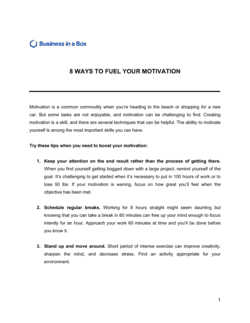
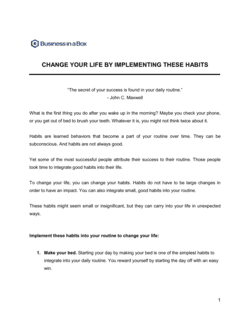
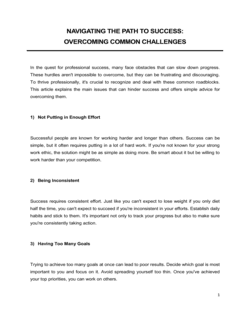
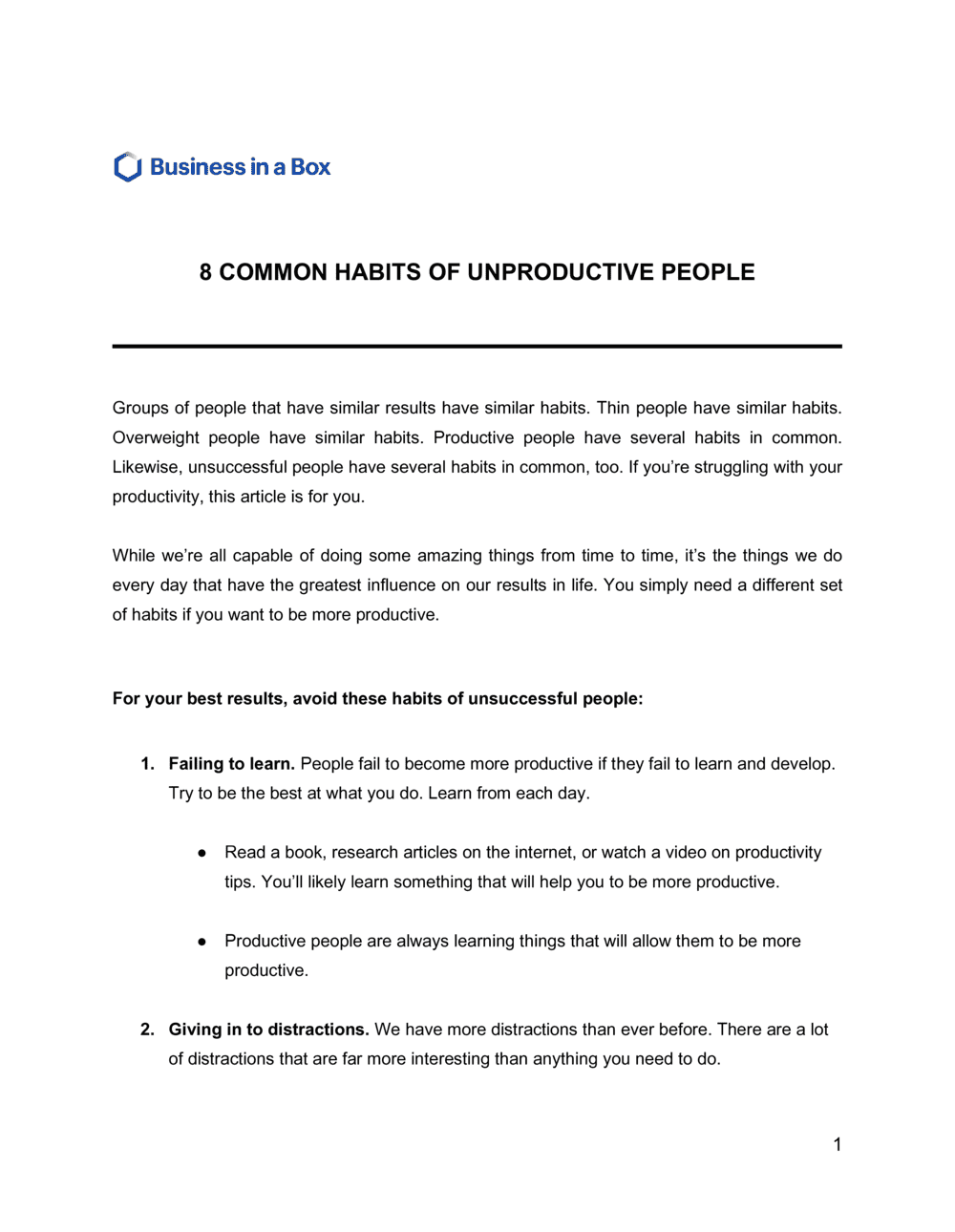
8 Common Habits of Unproductive People is a structured reference guide that identifies and explains the eight behavioral patterns most consistently linked to low output and poor performance in professional settings. This free Word download gives managers, team leads, and individuals a concrete framework for recognizing productivity blockers β€” and the specific corrective actions that reverse them.
When you need it
Use it when onboarding new team members, conducting performance reviews, building a workplace productivity program, or when an individual contributor or team is consistently missing deadlines and output targets despite adequate resources.
What's inside
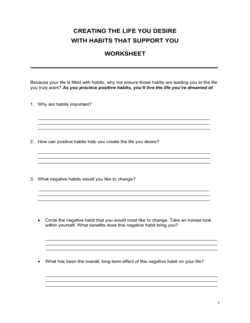
Eight habit profiles β€” each with a clear behavioral description, the organizational and individual costs associated with it, and actionable steps to correct the pattern. The guide also includes a self-assessment checklist and a brief introduction framing why habits, not effort or intelligence, drive most productivity gaps.

What is 8 Common Habits of Unproductive People?

8 Common Habits of Unproductive People is a structured reference guide that identifies the eight behavioral patterns most consistently linked to low output in professional environments β€” from starting the day without a plan to neglecting the recovery rhythms that sustain cognitive performance. Each habit is explained in plain terms, paired with the real cost it imposes on individual and team productivity, and followed by a concrete corrective action. Unlike generic productivity advice, the guide treats unproductive behavior as a diagnosable and changeable pattern rather than a fixed personality trait. The free Word download includes a self-assessment checklist that allows individuals to identify their own dominant patterns and commit to specific behavioral changes within a defined timeframe.

Why You Need This Document

Most productivity problems are misdiagnosed. Managers address symptoms β€” missed deadlines, low output, repeated rework β€” without identifying the underlying behavioral habits driving them, so the same problems recur regardless of how many tools, processes, or goal-setting exercises are introduced. This guide provides a shared vocabulary and diagnostic framework that makes those conversations specific and actionable rather than vague and demoralizing. Without it, performance coaching defaults to subjective feedback that employees often experience as criticism rather than development. Used proactively β€” before a formal performance issue arises β€” it reduces the likelihood of ever needing a performance improvement plan, saving the manager, the employee, and the HR team significant time and friction. The template does the structural work so you can focus on the conversations that actually change behavior.

Which variant fits your situation?

If your situation is…Use this template
Addressing an entire team's collective productivity issuesTeam Performance Improvement Plan
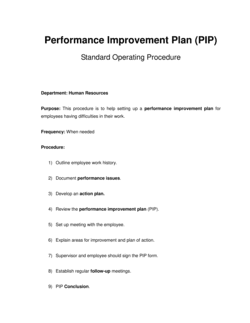
Documenting and managing a single employee's performance issues formallyEmployee Performance Improvement Plan (PIP)
Setting forward-looking productivity goals for a new hire or team memberEmployee Goal Setting Form
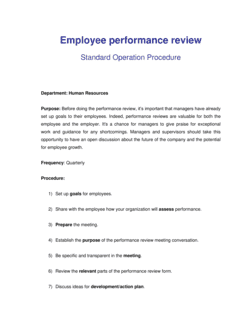
Conducting a structured annual or mid-year performance reviewEmployee Performance Review
Building a company-wide time management and productivity policyTime Management Policy
Establishing daily or weekly task priorities for an individual or teamDaily Task Planner
Identifying and resolving workflow bottlenecks at the process levelProcess Improvement Plan

Common mistakes to avoid

❌ Distributing the guide without a facilitation plan

Why it matters: A document sent by email without context is dismissed as generic productivity content β€” it produces no behavior change and can feel condescending to recipients.

Fix: Introduce the guide in a team setting, explain why it is being shared now, and connect it to a specific observed pattern or business goal. Follow-up conversation is what converts awareness into action.

❌ Using it as a performance management tool instead of a development tool

Why it matters: If employees perceive the guide as a precursor to disciplinary action, they respond defensively β€” underreporting their own habits and disengaging from the corrective actions.

Fix: Position the guide explicitly as a self-development resource. Keep self-assessment scores confidential unless the employee chooses to share them with their manager.

❌ Skipping the action planning section

Why it matters: Awareness of a bad habit without a concrete corrective action is rarely sufficient to change behavior β€” the habit loop reasserts itself within days.

Fix: Require each participant to write down one specific behavioral change for their top-scoring habit, with a start date and a 30-day check-in commitment before the meeting ends.

❌ Applying it only to individual contributors while exempting managers

Why it matters: Many of the eight habits β€” chronic multitasking, starting without a plan, deferring decisions β€” are at least as common in management as in individual contributor roles. Exempting managers signals that the habits are a 'staff problem,' not a cultural one.

Fix: Have managers complete the self-assessment first and share their results with the team before asking direct reports to complete it. This sets a tone of shared accountability.

The 10 key sections, explained

Introduction: Why Habits Drive Output

Habit 1: Starting the day without a plan

Habit 2: Chronic multitasking

Habit 3: Confusing activity with progress

Habit 4: Inability to say no

Habit 5: Perfectionism that prevents completion

Habit 6: Poor management of interruptions and distractions

Habit 7: Deferring decisions and avoiding difficult conversations

Habit 8: Neglecting recovery and sustainable work rhythms

Self-assessment checklist and action planning

How to fill it out

  1. 1

    Customize the introduction with your organizational context

    Replace the generic framing in the introduction with data or observations specific to your team or business. Reference real productivity metrics β€” missed deadlines, rework rates, or overtime hours β€” to make the problem tangible.

    πŸ’‘ One specific internal data point (e.g., '43% of our Q1 projects missed their deadline') is more motivating than generic statistics.

  2. 2

    Review each habit and adjust examples to your industry

    Read through each of the eight habit profiles and replace the bracketed placeholder examples with scenarios recognizable to your audience β€” the types of tasks, meeting patterns, and distractions specific to your workplace.

    πŸ’‘ A sales team and a software development team experience the same habits differently β€” tailor the language so readers see themselves in the examples.

  3. 3

    Add or remove habits to match your team's specific patterns

    The eight habits in this template are the most common, but they are not exhaustive. Add a ninth or tenth habit if your team has a documented pattern not covered, or remove any that are genuinely irrelevant to your context.

    πŸ’‘ Limit the final list to no more than ten habits β€” beyond that, the guide loses focus and readers disengage before reaching the action planning section.

  4. 4

    Customize the self-assessment scoring thresholds

    Adjust the rating scale and scoring thresholds in the self-assessment checklist to match the severity you want to signal. A 1–3 scale works for most teams; a 1–5 scale provides more granularity for coaching conversations.

    πŸ’‘ Add a column for 'my manager's rating' if you plan to use this in a 360-degree feedback context β€” the gap between self-rating and manager rating is often where the most useful coaching conversations begin.

  5. 5

    Set specific corrective actions for each habit

    For each habit, write at least one concrete behavioral intervention β€” not advice like 'prioritize better' but a specific action like 'write down three priorities before opening email each morning.' Pair each action with a measurable indicator.

    πŸ’‘ Corrective actions with a time-of-day trigger (e.g., 'at 8:45 AM, before opening email') are adopted at roughly twice the rate of general behavioral intentions.

  6. 6

    Add a 30-day follow-up checkpoint

    Insert a review date at the end of the document β€” 30 days from distribution β€” and specify who will conduct the check-in and what output will be reviewed to assess behavior change.

    πŸ’‘ A shared calendar invite sent alongside the document doubles follow-through rates compared to a note that 'we will revisit this next month.'

  7. 7

    Distribute with a brief facilitated discussion

    Share the completed guide in a team meeting and allow 15–20 minutes for open discussion of which habits resonate most. Normalized, non-judgmental conversation about the habits dramatically increases honest self-assessment scores.

    πŸ’‘ Have the manager share their own top-scoring habit first β€” it removes the defensiveness that otherwise prevents honest self-reporting.

Frequently asked questions

What are the most common habits of unproductive people?

The eight most consistently documented unproductive habits are: starting the day without a prioritized plan, chronic multitasking, confusing activity with progress, inability to decline non-essential requests, perfectionism that prevents task completion, poor management of interruptions, deferring decisions and difficult conversations, and neglecting recovery and sustainable work rhythms. Each habit is independently linked to lower output β€” most unproductive individuals exhibit three or more simultaneously.

Is this guide suitable for individual use or team use?

It is designed for both. Individual contributors can use the self-assessment to identify their own top two or three patterns and build a personal improvement plan. Managers and team leads can use it as a facilitated team exercise β€” distributing it ahead of a team meeting and using the self-assessment scores as the basis for a structured group discussion about shared productivity norms.

How is this different from a performance improvement plan?

A performance improvement plan (PIP) is a formal HR document used when an employee is at risk of disciplinary action β€” it documents required behaviors, timelines, and consequences. This guide is a development resource, not a disciplinary one. It is appropriate to use proactively with any employee or team, regardless of performance status, as part of a broader productivity or professional development program.

Can managers use this guide in one-on-one coaching conversations?

Yes β€” it is well suited to one-on-one coaching. Share the guide with the employee before the meeting, ask them to complete the self-assessment privately, then use the conversation to discuss which habits they rated highest and what specific behavioral change they want to commit to. Avoid using the guide to tell the employee which habits you believe they have β€” let the self-assessment drive the conversation.

How do I avoid the guide coming across as condescending to my team?

Frame the distribution around a positive organizational goal β€” improving team output, reducing overwork, or preparing for a growth phase β€” rather than as a response to a performance problem. Have the manager complete and share their own self-assessment first. Use language that positions the habits as universal patterns that affect high performers as much as struggling ones, because that is accurate.

How often should this guide be revisited?

A 30-day follow-up conversation is standard after initial distribution. After that, an annual review β€” aligned to performance review cycles or team planning sessions β€” is sufficient for most teams. Organizations going through rapid growth, significant role changes, or a shift to remote or hybrid work often benefit from revisiting the guide at each of those transition points, as new environmental conditions tend to reactivate dormant habits.

Are these habits relevant to remote and hybrid teams?

All eight habits are present in remote and hybrid settings β€” several are more pronounced. Chronic multitasking and distraction management are harder to control at home. The inability to say no compounds in asynchronous communication environments where requests arrive at all hours. Decision deferral accelerates when teams lack shared real-time visibility. The self-assessment scoring thresholds may need to be adjusted upward to reflect the amplified impact of these habits in distributed work contexts.

What should I do if a team member scores high on most or all eight habits?

A high score across most habits typically indicates a systemic issue β€” unclear role expectations, insufficient support, poor workload distribution, or an organizational culture that inadvertently rewards the wrong behaviors. In that case, the individual coaching conversation should be paired with a manager review of whether the role, workload, and environment are set up for success before attributing the pattern entirely to the individual.

How this compares to alternatives

vs Employee Performance Improvement Plan

A performance improvement plan is a formal HR document used when an employee is at risk of disciplinary action or termination. It documents required changes, timelines, and consequences. This habits guide is a development resource appropriate for any employee at any performance level β€” it should be used before a PIP becomes necessary, not instead of one when formal action is already warranted.

vs Employee Performance Review

A performance review is a structured evaluation of past output against defined goals β€” typically conducted annually or semi-annually. This habits guide identifies the behavioral root causes behind performance patterns. The two documents work well together: use the performance review to surface the output gap, then use the habits guide to diagnose the behavioral driver.

vs Time Management Policy

A time management policy sets organizational rules and expectations around schedules, availability, and meeting norms. This habits guide operates at the individual behavioral level β€” it explains why people fail to follow time management policies even when they intend to. Policies set the environment; the habits guide changes the behavior that operates within that environment.

vs Employee Goal Setting Form

A goal setting form documents forward-looking performance targets and milestones. This habits guide addresses the behavioral patterns that prevent people from reaching their goals. A goal setting form without behavioral self-awareness is an aspiration; paired with a habits self-assessment, it becomes an actionable plan with identified obstacles already surfaced.

Industry-specific considerations

Professional Services

Billable-hour pressure makes the activity-vs-progress confusion and perfectionism habits especially costly β€” time spent on non-billable rework directly reduces revenue per employee.

Technology / SaaS

Chronic multitasking and distraction management are the dominant habits in engineering and product teams, where deep focused work is the primary value-creation mechanism.

Retail / Operations

Starting without a plan and inability to say no are most prevalent in high-volume, task-dense retail and operations roles where reactive patterns become deeply embedded.

Healthcare

Neglecting recovery rhythms and decision deferral carry direct patient-safety implications in clinical settings, making this guide particularly relevant for team leads and department managers.

Template vs pro β€” what fits your needs?

PathBest forCostTime
Use the templateManagers, HR teams, and individuals who need a structured, ready-to-use framework without consulting supportFree30–60 minutes to customize and distribute
Template + professional reviewOrganizations embedding this into a formal L&D curriculum or manager training program$500–$2,000 for an L&D consultant to integrate it into a broader training module1–2 weeks
Custom draftedLarge enterprises commissioning a bespoke productivity assessment and coaching program tied to internal KPIs$5,000–$20,000+ for a custom organizational effectiveness engagement4–8 weeks

Glossary

Productivity
The ratio of useful output to the time and resources invested β€” measured not by activity level but by meaningful results delivered.
Procrastination
The habitual deferral of tasks despite knowing that delay will cause negative consequences β€” driven by avoidance of discomfort, not lack of time.
Parkinson's Law
The observation that work expands to fill the time available for its completion, often causing tasks to take far longer than necessary.
Multitasking
The practice of attempting to perform two or more cognitively demanding tasks simultaneously β€” research consistently shows it reduces quality and increases error rates.
Deep Work
Sustained, distraction-free focus on a cognitively demanding task β€” the mode of working that produces the highest-quality output per hour.
Time Blocking
A scheduling method where specific hours are reserved for specific tasks, preventing reactive work from crowding out high-priority deliverables.
Analysis Paralysis
A state in which over-analysis or excessive deliberation prevents a decision or action from being taken, stalling progress indefinitely.
Reactive Work Mode
A pattern of spending the majority of the workday responding to incoming requests β€” emails, messages, meetings β€” rather than executing against a planned priority list.
Accountability System
A structured mechanism β€” such as a manager check-in, peer review, or written commitment β€” that creates external consequence for failing to follow through on stated tasks.
Cognitive Load
The total amount of mental effort being used in working memory at a given time; high cognitive load from task-switching or interruptions reduces decision quality and output speed.

Part of your Business Operating System

This document is one of 3,000+ business & legal templates included in Business in a Box.

  • Fill-in-the-blanks β€” ready in minutes
  • Compatible with all office suites
  • Export to PDF and share electronically

Create your document in 3 simple steps.

From template to signed document β€” all inside one Business Operating System.
1
Download or open template

Access over 3,000+ business and legal templates for any business task, project or initiative.

2
Edit and fill in the blanks with AI

Customize your ready-made business document template and save it in the cloud.

3
Save, Share, Send, Sign

Share your files and folders with your team. Create a space of seamless collaboration.

Save time, save money, and create top-quality documents.

β˜…β˜…β˜…β˜…β˜…

"Fantastic value! I'm not sure how I'd do without it. It's worth its weight in gold and paid back for itself many times."

Managing Director Β· Mall Farm
Robert Whalley
Managing Director, Mall Farm Proprietary Limited
β˜…β˜…β˜…β˜…β˜…

"I have been using Business in a Box for years. It has been the most useful source of templates I have encountered. I recommend it to anyone."

Business Owner Β· 4+ years
Dr Michael John Freestone
Business Owner
β˜…β˜…β˜…β˜…β˜…

"It has been a life saver so many times I have lost count. Business in a Box has saved me so much time and as you know, time is money."

Owner Β· Upstate Web
David G. Moore Jr.
Owner, Upstate Web

Run your business with a system β€” not scattered tools

Stop downloading documents. Start operating with clarity. Business in a Box gives you the Business Operating System used by over 250,000 companies worldwide to structure, run, and grow their business.

Free Forever PlanΒ Β·Β No credit card required