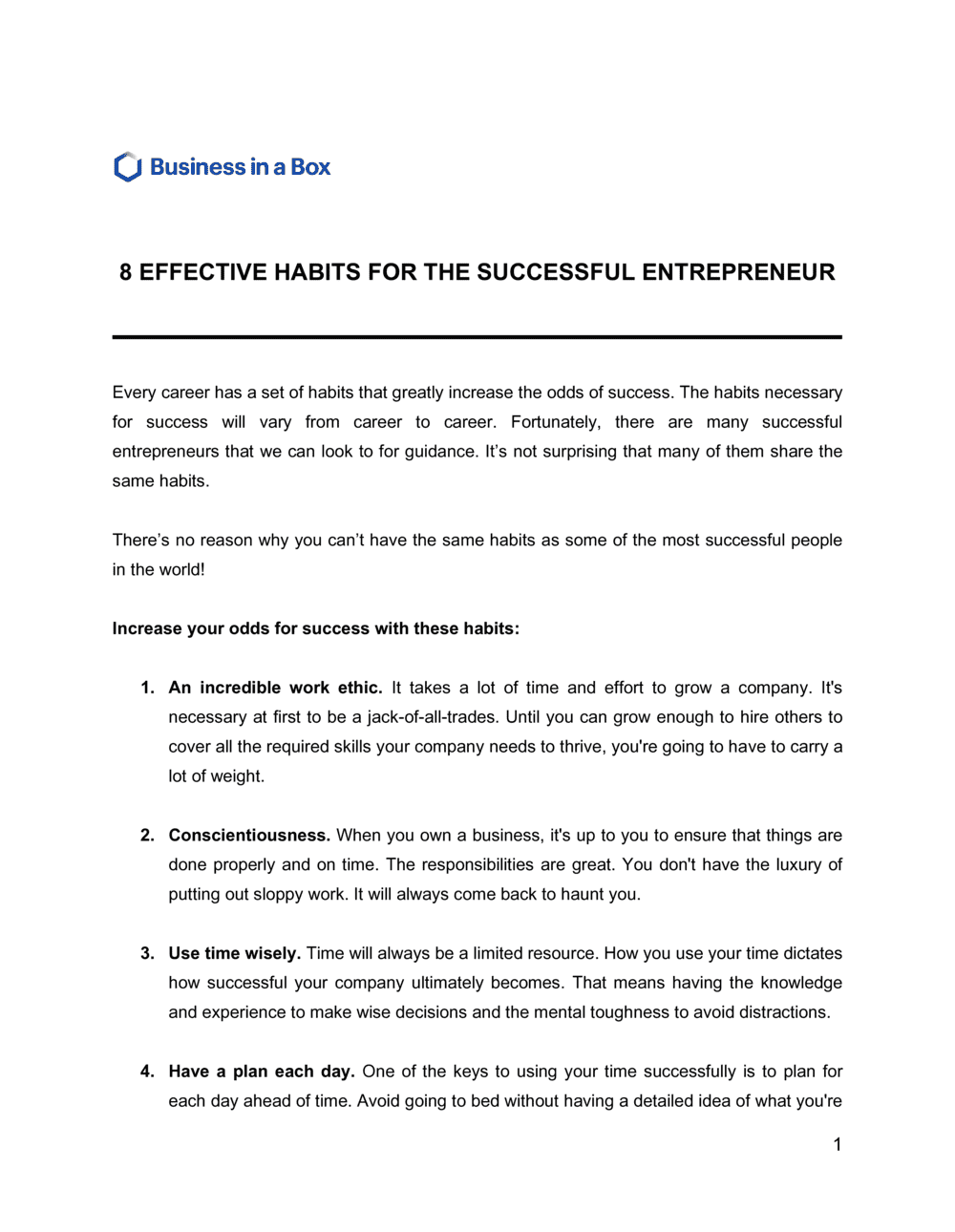
8 Effective Habits For The Successful Entrepreneur Template

Free to read • Save or share with one click

Free8 Effective Habits For The Successful Entrepreneur Template

At a glance

What it is
The 8 Effective Habits for the Successful Entrepreneur is a structured Word document that identifies and defines the eight core behavioral practices most consistently associated with entrepreneurial success — from deliberate goal-setting and time-blocking to continuous learning and resilience. This free download gives founders and business owners a concrete, editable reference they can adapt to their own context and use as a personal operating framework or team-alignment tool.
When you need it
Use it when launching a new venture, resetting business habits after a period of drift, onboarding co-founders or early employees around a shared culture of discipline, or preparing a personal development plan for yourself or your leadership team.
What's inside
Eight clearly defined habits covering mindset, productivity, financial discipline, relationship-building, and continuous learning — each explained with the rationale behind it, the specific behaviors it requires, and the outcomes it produces when practiced consistently.

What is the 8 Effective Habits for the Successful Entrepreneur?

The 8 Effective Habits for the Successful Entrepreneur is a structured Word document that defines the eight core behavioral practices most consistently linked to entrepreneurial success and translates each one into a specific, actionable commitment. It covers the full operating spectrum of entrepreneurial discipline — from goal-setting and deep-work scheduling to financial awareness, relationship-building, and weekly reflection — giving founders a concrete personal framework rather than generic advice. Each habit is explained with the rationale behind it, the exact behaviors it requires, and the measurable outcomes it produces when practiced consistently over time.

Why You Need This Document

Most founders have a business plan but no personal operating system — and the gap between strategic intent and daily execution almost always comes down to habits, not ideas. Without a defined framework, high-value behaviors like weekly financial review, intentional networking, and deep-work blocks get crowded out by reactive urgency within weeks of launch. The cost is invisible at first and catastrophic later: relationships go unmaintained until you need something, financial problems surface at month-end instead of mid-week when they can still be fixed, and decisions get made by default rather than by design. This template gives you a single editable document to define, track, and iterate on the eight habits that separate entrepreneurs who execute consistently from those who operate in permanent reactive mode — and it takes less than two hours to complete.

Which variant fits your situation?

If your situation is…Use this template
Developing a full structured growth strategy for the businessBusiness Plan
Setting measurable quarterly goals for yourself or your teamSMART Goals Template
Planning time allocation and priorities for the week aheadWeekly Schedule Template
Tracking daily habits and progress toward personal KPIsPersonal Development Plan
Onboarding a leadership team around shared behavioral standardsEmployee Handbook
Aligning a team around long-term vision and strategic prioritiesStrategic Planning Template
Establishing productivity standards across a growing organizationStandard Operating Procedure (SOP) Template

Common mistakes to avoid

❌ Trying to install all eight habits simultaneously

Why it matters: Willpower and habit-formation capacity are finite resources. Attempting eight behavioral changes at once almost always results in zero lasting changes.

Fix: Select the two habits with the lowest current scores, implement them for 60 days until they require minimal effort, then layer in the next two.

❌ Defining habits in vague, aspirational language

Why it matters: A habit defined as 'read more' or 'exercise regularly' has no trigger, no frequency, and no measurable standard — making it impossible to track or hold yourself accountable to.

Fix: Write every habit as a specific behavioral commitment: 'Read 20 pages of a business book every weekday morning before opening email.'

❌ Skipping the weekly review habit entirely

Why it matters: Without a regular review, the remaining seven habits drift out of practice within 4–6 weeks as daily urgency crowds out weekly discipline.

Fix: Block the weekly review as a recurring 45-minute calendar event on Friday afternoon, treat it as a non-negotiable meeting, and decline other bookings in that slot.

❌ Treating the document as a one-time exercise

Why it matters: Habits evolve as the business grows — what is critical at the founding stage is different from what is critical at a 50-person company, and a static document becomes irrelevant fast.

Fix: Schedule a quarterly revision of the document to update metrics, time commitments, and priorities to reflect the current stage of the business.

The 8 key sections, explained

Habit 1 — Set clear, written goals

Habit 2 — Protect time for deep work

Habit 3 — Maintain strict financial awareness

Habit 4 — Build and maintain relationships intentionally

Habit 5 — Invest in continuous learning

Habit 6 — Practice deliberate decision-making

Habit 7 — Build physical and mental resilience

Habit 8 — Review, reflect, and iterate weekly

How to fill it out

  1. 1

    Personalize the header and context

    Enter your name, business name, and the date you are committing to this framework. Adding a short personal mission statement at the top anchors the habits to your specific goals.

    💡 Write the mission statement in one sentence using the format: 'I [VERB] [FOR WHOM] so that [OUTCOME].' Specificity makes it stick.

  2. 2

    Rate yourself on each habit before editing

    Before customizing the language, score yourself 1–10 on each of the eight habits as they currently stand. This baseline assessment tells you which two or three habits need the most immediate focus.

    💡 Focus improvement energy on the two lowest-scoring habits first — trying to improve all eight simultaneously produces no meaningful change in any of them.

  3. 3

    Define your specific implementation for each habit

    Replace every [PLACEHOLDER] with a concrete, personal commitment — exact times, specific metrics, named tools, and measurable frequencies. Generic language produces generic behavior.

    💡 Use the format 'I will [SPECIFIC ACTION] at [SPECIFIC TIME] on [SPECIFIC DAYS] using [SPECIFIC TOOL]' for each habit — the more specific, the more likely the behavior is to stick.

  4. 4

    Identify your accountability mechanism

    For each habit, note how you will track it — a daily checklist, a journal entry, a weekly score, or a peer accountability partner who receives your update each Friday.

    💡 Habits tracked with a visible streak — even a simple paper calendar with an X for each completed day — are followed through at significantly higher rates than habits tracked mentally.

  5. 5

    Set a 30-day review checkpoint

    Schedule a calendar event 30 days from today to review your scores on each habit and adjust any implementation details that aren't working in practice.

    💡 Don't wait for a habit to feel natural before the 30-day mark — most behavioral research puts the formation window at 60–90 days, not the popular '21 days' figure.

  6. 6

    Share the document with a trusted peer or coach

    Send the completed document to one person — a co-founder, mentor, or coach — who will ask you about your progress at a defined interval.

    💡 The act of sharing a commitment publicly increases follow-through by making the cost of inaction social as well as personal.

Frequently asked questions

What are the most effective habits for entrepreneurs?

The eight habits most consistently linked to entrepreneurial success are: setting written goals with regular review cadences, protecting deep-work time blocks, maintaining weekly financial awareness, building relationships intentionally, committing to continuous learning, practicing deliberate decision-making, sustaining physical and mental resilience, and conducting a weekly review and reset. None of these is a revelation in isolation — the differentiator is practicing all eight consistently over years, not weeks.

Why do successful entrepreneurs focus on habits rather than motivation?

Motivation is a feeling that fluctuates with circumstances. Habits are automated behaviors that execute regardless of how you feel on a given day. Entrepreneurs who rely on motivation to drive productivity output inconsistently — good weeks follow good moods, and bad weeks follow setbacks. Habit-driven entrepreneurs produce consistent output because the behavior no longer requires a decision; it runs on a schedule.

How long does it take to build a new entrepreneurial habit?

Behavioral research places the average habit formation window at 66 days, with a range of 18–254 days depending on the complexity of the behavior and individual differences. The popular '21 days' figure is not supported by evidence. Plan for 60–90 days of deliberate repetition before a new behavior becomes genuinely automatic, and build in a tracking mechanism to sustain consistency during that formation period.

Which habit should an entrepreneur develop first?

The weekly review habit is the highest-leverage starting point because it creates the feedback loop that reinforces every other habit. Without a regular review, you cannot accurately track which habits you are keeping and which you are rationalizing. Start with the weekly review, then use it to identify and install the next most impactful habit for your specific situation.

Can I adapt this template for my whole team?

Yes. The template is written from the perspective of an individual entrepreneur but can be adapted for a leadership team by replacing first-person language with team-level commitments and shared metrics. It works well as a onboarding document for co-founders and early hires where you want to establish shared behavioral expectations from day one.

How is this different from a business plan?

A business plan documents what the business will do — market, strategy, financials, and operations. This habits template documents how the entrepreneur will operate — the personal behaviors and discipline that determine whether the business plan gets executed. Both are necessary; a business plan without disciplined execution is a document, and entrepreneurial habits without a strategic direction are activity without outcome.

What tools work best for tracking entrepreneur habits?

Simple tools work best for consistency. A paper checklist, a notes app with a daily template, or a basic spreadsheet with one row per day and one column per habit are more durable than complex productivity apps. The tracking system should take under two minutes to update daily — any more friction than that and it stops being used within two weeks.

Should I share my habit commitments publicly?

Sharing commitments with one or two trusted individuals — a co-founder, mentor, or accountability partner — measurably increases follow-through. Broad public declarations (social media posts) have mixed evidence: they can produce short-term motivation but sometimes substitute the feeling of progress for actual progress. A small, accountable audience is more effective than a large, passive one.

How this compares to alternatives

vs Personal Development Plan

A personal development plan maps broad skill-building goals and learning objectives over a 6–12 month horizon. This habits template focuses specifically on the eight daily and weekly behavioral practices that sustain entrepreneurial performance — it is narrower in scope but more immediately actionable. Use both together for a complete personal growth framework.

vs Strategic Planning Template

A strategic plan defines where the business is going over 3–5 years — goals, initiatives, KPIs, and resource allocation. This habits template defines how the entrepreneur personally operates day-to-day to get there. Strategic plans set direction; habits determine whether execution happens consistently enough to reach the destination.

vs Business Plan

A business plan is an external-facing document covering market, competitive positioning, operations, and financial projections. This habits template is an internal personal operating framework. A business plan without a disciplined entrepreneur behind it rarely executes; this template addresses the human system that drives the business system.

vs Employee Handbook

An employee handbook codifies company-wide policies and behavioral expectations for all staff. This habits template is a personal framework for the entrepreneur or founder specifically. The handbook governs team behavior; the habits guide governs the leader's own operating discipline — and leadership behavior is the primary input to team culture.

Industry-specific considerations

Technology / SaaS

Deep-work blocks and deliberate decision-making habits are especially critical for technical founders managing both product development and investor relationships simultaneously.

Professional Services

Relationship-building and continuous-learning habits directly drive client retention and referral rates in consulting, legal, and advisory businesses where reputation is the primary growth channel.

Retail / E-commerce

Weekly financial awareness and goal-review habits are particularly high-leverage for retail owners managing thin margins, seasonal cash-flow swings, and inventory timing.

Creative and Marketing Agencies

Time-blocking and resilience habits address the chronic context-switching and client-driven urgency that erodes agency founders' strategic capacity over time.

Template vs pro — what fits your needs?

PathBest forCostTime
Use the templateFounders and business owners who want a structured personal operating framework they can complete and apply independentlyFree1–2 hours to complete and personalize
Template + professional reviewEntrepreneurs working with a business coach or mentor who will review, challenge, and hold them accountable to the commitments$200–$500 for a coaching session1–3 days including the coaching conversation
Custom draftedLeadership teams or accelerator cohorts where a facilitator tailors the habit framework to a specific business stage, industry, or team dynamic$1,000–$5,000 for a facilitated workshop or custom program1–2 weeks

Glossary

Time-Blocking
A scheduling method where specific tasks are assigned to dedicated, protected time slots on the calendar rather than tackled reactively.
Growth Mindset
The belief that abilities and intelligence can be developed through effort, learning, and persistence — as opposed to being fixed at birth.
Deep Work
Focused, uninterrupted cognitive effort on a high-value task, free from distractions — typically scheduled in blocks of 90 minutes or more.
Accountability System
A structure — a coach, peer group, or tracking tool — that creates external pressure to follow through on stated commitments.
Financial Discipline
Consistent habits around budgeting, cash-flow monitoring, and separating personal and business finances to maintain business solvency.
Networking Intentionality
The practice of building relationships with a defined purpose — specific industries, roles, or goals — rather than collecting contacts indiscriminately.
Continuous Learning Loop
A recurring personal practice of reading, attending industry events, or taking courses to update knowledge and skills at a consistent cadence.
Resilience Practice
Deliberate habits — reflection, physical exercise, recovery time — that build the capacity to absorb setbacks and maintain performance under pressure.
Decision Fatigue
The decline in decision quality that occurs after making a high volume of choices — reduced by routinizing low-stakes decisions in advance.
Strategic Pause
A scheduled, protected block of time — daily, weekly, or monthly — dedicated to reviewing progress against goals rather than executing on immediate tasks.

Part of your Business Operating System

This document is one of 3,000+ business & legal templates included in Business in a Box.

  • Fill-in-the-blanks — ready in minutes
  • Compatible with all office suites
  • Export to PDF and share electronically

Create your document in 3 simple steps.

From template to signed document — all inside one Business Operating System.
1
Download or open template

Access over 3,000+ business and legal templates for any business task, project or initiative.

2
Edit and fill in the blanks with AI

Customize your ready-made business document template and save it in the cloud.

3
Save, Share, Send, Sign

Share your files and folders with your team. Create a space of seamless collaboration.

Save time, save money, and create top-quality documents.

★★★★★

"Fantastic value! I'm not sure how I'd do without it. It's worth its weight in gold and paid back for itself many times."

Managing Director · Mall Farm
Robert Whalley
Managing Director, Mall Farm Proprietary Limited
★★★★★

"I have been using Business in a Box for years. It has been the most useful source of templates I have encountered. I recommend it to anyone."

Business Owner · 4+ years
Dr Michael John Freestone
Business Owner
★★★★★

"It has been a life saver so many times I have lost count. Business in a Box has saved me so much time and as you know, time is money."

Owner · Upstate Web
David G. Moore Jr.
Owner, Upstate Web

Run your business with a system — not scattered tools

Stop downloading documents. Start operating with clarity. Business in a Box gives you the Business Operating System used by over 250,000 companies worldwide to structure, run, and grow their business.

Start free · No credit card required