5 Essential Elements For Running A Successful Home Business Template

Free to read β€’ Save or share with one click

Free5 Essential Elements For Running A Successful Home Business Template

At a glance

What it is
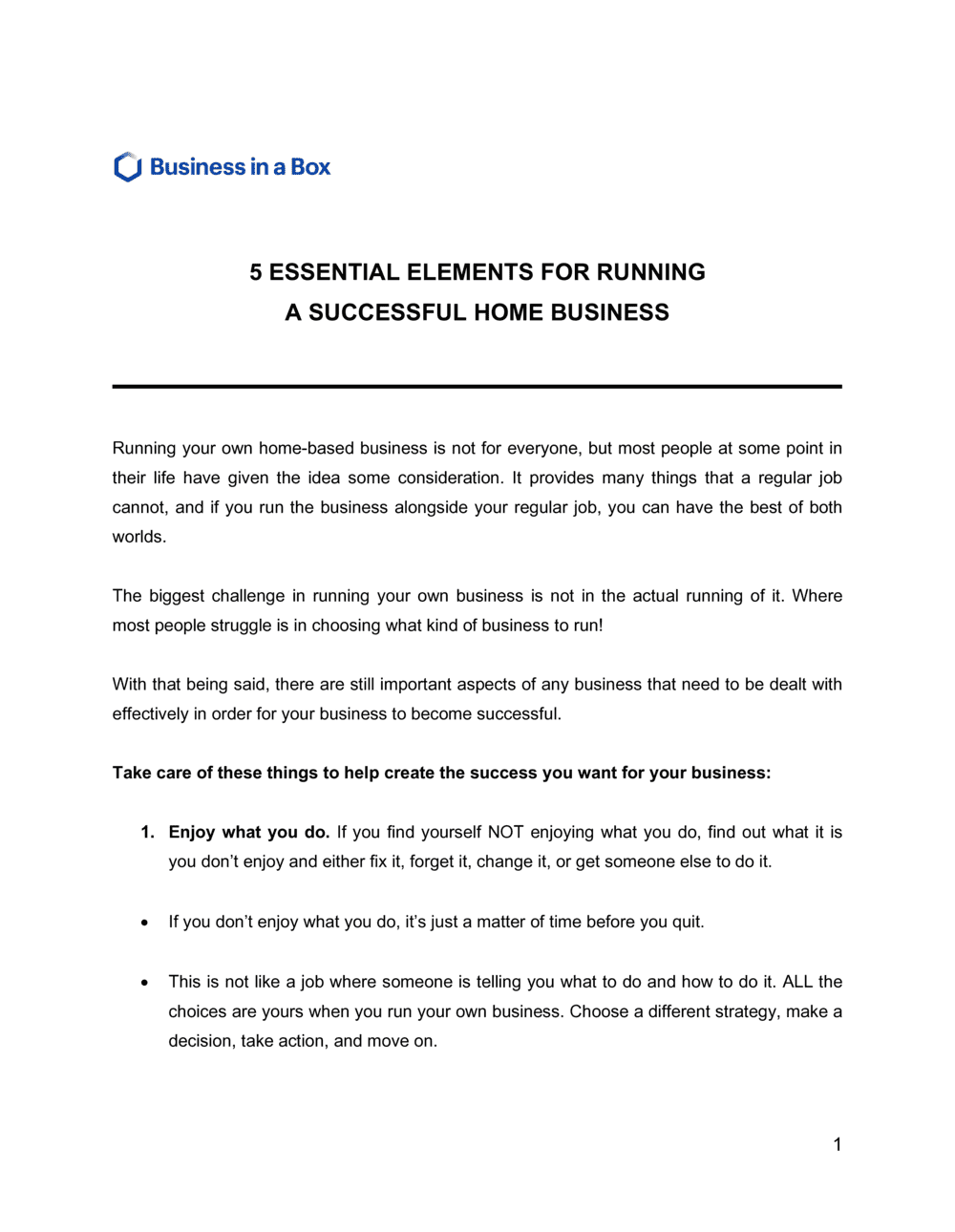
This template is a structured Word document that walks home-based business owners through the five foundational pillars of a viable home business: dedicated workspace, daily schedule, financial management, marketing strategy, and legal and regulatory compliance. It is a free download you can edit online and export as PDF to use as an internal operating guide, a reference checklist, or a planning document to share with an accountant or advisor.
When you need it
Use it when launching a home-based business for the first time, when an existing home venture is growing faster than your informal systems can handle, or when you need to formalize operations before applying for a business license, home-office tax deduction, or small business loan.
What's inside
The template covers workspace design and separation, time management and scheduling structures, income and expense tracking methods, customer acquisition and marketing basics, and the legal, tax, and insurance considerations specific to home-based operations.

What is the 5 Essential Elements for Running a Successful Home Business Template?

The 5 Essential Elements for Running a Successful Home Business template is a structured operational guide that helps home-based business owners build the five foundational systems every viable home venture requires: a dedicated workspace, a disciplined daily schedule, a formal financial management approach, a consistent marketing strategy, and a legal and licensing compliance checklist. Unlike a full business plan, this document focuses on day-to-day operations rather than investor-facing strategy β€” giving solo operators and micro-business owners a practical, room-by-room, hour-by-hour framework they can act on immediately. It is available as a free Word download, editable online, and exportable as PDF.

Why You Need This Document

Most home businesses fail not because the underlying service or product is weak, but because the operational infrastructure around it was never built. Without a defined workspace, a tax deduction is lost and focus erodes. Without set hours, clients expect 24/7 availability and burnout follows. Without a separate business bank account, bookkeeping becomes a quarterly nightmare and loan applications stall. Without a licensing check, fines and forced closure are real risks even for businesses generating genuine revenue. This template closes all five gaps in a single sitting, giving you a written record of your operating decisions that you can share with an accountant, advisor, or household member β€” and return to every quarter as the business grows.

Which variant fits your situation?

If your situation is…Use this template
Launching a brand-new home business from scratch5 Essential Elements for Running a Successful Home Business
Creating a formal multi-year business plan for a home ventureBusiness Plan
Tracking daily tasks and priorities for a solo home-based operationDaily Task Planner
Managing monthly income and expenses for tax preparationSmall Business Budget Template
Defining services and rates before approaching home-based clientsService Agreement
Marketing a home business to local or online audiencesMarketing Plan
Separating personal and business finances for a home operationBusiness Expense Report

Common mistakes to avoid

❌ No physical separation between workspace and living space

Why it matters: Working from a shared space like a couch or kitchen table reduces focus, disqualifies the space from tax deductions, and makes it hard to mentally close the workday.

Fix: Designate a specific area used only for business, even if it is a partitioned corner of a room β€” document its exclusive use from day one.

❌ Undefined business hours leading to always-on availability

Why it matters: Without set hours, home business owners respond to clients at all hours, eroding personal time and making it impossible to sustain productivity long-term.

Fix: Write your business hours into your email signature, voicemail, and client onboarding materials so expectations are set before a single message is sent.

❌ Mixing personal and business finances

Why it matters: Commingled accounts make quarterly tax estimates inaccurate, complicate bookkeeping, and create significant problems if the business is ever audited or needs to demonstrate revenue for a loan.

Fix: Open a separate business bank account before accepting the first payment β€” even a free sole-proprietor checking account creates the separation needed.

❌ Skipping local licensing and zoning checks

Why it matters: Operating a home business without the required permits can result in fines, forced closure, or inability to deduct business expenses β€” even if the business itself is legitimate.

Fix: Research your city or county's home occupation permit and zoning requirements before your first client transaction, and renew permits annually.

The 8 key sections, explained

Element 1 β€” Dedicated workspace setup

Element 2 β€” Daily schedule and time management

Element 3 β€” Financial management system

Element 4 β€” Marketing and customer acquisition strategy

Element 5 β€” Legal, licensing, and compliance checklist

Professional boundaries and client communication policy

Technology and tools inventory

Growth and milestone planning

How to fill it out

  1. 1

    Assess and designate your workspace

    Walk through your home and identify a space that can be used exclusively for business. Measure the square footage, list the equipment you need, and note what needs to be purchased or reorganized before launch.

    πŸ’‘ Photograph the dedicated workspace after setup β€” this documentation supports a home-office tax deduction if the space is later audited.

  2. 2

    Define your working hours and time blocks

    Set specific start and end times for your business day, block out deep-work hours for client deliverables, and designate separate time for administrative tasks like email, invoicing, and bookkeeping.

    πŸ’‘ Share your schedule with household members in writing β€” a visible posted schedule reduces interruptions more effectively than a verbal request.

  3. 3

    Open a dedicated business bank account

    Choose a bank account used exclusively for business income and expenses. Link it to your accounting software and set up a recurring transfer of your estimated tax percentage to a separate savings account on every payment received.

    πŸ’‘ Many business checking accounts are free for sole proprietors β€” shop three options before choosing, looking at transaction fees and online banking features.

  4. 4

    Complete the legal and licensing checklist

    Research your municipality's home occupation permit requirements, confirm your zoning allows the type of business activity you plan, select a business structure, and obtain any required licenses before your first client transaction.

    πŸ’‘ Search '[your city] home occupation permit' and '[your city] business license' β€” most municipalities publish the requirements and fees online.

  5. 5

    Define your target customer and two primary marketing channels

    Write a one-sentence description of your ideal customer, then select two acquisition channels you will commit to consistently β€” one referral-based and one digital. Document the specific weekly or monthly actions for each channel.

    πŸ’‘ Consistency beats volume in early-stage marketing. Two channels executed weekly outperform six channels maintained sporadically.

  6. 6

    Set your client communication policy

    Decide which channels clients can use to reach you, define your response-time commitment, and document what happens with after-hours requests. Include this policy in your onboarding email or service agreement.

    πŸ’‘ Auto-replies on email and voicemail that state your response window set expectations automatically without any extra effort per client.

  7. 7

    Set 90-day, 6-month, and 12-month milestones

    Write one specific, measurable target for each horizon β€” a revenue figure, client count, or capability upgrade. Schedule a calendar review at each milestone to assess progress and adjust.

    πŸ’‘ Tie your 6-month milestone to a concrete financial threshold β€” such as replacing 50% of a prior salary β€” so the review has a real decision point attached to it.

Frequently asked questions

What are the five essential elements for running a successful home business?

The five elements are a dedicated workspace, a structured daily schedule, a formal financial management system, a consistent marketing and customer acquisition strategy, and a legal and licensing compliance checklist. Each element addresses a common failure point for home-based businesses β€” from tax deduction eligibility to client pipeline management. This template walks you through each one with specific prompts and sample language.

Do I need a business license to run a business from home?

In most jurisdictions, yes. The majority of US municipalities require a home occupation permit, general business license, or both β€” even for businesses that do not receive clients at home. Requirements and fees vary by city and county. Search your municipality's website for 'home occupation permit' requirements before launching, and renew annually as required.

Can I deduct a home office on my taxes?

You can generally deduct a home office if you use a defined area of your home exclusively and regularly for business. The IRS allows two calculation methods: the simplified method ($5 per square foot, up to 300 sq ft) and the actual expense method (a percentage of mortgage interest, rent, utilities, and insurance proportional to the office square footage). Keep documentation β€” photographs and measurements β€” to support the deduction.

What is the best business structure for a home-based business?

Most home-based businesses start as sole proprietorships because there is no formation cost or administrative overhead. Forming an LLC is worth considering once the business generates meaningful revenue or if it carries liability risk β€” such as consulting, coaching, or product sales. An LLC separates personal assets from business obligations and typically costs $50–$500 in state filing fees. Consult an accountant before choosing a structure, as the tax implications differ.

How do I separate work and personal life when running a business from home?

Three practices make the biggest difference: set fixed working hours and communicate them to clients and household members, designate a physical workspace used only for business, and create a shutdown ritual β€” closing your laptop, logging out of tools, and leaving the workspace β€” that signals the end of the workday. Time-blocking client work, admin, and personal time on a shared calendar helps enforce these boundaries consistently.

How much should I set aside for taxes as a home business owner?

Self-employed individuals in the US typically set aside 25–30% of net income to cover federal income tax and self-employment tax (15.3%). State income tax adds 0–13% depending on location. Setting aside 30% of every payment received into a separate savings account and making estimated quarterly tax payments by the IRS deadlines (typically April 15, June 15, September 15, and January 15) prevents end-of-year surprises. An accountant can refine this estimate based on your deductions.

What insurance does a home-based business need?

Standard homeowner's or renter's insurance typically excludes business equipment and liability. Home-based business owners should consider a home business endorsement or standalone business owner's policy covering equipment, general liability, and β€” for service providers β€” professional liability (errors and omissions) insurance. Costs range from $200–$1,500 per year depending on coverage and industry.

How do I find clients for a new home-based business?

The fastest early-stage channel is direct referrals from your existing professional and personal network β€” email everyone you know, describe what you do specifically, and ask for an introduction to anyone who might need it. Pair this with one digital channel (LinkedIn, Instagram, or a simple website with SEO) maintained consistently. Two channels worked weekly produce more results than six channels updated sporadically.

When should I move my home business out of the house?

Consider a transition when client meetings require a professional space more than twice a week, when the home workspace cannot expand to accommodate additional equipment or team members, when zoning or HOA restrictions limit growth, or when monthly revenue consistently exceeds the cost of a shared workspace or small commercial lease. Many home businesses use co-working memberships as an intermediate step before committing to a dedicated office.

How this compares to alternatives

vs Business Plan

A business plan is a 20–35 page document designed for investors, lenders, or boards β€” covering market analysis, competitive positioning, and multi-year financial projections. This home business template is an operational guide focused on day-to-day systems and compliance for a solo or micro-business. Use the home business template to get operations running; build a full business plan when you need outside capital.

vs Marketing Plan

A marketing plan is a dedicated document covering customer segmentation, channel strategy, campaign calendars, and budget allocation in depth. This home business template includes a marketing element as one of five operational pillars. Use this template for initial setup; graduate to a standalone marketing plan once your business is generating consistent revenue and you are ready to scale acquisition.

vs Small Business Budget Template

A small business budget template is a financial-only document focused on income, expense categories, and variance tracking. The home business template addresses finances as one element alongside workspace, scheduling, marketing, and legal compliance. Use both together: this template defines your financial management approach; the budget template executes it month by month.

vs Service Agreement

A service agreement is a legally binding document between a provider and a client that governs deliverables, payment, and liability for a specific engagement. This home business template is an internal operating document β€” it does not create enforceable obligations with clients. Use a service agreement for every client relationship; use this template to organize the business that services them.

Industry-specific considerations

Professional Services

Home-based consultants, coaches, and accountants need clear client communication policies and professional liability insurance to operate credibly without a commercial office.

Creative and Marketing

Designers, photographers, and content creators rely on dedicated workspace for equipment setup and require strong portfolio-based marketing channels to attract remote or local clients.

E-commerce and Retail

Home-based product sellers need inventory storage separate from living areas, clear zoning compliance for any shipping or receiving activity, and a financial system that tracks cost of goods sold.

Technology and Freelance Development

Home-based developers and IT consultants depend on reliable redundant internet, secure remote-work setups, and structured time blocking to manage multiple client projects simultaneously.

Template vs pro β€” what fits your needs?

PathBest forCostTime
Use the templateFirst-time home business owners setting up operations, freelancers formalizing existing work-from-home routinesFree2–4 hours to complete
Template + professional reviewHome business owners applying for a business license, home-office deduction, or small business loan who want an accountant or advisor to review their financial and compliance sections$150–$400 for a one-hour accountant or business advisor review1–3 days
Custom draftedHome businesses with employees, significant inventory, or operations in a regulated industry (food, childcare, financial services) that require a tailored compliance and operations plan$500–$2,000 for a business consultant or attorney1–2 weeks

Glossary

Home Office Deduction
A tax deduction available to business owners who use a portion of their home exclusively and regularly for business, calculated either by the simplified method or actual expense method.
Dedicated Workspace
A physically separate area of the home used solely for business activities β€” a requirement for most home-office tax deductions and a key factor in maintaining work-life separation.
Time Blocking
A scheduling technique where specific hours are reserved for defined tasks β€” such as client work from 9–12 and admin from 1–3 β€” to improve focus and protect personal time.
Sole Proprietorship
The simplest business structure, where one person owns and operates the business with no legal separation between personal and business assets.
LLC (Limited Liability Company)
A business structure that separates personal assets from business liabilities, offering limited legal protection without the complexity of a corporation.
Business License
A government-issued permit that authorizes a person to operate a business within a specific municipality or jurisdiction β€” often required even for home-based businesses.
Zoning Regulations
Local laws that govern how a property may be used β€” some residential zones restrict or prohibit certain commercial activities, including client visits to a home office.
Self-Employment Tax
A US federal tax covering Social Security and Medicare contributions for self-employed individuals, currently 15.3% on net self-employment income.
Estimated Quarterly Taxes
Tax payments made four times per year by self-employed individuals to cover income and self-employment tax, since no employer withholds taxes from their pay.
Professional Liability Insurance
Coverage that protects a business owner against claims of negligence, errors, or omissions arising from professional services delivered β€” particularly important for home-based service businesses.

Part of your Business Operating System

This document is one of 3,000+ business & legal templates included in Business in a Box.

  • Fill-in-the-blanks β€” ready in minutes
  • Compatible with all office suites
  • Export to PDF and share electronically

Create your document in 3 simple steps.

From template to signed document β€” all inside one Business Operating System.
1
Download or open template

Access over 3,000+ business and legal templates for any business task, project or initiative.

2
Edit and fill in the blanks with AI

Customize your ready-made business document template and save it in the cloud.

3
Save, Share, Send, Sign

Share your files and folders with your team. Create a space of seamless collaboration.

Save time, save money, and create top-quality documents.

β˜…β˜…β˜…β˜…β˜…

"Fantastic value! I'm not sure how I'd do without it. It's worth its weight in gold and paid back for itself many times."

Managing Director Β· Mall Farm
Robert Whalley
Managing Director, Mall Farm Proprietary Limited
β˜…β˜…β˜…β˜…β˜…

"I have been using Business in a Box for years. It has been the most useful source of templates I have encountered. I recommend it to anyone."

Business Owner Β· 4+ years
Dr Michael John Freestone
Business Owner
β˜…β˜…β˜…β˜…β˜…

"It has been a life saver so many times I have lost count. Business in a Box has saved me so much time and as you know, time is money."

Owner Β· Upstate Web
David G. Moore Jr.
Owner, Upstate Web

Run your business with a system β€” not scattered tools

Stop downloading documents. Start operating with clarity. Business in a Box gives you the Business Operating System used by over 250,000 companies worldwide to structure, run, and grow their business.

Start freeΒ Β·Β No credit card required