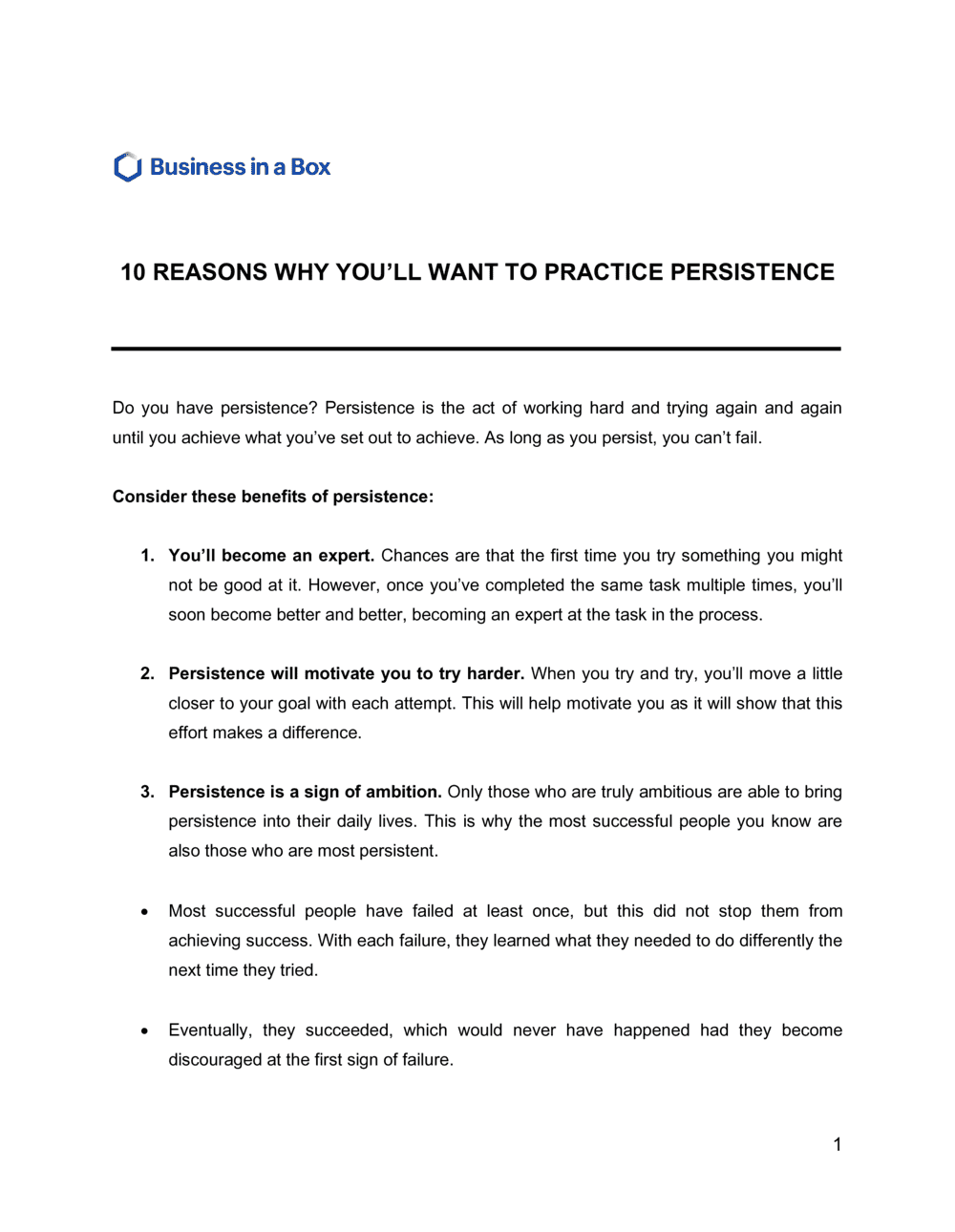
10 Reasons Why Youll Want To Practice Persistence Template

Free to read β€’ Save or share with one click

Free10 Reasons Why Youll Want To Practice Persistence Template

At a glance

What it is
The 10 Reasons Why You'll Want to Practice Persistence is a structured motivational and operational guide that walks business leaders, managers, and individuals through ten concrete, evidence-based reasons why sustained effort over time produces results that short-term thinking cannot. This free Word download is fully editable β€” adapt it for onboarding programs, team training sessions, or personal development initiatives β€” and export as PDF to distribute or present.
When you need it
Use it when a team or individual is facing setbacks, stalling on a long-term initiative, or struggling to maintain momentum through a difficult growth phase. It is equally effective as a proactive culture-building tool during onboarding or annual planning.
What's inside
Ten structured sections each covering a distinct rationale for persistence, from building compounding momentum and developing resilience to establishing credibility and unlocking delayed opportunity. Each section pairs a core argument with practical business context and actionable takeaways.

What is the 10 Reasons to Practice Persistence Guide?

The 10 Reasons Why You'll Want to Practice Persistence is a structured motivational and operational document that presents ten concrete, evidence-based arguments for why sustained effort β€” applied consistently over time β€” produces results that talent, timing, or resources alone cannot deliver. Each section moves beyond abstract encouragement to identify a specific business mechanism: compounding momentum, reduced cost of failure, expanded tolerance for uncertainty, identity formation, and more. The document is designed for use in business contexts β€” leadership coaching, team training, onboarding programs, and personal development planning β€” and is formatted in Word so it can be customized with real organizational examples and distributed as PDF.

Why You Need This Document

Without a shared, articulated framework for persistence, teams abandon long-term strategies at the first serious obstacle β€” not because the strategy was wrong, but because no one has made the case for staying the course when results are delayed. The cost of this is concrete: product launches stall in the gap between effort and traction, sales pipelines dry up when prospecting feels futile, and change initiatives collapse before the compounding effect activates. This guide gives leaders a structured tool to address that gap β€” not with generic motivation, but with ten specific arguments that reframe difficulty as a necessary part of the process. Used before a challenging initiative begins, it builds the psychological contract that keeps teams executing when progress is invisible. Used during a plateau, it gives individuals and groups a framework to interpret their situation and recommit. Used as part of onboarding, it embeds persistence as an organizational value before the first hard test arrives.

Which variant fits your situation?

If your situation is…Use this template
Delivering persistence principles in a team workshop or training sessionEmployee Training Plan
Embedding persistence as part of a broader company culture initiativeCompany Culture Guide
Coaching an individual employee on performance and resilienceEmployee Performance Improvement Plan
Documenting personal or professional development goals tied to persistencePersonal Development Plan
Building persistence into an annual business strategy or planning cycleStrategic Planning Template
Motivating a sales team with structured persistence principlesSales Plan Template

Common mistakes to avoid

❌ Using generic, inspirational language instead of specific business arguments

Why it matters: Professionals discount motivational content that reads as generic β€” it signals the author did not think through their specific situation, and the guide gets skimmed or discarded.

Fix: Replace every abstract claim with a specific business mechanism β€” 'persistence builds momentum' becomes 'each consecutive week of outreach reduces average first-response time by a measurable increment.'
❌ Omitting the distinction between productive and unproductive persistence

Why it matters: Telling teams to 'keep going' without acknowledging when a pivot is warranted erodes the guide's credibility and can lead to teams persisting with a broken strategy.

Fix: Add a brief section or callout that defines the difference β€” productive persistence adjusts the method while maintaining the goal; unproductive persistence repeats the same failed approach.

❌ Skipping the closing commitment or action step

Why it matters: A guide that concludes with an argument rather than a behavior leaves readers informed but unchanged β€” motivation without a next step dissipates within 48 hours.

Fix: End every version of this document with a single, specific, time-bound commitment the reader makes in writing before they close the file.

❌ Distributing the guide without a delivery context or framing

Why it matters: A document shared without context reads as generic corporate content β€” readers do not self-apply its lessons because no one has connected it to their current challenge.

Fix: Always pair distribution with a one-paragraph written framing or a brief verbal introduction that names the specific challenge the guide is meant to address.

❌ Keeping all 10 sections at the same depth regardless of audience

Why it matters: A workshop audience needs punchy, scannable sections with discussion prompts; a self-directed reader needs fuller explanations β€” one-size formatting reduces effectiveness for both.

Fix: Create two versions: a condensed workshop edition (one key argument and one prompt per section) and a full reference edition with examples and action steps.

❌ Filling the examples with hypothetical or fictional companies

Why it matters: Fabricated examples are immediately recognizable and undermine the guide's authority β€” readers disengage when they sense the evidence is invented rather than observed.

Fix: Use real, named business examples from publicly documented company histories, or replace with honest first-person examples from your own organization's experience.

The 11 key sections, explained

Introduction: The case for persistence

Reason 1 β€” Persistence builds compounding momentum

Reason 2 β€” Persistence develops problem-solving capability

Reason 3 β€” Persistence establishes credibility and trust

Reason 4 β€” Persistence expands tolerance for uncertainty

Reason 5 β€” Persistence creates optionality through delayed opportunity

Reason 6 β€” Persistence is the mechanism that converts skill into results

Reason 7 β€” Persistence reduces the effective cost of failure

Reason 8 β€” Persistence shapes organizational culture

Reason 9 β€” Persistence activates intrinsic motivation

Reason 10 β€” Persistence compounds identity over time

How to fill it out

  1. 1

    Define your audience and delivery context

    Decide whether this document will be used in a one-on-one coaching session, a group workshop, an onboarding program, or as a self-directed reading. The tone and depth of each section should match the context.

    πŸ’‘ For group delivery, trim each section to a single key argument and add a discussion prompt β€” the full version works better as pre-reading or individual reference.

  2. 2

    Customize the introduction with a specific business context

    Replace generic references in the introduction with a concrete challenge your organization is currently navigating β€” a stalled product launch, a long sales cycle, or a difficult market. Specificity makes the guide credible.

    πŸ’‘ Name the challenge in the first paragraph β€” readers engage immediately when they recognize their own situation in the opening lines.

  3. 3

    Tailor the examples in each reason section

    Replace the placeholder examples in each of the 10 reason sections with real examples from your industry, your company's history, or publicly known business stories your audience will recognize.

    πŸ’‘ One real, specific example per section outperforms three generic ones β€” specificity signals that the author has thought through the argument, not recycled it.

  4. 4

    Add measurable actions to each section

    Each reason becomes more actionable when paired with a concrete behavior β€” for example, Reason 1 on momentum pairs with a daily progress log; Reason 9 on intrinsic motivation pairs with a milestone-tracking board.

    πŸ’‘ Keep each action to one sentence and one behavior. Multiple action items per section compete for attention and reduce follow-through.

  5. 5

    Include a reflection or discussion prompt per section

    For team or coaching use, add one open-ended question at the end of each section to prompt honest self-assessment β€” e.g., 'Where in your current work are you stopping just before the compounding effect would kick in?'

    πŸ’‘ Questions that name a specific behavior (stopping, avoiding, deflecting) produce more honest responses than abstract ones about goals or values.

  6. 6

    Add a closing commitment section

    After Reason 10, include a one-page section where the reader or team commits to one specific persistence practice they will start in the next 7 days β€” with a named date and a named accountability partner.

    πŸ’‘ Written commitments with a specific date and an accountable witness are completed at roughly 3Γ— the rate of unwritten intentions.

  7. 7

    Export as PDF and distribute before a key challenge or planning event

    Timing matters β€” distribute this guide 24–48 hours before a team meeting, performance review, or planning cycle where persistence will be a theme, so readers arrive primed.

    πŸ’‘ A brief 5-minute verbal framing of why you are sharing the guide before distributing it increases engagement more than any design or formatting change.

Frequently asked questions

What is the '10 Reasons to Practice Persistence' document?

It is a structured motivational and operational guide that presents ten concrete, evidence-based arguments for why sustained effort over time produces results that talent, resources, or short-term thinking alone cannot. It is designed for use in business settings β€” team training, leadership coaching, onboarding, or personal development planning β€” and is formatted in Word for easy customization and distribution.

Who should use this persistence guide?

Business owners, team managers, HR professionals, executive coaches, sales leaders, and startup founders all use this document to reinforce long-term thinking in their teams or clients. It is most effective when distributed before or during a period of sustained challenge β€” a long sales cycle, a product development slog, or an organizational change initiative β€” rather than after the difficulty has passed.

How is this different from a generic motivational poster or speech?

Each of the ten sections pairs a core behavioral argument with a specific business mechanism β€” compounding momentum, reduced cost of failure, identity formation β€” rather than relying on inspiration alone. The template includes placeholders for real organizational examples and closes with a written commitment structure, making it an operational tool rather than a passive piece of content.

Can this document be used in a team workshop setting?

Yes β€” it is designed for dual use. For workshops, trim each section to the core argument and add a discussion prompt so the guide becomes a facilitation tool. For self-directed reading, keep the full explanations and action steps. The Word format makes it straightforward to create two separate versions from the same source file.

How long should the completed guide be?

For individual or self-directed use, a complete version runs 8–12 pages including the introduction, all ten reason sections, and a closing commitment page. For a workshop handout, a condensed version of 3–5 pages with one argument and one prompt per section is more practical. Both formats work from the same Word template.

Should this guide be customized for each team or audience?

Customization significantly increases effectiveness. Replacing generic examples with real situations your audience recognizes β€” a specific product challenge, a named client, a documented setback β€” converts the guide from informational to directly actionable. The minimum useful customization is the introduction and at least three of the ten reason sections.

What is the difference between persistence and stubbornness in a business context?

Persistence maintains commitment to the goal while remaining willing to adapt the method. Stubbornness maintains commitment to a specific method regardless of evidence that it is not working. A well-used version of this guide makes this distinction explicit β€” usually in the introduction or as a callout in Reason 6 β€” so teams understand that pivoting tactics is not a failure of persistence.

How often should a business revisit or redistribute this document?

Distribute it at the start of any initiative expected to take longer than 90 days, again at the midpoint if momentum is visibly stalling, and optionally at the annual planning cycle as a culture-reinforcement touchpoint. One-time distribution produces short-lived effect; recurring reference at key moments builds persistence as an organizational habit rather than a one-off message.

How this compares to alternatives

vs Personal Development Plan

A personal development plan is a goal-setting and skill-building roadmap for an individual. This persistence guide explains why sustained effort toward any goal is worth maintaining β€” it is the philosophical and motivational foundation that makes a development plan more likely to be followed through. Use both together: the persistence guide as the mindset framework, the development plan as the execution structure.

vs Performance Improvement Plan

A performance improvement plan (PIP) is a formal HR document that sets specific performance targets for an employee who is underperforming, with consequences for non-compliance. This persistence guide is a motivational and educational resource β€” not a corrective tool. A manager might use this guide proactively to build resilience before performance issues arise, whereas a PIP is a reactive intervention after a performance threshold has been crossed.

vs Employee Training Plan

An employee training plan maps specific skills, learning objectives, and timelines for capability development. This persistence guide addresses the behavioral and motivational layer beneath skill acquisition β€” why effort should be sustained when learning is slow or results are delayed. The two documents complement each other: the training plan defines what to learn; the persistence guide explains why to keep going when it gets hard.

vs Strategic Planning Template

A strategic plan sets organizational goals, initiatives, and resource allocation for a defined planning horizon. This persistence guide does not replace strategic planning β€” it addresses the human execution layer that determines whether a strategy is actually followed through. Teams that have a strategic plan but lack a shared commitment to persistent execution abandon the strategy at the first serious obstacle. Use this guide during or after strategic planning to reinforce the behavioral commitment required to execute.

Industry-specific considerations

Sales and Business Development

Used to sustain team performance through long deal cycles, high-rejection prospecting periods, and quota pressure β€” where quitting before the compounding effect activates is the single most common failure mode.

Technology and SaaS

Applied during extended product development sprints, slow user-acquisition ramps, or post-pivot rebuilds β€” contexts where the lag between effort and measurable outcome is longest and team morale is most at risk.

Retail and E-commerce

Relevant during new market entry, brand-building phases, or post-launch periods where customer acquisition is slower than projected and the temptation to abandon the strategy is highest.

Education and Coaching

Core curriculum material for executive coaches, career counselors, and professional development programs β€” used as a structured framework to help clients move through performance plateaus and self-doubt cycles.

Template vs pro β€” what fits your needs?

PathBest forCostTime
Use the templateBusiness owners, managers, and coaches who want to adapt and distribute the guide directly to their teamsFree1–3 hours to customize and distribute
Template + professional reviewOrganizations embedding this into a formal onboarding or leadership development curriculum$200–$800 for an L&D consultant or executive coach review1–2 days
Custom draftedEnterprise teams requiring a fully branded, proprietary motivational framework integrated into a multi-session leadership program$2,000–$8,000 for custom content development2–6 weeks

Glossary

Persistence
Continued effort toward a goal despite obstacles, setbacks, delays, or repeated failure β€” without reducing the quality or commitment of the effort.
Resilience
The capacity to recover quickly from difficulties and return to effective functioning after a disruption or failure.
Growth Mindset
The belief that abilities and intelligence can be developed through dedication and hard work, as opposed to being fixed traits.
Compounding Momentum
The progressive acceleration of results that occurs when consistent small actions accumulate into disproportionately large outcomes over time.
Delayed Gratification
The ability to resist an immediate reward in favor of a later, more significant reward β€” a core behavioral trait associated with long-term success.
Grit
A combination of passion and sustained persistence toward long-term goals, independent of short-term feedback or recognition.
Performance Plateau
A period during which measurable progress stalls despite continued effort β€” often a precursor to a breakthrough if effort is maintained.
Cognitive Reframing
A mental technique that changes the interpretation of a situation β€” particularly a setback β€” from negative to constructive without denying the facts.
Intrinsic Motivation
Motivation driven by internal rewards such as personal satisfaction or purpose, rather than external incentives like pay or recognition.
Accountability Framework
A system of structures, check-ins, and expectations that keeps individuals or teams committed to stated goals over time.

Part of your Business Operating System

This document is one of 3,000+ business & legal templates included in Business in a Box.

  • Fill-in-the-blanks β€” ready in minutes
  • Compatible with all office suites
  • Export to PDF and share electronically

Create your document in 3 simple steps.

From template to signed document β€” all inside one Business Operating System.
1
Download or open template

Access over 3,000+ business and legal templates for any business task, project or initiative.

2
Edit and fill in the blanks with AI

Customize your ready-made business document template and save it in the cloud.

3
Save, Share, Send, Sign

Share your files and folders with your team. Create a space of seamless collaboration.

Save time, save money, and create top-quality documents.

β˜…β˜…β˜…β˜…β˜…

"Fantastic value! I'm not sure how I'd do without it. It's worth its weight in gold and paid back for itself many times."

Managing Director Β· Mall Farm
Robert Whalley
Managing Director, Mall Farm Proprietary Limited
β˜…β˜…β˜…β˜…β˜…

"I have been using Business in a Box for years. It has been the most useful source of templates I have encountered. I recommend it to anyone."

Business Owner Β· 4+ years
Dr Michael John Freestone
Business Owner
β˜…β˜…β˜…β˜…β˜…

"It has been a life saver so many times I have lost count. Business in a Box has saved me so much time and as you know, time is money."

Owner Β· Upstate Web
David G. Moore Jr.
Owner, Upstate Web

Run your business with a system β€” not scattered tools

Stop downloading documents. Start operating with clarity. Business in a Box gives you the Business Operating System used by over 250,000 companies worldwide to structure, run, and grow their business.

Start freeΒ Β·Β No credit card required