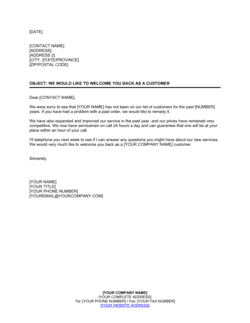
You've Attained Valued Customer Status with our Company Template

Free Word download • Edit online • Save & share with Drive • Export to PDF

1 page20–25 min to fillDifficulty: StandardSignature requiredLegal review recommended
Learn more ↓
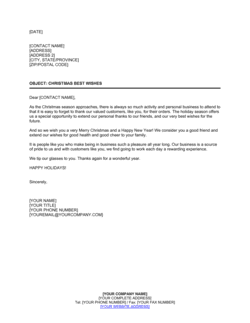
FreeYou've Attained Valued Customer Status with our Company Template

At a glance

What it is
A Valued Customer Status Letter is a formal written communication — and binding addendum to an existing customer relationship — that officially notifies a client of their elevation to a preferred or valued tier within a loyalty or rewards program. This free Word download lets you edit status criteria, benefits, obligations, and term length online, then export as PDF for signature and delivery.
When you need it
Use it when a customer has met a defined spending threshold, tenure milestone, or engagement benchmark that qualifies them for enhanced pricing, priority service, or exclusive perks. It formalizes the relationship upgrade and sets enforceable expectations on both sides.
What's inside
The letter covers the criteria that triggered valued status, the specific benefits conferred, any obligations the customer must maintain to retain status, the program term and renewal conditions, limitations of liability, and governing law.

What is a Valued Customer Status Letter?

A Valued Customer Status Letter is a formal written communication — and typically a binding legal addendum to an existing commercial relationship — that officially notifies a client they have reached a recognized loyalty or reward tier within a company's program. It documents the specific criteria the customer met to qualify, the precise benefits they are entitled to, the conditions required to maintain status, and the program term. Unlike a casual thank-you note, a properly drafted and countersigned status letter creates enforceable obligations: the company must deliver the promised benefits; the customer must meet the retention thresholds to keep them. It functions as both a customer relationship tool and a contract that protects both parties from misunderstanding.

Why You Need This Document

Without a written, signed status letter, loyalty program disputes are settled by whoever has the more compelling version of events — and companies almost always lose. A customer who believes they were promised priority service or a 20% discount but never received it has strong grounds for a complaint, a chargeback, or a public grievance if the terms were never documented. Conversely, a company that issues vague verbal assurances about "special status" may find itself obligated to extend benefits indefinitely, even when the customer's purchasing drops to zero. A properly structured status letter eliminates both risks: it records exactly what was earned, what it is worth, how long it lasts, and what happens if circumstances change. For businesses running tiered programs across dozens or hundreds of accounts, this template provides a consistent, legally sound baseline that sales and customer success teams can customize in minutes.

Which variant fits your situation?

If your situation is…Use this template
Welcoming a customer to a tiered rewards program for the first timeYou've Attained Valued Customer Status With Our Company
Renewing or confirming continued valued status for another program yearCustomer Status Renewal Letter
Notifying a customer of a downgrade due to reduced activityCustomer Status Change Notification Letter
Inviting a customer to a VIP or exclusive membership programCustomer Loyalty Program Agreement
Thanking a long-term client for their business without conferring formal statusCustomer Appreciation Letter
Offering a preferred pricing addendum to an existing service agreementContract Amendment / Addendum
Communicating exclusive terms to a wholesale or trade accountWholesale Account Agreement

Common mistakes to avoid

❌ Vague qualification criteria

Why it matters: Describing qualification as 'loyal purchasing behavior' or 'consistent engagement' gives the customer grounds to argue they qualify regardless of actual spend, and the company no clean basis to deny or revoke status.

Fix: Replace every qualitative phrase with a specific, verifiable metric — dollar amount, transaction count, or account age — tied to a defined measurement period.

❌ No retention requirement clause

Why it matters: Without an ongoing activity requirement, a customer who qualified once may claim full status benefits indefinitely, even if they make no further purchases for the rest of the program year.

Fix: Add a minimum quarterly or annual purchasing threshold that the customer must maintain, and specify the notice procedure if status is suspended for non-compliance.

❌ Mixing contractual and discretionary benefits in a single sentence

Why it matters: Writing 'you are entitled to a 15% discount and may receive early access to new products' creates ambiguity — courts may read the entire sentence as conferring hard entitlements to both.

Fix: Enumerate contractual benefits in a separate numbered list from discretionary perks. Use distinct language for each category and explain in a preamble that only items in the first list are guaranteed.

❌ No program modification right

Why it matters: Without a reserved right to modify or discontinue the program, any change to benefits — even a minor adjustment to a support SLA — could be challenged as a breach of contract by a litigious customer.

Fix: Include a clear modification clause with a reasonable advance notice period (30 days minimum) and specify that benefits already accrued before notice are protected.

The 9 key clauses, explained

Parties and relationship recital

In plain language: Identifies the company and the customer by legal name, references the existing commercial relationship, and establishes the purpose of the letter.

Sample language
This letter is issued by [COMPANY LEGAL NAME] ('Company') to [CUSTOMER FULL NAME / ENTITY NAME] ('Customer') in recognition of Customer's achievement of Valued Customer Status under the Company's [PROGRAM NAME] program, effective [DATE].

Common mistake: Using a trade name or brand name instead of the registered legal entity — if a dispute arises, the contracting party must match payroll, invoicing, and registration records exactly.

Status qualification criteria

In plain language: States the specific threshold or combination of factors the customer met to qualify — e.g., cumulative spend, number of transactions, account age, or referral volume.

Sample language
Customer has satisfied the qualification criteria for Valued Status by achieving cumulative purchases of $[AMOUNT] during the [PERIOD] ending [DATE], as recorded in Company's account management system.

Common mistake: Stating criteria vaguely ('consistent purchasing history') rather than with a specific, verifiable number — vague criteria invite disputes about whether status was earned or can be revoked.

Status benefits and entitlements

In plain language: Lists each specific benefit the customer receives — discounts, priority service, dedicated account access, exclusive offers — with enough detail to be enforceable.

Sample language
As a Valued Customer, you are entitled to: (a) a [X]% discount on all purchases during the Program Term; (b) priority access to [SERVICE / PRODUCT LINE]; and (c) a dedicated account representative reachable at [CONTACT DETAILS].

Common mistake: Listing benefits in aspirational language ('may receive' or 'could enjoy') — use 'are entitled to' for contractual benefits and 'may receive at Company's discretion' for non-binding perks, and keep the two categories clearly separate.

Retention requirements

In plain language: Specifies what the customer must do during the program term to maintain status — minimum spend per quarter, continued account activity, or compliance with payment terms.

Sample language
To retain Valued Customer Status throughout the Program Term, Customer must maintain minimum qualifying purchases of $[AMOUNT] per [QUARTER / YEAR] and remain in good standing on all outstanding invoices.

Common mistake: Omitting retention requirements entirely, which creates an implied perpetual entitlement — if the customer's purchasing drops to zero, the company may still owe full status benefits.

Program term and renewal

In plain language: States the start and end date of the current status period and explains whether status renews automatically upon re-qualification or requires a new issuance.

Sample language
Valued Customer Status under this letter is effective from [START DATE] through [END DATE] ('Program Term'). Status will automatically renew for successive 12-month periods if Customer satisfies the qualification criteria within the 90-day period preceding each renewal date.

Common mistake: Setting a program term without a renewal mechanism, forcing the company to reissue a new letter every year and creating gaps in coverage that confuse customers and sales teams.

Program modification and termination right

In plain language: Reserves the company's right to change benefits, modify qualification thresholds, or discontinue the program entirely, subject to reasonable advance notice.

Sample language
Company reserves the right to modify, suspend, or discontinue the [PROGRAM NAME] program or any component of Valued Customer Status upon [30] days' written notice to Customer. Benefits already accrued as of the notice date will not be retroactively reduced.

Common mistake: No modification clause at all — without it, any unilateral change to the program could be challenged as a breach of the letter's terms, even for economically insignificant adjustments.

Limitation of liability

In plain language: Caps the company's remedies if a promised benefit cannot be delivered — typically limiting the customer's recourse to a credit or substitute benefit rather than consequential or punitive damages.

Sample language
In the event Company is unable to deliver any specified benefit under this letter, Company's sole obligation shall be to provide Customer with a credit of equivalent value toward future purchases. Company shall not be liable for indirect, incidental, or consequential damages arising from any failure to deliver status benefits.

Common mistake: Omitting the limitation entirely, which leaves the company exposed to disproportionate damage claims if, for example, a priority service slot cannot be honored during a high-demand period.

Confidentiality of program terms

In plain language: Requests that the customer keep specific discount rates, pricing tiers, or program criteria confidential to prevent competitive harm or customer equity issues.

Sample language
Customer agrees to keep the specific discount rates and benefit terms set out in this letter confidential and not to disclose them to third parties without Company's prior written consent.

Common mistake: Skipping this clause for tiered pricing programs — if one customer discloses a preferential rate to others who don't qualify, the company faces pricing equity complaints and potential channel conflict.

Governing law and dispute resolution

In plain language: Specifies which jurisdiction's law governs the letter and how disputes will be resolved — typically the company's principal place of business.

Sample language
This letter shall be governed by the laws of [STATE / PROVINCE / COUNTRY]. Any dispute arising hereunder shall be resolved by binding arbitration in [CITY] under the rules of [AAA / JAMS / applicable arbitration body], except claims for injunctive or equitable relief.

Common mistake: Choosing a governing law jurisdiction with no connection to either party's operations — courts may decline to enforce choice-of-law provisions that appear designed solely to disadvantage the customer.

How to fill it out

  1. 1

    Enter legal entity names and account reference

    Fill in the company's full registered legal name and the customer's legal name or entity name exactly as they appear in your CRM or invoicing system. Include an account or customer ID number for easy reference.

    💡 Cross-check the customer's legal name against their most recent invoice or signed agreement — discrepancies between documents create enforcement gaps.

  2. 2

    Define the qualification criteria with specific numbers

    Replace placeholder criteria with the exact threshold the customer met — dollar amount spent, number of orders, or account tenure in months. Reference the specific measurement period (e.g., 'January 1 through December 31, 2025').

    💡 Pull the qualifying figure directly from your billing or CRM system and note the data source in an internal memo so you can substantiate the threshold if the customer ever disputes qualification.

  3. 3

    List each status benefit precisely

    Enumerate every benefit in lettered sub-paragraphs with exact terms — percentage discount, specific product or service lines covered, contact details for dedicated support. Separate contractual entitlements from discretionary perks.

    💡 Use 'are entitled to' for hard commitments and 'may receive at Company's discretion' for soft perks — mixing the two in a single clause creates unintended obligations.

  4. 4

    Set retention requirements and minimum activity thresholds

    Specify the minimum purchasing or engagement activity required per quarter or year to maintain status. Tie the threshold to your existing data so you can monitor compliance without manual review.

    💡 Set the retention threshold at roughly 70–80% of the qualification threshold — high enough to be meaningful, low enough that a single slow quarter doesn't trigger an automatic downgrade.

  5. 5

    State the program term start and end dates

    Enter the exact effective date and expiration date of the current status period. Confirm whether renewal is automatic upon re-qualification or requires a new letter to be issued.

    💡 Align the program term with your fiscal year if possible — it simplifies annual reviews and makes reporting and CRM updates easier to schedule.

  6. 6

    Review the modification and limitation clauses

    Confirm the notice period in the modification clause is achievable given your operational capacity. Review the limitation of liability language to ensure it covers your most likely failure scenarios — out-of-stock inventory, staffing shortages, or platform outages.

    💡 A 30-day modification notice period is standard for most B2B programs; consider 60 days for enterprise accounts where procurement cycles are longer.

  7. 7

    Obtain signatures and file the executed letter

    Send the letter to the customer for countersignature. Both parties should retain a fully executed copy. Store the signed letter alongside the customer's master service agreement in your contract management system.

    💡 Use an e-signature platform with a timestamped audit trail — execution date matters for program term calculations and any future status disputes.

Frequently asked questions

What is a valued customer status letter?

A valued customer status letter is a formal written notice — and typically a binding addendum to an existing customer relationship — that officially informs a client they have reached a recognized loyalty or reward tier. It documents the criteria the customer met, the specific benefits they are entitled to, the conditions for maintaining status, and the program term. When signed by both parties, it creates enforceable obligations on both sides.

Is a valued customer status letter legally binding?

Yes, when properly drafted and executed with signatures from both parties, a valued customer status letter is generally enforceable as a binding addendum or amendment to the existing commercial relationship. The key is specificity — courts are more likely to enforce clearly defined entitlements than vague promises. If the letter is issued unilaterally without a countersignature, its enforceability depends on whether the customer accepted the terms through conduct, such as continuing to purchase and redeem benefits.

What should a valued customer status letter include?

At minimum, the letter should include the legal names of both parties, the specific criteria the customer met to qualify, an itemized list of status benefits with exact terms, retention requirements for maintaining status, the program term start and end dates, renewal conditions, the company's right to modify or discontinue the program, a limitation of liability clause, and a governing law provision. Missing any of these creates gaps that courts will fill using jurisdiction-specific defaults.

Do I need a signature on a customer status letter?

For the letter to function as a binding legal document, yes — both the company and the customer should sign it. A countersigned letter eliminates disputes about whether the customer received and accepted the terms. Without a signature, the letter is a unilateral communication that may still create expectations, but its enforceability depends on whether acceptance can be inferred from the customer's conduct.

How long should valued customer status last?

Most programs use a 12-month program term aligned to the calendar or fiscal year, with automatic renewal upon re-qualification. Shorter terms of 6 months work well for high-velocity retail or e-commerce programs where purchasing patterns change quickly. Longer terms of 24 months are common for enterprise B2B accounts where the customer's purchasing cycles are slower and relationship continuity matters more than annual resets.

Can a company revoke valued customer status?

Yes, provided the letter includes a clear modification or termination clause with reasonable advance notice. Without such a clause, unilateral revocation could constitute a breach of the letter's terms, exposing the company to a claim for the value of forfeited benefits. In most jurisdictions, 30 days' written notice is considered reasonable for consumer programs; enterprise B2B programs typically use 60 days.

What happens if the company cannot deliver a promised benefit?

A well-drafted limitation of liability clause restricts the customer's remedy to a credit of equivalent value rather than consequential or punitive damages. Without this clause, failure to deliver a promised benefit — such as a priority service slot or an exclusive discount — could expose the company to disproportionate damage claims. Always include explicit remedy limitation language for programs with service-level commitments.

Do customer loyalty letters need to comply with consumer protection laws?

Yes, in most jurisdictions. Consumer protection statutes in the US (at the state level), Canada, the UK (Consumer Rights Act 2015), and the EU (Unfair Commercial Practices Directive) prohibit misleading or deceptive commercial communications. A letter that promises benefits the company cannot realistically deliver, or that buries material conditions in fine print, may trigger regulatory scrutiny or class action exposure. The plain-language drafting approach in this template is designed to minimize that risk.

Should different status tiers use separate letters?

Yes. Each tier — Silver, Gold, Platinum, or equivalent — should have its own letter with distinct qualification criteria, benefit schedules, and retention requirements. Using a single generic letter for multiple tiers creates ambiguity about which benefits apply to which customer, and makes it harder to defend a benefit denial if a customer argues they qualified for a higher tier.

How this compares to alternatives

vs Customer Appreciation Letter

A customer appreciation letter is a non-binding goodwill communication that thanks a client for their business without conferring formal rights or benefits. A valued customer status letter is a binding document that creates enforceable entitlements and obligations on both sides. Use an appreciation letter for relationship maintenance; use a status letter when specific benefits and conditions need to be documented and signed.

vs Contract Amendment

A contract amendment modifies the specific terms of an existing agreement — price, scope, or duration — and requires mutual assent to every changed provision. A valued customer status letter creates a supplemental benefit layer on top of the existing relationship without renegotiating original terms. If the status benefits materially alter pricing or service levels already governed by a master agreement, a formal amendment is the more appropriate vehicle.

vs Customer Loyalty Program Agreement

A loyalty program agreement is a comprehensive multi-page contract establishing the full rules of a rewards program — enrollment, earning mechanics, redemption, expiration, and termination. A valued customer status letter is a shorter, individual-level document notifying a specific customer of their tier and benefits within a program that may already be governed by a broader agreement. Use the letter for individual notifications; use the program agreement for the program's foundational rules.

vs Service Level Agreement (SLA)

A service level agreement defines measurable performance standards — uptime, response time, resolution time — for the entire commercial relationship or a specific service. A valued customer status letter may reference enhanced SLA terms as one of the status benefits, but it does not replace a standalone SLA. For service-oriented businesses, issue both: the SLA governs performance standards; the status letter formalizes the customer's entitlement to the elevated tier.

Industry-specific considerations

Retail and e-commerce

Tiered spend thresholds trigger status upgrades automatically; letters document discount rates, early-access windows, and free-shipping entitlements for each tier.

Financial services

Premium client status letters confer access to dedicated advisors, preferential fee structures, and priority processing — all of which require precise written terms to satisfy regulatory obligations.

SaaS and technology

Long-tenured or high-seat-count subscribers receive status letters confirming locked-in pricing, priority support SLAs, and dedicated customer success contacts.

Hospitality and travel

Elite-tier status letters document upgrade entitlements, complimentary services, and early check-in rights that must be enforceable across multiple properties or partners.

Professional services

Key account clients receive status letters confirming preferred billing rates, guaranteed response times, and access to senior practitioners not available to standard clients.

Manufacturing and wholesale

High-volume buyers are recognized with status letters that formalize volume pricing, priority allocation during supply constraints, and extended payment terms.

Jurisdictional notes

United States

Consumer loyalty program communications are subject to FTC truth-in-advertising standards and, increasingly, state consumer protection statutes. California's CCPA and automatic renewal laws (California Business & Professions Code §17600) impose specific disclosure requirements for programs that renew automatically. Some states require that loyalty point expiration be disclosed prominently. Non-compete and confidentiality provisions added to customer letters may be unenforceable against individual consumers in several states.

Canada

Canada's Competition Act and consumer protection legislation in each province regulate misleading advertising and deceptive marketing practices — including overstated loyalty benefits. Quebec's Consumer Protection Act imposes strict plain-language and disclosure requirements on commercial communications sent to Quebec consumers. PIPEDA and provincial privacy laws govern the collection and use of the customer data used to track qualification criteria. Letters should reference these obligations if personal data is mentioned.

United Kingdom

The Consumer Rights Act 2015 requires that contractual terms offered to consumers be fair, transparent, and not create a significant imbalance in the parties' rights. The UK Advertising Standards Authority's CAP Code applies to promotional communications, including loyalty program letters. Post-Brexit, UK GDPR governs the use of customer data to determine status qualification and requires a lawful basis for processing. Material modifications to status benefits require adequate notice under general contract law principles.

European Union

The EU Unfair Commercial Practices Directive prohibits misleading omissions in commercial communications — benefits must be described accurately and material conditions disclosed clearly. GDPR Article 6 requires a lawful basis for processing customer purchasing data to determine loyalty qualification; legitimate interests or contract performance are the most common bases. Member states including France and Germany impose additional consumer-facing disclosure obligations on loyalty programs. Automatic renewal clauses must comply with local consumer contract regulations, which vary significantly by member state.

Template vs lawyer — what fits your deal?

PathBest forCostTime
Use the templateSmall to mid-size businesses running straightforward tiered loyalty programs for consumer or SMB customersFree15–30 minutes per letter
Template + legal reviewPrograms with significant monetary value, enterprise accounts, or status letters referencing complex pricing addenda$200–$500 for a lawyer or contracts specialist review1–3 days
Custom draftedFinancial services firms, regulated industries, or programs with multi-jurisdiction consumer law exposure and high-value benefit commitments$1,000–$3,000+1–2 weeks

Glossary

Valued Customer Status
A formally recognized tier within a company's loyalty or rewards program that entitles the customer to defined benefits upon meeting specified criteria.
Status Qualification Criteria
The measurable thresholds — such as annual spend, transaction count, or account tenure — a customer must reach to earn or retain a given status tier.
Program Term
The defined period during which valued status and associated benefits are active, typically 12 months from the date of qualification.
Status Benefits
The specific privileges, discounts, or service enhancements granted to a customer holding valued status, enumerated in the letter.
Retention Requirement
Ongoing spending or engagement thresholds the customer must maintain throughout the program term to avoid status downgrade.
Discretionary Benefit
A perk the company may provide at its own discretion, without creating a contractual obligation to do so in every instance.
Binding Addendum
A supplemental document that amends or extends an existing agreement — here, the customer's original purchase or service contract — and is enforceable on its own terms.
Governing Law Clause
The provision specifying which jurisdiction's laws control interpretation and enforcement of the letter's terms.
Limitation of Liability
A clause capping the company's financial exposure if benefits cannot be delivered — for example, limiting remedies to a credit rather than consequential damages.
Renewal Condition
The criteria that must be met in the final period of a program term for status to automatically continue into the next period.
Program Modification Right
The company's reserved right to change, suspend, or discontinue status benefits upon reasonable advance notice to the customer.

Part of your Business Operating System

This document is one of 3,000+ business & legal templates included in Business in a Box.

  • Fill-in-the-blanks — ready in minutes
  • 100% customizable Word document
  • Compatible with all office suites
  • Export to PDF and share electronically

Create your document in 3 simple steps.

From template to signed document — all inside one Business Operating System.
1
Download or open template

Access over 3,000+ business and legal templates for any business task, project or initiative.

2
Edit and fill in the blanks with AI

Customize your ready-made business document template and save it in the cloud.

3
Save, Share, Send, Sign

Share your files and folders with your team. Create a space of seamless collaboration.

Save time, save money, and create top-quality documents.

★★★★★

"Fantastic value! I'm not sure how I'd do without it. It's worth its weight in gold and paid back for itself many times."

Managing Director · Mall Farm
Robert Whalley
Managing Director, Mall Farm Proprietary Limited
★★★★★

"I have been using Business in a Box for years. It has been the most useful source of templates I have encountered. I recommend it to anyone."

Business Owner · 4+ years
Dr Michael John Freestone
Business Owner
★★★★★

"It has been a life saver so many times I have lost count. Business in a Box has saved me so much time and as you know, time is money."

Owner · Upstate Web
David G. Moore Jr.
Owner, Upstate Web

Run your business with a system — not scattered tools

Stop downloading documents. Start operating with clarity. Business in a Box gives you the Business Operating System used by over 250,000 companies worldwide to structure, run, and grow their business.

Free Forever Plan · No credit card required