Waiver of Notice Meeting of Incorporators Template

Free Word download β€’ Edit online β€’ Save & share with Drive β€’ Export to PDF

1 pageβ€’15–20 min to fillβ€’Difficulty: Standard
Learn more ↓
FreeWaiver of Notice Meeting of Incorporators Template

At a glance

What it is
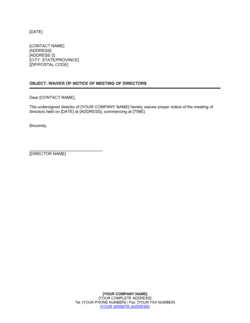
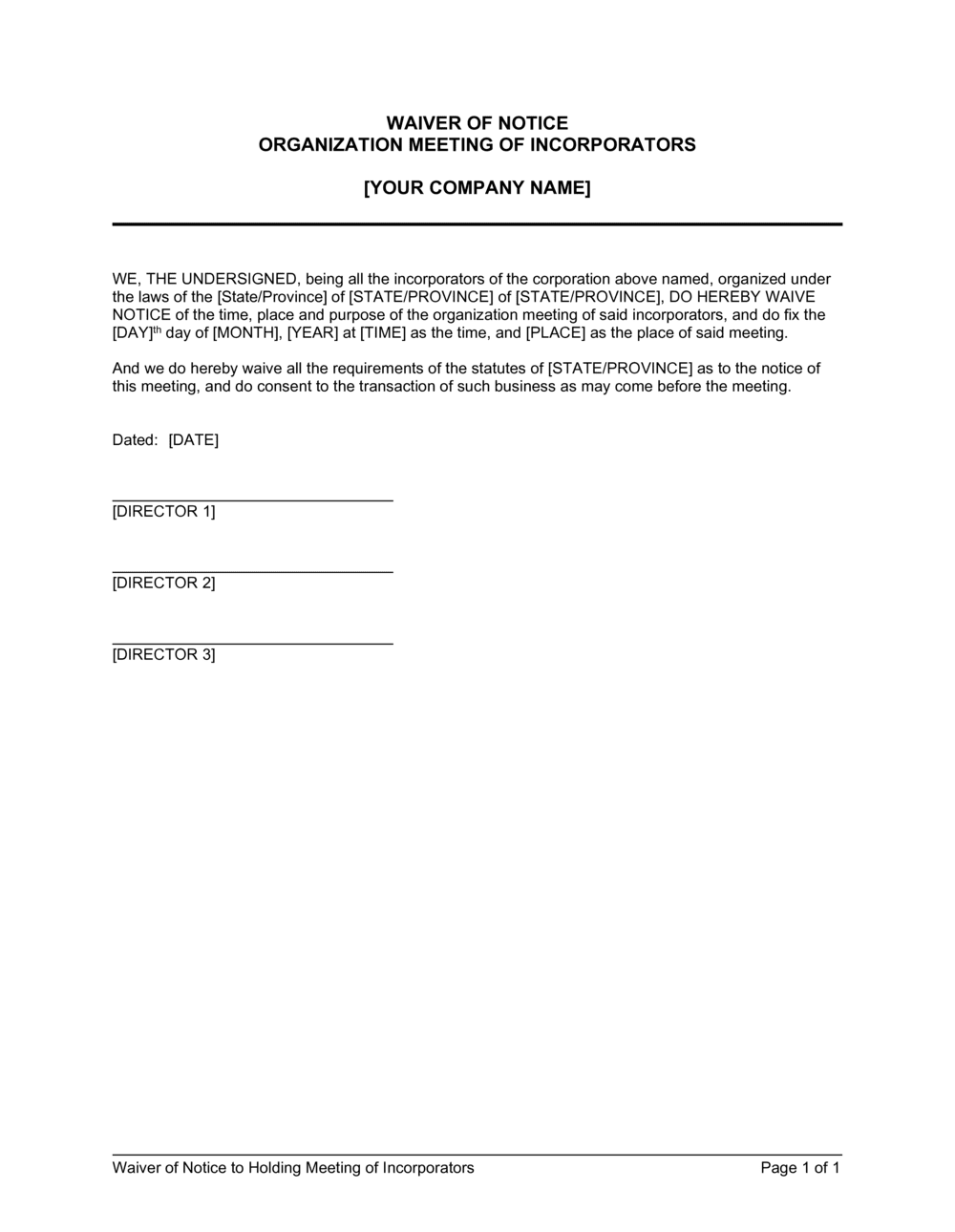
A Waiver of Notice Meeting of Incorporators is a brief formal document signed by all incorporators of a new corporation confirming that they agree to hold the organizational meeting without the advance written notice typically required by state statute or bylaws. This free Word download lets you complete and store the waiver in minutes and export it as PDF for your corporate records book.
When you need it
Use it immediately after filing articles of incorporation, when all incorporators are available and ready to convene the first organizational meeting sooner than the statutory or bylaw notice period would normally allow.
What's inside
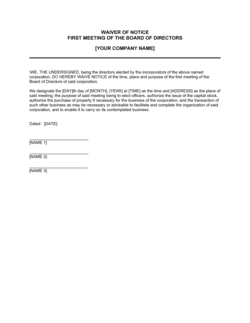
Corporation name and state of incorporation, date and location of the meeting, an express waiver of the required advance notice period, signature lines for every incorporator, and a statement that the waiver is to be filed with the corporate minutes.

What is a Waiver of Notice Meeting of Incorporators?

A Waiver of Notice Meeting of Incorporators is a brief formal document signed by all incorporators of a newly formed corporation confirming that they voluntarily give up their right to the statutory advance notice period before the first organizational meeting is held. State corporation laws typically require that incorporators receive written notice β€” often between 2 and 10 days β€” before an organizational meeting can be called. When all incorporators are present and ready to act immediately after the articles of incorporation are filed, this waiver eliminates that waiting period and allows the meeting to proceed without delay. The signed document becomes a permanent part of the corporation's minute book alongside the organizational meeting minutes.

Why You Need This Document

Without this waiver on file, the resolutions adopted at the incorporators meeting β€” including electing initial directors, adopting bylaws, and authorizing the corporation to open a bank account β€” rest on a procedurally incomplete foundation. Any incorporator, future investor, or acquiring party conducting due diligence can raise a validity challenge if the notice requirement was neither satisfied nor formally waived. Banks routinely review the corporate minute book before opening a business account, and they will flag a missing waiver. The document takes under ten minutes to complete using this template, and once signed and attached to the meeting minutes it permanently closes that procedural gap β€” giving your corporation a clean, complete organizational record from day one.

Which variant fits your situation?

If your situation is…Use this template
All incorporators can meet immediately after filing articlesWaiver of Notice Meeting of Incorporators
Waiving notice for the first meeting of the board of directorsWaiver of Notice First Meeting of Board of Directors
Waiving notice for an annual shareholder meetingWaiver of Notice Annual Meeting of Shareholders
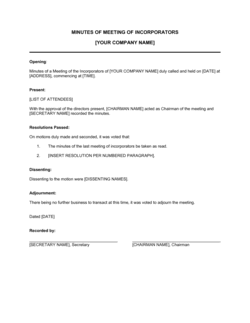
Documenting what was decided at the incorporators meetingMinutes of Meeting of Incorporators
Formally adopting bylaws and appointing initial directorsAction by Written Consent of Incorporators
Organizing a limited liability company instead of a corporationLLC Operating Agreement

Common mistakes to avoid

❌ Not all incorporators sign the waiver

Why it matters: A waiver signed by fewer than all incorporators does not satisfy the notice requirement β€” any absent incorporator retains the right to challenge the meeting's validity.

Fix: List every incorporator named in the articles and obtain a signature from each before the meeting is convened. Use electronic signature tools if signers are in different locations.

❌ Waiver date is after the meeting date

Why it matters: A waiver signed after the meeting occurred offers no legal protection β€” the notice requirement was already operative at the time the meeting was held.

Fix: Execute the waiver before or simultaneously with convening the meeting. Date each signature accurately and do not backdate.

❌ Meeting details in the waiver differ from the minutes

Why it matters: Discrepancies in date, time, location, or purpose between the waiver and the minutes suggest the documents were not contemporaneous, which can undermine the corporate record in due diligence.

Fix: Confirm all meeting details are finalized before completing either document, and copy the exact language from the waiver into the minutes header.

❌ Waiver is signed but not filed with the minutes

Why it matters: An unattached waiver provides no practical protection β€” if the minute book is ever reviewed, the absence of the waiver makes the meeting appear improperly noticed.

Fix: Insert the signed waiver as the first document in the meeting's section of the minute book, immediately before the minutes themselves.

The 8 key clauses, explained

Document title and date

In plain language: Identifies the document as a waiver of notice and records the date it is being signed, establishing when the waiver was executed.

Sample language
WAIVER OF NOTICE OF MEETING OF INCORPORATORS OF [CORPORATION NAME] Date: [DATE]

Common mistake: Leaving the date blank and filling it in later. An undated waiver can create ambiguity about whether it preceded or followed the meeting itself.

Corporation identification

In plain language: States the full legal name of the corporation and the state in which it was incorporated, tying the waiver to the correct entity.

Sample language
The undersigned, being all of the incorporators of [CORPORATION NAME], a corporation organized under the laws of the State of [STATE],

Common mistake: Using a trade name or DBA instead of the exact legal name as it appears on the filed articles of incorporation β€” this creates a mismatch in the corporate record book.

Express waiver of required notice

In plain language: The core operative clause β€” each incorporator explicitly waives their right to the advance notice period required by statute or bylaws.

Sample language
hereby waive all notice, statutory or otherwise, of the time, place, and purpose of the meeting of incorporators,

Common mistake: Omitting the phrase 'statutory or otherwise,' which could leave open the argument that only contractual notice β€” not the statutory minimum β€” was waived.

Meeting date, time, and location

In plain language: Specifies when and where the organizational meeting will be (or was) held, so the waiver matches the meeting minutes exactly.

Sample language
and consent to the holding of said meeting on [DATE] at [TIME], at [ADDRESS / LOCATION],

Common mistake: Entering a different date or location than what appears in the minutes, creating a discrepancy that can complicate corporate record audits.

Purpose of the meeting

In plain language: Briefly states the business to be transacted at the organizational meeting, such as adopting bylaws and electing initial directors.

Sample language
for the purpose of adopting bylaws, electing directors, and transacting any other business that may properly come before the meeting.

Common mistake: Leaving the purpose line blank or too vague. Stating the purpose links the waiver to its corresponding minutes and confirms all matters acted upon were within scope.

Waiver of objection to meeting

In plain language: Each signer confirms they have no objection to the meeting being held and that they agree all actions taken at it are valid.

Sample language
We further agree that any business transacted at said meeting shall be as valid as if the meeting had been duly called and noticed.

Common mistake: Omitting this validation clause. Without it, an incorporator could later argue the meeting's resolutions are void due to improper notice, even after signing the waiver.

Filing instruction

In plain language: Directs that the signed waiver be filed with or attached to the minutes of the meeting in the corporate record book.

Sample language
This waiver shall be filed with the minutes of the meeting and shall constitute part of the records of the corporation.

Common mistake: Signing the waiver but never attaching it to the minutes. An unattached waiver defeats its purpose β€” auditors and attorneys need to see it with the meeting record.

Signature block for each incorporator

In plain language: Provides a dated signature line for each incorporator, with their printed name below, confirming their individual consent.

Sample language
Signature: _________________________ Name: [INCORPORATOR FULL NAME] Date: [DATE]

Common mistake: Having only one incorporator sign when multiple incorporators exist. All incorporators must sign for the waiver to be valid β€” a partial waiver does not satisfy the notice requirement.

How to fill it out

  1. 1

    Enter the corporation's legal name and state

    Copy the exact corporate name from the filed articles of incorporation β€” including any punctuation like 'Inc.' or 'Corp.' β€” and enter the state of incorporation.

    πŸ’‘ Pull the name directly from your state's business entity search portal to ensure character-for-character accuracy.

  2. 2

    Insert the meeting date, time, and location

    Enter the exact date, start time, and physical or virtual address where the organizational meeting will be held. These details must match the meeting minutes.

    πŸ’‘ If the meeting will be held via video conference, note the platform and link or dial-in details in the location field.

  3. 3

    State the purpose of the meeting

    List the primary agenda items: typically adopting bylaws, electing initial directors, authorizing a bank account, and any other organizational actions planned.

    πŸ’‘ Include the catch-all phrase 'and transacting any other business properly before the meeting' to cover ancillary items without needing to amend the waiver.

  4. 4

    Add a signature block for every incorporator

    Confirm the list of all incorporators from the articles of incorporation and add a signature line with a printed name and date field for each one.

    πŸ’‘ If there is only one incorporator, note that beside the signature block so reviewers understand no additional signatures are needed.

  5. 5

    Obtain signatures from all incorporators before the meeting

    Circulate the waiver for signature before convening the meeting. Each incorporator signs and dates their block, confirming their consent.

    πŸ’‘ Collecting signatures via a PDF e-sign workflow is acceptable in most states β€” keep the execution timestamp in your records.

  6. 6

    Attach the waiver to the meeting minutes

    File the completed, signed waiver immediately after the meeting minutes in the corporate minute book. Both documents together form the complete organizational record.

    πŸ’‘ Number your formation documents in order β€” articles, waiver, minutes, bylaws, initial resolutions β€” to make the record book easy to navigate during due diligence.

Frequently asked questions

What is a waiver of notice for a meeting of incorporators?

A waiver of notice for a meeting of incorporators is a signed document in which all incorporators of a newly formed corporation voluntarily give up their right to the advance notice period β€” typically required by state law or bylaws β€” before the first organizational meeting. It allows the meeting to be held at any agreed time without waiting for the statutory notice window to expire.

Why is a waiver of notice needed for an incorporators meeting?

Most state corporation statutes require that incorporators receive written advance notice β€” often 2 to 10 days β€” before an organizational meeting is called. When all incorporators are available and ready to act immediately after filing articles, the waiver allows them to proceed without the delay. Skipping the waiver without satisfying the notice period can expose the meeting's resolutions to a later validity challenge.

Do all incorporators need to sign the waiver?

Yes. The waiver is only effective if every person listed as an incorporator on the articles of incorporation signs it. A waiver signed by some but not all incorporators does not eliminate the notice obligation for those who did not sign. If one incorporator is unavailable, the formal notice period must be satisfied instead.

What is the difference between a waiver of notice and meeting minutes?

A waiver of notice is signed before the meeting and confirms that all incorporators consent to holding it without advance notice. Meeting minutes are recorded after the meeting and document the decisions made. Both documents are required for a complete organizational meeting record and should be stored together in the corporate minute book.

Can the waiver of notice be signed electronically?

In most US states, electronic signatures are valid for internal corporate documents under the ESIGN Act and state equivalents, provided all parties consent to electronic execution. Confirm with your state's corporate statutes or a local attorney if you are in a jurisdiction with specific ink-signature requirements for formation records.

When should the waiver be signed β€” before or during the meeting?

The waiver should be signed before the meeting is formally convened. Signing it during or after the meeting does not retroactively satisfy the notice requirement for the period before the meeting began. Circulate the document for signature at least a few minutes before calling the meeting to order to maintain a clean chronological record.

Does a waiver of notice need to be notarized?

No. A waiver of notice for an incorporators meeting is an internal corporate document and does not require notarization in any US state. Plain signatures with printed names and dates are sufficient. The completed waiver is filed in the corporate minute book, not with any government agency.

What happens if no waiver is signed and no formal notice is given?

If neither a waiver nor proper advance notice is provided, the organizational meeting and any resolutions adopted at it β€” such as electing directors or adopting bylaws β€” may be challenged as procedurally defective. In practice, courts often apply a ratification doctrine, but the safer path is always to have a signed waiver on file before the meeting is held.

How this compares to alternatives

vs Minutes of Meeting of Incorporators

The minutes record what was decided at the organizational meeting β€” bylaws adopted, directors elected, and other actions taken. The waiver of notice is the prerequisite document signed before the meeting is called. Both are required for a complete organizational record; the waiver enables the meeting, the minutes document it.

vs Waiver of Notice First Meeting of Board of Directors

A board of directors waiver of notice serves the same function but applies to the first meeting of the elected board rather than the incorporators. Incorporators hold authority only during the organizational phase; once directors are elected, the board takes over and its own notice requirements apply.

vs Action by Written Consent of Incorporators

A written consent allows incorporators to take organizational actions β€” adopting bylaws, electing directors β€” without holding any meeting at all. It eliminates the need for both a formal meeting and a waiver of notice. Use written consent when incorporators cannot meet even informally; use the waiver when a meeting will be held but on short notice.

vs LLC Operating Agreement

An LLC operating agreement governs an entirely different entity type. LLCs do not have incorporators; they have members or organizers. The waiver of notice is specific to corporations. If your entity is an LLC, the operating agreement is the foundational formation document β€” no incorporator meeting or waiver applies.

Industry-specific considerations

Technology / SaaS

Fast-moving founding teams frequently incorporate and need to convene organizational meetings on the same day to authorize equity grants and stock option plans.

Professional Services

Attorneys, accountants, and consultants incorporating a new practice need complete formation records before opening client accounts or executing engagement letters as a corporation.

Real Estate

Real estate investors often form project-specific corporations on tight acquisition timelines and need all formation documents complete before closing.

Retail / E-commerce

Entrepreneurs launching retail corporations need a clean minute book to open a business bank account and apply for merchant processing as soon as the entity is formed.

Template vs pro β€” what fits your needs?

PathBest forCostTime
Use the templateFounders and small business owners forming a straightforward domestic corporation with a small number of incorporatorsFree5–10 minutes
Template + professional reviewMulti-founder corporations or formations in states with specific organizational meeting requirements$100–$300 (paralegal or attorney review of full formation document package)1–2 hours
Custom draftedComplex multi-jurisdiction formations, institutional incorporators, or corporations preparing for immediate outside investment$500–$1,500 (attorney-drafted formation package)1–3 days

Glossary

Incorporator
The individual or entity who signs and files the articles of incorporation with the state and holds authority to take organizational actions before directors are elected.
Waiver of Notice
A written statement in which a person entitled to advance notice of a meeting voluntarily gives up that right and agrees the meeting may proceed.
Organizational Meeting
The first formal meeting of incorporators (and sometimes initial directors) at which bylaws are adopted, directors are elected, and other foundational corporate actions are taken.
Articles of Incorporation
The charter document filed with the state that formally creates a corporation and establishes its name, registered agent, and authorized shares.
Statutory Notice Period
The minimum number of days advance notice required by state law before a corporate meeting may be held, typically ranging from 2 to 10 days for incorporator meetings.
Corporate Minute Book
The official binder or file where a corporation stores its formation documents, minutes, resolutions, stock records, and waivers.
Bylaws
The internal rules governing how a corporation is managed, including meeting procedures, officer roles, and voting requirements.
Registered Agent
The individual or company designated to receive official legal and government correspondence on behalf of a corporation in its state of incorporation.
Written Consent
A document by which directors, shareholders, or incorporators take a corporate action without holding a physical meeting, by signing their approval in writing.

Part of your Business Operating System

This document is one of 3,000+ business & legal templates included in Business in a Box.

  • Fill-in-the-blanks β€” ready in minutes
  • 100% customizable Word document
  • Compatible with all office suites
  • Export to PDF and share electronically

Create your document in 3 simple steps.

From template to signed document β€” all inside one Business Operating System.
1
Download or open template

Access over 3,000+ business and legal templates for any business task, project or initiative.

2
Edit and fill in the blanks with AI

Customize your ready-made business document template and save it in the cloud.

3
Save, Share, Send, Sign

Share your files and folders with your team. Create a space of seamless collaboration.

Save time, save money, and create top-quality documents.

β˜…β˜…β˜…β˜…β˜…

"Fantastic value! I'm not sure how I'd do without it. It's worth its weight in gold and paid back for itself many times."

Managing Director Β· Mall Farm
Robert Whalley
Managing Director, Mall Farm Proprietary Limited
β˜…β˜…β˜…β˜…β˜…

"I have been using Business in a Box for years. It has been the most useful source of templates I have encountered. I recommend it to anyone."

Business Owner Β· 4+ years
Dr Michael John Freestone
Business Owner
β˜…β˜…β˜…β˜…β˜…

"It has been a life saver so many times I have lost count. Business in a Box has saved me so much time and as you know, time is money."

Owner Β· Upstate Web
David G. Moore Jr.
Owner, Upstate Web

Run your business with a system β€” not scattered tools

Stop downloading documents. Start operating with clarity. Business in a Box gives you the Business Operating System used by over 250,000 companies worldwide to structure, run, and grow their business.

Start freeΒ Β·Β No credit card required