Notice of Meeting of Shareholders_Special Template

Free Word download β€’ Edit online β€’ Save & share with Drive β€’ Export to PDF

1 pageβ€’15–20 min to fillβ€’Difficulty: Standard
Learn more ↓
FreeNotice of Meeting of Shareholders_Special Template

At a glance

What it is
A Notice of Special Meeting of Shareholders is a formal written notice sent to all shareholders informing them of an extraordinary or special general meeting called outside the company's regular annual meeting schedule. This free Word download gives you a ready-to-use template you can edit online and export as PDF or send by mail to shareholders in minutes.
When you need it
Use it whenever the board of directors calls a meeting to address urgent or specific business matters β€” such as approving a merger, amending the articles of incorporation, or authorizing a major capital transaction β€” that cannot wait for the next annual general meeting.
What's inside
Company and meeting identification details, date, time, and location of the meeting (or virtual access details), a clear statement of the specific business items to be addressed, quorum and voting instructions, and proxy information for shareholders unable to attend in person.

What is a Notice of Special Meeting of Shareholders?

A Notice of Special Meeting of Shareholders is a formal written communication issued by a corporation to inform all eligible shareholders of an extraordinary general meeting convened outside the company's regular annual meeting cycle. Unlike an annual general meeting, a special meeting exists for one purpose only: to transact the specific items of business stated in the notice β€” nothing more. The notice identifies the corporation, states the exact date, time, and location of the meeting, lists each agenda item with sufficient detail for shareholders to form a view, and provides proxy instructions for those who cannot attend in person.

Why You Need This Document

Calling a special shareholder meeting without a properly issued written notice is not a procedural technicality β€” it is a legal defect that can void every resolution passed at that meeting. Corporate statutes in every major jurisdiction require advance written notice delivered within a prescribed window, typically between 10 and 60 days before the meeting date. A notice that omits a required agenda item, misstates the quorum threshold, or is issued by the wrong authority gives dissenting shareholders the grounds to challenge the outcome in court. For decisions as consequential as approving a merger, authorizing a new share class, or amending the articles of incorporation, the cost of a defective notice can far exceed the cost of getting it right the first time. This template gives you a complete, properly structured notice you can issue in under 30 minutes.

Which variant fits your situation?

If your situation is…Use this template
Annual routine meeting covering financial statements and director electionsNotice of Annual General Meeting of Shareholders
Meeting called specifically to remove or replace a directorNotice of Meeting of Shareholders (Director Removal)
Meeting to approve a merger, acquisition, or amalgamationNotice of Special Meeting of Shareholders (Merger)
Written resolution in lieu of a physical shareholder meetingShareholders Written Resolution
Meeting to amend the company's bylaws or articlesNotice of Special Meeting (Bylaw Amendment)
Meeting called by shareholders rather than the boardRequisition for Special Meeting of Shareholders
Meeting of a committee or subgroup of the board rather than shareholdersNotice of Board Meeting

Common mistakes to avoid

❌ Giving insufficient advance notice

Why it matters: Most corporate statutes require a minimum of 10 to 60 days' notice before a special meeting. A meeting held with less notice is voidable, and any resolutions passed may be challenged or overturned.

Fix: Check your corporate bylaws and the applicable statute for the governing jurisdiction before setting the meeting date, and ensure the notice is issued with at least the required minimum lead time.
❌ Vague or incomplete agenda items

Why it matters: At a special meeting, shareholders may only transact the specific business stated in the notice. A vague or missing agenda item means any resolution on that topic is procedurally invalid and may be unenforceable.

Fix: Write each agenda item with enough detail that a shareholder can vote by proxy without attending β€” include the type of resolution required and a brief description of what is being approved.

❌ Using a trade name instead of the registered legal entity name

Why it matters: If the company name on the notice does not match the registered entity, the notice may not satisfy statutory requirements, leaving the meeting and its resolutions open to legal challenge.

Fix: Always verify the exact registered corporate name from official incorporation or registry documents and use it verbatim on every formal corporate notice.

❌ Failing to include proxy instructions and a proxy form

Why it matters: Shareholders who cannot attend in person lose their ability to vote if no proxy mechanism is provided, which can result in challenges to quorum and to the validity of resolutions passed.

Fix: Include clear proxy instructions β€” deadline, submission method, and contact details β€” and attach a pre-populated proxy form to every notice issued.

The 8 key clauses, explained

Company identification and meeting heading

In plain language: States the full legal name of the corporation and identifies the document as a Notice of Special Meeting of Shareholders.

Sample language
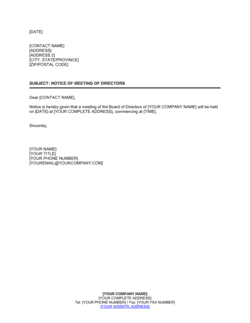
NOTICE OF SPECIAL MEETING OF SHAREHOLDERS OF [COMPANY LEGAL NAME]

Common mistake: Using a trade name instead of the registered corporate name β€” the notice may be invalid if the legal entity cannot be identified from the document.

Notice date and record date

In plain language: States when the notice is being issued and, where required, the record date that determines which shareholders are entitled to receive the notice and vote.

Sample language
Notice Date: [DATE]. Shareholders of record as of [RECORD DATE] are entitled to receive this notice and to vote at the meeting.

Common mistake: Omitting the record date when the company's bylaws or applicable statute requires one, which can create disputes about who is eligible to vote.

Meeting date, time, and location

In plain language: Specifies the exact date, start time, and physical or virtual location where the special meeting will be held.

Sample language
The Special Meeting will be held on [DATE] at [TIME] [TIMEZONE] at [ADDRESS / VIRTUAL MEETING LINK AND ACCESS INSTRUCTIONS].

Common mistake: Providing only a city or general address without a room number or virtual access link, causing shareholders to miss the meeting or arrive at the wrong location.

Purpose and agenda statement

In plain language: Describes the specific business items to be considered at the meeting β€” this is the most critical clause because only agenda items may be transacted at a special meeting.

Sample language
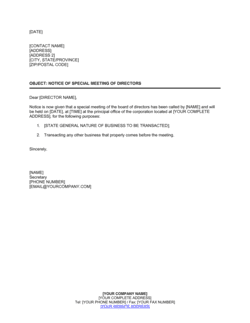
The purpose of this Special Meeting is to consider and, if deemed advisable, to pass resolutions approving: (1) [AGENDA ITEM 1]; (2) [AGENDA ITEM 2].

Common mistake: Using vague language such as 'other business' as a catch-all. At a special meeting, only the stated agenda items may be acted upon β€” vague language invites challenges to any resolution passed.

Quorum statement

In plain language: Reminds shareholders of the quorum requirement and what will happen if quorum is not reached.

Sample language
A quorum for the transaction of business consists of [X]% of the issued and outstanding shares, represented in person or by proxy. If quorum is not present within [30] minutes of the scheduled start time, the meeting will be adjourned to [DATE AND TIME].

Common mistake: Citing a quorum threshold that differs from what is stated in the company's bylaws or articles β€” the governing documents control, and a notice that misstates quorum can invalidate the meeting.

Proxy instructions

In plain language: Informs shareholders of their right to appoint a proxy to attend and vote on their behalf, and states the deadline and method for submitting a proxy form.

Sample language
Shareholders who are unable to attend the meeting in person are encouraged to complete and return the enclosed Proxy Form to [CONTACT / ADDRESS] no later than [DATE AND TIME], being not less than [48] hours before the meeting.

Common mistake: Setting a proxy submission deadline that is shorter than the minimum required by the company's bylaws or applicable corporate statute, exposing the company to challenges on proxy validity.

Voting threshold disclosure

In plain language: States the type of resolution required for each agenda item β€” ordinary (simple majority) or special (two-thirds or higher) β€” so shareholders know the voting threshold before the meeting.

Sample language
Agenda Item 1 requires an ordinary resolution (approval by more than 50% of votes cast). Agenda Item 2 requires a special resolution (approval by at least [66.67%] of votes cast).

Common mistake: Omitting the voting threshold, which leaves shareholders unable to assess whether the resolution is likely to pass and prevents informed proxy decisions.

Authorized signatory and corporate officer block

In plain language: Identifies who is issuing the notice on behalf of the corporation β€” typically the corporate secretary or a director β€” and includes the title and date of signing.

Sample language
By Order of the Board of Directors. [NAME], [TITLE β€” e.g., Corporate Secretary]. Dated: [DATE].

Common mistake: Leaving the signatory block blank or unsigned before distributing the notice β€” an unsigned or unattributed notice may not satisfy statutory requirements for a valid meeting.

How to fill it out

  1. 1

    Enter the company's full legal name

    Use the exact registered corporate name as it appears in your articles of incorporation or corporate registry filing. Do not use a trade name or abbreviation.

    πŸ’‘ Cross-check the name against your most recent annual corporate filing to avoid discrepancies that could invalidate the notice.

  2. 2

    Set the notice date and record date

    Enter today's date as the notice date. Determine the record date by checking your bylaws and the applicable corporate statute for the minimum notice period required β€” commonly 10 to 60 days before the meeting.

    πŸ’‘ For publicly listed companies, the record date must typically be set at least 10 days before the meeting date under most securities regulations.

  3. 3

    Specify the meeting date, time, and location

    Choose a date that respects the minimum statutory notice period. Enter the exact start time with time zone, and include the full physical address or virtual meeting platform link and access credentials.

    πŸ’‘ If holding a hybrid meeting, include both the physical address and the virtual access link in the same clause to avoid any ambiguity.

  4. 4

    Draft the agenda items clearly and specifically

    List every item of business to be transacted, numbered sequentially. Write each item with enough specificity that a shareholder can form a view and instruct a proxy before attending.

    πŸ’‘ Avoid 'general business' or 'any other matters' β€” at a special meeting, only the stated agenda items may be acted upon.

  5. 5

    Confirm the quorum threshold

    Look up the quorum requirement in your corporate bylaws or articles and enter the correct percentage or number of shares. State what happens if quorum is not met β€” typically adjournment to a stated fallback date.

    πŸ’‘ If the bylaws allow a reduced quorum at an adjourned meeting, state the reduced threshold explicitly to avoid a second round of notices.

  6. 6

    Complete the proxy instructions and deadline

    Enter the name and address (or email) to which proxy forms should be returned and the deadline β€” typically 24 to 48 hours before the meeting, subject to your bylaws.

    πŸ’‘ Attach a pre-completed Proxy Form to the notice to make it as easy as possible for shareholders to participate without attending in person.

  7. 7

    Sign and date the notice

    Have the authorized corporate officer β€” typically the corporate secretary or a director β€” sign the notice and enter the date of signing before distribution.

    πŸ’‘ Retain a copy of the signed notice and a record of how and when it was delivered to each shareholder β€” proof of service is essential if a shareholder later challenges the validity of the meeting.

Frequently asked questions

What is a notice of special meeting of shareholders?

A notice of special meeting of shareholders is a formal written communication sent to all eligible shareholders informing them of an extraordinary meeting called outside the company's regular annual schedule. It specifies the date, time, location, and β€” critically β€” the specific agenda items to be considered. Unlike an annual general meeting, a special meeting may only transact the business expressly stated in the notice.

When should a special meeting of shareholders be called?

A special meeting is called when the board of directors or a qualifying group of shareholders needs to obtain shareholder approval on a time-sensitive matter that cannot wait for the next annual general meeting. Common triggers include approving a merger or acquisition, authorizing a new class of shares, amending the articles of incorporation or bylaws, removing a director, or approving a major asset sale.

How much notice is required for a special shareholders meeting?

The required notice period varies by jurisdiction and corporate bylaws. Most corporate statutes in the United States and Canada require a minimum of 10 days and a maximum of 60 days' advance written notice. The UK Companies Act 2006 generally requires at least 14 clear days for private companies and 21 days for public companies. Always confirm the applicable statutory minimum and your own bylaws before setting the meeting date.

What is the difference between a special meeting and an annual general meeting?

An annual general meeting is held on a regular schedule β€” typically once per fiscal year β€” to cover routine matters such as financial statement approval, director elections, and auditor appointment. A special meeting is convened on an as-needed basis to address one or more specific extraordinary matters. At a special meeting, only the agenda items stated in the notice may be transacted; no other business may be introduced.

Can shareholders call a special meeting themselves?

In most jurisdictions, shareholders holding a minimum threshold of shares β€” typically 5% to 10% of issued and outstanding shares β€” may requisition the board to call a special meeting. If the board fails to call the meeting within a prescribed period after receiving the requisition, the requisitioning shareholders may generally call it themselves. The exact thresholds and procedures are set by the applicable corporate statute and the company's bylaws.

Does a notice of special meeting need to be signed?

No wet signature is legally required in most jurisdictions for the notice itself to be valid, but best practice is to have the corporate secretary or an authorized director sign and date the notice before distribution. A signed notice establishes clear authority for who issued it and creates a clean evidentiary record if the meeting's validity is later challenged.

What happens if quorum is not reached at a special meeting?

If the required quorum is not present within the time specified in the bylaws β€” typically 30 minutes after the scheduled start β€” the meeting is adjourned. Depending on the bylaws and applicable statute, the adjourned meeting may be held at a reduced quorum threshold, or a new notice may be required. Always specify in the original notice what happens if quorum is not met to avoid a second round of notice and administration.

Is a notice of special meeting the same as a proxy circular?

No. A notice of special meeting informs shareholders of the meeting date, location, and agenda. A proxy circular (also called a proxy statement in the US) is a more detailed document that provides background information, management recommendations, and financial disclosure to help shareholders vote on each agenda item. Publicly listed companies are typically required to distribute both together; private companies often distribute only the notice with a proxy form attached.

Can a special meeting be held virtually?

Yes, in most jurisdictions, corporate statutes now permit shareholder meetings to be held entirely by electronic means or in a hybrid format, provided the company's bylaws allow it and the notice includes clear virtual access instructions. The notice must state the platform, meeting link, and any access credentials so that all shareholders have a genuine opportunity to participate and vote.

How this compares to alternatives

vs Notice of Annual General Meeting of Shareholders

An annual general meeting notice covers routine, recurring business β€” financial statements, director elections, auditor appointment β€” on a fixed yearly schedule. A special meeting notice is convened on an as-needed basis for a single, defined extraordinary purpose. The two differ in frequency, formality of agenda, and the scope of business that may be transacted.

vs Shareholders Written Resolution

A written resolution allows shareholders to approve a matter without holding a physical or virtual meeting at all, provided the applicable statute and bylaws permit it and all (or a qualifying majority of) shareholders sign. A special meeting notice is required when the matter demands a formal meeting, when written resolution is not permitted by statute (e.g., for certain public company decisions), or when shareholders need to deliberate before voting.

vs Notice of Board Meeting

A board meeting notice is directed at directors, not shareholders, and is used to convene the board for internal governance and operational decisions within the board's authority. A special meeting of shareholders is called when a matter exceeds board authority and requires shareholder approval under the articles, bylaws, or statute.

vs Proxy Form

A proxy form is the instrument a shareholder completes to authorize another person to attend and vote on their behalf. It is a companion document to the notice β€” the notice creates the obligation to attend or appoint a proxy, while the proxy form is the mechanism for doing so. Both should be distributed together for any special meeting.

Industry-specific considerations

Technology / SaaS

Special meetings are frequently called to authorize new equity rounds, approve stock option plan expansions, or ratify a merger with an acquirer on an accelerated timeline.

Professional Services

Law firms, accounting firms, and consultancies structured as corporations use special meeting notices to approve partner buy-ins, profit-sharing amendments, or firm restructurings.

Manufacturing

Capital-intensive businesses call special meetings to authorize major equipment purchases, facility acquisitions, or debt issuances that exceed board authority thresholds.

Retail / E-commerce

Retail corporations use special meetings to approve strategic pivots, franchise arrangements, or sale-of-business transactions that require shareholder consent under the articles.

Template vs pro β€” what fits your needs?

PathBest forCostTime
Use the templatePrivate companies with a small, known shareholder group calling a standard special meetingFree15–30 minutes
Template + professional reviewCompanies with complex share structures, multiple share classes, or a contentious agenda item$200–$500 for a corporate lawyer or corporate secretary review1–2 business days
Custom draftedPublicly listed companies, cross-border share structures, or meetings subject to securities regulation disclosure requirements$1,000–$5,000+1–2 weeks

Glossary

Special Meeting
A shareholder meeting convened outside the regular annual schedule to address one or more specific, defined agenda items.
Quorum
The minimum number or percentage of shareholders β€” or their proxies β€” that must be present for the meeting to validly transact business.
Proxy
A written authorization allowing one shareholder to vote on behalf of another who cannot attend the meeting in person.
Record Date
The date on which shareholders must be registered owners of shares in order to receive notice of, and vote at, the meeting.
Articles of Incorporation
The foundational corporate charter document filed with the state or province that establishes the company and its basic structure.
Ordinary Resolution
A resolution passed by a simple majority (more than 50%) of votes cast at a shareholder meeting.
Special Resolution
A resolution requiring a higher threshold of approval β€” typically two-thirds or 75% of votes cast β€” for significant corporate changes such as amending the articles.
Notice Period
The minimum number of days' advance notice that must be given to shareholders before a meeting is held, as required by statute or the company's bylaws.
Agenda
The list of specific business items that will be considered and voted on at the meeting β€” only items listed on the agenda may be transacted at a special meeting.
Adjournment
The postponement of a meeting to a later date, either because quorum was not reached or because more time is needed to transact the business at hand.

Part of your Business Operating System

This document is one of 3,000+ business & legal templates included in Business in a Box.

  • Fill-in-the-blanks β€” ready in minutes
  • 100% customizable Word document
  • Compatible with all office suites
  • Export to PDF and share electronically

Create your document in 3 simple steps.

From template to signed document β€” all inside one Business Operating System.
1
Download or open template

Access over 3,000+ business and legal templates for any business task, project or initiative.

2
Edit and fill in the blanks with AI

Customize your ready-made business document template and save it in the cloud.

3
Save, Share, Send, Sign

Share your files and folders with your team. Create a space of seamless collaboration.

Save time, save money, and create top-quality documents.

β˜…β˜…β˜…β˜…β˜…

"Fantastic value! I'm not sure how I'd do without it. It's worth its weight in gold and paid back for itself many times."

Managing Director Β· Mall Farm
Robert Whalley
Managing Director, Mall Farm Proprietary Limited
β˜…β˜…β˜…β˜…β˜…

"I have been using Business in a Box for years. It has been the most useful source of templates I have encountered. I recommend it to anyone."

Business Owner Β· 4+ years
Dr Michael John Freestone
Business Owner
β˜…β˜…β˜…β˜…β˜…

"It has been a life saver so many times I have lost count. Business in a Box has saved me so much time and as you know, time is money."

Owner Β· Upstate Web
David G. Moore Jr.
Owner, Upstate Web

Run your business with a system β€” not scattered tools

Stop downloading documents. Start operating with clarity. Business in a Box gives you the Business Operating System used by over 250,000 companies worldwide to structure, run, and grow their business.

Start freeΒ Β·Β No credit card required