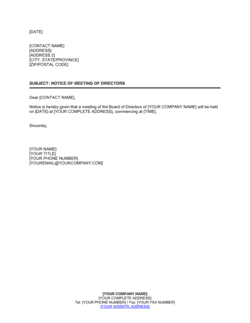
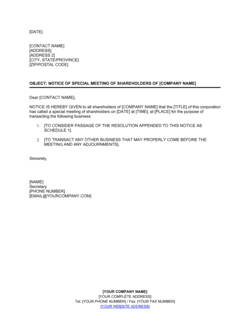
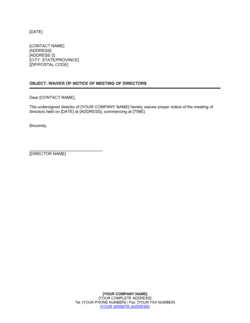
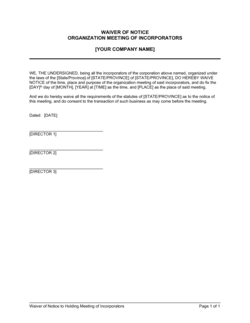
Notice of Meeting of Directors_Special Template

Free Word download • Edit online • Save & share with Drive • Export to PDF

1 page15–20 min to fillDifficulty: Standard
Learn more ↓
FreeNotice of Meeting of Directors_Special Template

At a glance

What it is
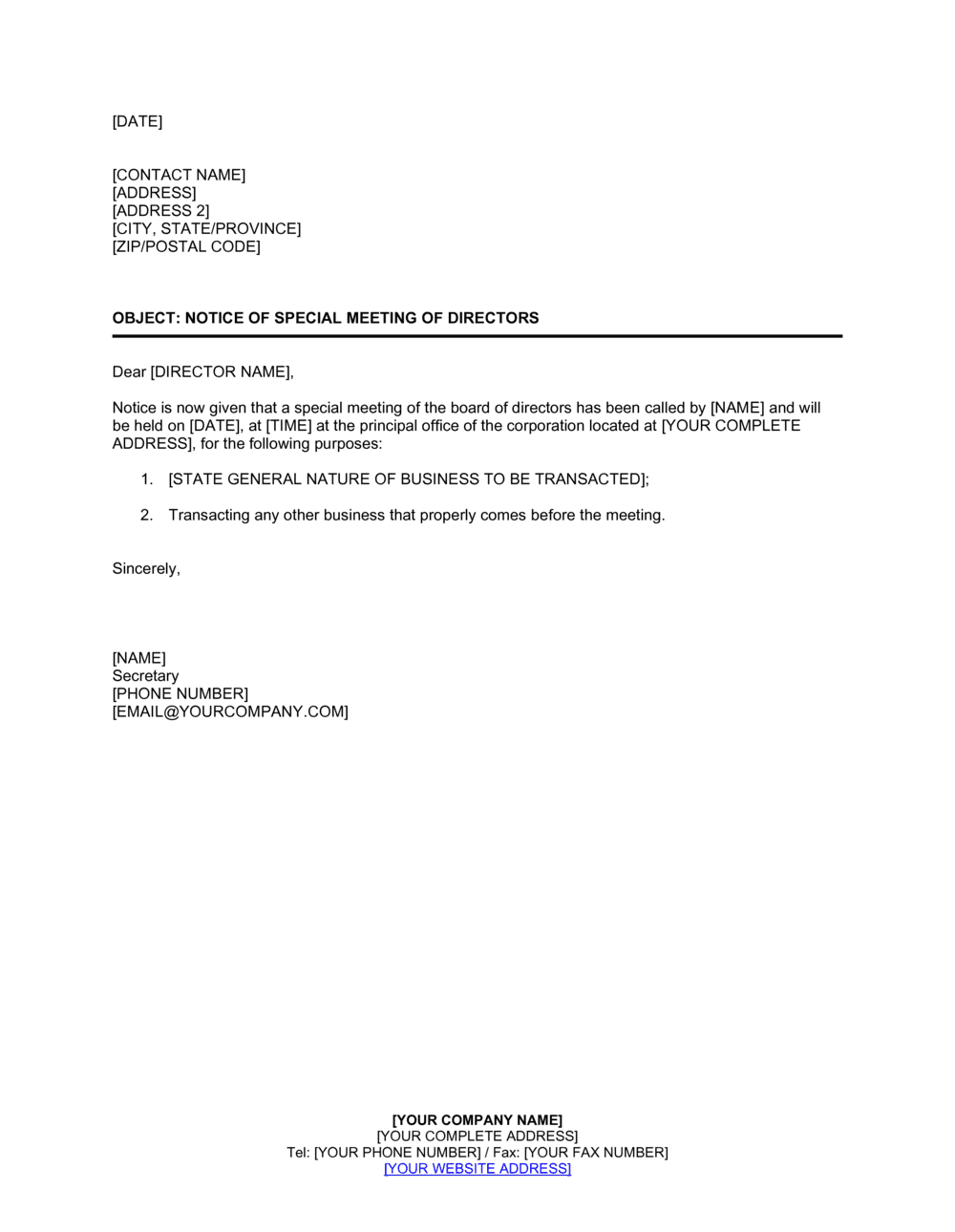
A Notice of Special Meeting of Directors is a formal written communication sent to all board members to convene an extraordinary meeting outside the regular meeting schedule. This free Word download lets you specify the exact agenda items, date, time, and location so directors receive proper advance notice and the meeting remains procedurally valid.
When you need it
Use it whenever urgent or specific business — such as approving an acquisition, authorizing an emergency loan, or addressing a governance matter — cannot wait for the next regularly scheduled board meeting. Special meetings are limited to the items listed in the notice, so precision in drafting the agenda is essential.
What's inside
Company name and heading, date of notice, names and addresses of directors, meeting date, time, and location (physical or virtual), a specific itemized agenda, quorum and attendance instructions, and the secretary or officer's signature block.

What is a Notice of Special Meeting of Directors?

A Notice of Special Meeting of Directors is a formal written communication issued to every member of a company's board of directors to convene an extraordinary meeting outside the regular meeting schedule. Unlike a regular board meeting — where directors can raise any item of business — a special meeting is confined strictly to the agenda items listed in the notice itself. This means the notice must precisely identify each matter the board will consider, making the agenda the most consequential part of the document. The notice also records the meeting date, time, and location and triggers the minimum advance-notice period required by the company's bylaws or applicable corporate statute.

Why You Need This Document

When time-sensitive board decisions arise between regular meetings — approving emergency financing, authorizing a major acquisition, or responding to a governance crisis — proceeding without a properly issued notice exposes every resolution to legal challenge. A director who was not given adequate advance notice, or who was omitted from the notice list entirely, can move to void the resolutions passed at that meeting. Missing or vague agenda language creates the same risk: courts have invalidated board resolutions on items that were not clearly stated in the notice. This template gives you a compliant, professionally structured notice you can complete in under 15 minutes, ensuring your special meeting and the decisions made in it stand on solid procedural ground.

Which variant fits your situation?

If your situation is…Use this template
Calling a routine, pre-scheduled board meetingNotice of Regular Meeting of Directors
Notifying shareholders of a special general meetingNotice of Special Meeting of Shareholders
Holding a board meeting by written consent without conveningDirectors Unanimous Written Consent
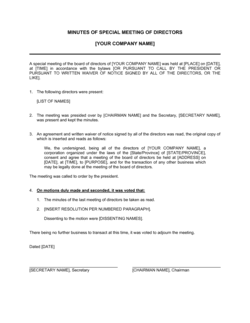
Documenting the decisions made after the meeting concludesMinutes of Special Meeting of Directors
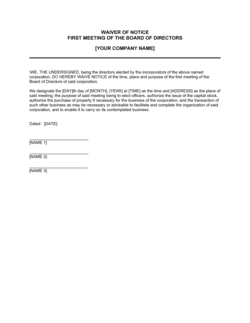
Waiving the formal notice requirement for the special meetingWaiver of Notice of Special Meeting of Directors
Calling a special meeting of members in a nonprofit or associationNotice of Special Meeting of Members

Common mistakes to avoid

❌ Insufficient notice period

Why it matters: Holding the meeting before the bylaw-mandated notice period expires can invalidate all resolutions passed, exposing the company to legal challenge by any director who was not given adequate time to prepare.

Fix: Check the notice period in your bylaws before setting the meeting date. If urgency requires a shorter window, obtain signed waivers of notice from all directors before the meeting begins.

❌ Vague or overbroad agenda

Why it matters: Special meetings are limited to the agenda items stated in the notice. A vague agenda like 'other business' gives directors no meaningful warning and may invalidate votes on unspecified matters.

Fix: Write each agenda item as a specific action statement — name the transaction, amount, or decision to be voted on — so directors know exactly what they are being asked to approve.

❌ Omitting one or more directors

Why it matters: Any director who was not notified can challenge the validity of resolutions passed at the meeting, particularly if the outcome affected their interests or the company's governance.

Fix: Cross-reference the notice recipient list against the current director register in the minute book before issuing the notice, and retain delivery confirmation for each director.

❌ No waiver of notice for absent directors

Why it matters: If an absent director did not receive or waive formal notice, their absence may be grounds to challenge quorum or the validity of the meeting itself.

Fix: Always attach a pre-completed Waiver of Notice to the notice package and follow up with absent directors to return it before the meeting is called to order.

The 8 key clauses, explained

Heading and company identification

In plain language: States the company's full legal name and identifies the document as a notice of special meeting of directors.

Sample language
NOTICE OF SPECIAL MEETING OF DIRECTORS OF [COMPANY LEGAL NAME]

Common mistake: Using a trade name or DBA instead of the registered legal entity name — the notice must match the entity name in the corporate register to be procedurally valid.

Date of notice

In plain language: Records the date the notice is issued, which starts the clock on the required notice period under the bylaws or applicable statute.

Sample language
Date of Notice: [DATE]

Common mistake: Dating the notice the same day as the meeting, which typically violates the minimum notice period in the bylaws and can render the meeting and its resolutions invalid.

Recipients

In plain language: Identifies each director being notified, either by name or as a collective, confirming that notice has been sent to all directors entitled to attend.

Sample language
TO: The Directors of [COMPANY LEGAL NAME]

Common mistake: Omitting one or more directors from the notice list — any resolution passed at a meeting where a director was not properly notified can be challenged by that director.

Meeting date, time, and location

In plain language: Specifies when and where the meeting will be held, including the full address for in-person meetings or a dial-in or video link for virtual meetings.

Sample language
A Special Meeting of the Directors will be held on [DATE] at [TIME] [TIMEZONE] at [ADDRESS / VIDEO CONFERENCE LINK].

Common mistake: Providing incomplete virtual meeting details — missing a passcode or link means directors cannot join, potentially breaking quorum before the meeting starts.

Purpose and agenda

In plain language: Lists the specific items of business the meeting will address; this is the most critical clause because special meetings are generally confined to the stated agenda.

Sample language
The purpose of this Special Meeting is to consider and, if deemed appropriate, to resolve the following matters: 1. [AGENDA ITEM 1]; 2. [AGENDA ITEM 2].

Common mistake: Using vague agenda language like 'to discuss general business matters' — this defeats the purpose of a special meeting notice and may invalidate any resolutions passed on unspecified items.

Quorum statement

In plain language: Reminds directors of the quorum requirement so they understand how many members must attend for the meeting to proceed.

Sample language
A quorum for the transaction of business shall be [NUMBER] directors, as required by the Corporation's Bylaws.

Common mistake: Omitting the quorum statement and proceeding with a meeting that falls below the bylaw minimum — resolutions passed without quorum are void.

Attendance and response instructions

In plain language: Instructs directors on how to confirm attendance, connect virtually, or submit a waiver of notice if they cannot attend.

Sample language
Please confirm your attendance by [DATE] by contacting [NAME] at [EMAIL / PHONE]. If you are unable to attend, please execute the enclosed Waiver of Notice.

Common mistake: Failing to include a waiver of notice with the notification — directors who cannot attend need a way to formally waive notice so the meeting can proceed without challenge.

Signature block

In plain language: Identifies the officer issuing the notice — typically the corporate secretary or CEO — and provides their name and title.

Sample language
By Order of the Board of Directors, [SIGNATURE], [NAME], [TITLE], [COMPANY LEGAL NAME]

Common mistake: Leaving the signature block unsigned before distribution — an unsigned notice lacks authority and may not satisfy bylaw requirements for valid service of notice.

How to fill it out

  1. 1

    Enter the company's full legal name

    Replace every instance of [COMPANY LEGAL NAME] with the exact name on the certificate of incorporation or articles of organization. Check your corporate register if unsure.

    💡 Copy and paste the legal name from your most recent annual report or corporate filing to avoid transcription errors.

  2. 2

    Set the date of notice and confirm the notice period

    Enter today's date as the date of notice, then count forward to confirm the meeting date provides at least the minimum days' notice required by your bylaws — typically 2 to 10 business days for special meetings.

    💡 If the matter is urgent and you cannot meet the notice period, prepare a Waiver of Notice for each director to sign before the meeting proceeds.

  3. 3

    List all directors in the recipients block

    Confirm your current director list against the corporate register and name every sitting director. If sending by email, include each director's last known email address.

    💡 Keep a certified copy of your current director list in your minute book so you always have an authoritative reference at notice time.

  4. 4

    Specify the meeting date, time, and location

    Enter the full date, start time with timezone, and either the physical address or the complete virtual meeting link with passcode. For hybrid meetings, include both.

    💡 Send a calendar invitation alongside the formal notice so directors block the time immediately — the notice is the legal record, the invitation is the practical prompt.

  5. 5

    Draft the agenda with precise, specific items

    List each item of business using action-oriented language that describes exactly what the board will vote on — for example, 'Authorize the CEO to execute the [LENDER NAME] credit facility not to exceed $[AMOUNT].' Vague headings open the door to procedural challenges.

    💡 Use numbered agenda items so the minutes can reference them by number, making the record cleaner and easier to cross-reference.

  6. 6

    Confirm the quorum requirement and add attendance instructions

    Check the bylaws for the quorum number, enter it in the quorum statement, and include clear instructions for directors to confirm attendance or submit a waiver of notice.

    💡 Attach a pre-drafted Waiver of Notice to the notice package so absent directors can return it in the same communication cycle.

  7. 7

    Sign and distribute the notice

    Have the authorized officer (corporate secretary or CEO) sign the notice, then deliver it to every director by the method specified in the bylaws — email, physical mail, or hand delivery.

    💡 Keep a distribution log (email read receipts or delivery confirmations) in the corporate minute book as evidence that every director received proper notice.

Frequently asked questions

What is a notice of special meeting of directors?

A notice of special meeting of directors is a formal written document sent to all board members to convene an extraordinary meeting outside the regular schedule. It must specify the exact date, time, location, and agenda items to be addressed. Because special meetings are typically limited to the business listed in the notice, the agenda must be precise and complete before the notice is issued.

How much advance notice is required for a special board meeting?

The required notice period is set by the company's bylaws, which commonly require between 2 and 10 business days for special meetings. Some jurisdictions also impose statutory minimums that apply regardless of what the bylaws say. If the matter is genuinely urgent, most corporate statutes allow directors to waive the notice period by signing a Waiver of Notice before or at the start of the meeting.

What is the difference between a special meeting and a regular meeting of directors?

A regular meeting follows a pre-set schedule established in the bylaws and can address any item of business. A special meeting is called on an ad hoc basis to address specific, time-sensitive matters that cannot wait for the next regular meeting. The critical difference is that special meetings are generally confined to the agenda items listed in the notice — directors cannot introduce additional business.

Can a special meeting be held virtually?

Yes, in most jurisdictions and under most modern corporate bylaws, special meetings of directors can be held by telephone, video conference, or other electronic means, provided all participating directors can communicate simultaneously. The notice should include the complete virtual meeting link or dial-in information so directors can participate without barriers.

What happens if a director does not receive the notice?

Any director who did not receive proper notice can challenge the validity of resolutions passed at the meeting. To protect against this, keep delivery confirmation records and, if any director cannot attend or did not receive timely notice, obtain a signed Waiver of Notice from them before the meeting proceeds. Courts in most jurisdictions have voided board resolutions where notice was defective and the affected director objected promptly.

Does the notice need to be signed?

Yes, the notice should be signed by an authorized officer — typically the corporate secretary or CEO — to confirm it is issued with proper authority. An unsigned notice may not satisfy the bylaw requirement for valid service and could expose the meeting's resolutions to a procedural challenge.

What should the agenda say for a special meeting?

Each agenda item should be written as a specific, action-oriented statement describing exactly what the board is being asked to consider or approve — for example, "Authorize entry into the [LENDER NAME] credit facility in an amount not to exceed $[AMOUNT]." Avoid broad or vague headings. Resolutions passed on matters not included in the agenda can be challenged and invalidated.

Is a waiver of notice the same as the notice itself?

No. A notice is the formal advance communication sent before the meeting. A Waiver of Notice is a separate document a director signs to give up their right to that advance notice — typically used when a director is unable to attend or when the meeting must be held before the normal notice period expires. Both documents should be retained in the corporate minute book as evidence of proper procedure.

Can resolutions be passed at a special meeting without holding a meeting?

In most jurisdictions, directors can pass resolutions by unanimous written consent without convening a formal meeting at all, provided every director signs the consent resolution. This is faster than calling a special meeting and avoids notice-period requirements. However, if even one director declines to sign, a properly noticed meeting is required.

How this compares to alternatives

vs Notice of Regular Meeting of Directors

A regular meeting notice convenes a scheduled, recurring board meeting where any item of business may be raised. A special meeting notice is for extraordinary, unscheduled sessions limited strictly to the listed agenda items. Use the regular notice for routine board governance and the special notice for urgent, specific decisions that cannot wait.

vs Minutes of Special Meeting of Directors

The notice initiates the special meeting by informing directors of the agenda in advance. The minutes record what was actually discussed and resolved after the meeting concludes. Both documents belong in the corporate minute book, and the minutes should reference the notice to confirm the meeting was properly convened.

vs Waiver of Notice of Special Meeting of Directors

The notice is the standard mechanism for satisfying the advance-notice requirement. A waiver of notice is a director's signed consent to skip that requirement — used when the matter is urgent or a director cannot attend. The two documents are complementary: issue the notice first, then use waivers for any directors who cannot receive timely notice.

vs Notice of Special Meeting of Shareholders

A notice of special meeting of shareholders convenes equity owners — not the board — to vote on major corporate matters such as amendments to articles or a merger. The notice of special meeting of directors convenes only the board to handle day-to-day governance and authority delegated to directors. Different audiences, different quorum rules, and typically different notice periods.

Industry-specific considerations

Technology / SaaS

Frequently used to authorize funding rounds, approve new option pool grants, or resolve an urgent IP licensing decision between regular quarterly meetings.

Financial Services

Regulatory events, emergency credit line authorizations, and personnel changes affecting licensed officers often require a special meeting with precise agenda language to satisfy compliance records.

Real Estate

Property acquisitions, dispositions, or mortgage authorizations frequently require a special meeting because deal timelines rarely align with the regular meeting schedule.

Nonprofit / Associations

Crisis response, emergency grant approvals, or executive leadership changes require special board meetings where the agenda must be tightly defined to limit board liability.

Template vs pro — what fits your needs?

PathBest forCostTime
Use the templateAny incorporated business or nonprofit calling a standard special board meeting with a straightforward agendaFree10–15 minutes
Template + professional reviewCompanies with complex governance structures, multiple share classes, or a contested or sensitive agenda item$150–$400 (corporate counsel review)1–2 business days
Custom draftedPublicly traded companies, regulated financial institutions, or meetings involving a material transaction under regulatory scrutiny$500–$2,000+2–5 business days

Glossary

Special Meeting
A board meeting called outside the regular schedule to address specific, pre-defined agenda items that cannot wait for the next ordinary meeting.
Notice Period
The minimum number of days' advance warning required by corporate bylaws or applicable statute before a board meeting can lawfully be held.
Quorum
The minimum number of directors who must be present for the board to transact business and pass valid resolutions.
Agenda
The written list of specific items of business to be discussed and voted on at a meeting; at a special meeting, only agenda items listed in the notice may be considered.
Waiver of Notice
A signed document in which a director voluntarily gives up their right to formal advance notice, allowing the meeting to proceed without the statutory notice period.
Corporate Secretary
The officer responsible for maintaining corporate records, issuing meeting notices, and recording minutes of board proceedings.
Resolution
A formal decision adopted by the board of directors, typically by majority or unanimous vote, that authorizes a specific action or policy.
Bylaws
The internal rules governing a corporation's operations, including the procedures for calling, noticing, and conducting board meetings.
Unanimous Written Consent
An alternative to a formal meeting in which all directors sign a written resolution, valid in most jurisdictions when every director agrees and no meeting is held.
Proxy
Written authorization allowing one director to vote or act on behalf of another at a board meeting, where permitted by the company's bylaws.

Part of your Business Operating System

This document is one of 3,000+ business & legal templates included in Business in a Box.

  • Fill-in-the-blanks — ready in minutes
  • 100% customizable Word document
  • Compatible with all office suites
  • Export to PDF and share electronically

Create your document in 3 simple steps.

From template to signed document — all inside one Business Operating System.
1
Download or open template

Access over 3,000+ business and legal templates for any business task, project or initiative.

2
Edit and fill in the blanks with AI

Customize your ready-made business document template and save it in the cloud.

3
Save, Share, Send, Sign

Share your files and folders with your team. Create a space of seamless collaboration.

Save time, save money, and create top-quality documents.

★★★★★

"Fantastic value! I'm not sure how I'd do without it. It's worth its weight in gold and paid back for itself many times."

Managing Director · Mall Farm
Robert Whalley
Managing Director, Mall Farm Proprietary Limited
★★★★★

"I have been using Business in a Box for years. It has been the most useful source of templates I have encountered. I recommend it to anyone."

Business Owner · 4+ years
Dr Michael John Freestone
Business Owner
★★★★★

"It has been a life saver so many times I have lost count. Business in a Box has saved me so much time and as you know, time is money."

Owner · Upstate Web
David G. Moore Jr.
Owner, Upstate Web

Run your business with a system — not scattered tools

Stop downloading documents. Start operating with clarity. Business in a Box gives you the Business Operating System used by over 250,000 companies worldwide to structure, run, and grow their business.

Start free · No credit card required