Waiver of Notice of Meeting of Directors Template

Free Word download β€’ Edit online β€’ Save & share with Drive β€’ Export to PDF

1 pageβ€’15–20 min to fillβ€’Difficulty: Standard
Learn more ↓
FreeWaiver of Notice of Meeting of Directors Template

At a glance

What it is
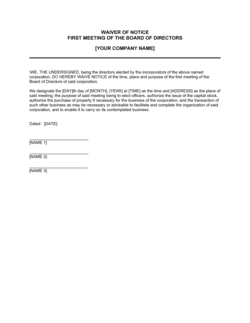
A Waiver of Notice of Meeting of Directors is a formal written document signed by board members to confirm they voluntarily give up their right to receive advance written notice of a directors' meeting. This free Word download gives you a ready-to-use template you can edit online and attach to your board meeting minutes in minutes.
When you need it
Use it when a board meeting must be called on short notice β€” without the advance written notice period specified in your bylaws or articles β€” and all directors agree to waive that requirement. It also protects the validity of decisions made at meetings where procedural notice was not given.
What's inside
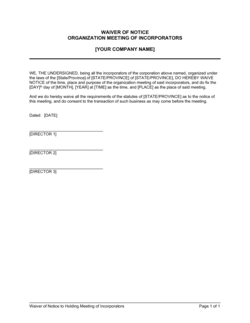
Company name and jurisdiction, meeting date, time and location, a clear waiver statement, purpose of the meeting, and a signature block for each director. Together these components confirm unanimous consent and make the meeting record procedurally complete.

What is a Waiver of Notice of Meeting of Directors?

A Waiver of Notice of Meeting of Directors is a formal written document in which each member of a corporation's board of directors voluntarily relinquishes their right to receive advance written notice of a specific board meeting. Corporate bylaws and most state and provincial corporation statutes require that directors be notified of any board meeting within a set timeframe β€” typically 2 to 10 business days β€” before it is convened. When a meeting must be held on shorter notice, this waiver substitutes for that requirement, confirming that every director who signs has agreed to meet without the usual lead time.

The document is brief by design: it names the corporation, identifies the meeting date, time, and location, states the purpose of the meeting, and includes a clear waiver statement alongside a signature block for each director. Once signed, it is attached to the meeting minutes as an exhibit, creating a complete and procedurally valid board record.

Why You Need This Document

Without a signed waiver, any resolution passed at a board meeting held without proper advance notice is vulnerable to challenge β€” by a dissenting director, a shareholder, a lender reviewing your governance records, or a court. The consequences range from an administrative correction to a finding that a specific corporate action (approving a loan, issuing shares, authorizing a contract) was never validly taken. Lenders and investors conducting due diligence check that board approvals were properly documented; a missing waiver in your minute book is a common finding that delays closings and raises questions about overall governance discipline. This template gives you a clean, fillable document you can complete in under 10 minutes, circulate for signatures before the meeting is called to order, and file directly in your corporate minute book β€” closing the procedural gap before it becomes a problem.

Which variant fits your situation?

If your situation is…Use this template
All directors are present and agree to hold an unscheduled board meetingWaiver of Notice of Meeting of Directors
Shareholders need to waive notice of a shareholder meetingWaiver of Notice of Annual Meeting of Shareholders
A written resolution is needed without holding any meeting at allWritten Consent of Board of Directors (Unanimous)
Formal advance notice is required and must be delivered in writingNotice of Meeting of Directors
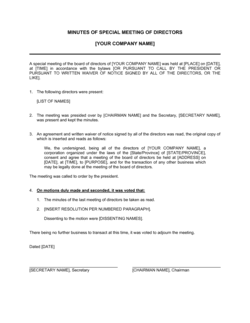
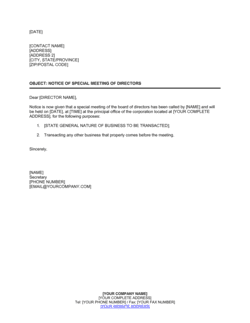
A special meeting is called for a single urgent agenda itemNotice of Special Meeting of Directors
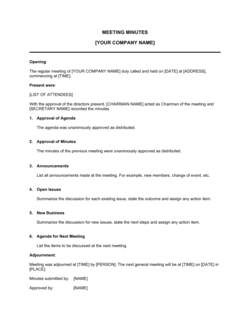
Minutes of the board meeting must be recorded alongside the waiverMinutes of Meeting of Directors

Common mistakes to avoid

❌ Dating the waiver after the meeting

Why it matters: A retroactive waiver may not cure a notice defect in many jurisdictions, leaving board decisions open to challenge by shareholders, lenders, or auditors.

Fix: Circulate and collect all signatures before the meeting is called to order. Use a digital signing tool if directors are remote.
❌ Leaving the meeting purpose blank or vague

Why it matters: Decisions on topics not identified in the stated purpose can be invalidated, creating liability for the corporation and personal exposure for directors who acted without proper authority.

Fix: List every specific agenda item by name before circulating the waiver. Add a general catch-all only as a supplement, not a replacement.

❌ Using only a quorum's signatures without documenting absent directors

Why it matters: If a director who did not sign later claims they were not properly notified, the validity of every resolution passed at that meeting can be disputed.

Fix: Either obtain all directors' signatures or note in the minutes why absent directors were excused and confirm quorum was met independently.

❌ Confusing a waiver of notice with a unanimous written consent

Why it matters: A waiver of notice still requires an actual meeting to be held and minutes to be recorded. Using it as a substitute for a written resolution means no valid corporate action was ever taken.

Fix: Use a Unanimous Written Consent of the Board when you want to approve a resolution without holding a meeting. Use a Waiver of Notice when a meeting will occur but advance notice was not given.

The 8 key clauses, explained

Document title and corporation identification

In plain language: Names the document, identifies the corporation by its full legal name, and states the jurisdiction of incorporation.

Sample language
WAIVER OF NOTICE OF MEETING OF DIRECTORS OF [CORPORATION NAME], a corporation incorporated under the laws of [STATE / PROVINCE].

Common mistake: Using the trade name instead of the registered corporate name. The legal entity name must match the articles of incorporation exactly, or the document's authority to bind the company is unclear.

Identity of the signatories

In plain language: Lists each director who is waiving notice, establishing that the waiver covers all or a defined subset of the board.

Sample language
The undersigned, being all the directors of [CORPORATION NAME] (or constituting a quorum of the Board of Directors), hereby waive notice of a meeting of the Board of Directors.

Common mistake: Failing to confirm whether all directors or only a quorum are signing. If less than the full board signs, record which directors are absent and why, to avoid later disputes about the meeting's validity.

Meeting date, time, and location

In plain language: States the specific date, start time, and physical or virtual location of the board meeting for which notice is being waived.

Sample language
Said meeting is to be held on [DATE], at [TIME], at [ADDRESS / VIRTUAL PLATFORM AND LINK].

Common mistake: Leaving the date or location blank and filling it in after signatures are collected. The waiver must reflect the exact meeting details at the time of signing to be procedurally sound.

Waiver statement

In plain language: The operative sentence in which each director explicitly waives their right to advance written notice of this particular meeting.

Sample language
Each of the undersigned hereby waives any and all notice required by the Bylaws of the Corporation or by applicable law with respect to the holding of such meeting.

Common mistake: Using vague language like 'agree to meet' instead of an explicit waiver. Without the word 'waive' and a reference to the bylaw or statutory requirement being released, the document may not satisfy a court or auditor.

Purpose of the meeting

In plain language: Briefly states the business to be transacted at the meeting, limiting the scope of what can validly be decided under this waiver.

Sample language
The purpose of said meeting is to consider and act upon the following: [AGENDA ITEM 1]; [AGENDA ITEM 2]; and any other business that may properly come before the Board.

Common mistake: Omitting the purpose entirely or writing 'general business.' Decisions made on matters not listed in the stated purpose can be challenged as outside the scope of the waivered meeting.

Consent to transaction of business

In plain language: Confirms that each signatory agrees that any business conducted at the meeting is valid and binding, even without prior notice.

Sample language
The undersigned further consent to the transaction of any and all business that may come before the meeting, including the matters stated above.

Common mistake: Confusing this clause with a unanimous written consent resolution. A waiver of notice authorizes a meeting to be held; a written consent replaces the meeting entirely. Using the wrong document can invalidate the intended corporate action.

Date of signing

In plain language: Records the date each director signed the waiver, which should be on or before the meeting date.

Sample language
IN WITNESS WHEREOF, the undersigned have executed this Waiver as of [DATE].

Common mistake: Dating the waiver after the meeting has already taken place. A waiver signed retroactively may not cure the notice defect in all jurisdictions and can raise audit or investor concerns.

Signature block

In plain language: Provides a printed name, title, and signature line for each director, creating a clear record of who waived their rights.

Sample language
Signature: _________________________ | Name (printed): [DIRECTOR FULL NAME] | Title: Director

Common mistake: Collecting only initials or email confirmations instead of full signatures. Most corporate bylaws and state statutes require a signed writing; an email chain or initials may not satisfy that requirement.

How to fill it out

  1. 1

    Enter the corporation's full legal name and jurisdiction

    Open the template and replace [CORPORATION NAME] with the exact name shown on your articles of incorporation. Add the state or province of incorporation.

    πŸ’‘ Cross-check your corporate registry filing or last annual return to confirm the precise legal name β€” including 'Inc.', 'LLC', or 'Ltd.' as registered.

  2. 2

    Confirm the list of directors signing the waiver

    Decide whether all directors or only a quorum will sign. If only a quorum, verify that number against your bylaws and note any absent directors separately in the meeting minutes.

    πŸ’‘ Getting all directors to sign β€” not just a quorum β€” eliminates any challenge to the meeting's validity and simplifies your governance file.

  3. 3

    Fill in the meeting date, time, and location

    Enter the exact date, start time, and physical address or virtual meeting link. If the meeting is virtual, include the platform name and the full URL or dial-in number.

    πŸ’‘ Complete this field before circulating for signatures β€” never leave blanks to fill in later, as that weakens the document's procedural integrity.

  4. 4

    State the purpose of the meeting

    List every agenda item that will be voted on or discussed. Be specific: 'Approval of a $50,000 line of credit with [BANK NAME]' is better than 'financial matters.'

    πŸ’‘ If the agenda is not yet finalized, add 'and any other business properly coming before the Board' as a catch-all β€” but do not rely on it as a substitute for listing known items.

  5. 5

    Set the signing date

    Enter the date the waiver will be signed. This should be on or before the meeting date β€” never after.

    πŸ’‘ If directors are in different locations, use a digital signing tool to capture timestamped signatures before the meeting convenes.

  6. 6

    Collect signatures from each director

    Distribute the completed waiver to all directors who will sign. Each director must print their name, sign, and confirm their title.

    πŸ’‘ Keep the original signed waiver with the corporate minute book and attach a copy to the meeting minutes as Exhibit A.

Frequently asked questions

What is a waiver of notice of meeting of directors?

A waiver of notice of meeting of directors is a written document signed by board members to confirm they voluntarily give up their right to receive advance written notice of a specific directors' meeting. It is used when a meeting must be held on short notice, and it protects the validity of any resolutions passed at that meeting by curing the procedural defect of missing or insufficient notice.

When is a waiver of notice required?

A waiver of notice is required whenever a board meeting is convened without the advance written notice period specified in the corporation's bylaws or applicable corporate statute β€” commonly 2 to 10 business days. It is also commonly used as a precautionary measure even when notice was given informally, to ensure the meeting record is procedurally clean for audits, investors, or lenders.

Does a waiver of notice of a directors' meeting need to be signed?

Yes. Most corporate bylaws and state or provincial corporation statutes require the waiver to be in writing and signed by each director who is waiving their rights. An email acknowledgment or verbal agreement typically does not satisfy this requirement. Keep the signed original in your corporate minute book.

Can a director waive notice after the meeting has already taken place?

Retroactive waivers are recognized in some jurisdictions but are generally weaker than pre-meeting waivers. A director who attends a meeting without objecting to the lack of notice is often deemed to have waived it implicitly, but relying on implied waiver is riskier than obtaining a signed document before the meeting. When possible, collect signatures before the meeting is called to order.

What is the difference between a waiver of notice and a unanimous written consent?

A waiver of notice clears the procedural requirement to give advance notice so that a physical or virtual meeting can validly take place. A unanimous written consent is a document in which all directors approve a resolution without holding a meeting at all. If you need to pass a board resolution quickly and no meeting is planned, a unanimous written consent is the correct document; the waiver of notice applies only when an actual meeting will occur.

Does every director need to sign the waiver of notice?

All directors should sign if possible. Technically, only those directors who are present or participating need to waive their individual right to notice β€” a director who does not sign and does not attend has simply not waived their rights. However, if quorum is met and those directors did not object in writing, their absence is typically handled through the meeting minutes rather than the waiver.

Should the waiver of notice be attached to the board meeting minutes?

Yes. The signed waiver should be attached to the minutes of the meeting as an exhibit β€” commonly labeled Exhibit A. This creates a single, coherent corporate record showing both that proper procedures were followed and what was decided at the meeting. Storing the waiver separately increases the risk of a missing document during due diligence or an audit.

Is a waiver of notice of directors' meeting the same across all states and provinces?

The concept is consistent across most corporate statutes in the US, Canada, and the UK, but the specific requirements β€” how notice must be waived, how far in advance, and what form the waiver must take β€” vary by jurisdiction. Always check your corporate bylaws and the applicable corporations act for your state or province to confirm any additional requirements before relying on a template waiver.

How this compares to alternatives

vs Notice of Meeting of Directors

A notice of meeting of directors is sent in advance to formally inform directors of an upcoming board meeting. A waiver of notice is used instead when advance notice was not or cannot be given. Use the notice when timing allows; use the waiver when it does not.

vs Written Consent of Board of Directors (Unanimous)

A unanimous written consent lets all directors approve a resolution without holding a meeting at all. A waiver of notice still requires an actual meeting to take place and minutes to be recorded. If no meeting is planned, a written consent is the correct document.

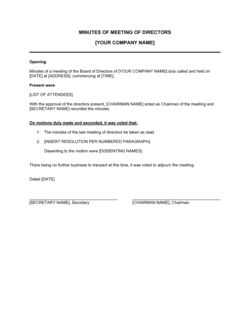
vs Minutes of Meeting of Directors

Board meeting minutes record what was discussed and decided at the meeting. A waiver of notice is a prerequisite document that validates the meeting's procedural standing. The two documents are complementary β€” the waiver should always be attached to the minutes as an exhibit.

vs Waiver of Notice of Annual Meeting of Shareholders

A shareholder meeting waiver of notice serves the same procedural function but applies to shareholder meetings rather than board of directors meetings. The signatories, quorum rules, and statutory requirements differ. Use the directors' version for board meetings and the shareholders' version for any general or annual meeting of shareholders.

Industry-specific considerations

Technology / SaaS

Frequently needed when investor boards must convene on short notice to approve a funding round, acquisition term sheet, or executive change.

Professional Services

Law firms, accounting firms, and consulting practices organized as corporations use the waiver to keep governance records clean without slowing down client-driven decisions.

Real Estate

Real estate holding companies and development corporations use waivers when boards must approve time-sensitive property acquisitions or financing commitments.

Retail and E-commerce

Closely held retail corporations rely on the waiver to validate urgent board decisions on supplier contracts, lease renewals, or capital expenditures called between regular meeting cycles.

Template vs pro β€” what fits your needs?

PathBest forCostTime
Use the templateSmall businesses, startups, and closely held corporations handling routine governance paperwork in-houseFree5–10 minutes
Template + professional reviewCorporations with investor boards, complex ownership structures, or governance requirements tied to a financing agreement$100–$300 (brief legal or corporate secretary review)Same day
Custom draftedPublic companies, regulated industries, or situations where a defective notice has already triggered a formal dispute$300–$1,000+1–3 days

Glossary

Waiver of Notice
A written statement in which a party voluntarily gives up their right to receive advance notification of a meeting or action.
Advance Notice Requirement
A bylaw or statutory provision specifying how many days before a meeting written notice must be delivered to directors β€” commonly 2 to 10 business days.
Quorum
The minimum number of directors who must be present at a board meeting for any business transacted to be legally valid.
Corporate Bylaws
Internal rules adopted by a corporation that govern how it is managed, including procedures for calling and conducting board meetings.
Board of Directors
The group of individuals elected by shareholders to oversee the management and strategic direction of a corporation.
Corporate Governance
The system of rules, practices, and processes by which a corporation is directed and controlled, including how meetings are documented.
Special Meeting
A board meeting called outside the regular meeting schedule to address a specific urgent matter.
Unanimous Consent
Agreement by all eligible parties β€” here, all directors β€” to a particular action or procedural waiver without a formal vote.
Minutes
The official written record of what was discussed and decided at a board meeting, to which the waiver is typically attached as an exhibit.
Defective Notice
A notice of meeting that was not delivered in the form, manner, or timeframe required by the bylaws β€” which a signed waiver can cure retroactively.

Part of your Business Operating System

This document is one of 3,000+ business & legal templates included in Business in a Box.

  • Fill-in-the-blanks β€” ready in minutes
  • 100% customizable Word document
  • Compatible with all office suites
  • Export to PDF and share electronically

Create your document in 3 simple steps.

From template to signed document β€” all inside one Business Operating System.
1
Download or open template

Access over 3,000+ business and legal templates for any business task, project or initiative.

2
Edit and fill in the blanks with AI

Customize your ready-made business document template and save it in the cloud.

3
Save, Share, Send, Sign

Share your files and folders with your team. Create a space of seamless collaboration.

Save time, save money, and create top-quality documents.

β˜…β˜…β˜…β˜…β˜…

"Fantastic value! I'm not sure how I'd do without it. It's worth its weight in gold and paid back for itself many times."

Managing Director Β· Mall Farm
Robert Whalley
Managing Director, Mall Farm Proprietary Limited
β˜…β˜…β˜…β˜…β˜…

"I have been using Business in a Box for years. It has been the most useful source of templates I have encountered. I recommend it to anyone."

Business Owner Β· 4+ years
Dr Michael John Freestone
Business Owner
β˜…β˜…β˜…β˜…β˜…

"It has been a life saver so many times I have lost count. Business in a Box has saved me so much time and as you know, time is money."

Owner Β· Upstate Web
David G. Moore Jr.
Owner, Upstate Web

Run your business with a system β€” not scattered tools

Stop downloading documents. Start operating with clarity. Business in a Box gives you the Business Operating System used by over 250,000 companies worldwide to structure, run, and grow their business.

Start freeΒ Β·Β No credit card required