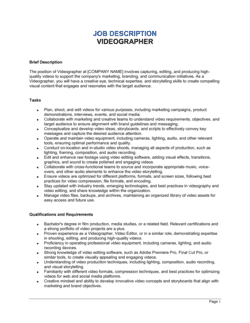
Video Editor Job Description Template

Free Word download • Edit online • Save & share with Drive • Export to PDF

2 pages20–30 min to fillDifficulty: StandardSignature requiredLegal review recommended
Learn more ↓
FreeVideo Editor Job Description Template

At a glance

What it is
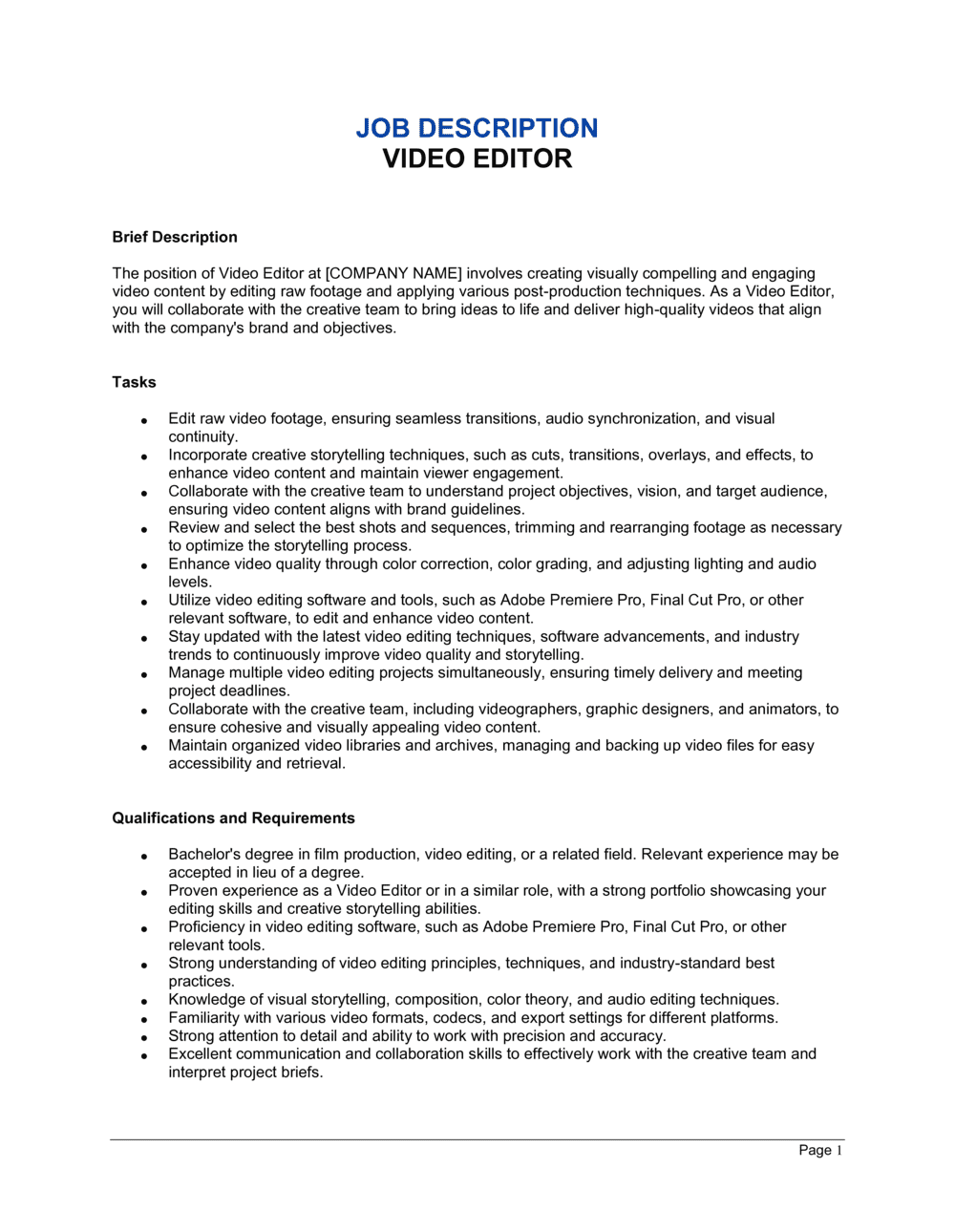
A Video Editor Job Description is a formal employment document that defines the scope of work, required skills, compensation structure, IP ownership, confidentiality obligations, and reporting structure for a video editing role. This free Word download can be edited online and exported as PDF — suitable for full-time staff hires, fixed-term contracts, or freelance engagements where enforceable terms are required.
When you need it
Use it when hiring a video editor as a full-time employee, engaging one as a contractor for a defined project, or formalizing an existing informal arrangement where IP ownership or confidentiality has never been documented.
What's inside
Role title and reporting structure, core duties and deliverable standards, required technical skills and software proficiencies, compensation and benefits, intellectual property assignment, confidentiality obligations, revision and approval workflow terms, and termination conditions.

What is a Video Editor Job Description?

A Video Editor Job Description is a formal employment document that defines the terms of a video editing role — covering position title, core duties, required technical skills, compensation, intellectual property ownership, confidentiality obligations, revision workflows, and termination conditions. When signed by both employer and editor, it functions as a binding employment or service agreement that protects the employer's creative assets and sets clear performance expectations from day one. Unlike a casual job posting, a properly drafted job description creates enforceable obligations on both sides and eliminates the ambiguity that commonly surfaces around IP ownership, unlimited revision requests, and asset handover on departure.

Why You Need This Document

Without a written, signed job description, your exposure as an employer is significant and immediate. Finished videos and project files may legally belong to the editor — particularly freelancers, who retain copyright by default unless there is a written assignment. Revision scope is undefined and unlimited, creating a standing invitation for scope creep that erodes compensation and delays delivery schedules. There is no contractual basis for confidentiality over unreleased footage or client content, and when the editor leaves mid-project, there is nothing compelling them to hand over in-progress files. A signed video editor job description closes all of these gaps before work begins, for the cost of 20 minutes and a legal review where the stakes warrant it.

Which variant fits your situation?

If your situation is…Use this template
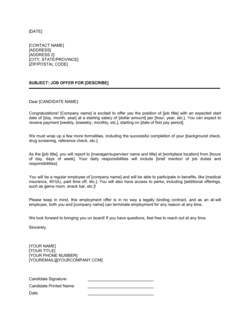
Hiring a permanent, salaried in-house video editorVideo Editor Job Description (Full-Time Employment)
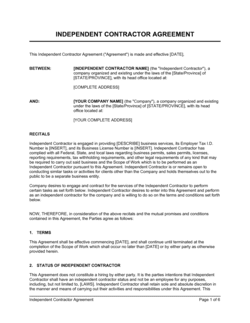
Engaging a freelancer for a single campaign or projectIndependent Contractor Agreement
Hiring a junior editor still building core skillsJunior Video Editor Job Description
Adding a senior editor responsible for managing a post-production teamSenior Video Editor / Post-Production Manager Job Description
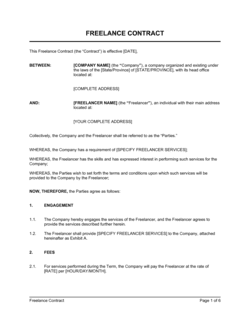
Formalizing an ongoing freelance arrangement with clear deliverablesFreelance Service Agreement
Bringing on a motion graphics designer alongside a video editorMotion Graphics Designer Job Description
Documenting post-production terms inside a broader production contractVideo Production Agreement

Common mistakes to avoid

❌ Omitting an IP assignment clause entirely

Why it matters: Without explicit assignment language, the editor may retain copyright over finished videos and project files — particularly freelancers and contractors, who are not covered by the work-made-for-hire doctrine automatically.

Fix: Include a written IP assignment clause covering all deliverables, project files, and derivative assets, executed before work begins. For contractors, the clause must be in a signed written agreement to invoke work-made-for-hire status under US copyright law.

❌ No revision-round limit or scope definition

Why it matters: Unlimited revisions without a written cap are among the most common sources of scope creep in creative engagements, eroding compensation and causing delivery delays that cascade across production schedules.

Fix: Define the number of included revision rounds, what qualifies as a revision versus a new creative direction, and the rate for additional rounds. Include this in the job description so candidates understand the workflow before accepting.

❌ Using at-will termination language for non-US hires

Why it matters: At-will employment is a US doctrine. Applying it in Canada, the UK, or the EU creates an unenforceable clause and exposes the employer to unlimited statutory notice claims.

Fix: Replace at-will language with a notice-period clause calibrated to the minimum statutory requirement in the editor's work location. Consult an employment lawyer before hiring across borders.

❌ Vague or absent equipment and data-security terms

Why it matters: Remote video editors routinely process gigabytes of unreleased footage on personal hardware. Without written terms on data handling and equipment return, recovering proprietary assets on departure is difficult and may require legal action.

Fix: Specify which equipment and software licenses the company provides, how company data must be stored and secured on personal devices, and the exact timeline and process for returning all assets on separation.

❌ Listing bonus amounts without the word 'discretionary'

Why it matters: A stated bonus percentage without a discretionary qualifier has been treated as a contractual entitlement in several jurisdictions, even when the employer intended it to be performance-conditional.

Fix: Add the word 'discretionary' before every bonus reference and include a sentence confirming that bonus payment is subject to individual and company performance in the relevant period.

❌ No project handover requirement on termination

Why it matters: An editor who leaves mid-project without a written handover obligation has no legal duty to deliver in-progress files, raw edits, or asset libraries — leaving the company unable to continue production without starting over.

Fix: Include a specific clause requiring the editor to deliver all in-progress project files, source footage references, and asset libraries within a defined number of business days of termination, in a specified format and to a specified destination.

The 9 key clauses, explained

Role title, department, and reporting structure

In plain language: Defines the exact job title, which team the editor sits within, and who they report to — creating a clear organizational position.

Sample language
[COMPANY NAME] is hiring a [JOB TITLE] reporting to the [TITLE OF SUPERVISOR] within the [DEPARTMENT] department, based at [LOCATION / REMOTE].

Common mistake: Using a vague title like 'Video Person' instead of a standardized title. Vague titles create ambiguity during performance reviews, compensation benchmarking, and termination proceedings.

Core duties and responsibilities

In plain language: Lists the specific editing tasks the role is responsible for — from rough cuts to final delivery — and the standards those outputs must meet.

Sample language
Editor shall: (a) edit raw footage into finished [FORMAT] videos of up to [DURATION]; (b) perform color grading and audio mixing to brand standards; (c) deliver final files in [CODEC / RESOLUTION] within [X] business days of brief receipt.

Common mistake: Listing duties so narrowly that any new task requires a contract amendment. Include a catch-all phrase such as 'and other duties reasonably assigned by the Company' to preserve operational flexibility.

Required skills and software proficiencies

In plain language: States the minimum technical skills, software experience, and portfolio evidence needed to perform the role — functioning as both a hiring filter and a performance standard.

Sample language
Minimum qualifications: [X] years of professional video editing experience; proficiency in [Adobe Premiere Pro / DaVinci Resolve / Final Cut Pro]; demonstrated experience with [MOTION GRAPHICS / COLOR GRADING / SOUND DESIGN]; portfolio of [X] completed projects available at [URL / ON REQUEST].

Common mistake: Listing every desirable skill as a requirement. Overly long must-have lists deter qualified candidates and create a contractual expectation that the employer then cannot hold the employee to without a corrective plan.

Compensation, bonus, and payment schedule

In plain language: States the base salary or project rate, payment frequency, any performance bonus eligibility, and overtime classification for hourly employees.

Sample language
Company shall pay Editor a base salary of $[AMOUNT] per [year / project], payable [bi-weekly / on project completion]. Editor is eligible for a discretionary annual bonus of up to [X]% of base salary based on quality output and on-time delivery.

Common mistake: Omitting the word 'discretionary' on bonuses. Courts in several jurisdictions have found that a regularly paid bonus becomes a contractual entitlement even without an explicit written guarantee.

Intellectual property assignment

In plain language: Transfers ownership of all finished videos, project files, raw edits, and derivative assets created in connection with the role to the employer — covering both on-premises and remote work.

Sample language
All video content, project files, motion graphics, sound designs, and related work product created by Editor in connection with this role are the sole property of [COMPANY NAME] and are hereby irrevocably assigned to the Company, whether created on Company equipment or otherwise.

Common mistake: Limiting IP assignment to work performed on company premises or equipment. Remote editors working on personal hardware may fall outside a narrowly worded clause, leaving ownership disputed.

Confidentiality and non-disclosure

In plain language: Prohibits the editor from sharing unreleased footage, client content, production workflows, or pricing information during or after the engagement.

Sample language
Editor shall not, during or after this engagement, disclose or use any Confidential Information — including unreleased footage, client briefs, production budgets, and proprietary workflows — without prior written consent of the Company.

Common mistake: Failing to define 'Confidential Information' specifically. Broad, undefined terms are harder to enforce and may be struck down as unreasonably vague. List the categories explicitly.

Revision rounds and approval workflow

In plain language: Sets the number of revision rounds included in the role or project scope, the process for delivering feedback, and how out-of-scope revision requests are handled.

Sample language
Each project includes [X] rounds of revisions based on consolidated written feedback. Additional revision rounds beyond this scope will be compensated at $[RATE] per round. Approval of the final cut by [APPROVER TITLE] constitutes acceptance of the deliverable.

Common mistake: Not defining what constitutes a 'revision' versus a new creative direction. Without this distinction, editors receive unlimited rework requests with no additional compensation, creating disputes and burnout.

Equipment, software, and asset responsibilities

In plain language: Clarifies whether the company provides hardware and software licenses, or whether the editor uses their own equipment, and who bears the cost of professional subscriptions.

Sample language
Company shall provide: [LIST OF EQUIPMENT / SOFTWARE LICENSES]. Editor is responsible for maintaining [their own equipment / the Company's issued equipment] in good working condition and shall return all Company property within [X] days of separation.

Common mistake: Leaving equipment ownership ambiguous. When an editor uses their own workstation to process company footage, questions of data security, file ownership, and return of assets arise immediately upon departure.

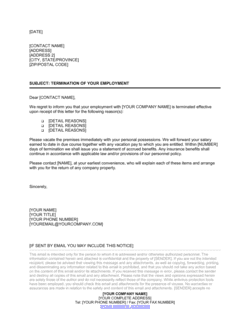
Termination, notice, and project completion obligations

In plain language: Specifies the notice period required to end the engagement, conditions for immediate termination for cause, and what happens to in-progress projects on departure.

Sample language
Either party may terminate this agreement with [X weeks'] written notice. Company may terminate immediately for cause — including missed deadlines of more than [X] business days or breach of confidentiality — without notice or additional compensation. On termination, Editor shall deliver all in-progress project files to Company within [X] business days.

Common mistake: No project handover requirement on termination. Losing access to in-progress edits, project files, and media assets when an editor leaves mid-project can delay a launch by weeks.

How to fill it out

  1. 1

    Define the exact role title and organizational position

    Enter the precise job title (e.g., 'Video Editor,' 'Senior Video Editor,' or 'Post-Production Coordinator'), the department, the direct supervisor's title, and whether the role is on-site, hybrid, or fully remote.

    💡 Use a title that matches industry-standard benchmarks — this simplifies salary benchmarking and ensures the job posting appears in relevant search results on LinkedIn and Indeed.

  2. 2

    List core duties with measurable output standards

    Describe each primary responsibility with enough specificity that performance can be assessed — include expected video formats, typical durations, delivery timelines, and quality standards such as codec and resolution requirements.

    💡 Add a brief catch-all clause ('and other duties reasonably assigned by the Company') so the role can evolve without requiring a formal contract amendment.

  3. 3

    Specify required software and technical skills

    List the NLE platforms, color grading tools, motion graphics applications, and audio software the role requires. Separate hard requirements from preferred skills to avoid over-filtering applicants.

    💡 Name specific software versions where version compatibility matters — e.g., 'Adobe Premiere Pro (2023 or later)' — especially in production environments where team members share project files.

  4. 4

    Complete the compensation and payment terms block

    Enter the base salary or project rate, payment schedule, overtime classification (exempt or non-exempt under the FLSA for US hires), and any bonus eligibility. Mark all bonuses as discretionary unless you intend them to be guaranteed.

    💡 State the currency explicitly for any editor working in a country different from the company's home jurisdiction to avoid exchange-rate disputes.

  5. 5

    Draft the IP assignment clause carefully

    Confirm that the clause covers all work product created in connection with the role, regardless of where or on what device it was produced. Reference both finished deliverables and raw project files, compositions, and motion graphics assets.

    💡 For editors in California, review Labor Code §2870, which limits IP assignment for inventions created entirely on the employee's own time without using company resources.

  6. 6

    Define revision rounds and the approval process

    Set the number of included revision rounds, the format for receiving feedback (e.g., consolidated written notes via a shared document), the turnaround time for each round, and how additional rounds will be scoped and priced.

    💡 Require consolidated feedback in a single document per round — editors who receive feedback from multiple stakeholders in fragmented channels lose significant productive hours reconciling conflicting notes.

  7. 7

    Set termination terms and project handover obligations

    Enter the required notice period for both parties, the conditions that permit immediate termination for cause (e.g., missed deadlines exceeding a defined threshold or breach of confidentiality), and the timeline and format for handing over in-progress project files on departure.

    💡 Specify the file format and destination for the handover — e.g., 'all project files delivered as a compressed archive to [SHARED DRIVE / SERVER PATH] within 5 business days' — to avoid ambiguity at a high-stress moment.

  8. 8

    Execute before the editor's first day or first deliverable

    Both parties must sign before work begins. Post-start-date signatures create a 'fresh consideration' problem in common-law jurisdictions that can void IP assignment and confidentiality clauses.

    💡 Use an eSign tool to timestamp execution and store the fully executed copy in a secure document repository accessible to both HR and legal.

Frequently asked questions

What is a video editor job description?

A video editor job description is a formal document that defines the scope of a video editing role — including specific duties, required software skills, deliverable standards, compensation, IP ownership, confidentiality obligations, and termination terms. When signed by both employer and editor, it functions as a binding employment or service agreement. It serves as both a hiring tool for attracting qualified applicants and a legal document for protecting the employer's creative assets.

Should a video editor job description include an IP assignment clause?

Yes, for both employees and contractors. An employee's work product is generally owned by the employer under the work-made-for-hire doctrine, but only when there is a written agreement and the work falls within the scope of employment. For contractors, a written IP assignment clause is legally required to transfer ownership — without it, the freelancer may retain copyright over every video they edit. Include the clause before work begins and confirm it covers both finished deliverables and underlying project files.

How many revision rounds should a video editor job description include?

Two to three rounds of revisions is the industry standard for most commercial and branded content projects. Each round should be defined as a single set of consolidated written notes delivered by one approval authority. Defining revision rounds in the job description sets expectations before hiring and gives the editor a contractual basis to charge for out-of-scope rework requests, reducing one of the most common sources of conflict in creative production.

Is a signed video editor job description legally binding?

Yes, when signed by both parties, a video editor job description that includes offer, acceptance, and consideration — typically salary or a project fee — is generally enforceable as a contract in most jurisdictions. The IP assignment, confidentiality, and termination clauses become binding obligations. The document is distinct from an informal job posting and should be treated as a formal employment or service agreement. Consider having an employment lawyer review it before use across jurisdictions.

What software should a video editor job description require?

The appropriate software requirements depend on the production environment. Adobe Premiere Pro and After Effects are standard for marketing and agency work. DaVinci Resolve is common in film and broadcast post-production. Final Cut Pro is prevalent in Apple-ecosystem environments. List only the software the role genuinely requires as a hard prerequisite — separating it from preferred proficiencies — so you do not exclude qualified candidates who can quickly upskill on secondary tools.

Can this template be used for freelance video editors?

Yes, with modifications. For freelancers, replace employment-specific language (salary, benefits, at-will termination) with project-fee and milestone-based payment terms, and confirm the IP assignment clause explicitly states that the work qualifies as work made for hire under a written agreement. Consider pairing the job description with a standalone Independent Contractor Agreement to cover indemnification, insurance requirements, and tax classification more completely.

What happens if I don't have a written job description for a video editor?

Without a written agreement, IP ownership defaults to the creator — meaning the editor may own the copyright to every video they produce. Confidentiality has no contractual basis, revision scope is undefined and unlimited, and termination terms are governed by jurisdiction-specific defaults that are typically more favorable to the employee. Disputes over deliverables, payment, and ownership become credibility contests rather than contract interpretation.

Does a video editor job description need to specify file formats and codecs?

Specifying delivery formats in the duties clause is strongly recommended. Without a defined codec, resolution, and file structure, editors deliver in whatever format is most convenient for them — which may not be compatible with the company's distribution platforms, broadcast specifications, or archival standards. Disputes over re-encoding costs and delivery failures are a common and avoidable source of project delay.

Do I need a lawyer to use this template?

For a straightforward domestic hire in a single jurisdiction, a well-completed template is generally sufficient for most small businesses and agencies. Legal review is recommended when the hire involves a senior post-production role with significant IP exposure, when the editor works in a jurisdiction with complex employment law (such as California, Ontario, or the UK), or when non-disclosure of client content is commercially critical. A one-hour template review typically costs $200–$400 and is worthwhile for any full-time hire.

How this compares to alternatives

vs Independent Contractor Agreement

An independent contractor agreement governs a project-based engagement with a self-employed video editor — covering deliverables, payment milestones, IP assignment, and liability. A job description defines an employment relationship with ongoing duties, a reporting structure, and employment entitlements. Misclassifying an employee as a contractor triggers back taxes, penalties, and benefit liability. Use the contractor agreement when you have no right to control how the editor works — only the result.

vs Employment Contract

An employment contract is a comprehensive binding agreement covering all material terms of the working relationship — compensation, benefits, IP, confidentiality, non-compete, termination, and severance — in full legal detail. A video editor job description focuses on role-specific terms and is typically issued alongside or incorporated into an employment contract. For any full-time hire, the job description should be attached as a schedule to the employment contract, not used as a standalone replacement.

vs Freelance Service Agreement

A freelance service agreement is a broader project engagement contract that adds indemnification, insurance requirements, payment dispute resolution, and sometimes non-solicitation terms to the core deliverable and IP provisions. A video editor job description focuses specifically on duties, skills, and role expectations. For recurring freelance engagements, pairing the job description with a freelance service agreement provides more complete legal coverage.

vs Video Production Agreement

A video production agreement governs the relationship between a production company and a client commissioning a video project — covering creative brief approval, production milestones, usage rights, and payment terms. A video editor job description governs the internal or contractor relationship with the person doing the editing. Both documents may be needed simultaneously: the production agreement faces outward to the client; the job description faces inward to the editor.

Industry-specific considerations

Marketing and Advertising

Brand-standards compliance, multi-format delivery for paid social and broadcast, and rapid turnaround cycles tied to campaign launch dates.

Media and Entertainment

Broadcast codec specifications, union or guild considerations (IATSE in North America), and strict confidentiality over unreleased episodic or film content.

E-learning and EdTech

Structured revision workflows tied to instructional design review stages, accessibility standards for captioning, and LMS-compatible output formats.

Corporate Communications

Internal and external video assets requiring tight confidentiality controls, executive approval workflows, and archival-quality file delivery for compliance records.

Jurisdictional notes

United States

At-will employment applies in most states, but California restricts non-compete clauses and limits IP assignment for off-duty work under Labor Code §2870. The work-made-for-hire doctrine under 17 U.S.C. §101 automatically assigns copyright to the employer for employee work product, but contractors require a signed written agreement to trigger the same result. Overtime classification under the FLSA depends on whether the editor's role meets the creative or administrative exemption thresholds — misclassification carries significant back-pay liability.

Canada

At-will employment does not exist in Canada. Employment Standards Acts in each province set minimum notice and termination pay obligations that contractual terms cannot reduce below. Ontario common-law notice can reach one month per year of service for long-tenured employees. Quebec contracts must be issued in French for provincially regulated employers. IP assignment clauses are enforceable but should explicitly address moral rights, which Canadian copyright law grants to creators and which must be expressly waived in writing.

United Kingdom

UK employers must provide a written statement of employment particulars on or before the employee's first day. Copyright in works created by an employee in the course of employment vests automatically in the employer under the Copyright, Designs and Patents Act 1988 — but freelancers retain copyright unless there is an explicit written assignment. IR35 rules apply when engaging editors through personal service companies, potentially reclassifying them as employees for tax purposes. Statutory minimum notice is one week per year of service after two years, capped at twelve weeks.

European Union

The EU Transparent and Predictable Working Conditions Directive requires written employment terms within seven days of hire. Copyright ownership rules vary by member state — in Germany and France, moral rights are stronger and largely non-waivable, requiring careful drafting of IP assignment clauses. GDPR obligations apply to any personal data processed by the editor in the course of their work, including footage featuring identifiable individuals. Post-employment non-competes generally require financial compensation to the employee to be enforceable, ranging from 25% to 100% of salary depending on the country.

Template vs lawyer — what fits your deal?

PathBest forCostTime
Use the templateSmall businesses and agencies hiring a domestic video editor in a standard employment or freelance arrangementFree20–30 minutes
Template + legal reviewFull-time hires with significant IP exposure, senior post-production roles, or editors working in California, Ontario, or the UK$200–$5001–3 days
Custom draftedMedia and entertainment companies, broadcast-regulated environments, multi-jurisdiction hires, or roles involving union agreements$800–$3,000+1–2 weeks

Glossary

Post-Production
The editing, color grading, sound mixing, and finishing work done to raw footage after principal photography or recording is complete.
Deliverable
A specific output — a finished video file in a defined format, resolution, and aspect ratio — that the editor must produce by a stated deadline.
Revision Round
A contractually defined cycle in which the client or employer reviews a cut and provides consolidated feedback for the editor to action.
IP Assignment
A clause transferring ownership of all edited video content, project files, and related assets created by the editor to the employer or client.
Non-Disclosure Obligation
A binding duty preventing the editor from sharing unreleased footage, client content, or proprietary production methods with third parties.
Color Grading
The process of adjusting the color, contrast, and tone of footage to achieve a consistent visual style across a production.
Codec
A compression and encoding standard (e.g., H.264, ProRes, DNxHD) that determines a video file's quality, size, and compatibility with editing and delivery systems.
Non-Linear Editing (NLE)
A digital editing method allowing editors to access and rearrange any part of a video project without altering the original source files, performed in software such as Adobe Premiere Pro or DaVinci Resolve.
At-Will Employment
An employment arrangement in which either party may end the relationship at any time for any lawful reason — applicable in most US states but not in Canada, the UK, or the EU.
Work Made for Hire
A US copyright doctrine under which work created by an employee within the scope of employment — or by a contractor under a written agreement — is owned by the employer or commissioning party from the moment of creation.
Probationary Period
A defined initial period — typically 30 to 90 days — during which the employer evaluates the editor's performance before confirming permanent employment status.

Part of your Business Operating System

This document is one of 3,000+ business & legal templates included in Business in a Box.

  • Fill-in-the-blanks — ready in minutes
  • 100% customizable Word document
  • Compatible with all office suites
  • Export to PDF and share electronically

Create your document in 3 simple steps.

From template to signed document — all inside one Business Operating System.
1
Download or open template

Access over 3,000+ business and legal templates for any business task, project or initiative.

2
Edit and fill in the blanks with AI

Customize your ready-made business document template and save it in the cloud.

3
Save, Share, Send, Sign

Share your files and folders with your team. Create a space of seamless collaboration.

Save time, save money, and create top-quality documents.

★★★★★

"Fantastic value! I'm not sure how I'd do without it. It's worth its weight in gold and paid back for itself many times."

Managing Director · Mall Farm
Robert Whalley
Managing Director, Mall Farm Proprietary Limited
★★★★★

"I have been using Business in a Box for years. It has been the most useful source of templates I have encountered. I recommend it to anyone."

Business Owner · 4+ years
Dr Michael John Freestone
Business Owner
★★★★★

"It has been a life saver so many times I have lost count. Business in a Box has saved me so much time and as you know, time is money."

Owner · Upstate Web
David G. Moore Jr.
Owner, Upstate Web

Run your business with a system — not scattered tools

Stop downloading documents. Start operating with clarity. Business in a Box gives you the Business Operating System used by over 250,000 companies worldwide to structure, run, and grow their business.

Free Forever Plan · No credit card required