Trade Secret Protection Policy Template

Free Word download β€’ Edit online β€’ Save & share with Drive β€’ Export to PDF

3 pagesβ€’20–30 min to fillβ€’Difficulty: Standard
Learn more ↓
FreeTrade Secret Protection Policy Template

At a glance

What it is
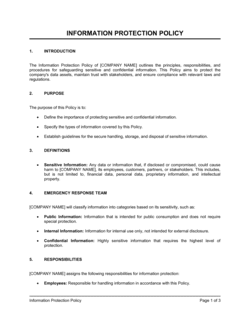
A Trade Secret Protection Policy is an internal operational document that defines what constitutes a trade secret within your organization, who may access it, how it must be stored and handled, and what happens when a breach occurs. This free Word download gives you a structured, editable starting point you can tailor to your industry and export as PDF for company-wide distribution.
When you need it
Use it when onboarding employees with access to proprietary information, when establishing information security procedures, or when a competitor dispute or workforce reduction makes formal trade secret governance urgent.
What's inside
A scope and definitions section, asset inventory guidance, access control rules, employee obligations, vendor and contractor requirements, physical and digital security standards, incident response procedures, and enforcement measures.

What is a Trade Secret Protection Policy?

A Trade Secret Protection Policy is an internal operational document that defines what information qualifies as a trade secret within your organization, establishes how that information must be classified, accessed, stored, and transmitted, and sets out the obligations of every person who touches it β€” from full-time employees to contractors and vendors. Unlike a non-disclosure agreement, which creates a bilateral legal obligation with a specific individual, this policy governs the entire organization and provides the documented framework courts look for when determining whether a company took "reasonable measures" to protect its proprietary information. Without that framework, even clearly valuable information can lose its legal protection.

Why You Need This Document

Under the US Defend Trade Secrets Act and equivalent state laws, a company can only enforce trade secret rights against a competitor or former employee if it can show it actively protected the information. A policy that names your assets, restricts access, trains your team, and sets response procedures is the primary form of that evidence. Without it, a former engineer can walk out with your source code, join a direct competitor, and leave you with no viable legal claim β€” not because you lacked the information, but because you cannot prove you treated it as a secret. The practical risks compound during workforce reductions, contractor engagements, and vendor relationships, where access is frequently granted without a corresponding offboarding or termination process. This template gives you the classification framework, access controls, incident response workflow, and enforcement language you need to close those gaps β€” in a single document you can deploy in hours rather than weeks.

Which variant fits your situation?

If your situation is…Use this template
Protecting all categories of confidential information, not just trade secretsConfidentiality Policy
Legally binding individual employees to secrecy obligationsNon-Disclosure Agreement (NDA)
Restricting departing employees from using competitive knowledgeNon-Compete Agreement
Governing third-party vendor access to proprietary informationVendor Confidentiality Agreement
Documenting information security standards across the entire organizationInformation Security Policy
Protecting IP during a merger, acquisition, or due-diligence processMutual Non-Disclosure Agreement

Common mistakes to avoid

❌ No trade secret asset inventory

Why it matters: Courts applying the DTSA and state trade secret laws require proof that specific information qualifies as a trade secret. A policy with no inventory forces you to prove asset status from scratch in litigation β€” a slow and expensive process.

Fix: Maintain a living Schedule A that lists each trade secret category, its custodian, and the date it was last reviewed. Update it at least annually.

❌ Scope limited to employees only

Why it matters: Contractors, interns, and vendors are responsible for a significant share of trade secret incidents. Excluding them from the policy leaves a documented gap that opposing counsel will exploit.

Fix: Extend the policy explicitly to all personnel with system or facility access, and require each group to sign a category-appropriate confidentiality agreement before access is granted.

❌ Access permissions granted but never revoked

Why it matters: A former employee with active credentials to a code repository or customer database is a live exposure for as long as the credentials work β€” regardless of what the policy says.

Fix: Build a maximum revocation window β€” 24 hours for high-risk roles β€” into the policy text, and assign a named role responsible for executing and confirming revocation at each departure.

❌ Vague employee obligations with no prohibited-action list

Why it matters: Obligations written as 'protect confidential information with reasonable care' give employees no actionable guidance and create ambiguity in disciplinary proceedings.

Fix: Replace generic language with a specific list of prohibited actions: personal email transmission, use of removable storage, access from unsecured Wi-Fi, and retention of copies after separation.

❌ No incident reporting timeline

Why it matters: A breach reported 30 days after discovery gives a court little sympathy for an emergency injunction request. Delay also allows misappropriated information to spread further.

Fix: Set a 24-hour reporting obligation for any suspected trade secret incident, name the reporting contact by role, and outline the first three containment steps so employees know exactly what to do.

❌ Policy distributed but never acknowledged

Why it matters: A policy employees claim they never saw is difficult to enforce. Without signed acknowledgments, you may not be able to demonstrate that employees were on notice of their obligations.

Fix: Collect a signed acknowledgment β€” digitally via your HRIS or on paper β€” from every in-scope individual at onboarding and each time the policy is materially updated.

The 10 key sections, explained

Purpose and scope

Definitions and information classification

Trade secret asset inventory

Access controls and need-to-know

Employee obligations

Vendor and contractor requirements

Physical and digital security standards

Incident response and breach procedures

Offboarding and departure procedures

Enforcement and disciplinary consequences

How to fill it out

  1. 1

    Complete the company and scope details

    Enter your legal entity name, the effective date, and a clear statement of who the policy applies to β€” employees, contractors, interns, and any third parties with system or facility access.

    πŸ’‘ Name specific job roles or departments with elevated access (e.g., R&D, engineering, sales) in the scope section so obligations are unambiguous.

  2. 2

    Define your classification tiers

    Adopt a tiered scheme with at least three levels β€” Internal, Confidential, and Trade Secret. Write one sentence describing what qualifies for each tier and what the default handling requirement is.

    πŸ’‘ Four tiers (adding Public) is optimal for most companies. More than four creates confusion about which tier applies; fewer than three is too coarse to be operationally useful.

  3. 3

    Build the trade secret asset inventory (Schedule A)

    List each trade secret asset by category β€” formulas, source code, customer lists, pricing models, manufacturing processes β€” with an owner, classification level, and review date. This register is your primary evidence that reasonable measures were taken.

    πŸ’‘ If your list exceeds 20 items, group assets into categories with a custodian responsible for each group rather than listing individual files.

  4. 4

    Set access control rules and approval workflow

    Specify who approves access, how requests are logged, and the maximum time allowed to revoke access after a role change or departure. Reference your identity management system (e.g., Active Directory, Okta) if applicable.

    πŸ’‘ Automate revocation where possible β€” a policy that relies entirely on manual steps will have gaps at the worst possible moments.

  5. 5

    Write specific employee and contractor obligations

    Replace generic 'treat with care' language with explicit dos and don'ts: approved storage locations, prohibited transmission channels, required encryption, and clean desk requirements.

    πŸ’‘ Attach a one-page 'quick reference card' summary of the most critical rules β€” employees are far more likely to follow what they can scan in 60 seconds.

  6. 6

    Define the incident response workflow

    Name the reporting contact (role, not individual name), set a maximum reporting window (24 hours is standard), and outline the containment and investigation steps.

    πŸ’‘ Reference your IT security incident response plan if one exists β€” the trade secret policy should dovetail with it, not duplicate it.

  7. 7

    Draft the offboarding checklist

    Create a step-by-step departure checklist covering credential revocation, material return, and exit interview with a signed acknowledgment form. Link or attach the acknowledgment as a separate exhibit.

    πŸ’‘ Require the departing employee to sign the acknowledgment before their final paycheck is released where permitted by local employment law.

  8. 8

    State enforcement consequences and obtain acknowledgments

    Finalize the enforcement section with a clear range of consequences. Then distribute the policy to all in-scope personnel and obtain a signed acknowledgment β€” digital or paper β€” that they have read and understood it.

    πŸ’‘ Store signed acknowledgments in your HRIS so they are retrievable immediately if a dispute arises.

Frequently asked questions

What is a trade secret protection policy?

A trade secret protection policy is an internal company document that defines what information qualifies as a trade secret, who may access it, how it must be handled and stored, and what steps employees and contractors must follow to prevent unauthorized disclosure. It also sets out the consequences of violations and the procedures for responding to a breach. Having a written policy is one of the primary ways a company demonstrates the "reasonable measures" required to maintain trade secret status under US federal law and most state statutes.

Why does a company need a trade secret protection policy?

Under the Defend Trade Secrets Act and most state trade secret laws, information only qualifies as a trade secret if the owner takes reasonable measures to keep it secret. Without a written policy β€” combined with access controls, confidentiality agreements, and training β€” a company may lose trade secret status entirely, leaving it with no legal remedy against a competitor who acquires the information. A policy also reduces insider risk by making obligations concrete and enforceable.

What is the difference between a trade secret policy and an NDA?

A trade secret protection policy is an internal operational document that governs how all personnel handle confidential information company-wide. An NDA is a bilateral contract between two specific parties β€” employer and employee, or company and vendor β€” that creates a legally enforceable obligation of secrecy. The policy sets the rules; the NDA creates the contractual hook to enforce them. You need both: the policy establishes your reasonable measures, and the NDA gives you a direct contractual claim against individuals who violate it.

Who should sign or acknowledge this policy?

Everyone with access to trade secret or confidential information should acknowledge the policy in writing β€” employees at onboarding, contractors before access is granted, and vendors before receiving any proprietary materials. Acknowledgments should be stored in your HRIS or contract management system so they are retrievable immediately if a dispute arises. Update acknowledgments whenever the policy is materially revised.
What qualifies as a trade secret?

Any information that (a) derives independent economic value from not being generally known to or readily ascertainable by competitors, and (b) is subject to reasonable measures to keep it secret can qualify. Common examples include proprietary formulas, source code, customer and pricing data, manufacturing processes, and business strategies. The critical factor is not the type of information but whether the company consistently treats it as secret and takes documented steps to protect it.

Does this policy replace an NDA?

No. A trade secret protection policy is an internal governance document, not a contract between the company and an individual. It establishes standards and procedures but does not by itself create a legally enforceable obligation against a specific person. NDAs and confidentiality clauses in employment contracts are the instruments that create individual contractual liability. The policy and the NDA work together β€” the policy defines what is protected; the NDA makes violation actionable.

How often should a trade secret protection policy be updated?

Review and update the policy at least annually, and immediately after any material change β€” a new product line, a significant acquisition, a workforce reduction, a security incident, or a change in applicable law. The trade secret asset inventory (Schedule A) should be reviewed on the same cycle. An outdated policy that does not reflect your current information assets or security practices undermines your "reasonable measures" argument in any subsequent litigation.

What should happen when an employee with trade secret access leaves?

On or before the employee's last day: revoke all system access, retrieve physical and digital materials containing trade secrets, conduct an exit interview reminding them of ongoing confidentiality obligations, and obtain a signed acknowledgment confirming no company information was retained. For high-risk departures β€” employees joining a direct competitor β€” consider consulting counsel about garden leave or an injunction if you have reason to believe misappropriation has already occurred.

Can a small business benefit from a trade secret protection policy?

Yes, and often more than larger companies. Small businesses typically lack the legal resources to litigate trade secret theft after the fact, making prevention critical. A written policy, combined with NDAs and basic access controls, creates a documented paper trail that supports emergency injunctive relief β€” often the only remedy that matters when a competitor already has your information. The cost of a template policy is a fraction of the cost of a single day of trade secret litigation.

How this compares to alternatives

vs Non-Disclosure Agreement (NDA)

An NDA is a bilateral contract that creates an individually enforceable confidentiality obligation between the company and a specific person. A trade secret protection policy is an internal governance document that establishes company-wide standards and procedures. The NDA gives you a direct contractual claim; the policy demonstrates the reasonable measures that make trade secret status legally defensible. Both are needed β€” they serve different functions.

vs Information Security Policy

An information security policy covers the full breadth of digital and physical security controls across all data types β€” including personal data, financial records, and operational systems. A trade secret protection policy focuses specifically on commercially valuable proprietary information and the legal requirements for maintaining its protected status. Companies typically need both, with the trade secret policy cross-referencing the security policy's technical controls.

vs Confidentiality Policy

A confidentiality policy governs the broad category of sensitive business information β€” HR data, financial results, client communications β€” that the company does not want disclosed externally. A trade secret protection policy is narrower and more legally precise: it targets information that qualifies for trade secret status under applicable law and documents the reasonable measures required to preserve that status. The trade secret policy is a legal shield; the confidentiality policy is an operational guardrail.

vs Non-Compete Agreement

A non-compete agreement restricts a departing employee from joining competitors or starting a competing business for a defined period and geography. A trade secret protection policy imposes ongoing obligations on all current personnel regardless of where they may go next. Non-competes are a post-employment tool that complements the policy but cannot substitute for it β€” the policy is what creates the protected status that a non-compete is designed to reinforce.

Industry-specific considerations

Technology / SaaS

Source code, proprietary algorithms, training data, and product roadmaps require tiered repository access controls and DLP tools referenced directly in the policy.

Manufacturing

Formulas, process parameters, and supplier pricing data are core trade secrets; physical security standards for plant access and equipment documentation are particularly important.

Professional Services

Client lists, fee structures, and proprietary methodologies drive competitive advantage; the policy must address consultant and contractor access given high workforce mobility.

Healthcare / MedTech

Clinical trial data, device designs, and reimbursement strategies are trade secrets that intersect with HIPAA and FDA regulatory obligations, requiring cross-referenced handling procedures.

Food and Beverage

Recipes, formulations, and supplier relationships are classic trade secrets; physical security for lab and production environments and strict vendor NDA requirements are standard.

Retail / E-commerce

Pricing algorithms, vendor terms, customer segmentation data, and demand-forecasting models require digital access controls and clear employee obligations around data export.

Template vs pro β€” what fits your needs?

PathBest forCostTime
Use the templateSmall and mid-sized businesses establishing formal trade secret governance for the first timeFree2–4 hours to customize and distribute
Template + professional reviewCompanies with significant IP assets, recent workforce reductions, or employees departing to direct competitors$300–$800 for a one-hour legal review1–3 days
Custom draftedEnterprise organizations with complex multi-jurisdiction IP portfolios, regulated industries, or active trade secret litigation$2,000–$8,000+2–4 weeks

Glossary

Trade Secret
Any business information β€” formula, process, design, customer list, or financial data β€” that derives economic value from not being generally known and is subject to reasonable protective measures.
Reasonable Measures
The affirmative steps a company must take to protect confidential information in order to qualify for trade secret status under applicable law; a written policy is a primary form of evidence.
Misappropriation
The unauthorized acquisition, disclosure, or use of a trade secret, whether by theft, breach of a duty to maintain secrecy, or improper means.
Information Classification
A tiered system (e.g., Public, Internal, Confidential, Trade Secret) that assigns handling requirements to data based on its sensitivity and business value.
Need-to-Know Basis
An access control principle limiting disclosure of confidential information only to individuals whose role requires it.
Inevitable Disclosure Doctrine
A legal theory allowing an employer to prevent a former employee from working for a competitor when they cannot perform their new role without inevitably using or disclosing trade secrets.
Defend Trade Secrets Act (DTSA)
A US federal law enacted in 2016 that allows trade secret owners to file civil claims in federal court and seek injunctive relief, damages, and attorney's fees.
Clean Desk Policy
A workplace rule requiring employees to clear physical documents and devices of confidential information when workstations are unattended.
Data Loss Prevention (DLP)
Technology tools and procedures that detect and prevent unauthorized transfer or exfiltration of sensitive data outside organizational systems.
Exit Interview Protocol
A documented procedure conducted at employee separation to remind departing staff of ongoing confidentiality obligations and retrieve company property and access credentials.

Part of your Business Operating System

This document is one of 3,000+ business & legal templates included in Business in a Box.

  • Fill-in-the-blanks β€” ready in minutes
  • 100% customizable Word document
  • Compatible with all office suites
  • Export to PDF and share electronically

Create your document in 3 simple steps.

From template to signed document β€” all inside one Business Operating System.
1
Download or open template

Access over 3,000+ business and legal templates for any business task, project or initiative.

2
Edit and fill in the blanks with AI

Customize your ready-made business document template and save it in the cloud.

3
Save, Share, Send, Sign

Share your files and folders with your team. Create a space of seamless collaboration.

Save time, save money, and create top-quality documents.

β˜…β˜…β˜…β˜…β˜…

"Fantastic value! I'm not sure how I'd do without it. It's worth its weight in gold and paid back for itself many times."

Managing Director Β· Mall Farm
Robert Whalley
Managing Director, Mall Farm Proprietary Limited
β˜…β˜…β˜…β˜…β˜…

"I have been using Business in a Box for years. It has been the most useful source of templates I have encountered. I recommend it to anyone."

Business Owner Β· 4+ years
Dr Michael John Freestone
Business Owner
β˜…β˜…β˜…β˜…β˜…

"It has been a life saver so many times I have lost count. Business in a Box has saved me so much time and as you know, time is money."

Owner Β· Upstate Web
David G. Moore Jr.
Owner, Upstate Web

Run your business with a system β€” not scattered tools

Stop downloading documents. Start operating with clarity. Business in a Box gives you the Business Operating System used by over 250,000 companies worldwide to structure, run, and grow their business.

Start freeΒ Β·Β No credit card required