1
Complete the scope and definitions block
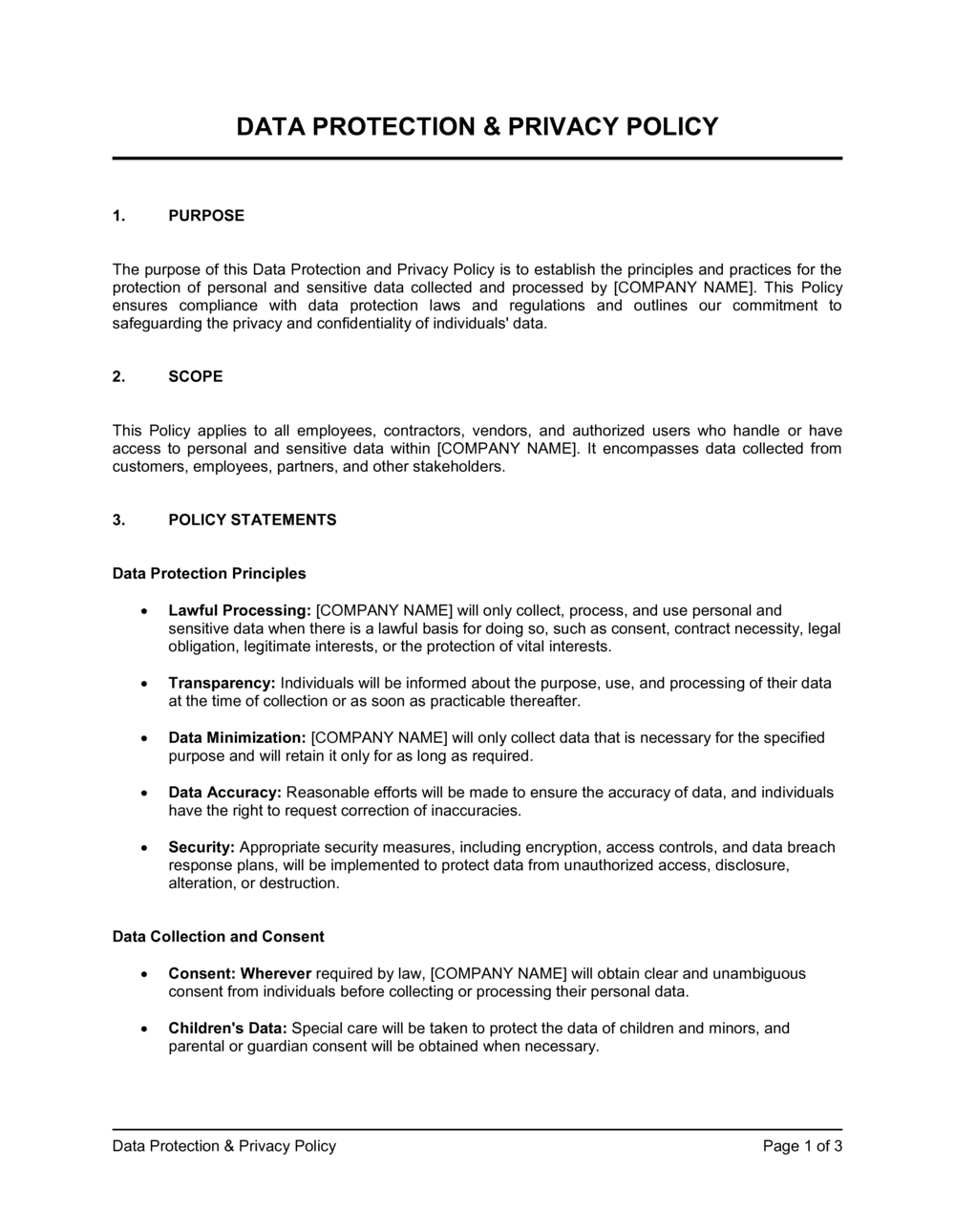
Enter your organization's legal name, the countries or jurisdictions where you operate, and the categories of individuals whose data you process — customers, employees, contractors, website visitors.
💡 Be explicit about subsidiaries and affiliated entities in the scope clause — regulators treat an unlisted entity as outside the policy's protection.
2
Map each processing activity to a lawful basis
List every category of processing (marketing emails, payroll, support tickets, analytics) and assign the correct GDPR lawful basis to each. For CCPA, document whether you sell or share personal data and the opt-out mechanism.
💡 Create a Record of Processing Activities (ROPA) spreadsheet in parallel — the policy and the ROPA should be consistent, and regulators often request both simultaneously.
3
Catalogue the personal data categories you collect
List every data type collected, the source (directly from the individual, a third party, or automated collection), and whether any special-category data — health, biometric, or ethnic origin — is processed.
💡 Interview department heads in HR, marketing, IT, and finance before drafting this section — shadow IT and informal data collection are commonly missed.
4
Define the data-subject rights fulfillment process
For each right (access, erasure, rectification, portability, restriction, objection), write out the internal steps, the staff member responsible, and the verification method used to confirm the requester's identity.
💡 Build a simple intake form or email alias (e.g., privacy@yourdomain.com) before publishing the policy — you need a working channel the day the policy goes live.
5
Set retention periods by data category
Assign a specific retention period to each data category, cite the legal or operational basis for the period, and name the deletion or anonymization method. Cross-reference any statutory minimums in your jurisdiction.
💡 Where no legal minimum applies, default to the shortest period operationally necessary — over-retention is a GDPR violation in itself.
6
Identify and document third-party processors
List every vendor category that receives personal data, confirm a Data Processing Agreement (DPA) is in place with each, and note any cross-border transfers and the transfer mechanism used (Standard Contractual Clauses, adequacy decision, etc.).
💡 Run a procurement checklist: before any new SaaS tool is approved, confirm a DPA is signed — do not allow tools to go live first and catch up on agreements later.
7
Document security controls and reference linked policies
List the specific technical controls in place and cross-reference your IT Security Policy by name and version number so both documents stay aligned.
💡 If your organization has an ISO 27001 or SOC 2 certification, reference the control framework here — it signals to auditors that the privacy policy is backed by tested operational controls.
8
Assign the DPO, set a review date, and publish
Enter the DPO's name and contact details, set the annual review date, assign the approval authority, and distribute the signed policy to all staff who handle personal data.
💡 Store the signed, version-controlled policy in a location that produces a timestamped audit trail — you may need to prove which version was active during a specific period.