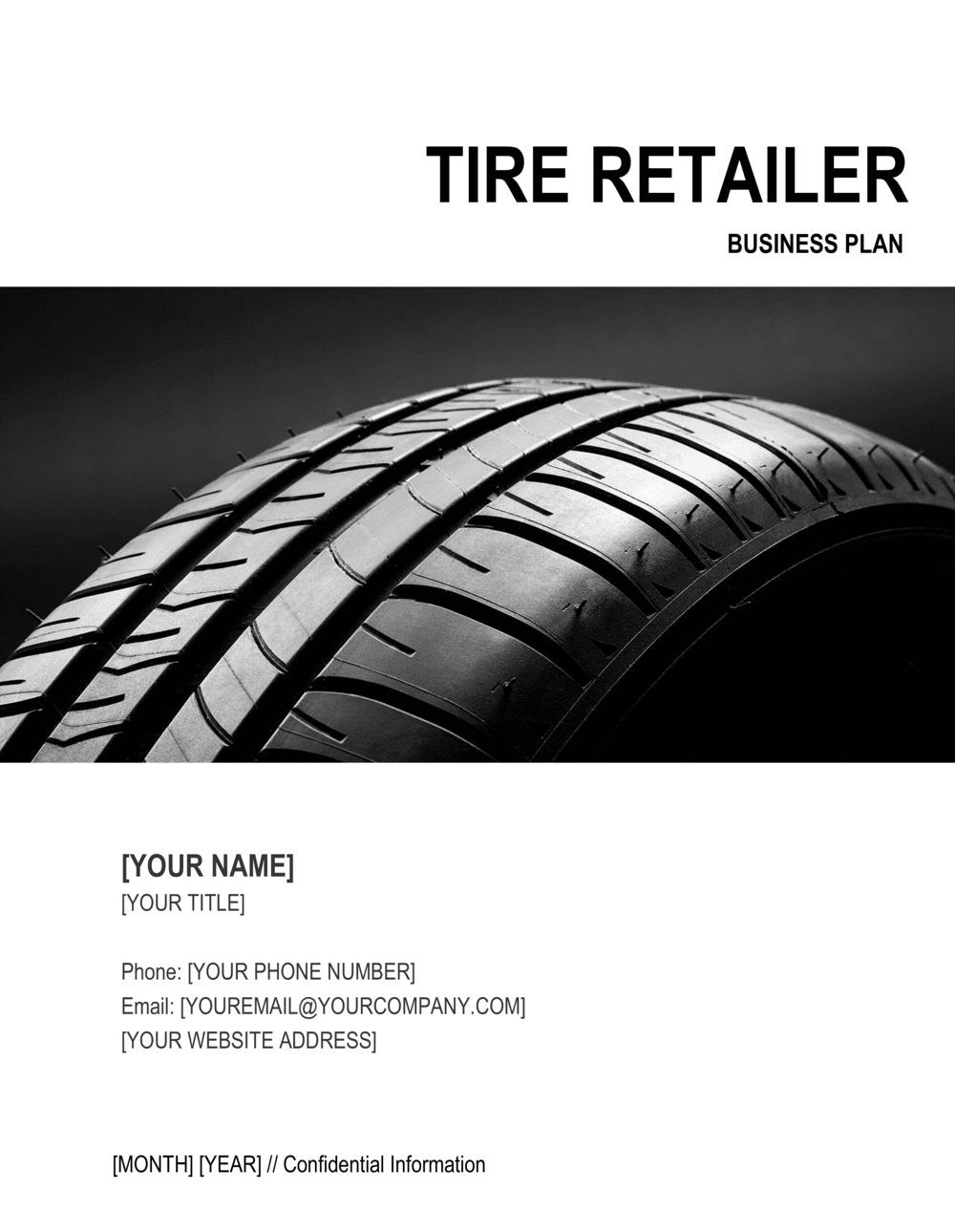
Tire Retailer Business Plan Template

Free Word download β€’ Edit online β€’ Save & share with Drive β€’ Export to PDF

28 pagesβ€’2h 25m – 3h 15m to fillβ€’Difficulty: Expert
Learn more ↓
FreeTire Retailer Business Plan Template

At a glance

What it is
A Tire Retailer Business Plan is a structured planning document that maps the strategy, operations, inventory model, and financial projections for a tire retail business β€” whether a standalone shop, a multi-bay service center, or a franchise location. This free Word download gives you an investor- and lender-ready starting point you can edit online and export as PDF to share with banks, partners, or franchise approvers.
When you need it
Use it when opening a new tire retail location, applying for a small business loan or SBA financing, seeking a franchise territory, or restructuring an existing tire shop around a new market or service model.
What's inside
Executive summary, company overview, market and competitive analysis, products and services, marketing and sales strategy, operations and staffing plan, inventory and supplier strategy, and 3-year financial projections including P&L, cash flow, and startup cost breakdown.

What is a Tire Retailer Business Plan?

A Tire Retailer Business Plan is a structured planning document that defines the strategy, market positioning, inventory model, operations, and financial projections for a tire retail business. It covers everything from local trade-area demand and competitive analysis to bay throughput modeling, supplier relationships, and a 3-year P&L β€” giving founders, lenders, and franchise approvers a complete picture of how the business will operate and generate returns. Unlike a generic retail business plan, this document accounts for the dynamics specific to tire retail: seasonal replacement cycles, service attach rate economics, distributor lead times, and technician throughput constraints.

Why You Need This Document

Opening a tire shop without a written business plan means walking into a bank or franchise conversation without the financial evidence lenders require β€” and SBA loan officers will not advance an application missing trade-area analysis, a startup cost schedule, or a credible revenue model. Beyond financing, the plan forces you to stress-test critical assumptions before you sign a lease: Can two bays at your projected ticket generate enough revenue to cover rent, labor, and inventory carrying costs? What happens if your primary distributor has a 3-day lead time instead of next-day? How many fleet accounts do you need to break even in Month 6? A completed plan surfaces these questions when answers are still cheap to find. This template gives you the structure to work through every section efficiently, so you spend your time on the market research and financial modeling that actually determines whether the business succeeds.

Which variant fits your situation?

If your situation is…Use this template
Opening a standalone independent tire shopTire Retailer Business Plan
Launching a full auto service center that includes tiresAuto Repair Shop Business Plan
Applying for a franchise territory with a national tire brandFranchise Business Plan
Quick internal planning for an early-stage tire shop conceptOne-Page Business Plan
Raising equity investment for a multi-location tire retail rolloutInvestor Business Plan
Planning a mobile tire installation serviceMobile Services Business Plan
Expanding an existing tire shop into wholesale distributionBusiness Expansion Plan

Common mistakes to avoid

❌ Using national tire market data without local trade-area analysis

Why it matters: A lender approving a loan for a specific address wants local vehicle population and competitor density data β€” citing a $45B national market without local context signals the founder hasn't done the ground-level research.

Fix: Pull registered vehicle counts and household income data for your primary and secondary trade areas from state DMV records or a market research report, and present these alongside national figures.

❌ Understating the initial inventory investment

Why it matters: Opening with insufficient inventory means turning away customers during the critical first 90 days, generating negative first impressions and online reviews that are hard to recover from.

Fix: Budget $60,000–$120,000 for opening inventory covering the top 50 passenger and light-truck SKUs by local vehicle population, and include this in the startup cost schedule with a supporting SKU list.

❌ Projecting revenue without a throughput ceiling

Why it matters: A two-bay shop physically cannot complete more than 90–100 standard installations per week β€” projecting 200 transactions per week in Year 1 without a capacity expansion plan destroys financial credibility.

Fix: Model revenue from bays Γ— technicians Γ— jobs per shift Γ— operating days, and explicitly note the capital investment or hiring trigger required to break through each capacity ceiling.

❌ Omitting the service attach rate from the revenue model

Why it matters: Tire-only retail margins average 25–35%; missing alignment, TPMS, and warranty revenue from the model understates both revenue and profitability, making the business appear less viable than it is.

Fix: Add a service attach rate assumption (target 60–75% of tire sales) and model mounting, balancing, alignment, and road hazard warranty revenue as separate line items.

The 9 key sections, explained

Executive Summary

Company Overview

Market Analysis

Competitive Analysis

Products and Services

Marketing and Sales Strategy

Operations and Staffing Plan

Inventory and Supplier Strategy

Financial Projections

How to fill it out

  1. 1

    Complete the company overview first

    Enter your legal business name, entity type, founding or planned opening date, physical address, and a one-sentence mission statement. This section anchors all other sections and confirms for lenders exactly who they are evaluating.

    πŸ’‘ If you haven't yet formed your legal entity, use your intended structure (e.g., 'LLC to be formed in [STATE]') and update before final submission.

  2. 2

    Research your local trade area

    Pull registered vehicle counts for your zip codes from your state DMV or an industry report. Cross-reference with local competitor locations and average household income. This data drives your market sizing and revenue assumptions.

    πŸ’‘ The Rubber Manufacturers Association (RMA) and Tire Industry Association publish annual US replacement tire demand figures by region β€” cite these as primary sources.

  3. 3

    Map your competition within a 5-mile radius

    List every tire retailer, quick-lube with tire service, and warehouse club within your trade area. Note their hours, brands carried, and online reviews. Write one specific paragraph on what your shop does better or differently.

    πŸ’‘ Check Google Maps reviews for your top two competitors β€” negative review themes (long wait times, poor communication, limited SKUs) are your differentiation opportunities.

  4. 4

    Define your product mix and margin tiers

    Categorize your planned inventory into premium, mid-range, and value tiers. Assign target revenue percentages to each tier. Confirm your key distributor's payment terms and next-day delivery capability for your region.

    πŸ’‘ Aim for no more than one primary distributor and one backup. Over-reliance on a single supplier with long lead times is a material risk lenders will ask about.

  5. 5

    Build the operations model around bays and throughput

    Count your service bays and calculate maximum daily throughput at a realistic utilization rate β€” typically 70–80% of theoretical capacity. Use this number to cap your revenue projections in Year 1.

    πŸ’‘ A single bay with one technician can realistically complete 6–8 standard mount-and-balance jobs per 8-hour shift. Do not project more than this without documenting a second technician or second shift.

  6. 6

    Model the financials from the bottom up

    Build revenue from transactions per day Γ— average ticket Γ— operating days β€” not from a revenue target you work backward from. Layer in COGS by margin tier, then fixed and variable operating expenses monthly for Year 1.

    πŸ’‘ Include a separate startup cost tab: equipment ($25,000–$60,000), leasehold improvements, initial inventory, first and last month rent, and 90 days of working capital reserve.

  7. 7

    State the funding ask with a specific use-of-funds table

    Summarize the total capital needed and break it into at least four buckets: equipment, inventory, leasehold improvements, and working capital. Tie each bucket to the corresponding line in your startup cost schedule.

    πŸ’‘ SBA 7(a) and 504 loans are the most common financing vehicles for tire shop startups β€” confirm your lender's documentation requirements before finalizing the plan format.

  8. 8

    Write the executive summary last

    Distill the single most compelling data point from each section into a 1–2 page summary. Include the business concept, market opportunity, competitive advantage, team, and funding ask.

    πŸ’‘ A bank loan officer reads the executive summary and financial projections first β€” if both are clear and internally consistent, the rest of the plan is confirmatory diligence.

Frequently asked questions

What is a tire retailer business plan?

A tire retailer business plan is a structured document that defines the strategy, operations, inventory model, and financial projections for a tire retail business. It covers market analysis, competitive positioning, staffing, supplier relationships, and a 3-year financial forecast. It is used to secure bank financing, meet franchise requirements, or guide internal operations planning.

What sections should a tire shop business plan include?

A complete tire retailer business plan includes an executive summary, company overview, local market and trade-area analysis, competitive analysis, products and services (brand mix and service offerings), marketing and sales strategy, operations and staffing plan, inventory and supplier strategy, and 3-year financial projections with a startup cost schedule. Omitting any of these sections typically results in a lender requesting additional documentation.

How much does it cost to open a tire shop?

Startup costs for an independent tire shop typically range from $150,000 to $450,000 depending on location, building lease terms, and equipment choices. Key cost buckets include tire changers and wheel balancers ($25,000–$60,000), an alignment system ($15,000–$30,000), leasehold improvements, initial inventory ($60,000–$120,000), and 3–6 months of working capital reserve. A franchise location adds franchise fees of $20,000–$50,000.

What profit margin should a tire retailer expect?

Tire-only gross margins typically run 25–35% on product. Bundling installation services, wheel alignment, TPMS service, and road hazard warranties raises effective gross margins to 40–50% on blended revenue. Net operating margins for a well-run independent tire shop with 3–4 bays generally fall in the 8–15% range after rent, labor, and overhead.

Do I need a business plan to get an SBA loan for a tire shop?

Yes. SBA 7(a) and 504 lenders require a complete business plan including financial projections, a startup cost schedule, and documentation of the owner's industry experience and management capability. Most SBA lenders also require 2–3 years of personal tax returns and a personal financial statement alongside the plan.

How do I project revenue for a tire shop business plan?

Build revenue from the bottom up: number of service bays Γ— technicians per bay Γ— jobs per technician per shift Γ— operating days per year Γ— average ticket value. A single bay with one technician producing 7 jobs per day at a $280 average ticket generates approximately $490,000 in annual revenue at 250 operating days. Add service attach revenue (alignment, TPMS, warranties) separately.

What is the difference between a tire retailer business plan and a general retail business plan?

A tire retailer business plan includes industry-specific sections that a generic retail plan omits: inventory throughput modeling by bay and technician, service attach rate analysis, TPMS and alignment service revenue, distributor terms and next-day delivery capability, and seasonal demand patterns tied to winter and all-season tire changeover cycles. A generic retail template cannot accurately model these dynamics.

How long should a tire shop business plan be?

For bank or SBA loan applications, 20–30 pages plus a financial model appendix is the standard range. The financial model itself β€” monthly P&L, cash flow, and balance sheet for Year 1 plus annual projections for Years 2–5 β€” typically adds 5–10 pages. A franchise application may have a prescribed format and page limit that overrides this guideline.

Can I write a tire retailer business plan myself?

Yes, for most SBA loans and independent financing. A structured template handles the format and section logic β€” your primary work is filling in accurate local market data, realistic throughput-based revenue projections, and a credible startup cost schedule. Consider hiring a business plan writer ($1,500–$5,000) for franchise applications or raises above $500,000 where the financial model complexity and competitive presentation matter most.

How this compares to alternatives

vs Auto Repair Shop Business Plan

An auto repair shop business plan covers a broader range of mechanical services β€” brakes, engine, transmission, and electrical β€” with different labor skill requirements and revenue streams. A tire retailer business plan focuses specifically on inventory throughput, brand mix strategy, and service attach economics. A tire shop adding general repair needs both frameworks merged.

vs One-Page Business Plan

A one-page plan is a rapid internal alignment tool for early ideation β€” it lacks the financial depth, trade-area analysis, and inventory modeling that SBA lenders and franchise approvers require. Use the one-page version to test the concept, then build the full tire retailer plan before any financing application.

vs Retail Store Business Plan

A generic retail store business plan covers merchandising, foot traffic, and POS operations but does not include tire-specific sections: bay throughput modeling, service attach rate analysis, TPMS revenue, distributor lead time risk, or seasonal changeover demand cycles. The tire retailer plan is purpose-built for these dynamics.

vs Financial Projections Template

A standalone financial projections template produces the numbers but provides no strategic context β€” no market analysis, competitive positioning, or operational rationale to explain why the projections are credible. Lenders and investors evaluate the plan and the numbers together; the financial projections template works as a supporting appendix, not a substitute for the full plan.

Industry-specific considerations

Automotive Retail

Throughput modeling by bay, seasonal inventory planning for winter tire changeovers, and service attach rate targets unique to tire retail drive the financial model.

Franchise Operations

Franchise tire retailers (Mavis, Discount Tire, Firestone) require a business plan meeting specific franchisor templates covering territory exclusivity, royalty cost modeling, and brand compliance.

Fleet Services

Fleet account revenue β€” negotiated per-tire pricing for commercial vehicles, delivery trucks, and municipal fleets β€” requires a separate pricing model and contract terms section.

E-commerce and Mobile Retail

Mobile tire installation businesses and online tire retailers require a logistics cost model, installer network management section, and last-mile delivery cost assumptions replacing traditional shop overhead.

Template vs pro β€” what fits your needs?

PathBest forCostTime
Use the templateIndependent tire shop owners applying for SBA loans under $500K or completing a franchise applicationFree2–3 weeks (30–60 hours)
Template + professional reviewFirst-time business owners who need a financial model review or local market data validation before lender submission$500–$2,000 for a business advisor or accountant review session3–4 weeks
Custom draftedMulti-location rollouts, institutional investors, or franchise development agreements requiring a professionally produced plan$2,500–$7,500 for a professional business plan writer4–6 weeks

Glossary

Cost of Goods Sold (COGS)
The direct cost of the tires and supplies sold in a period β€” purchase price from distributors plus freight, before labor or overhead.
Gross Margin
Revenue minus COGS expressed as a percentage β€” a key profitability metric for tire retailers, typically ranging from 30–50% depending on brand mix and service attach rate.
Inventory Turnover
How many times a retailer sells through its average inventory in a year β€” higher turnover means less capital tied up in slow-moving SKUs.
Service Attach Rate
The percentage of tire sales that also include a paid service β€” mounting, balancing, alignment, or TPMS reset β€” which significantly increases average ticket value.
Average Ticket Value
The average revenue generated per customer visit, calculated as total revenue divided by total number of transactions.
OEM vs. Aftermarket
OEM tires are original equipment manufacturer specifications matching what a vehicle came with from the factory; aftermarket tires are alternative brands or performance upgrades sold through retail channels.
TPMS (Tire Pressure Monitoring System)
A federally mandated sensor system in vehicles built after 2008 that monitors tire pressure β€” servicing it is a standard upsell opportunity during tire installation.
Road Hazard Warranty
A retailer-offered protection plan that covers repair or replacement of a tire damaged by road debris, potholes, or nails within a defined period or mileage.
Days Inventory Outstanding (DIO)
The average number of days a tire sits in inventory before being sold β€” a high DIO signals overstocking or slow-moving SKUs tying up working capital.
Wholesale vs. Retail Channel
Wholesale involves selling tires in bulk to other businesses at lower margins; retail involves selling directly to consumers or fleet operators at full margin.

Part of your Business Operating System

This document is one of 3,000+ business & legal templates included in Business in a Box.

  • Fill-in-the-blanks β€” ready in minutes
  • 100% customizable Word document
  • Compatible with all office suites
  • Export to PDF and share electronically

Create your document in 3 simple steps.

From template to signed document β€” all inside one Business Operating System.
1
Download or open template

Access over 3,000+ business and legal templates for any business task, project or initiative.

2
Edit and fill in the blanks with AI

Customize your ready-made business document template and save it in the cloud.

3
Save, Share, Send, Sign

Share your files and folders with your team. Create a space of seamless collaboration.

Save time, save money, and create top-quality documents.

β˜…β˜…β˜…β˜…β˜…

"Fantastic value! I'm not sure how I'd do without it. It's worth its weight in gold and paid back for itself many times."

Managing Director Β· Mall Farm
Robert Whalley
Managing Director, Mall Farm Proprietary Limited
β˜…β˜…β˜…β˜…β˜…

"I have been using Business in a Box for years. It has been the most useful source of templates I have encountered. I recommend it to anyone."

Business Owner Β· 4+ years
Dr Michael John Freestone
Business Owner
β˜…β˜…β˜…β˜…β˜…

"It has been a life saver so many times I have lost count. Business in a Box has saved me so much time and as you know, time is money."

Owner Β· Upstate Web
David G. Moore Jr.
Owner, Upstate Web

Run your business with a system β€” not scattered tools

Stop downloading documents. Start operating with clarity. Business in a Box gives you the Business Operating System used by over 250,000 companies worldwide to structure, run, and grow their business.

Start freeΒ Β·Β No credit card required